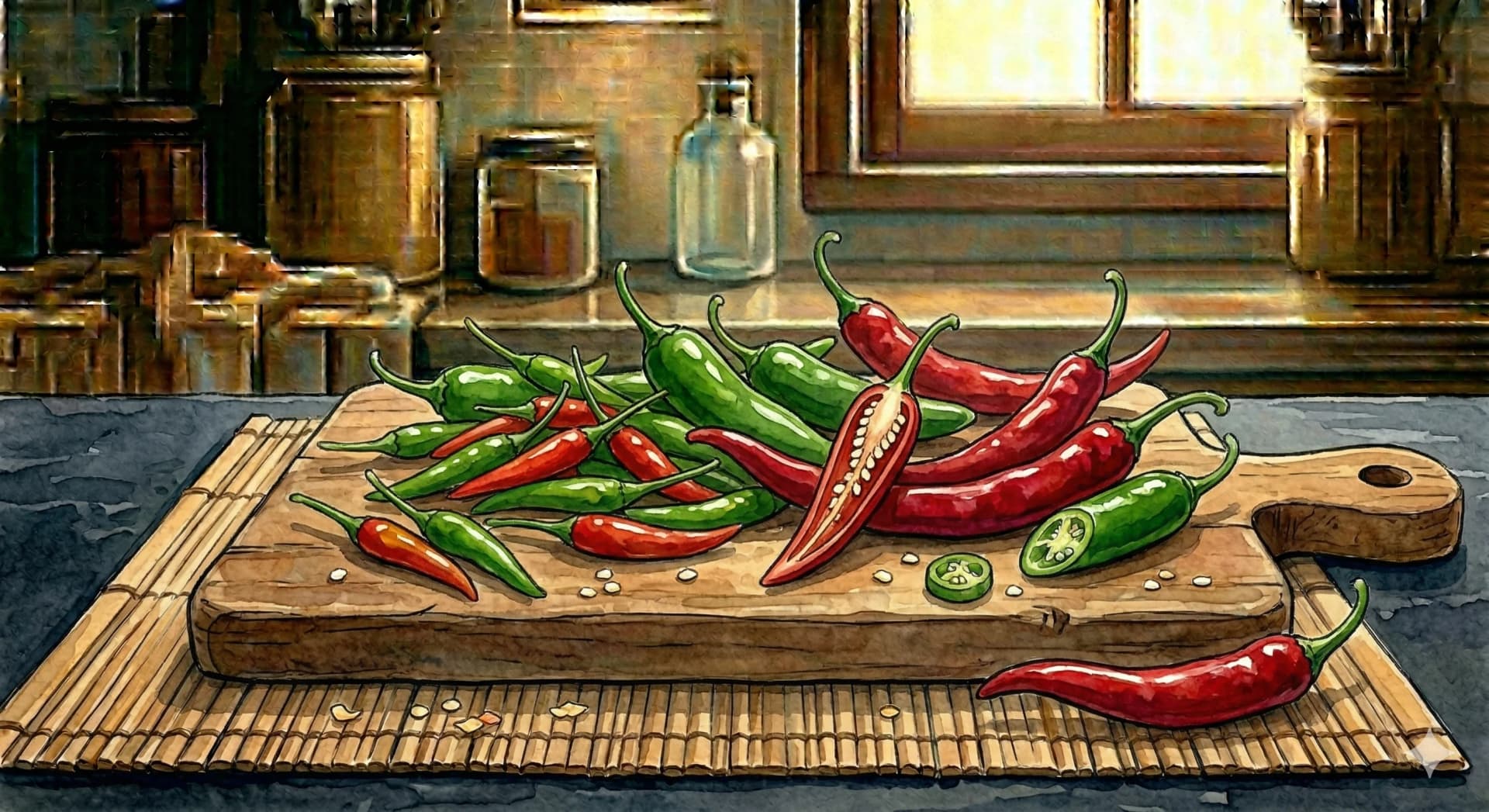
Fresh Chilies
Also known as: Xian La Jiao, Fresh Red Chilies, Fresh Green Chilies, Er Jing Tiao (fresh), Finger Chilies
Fresh chilies in Chinese cooking provide heat with brightness and fresh vegetable flavor that dried chilies cannot replicate. They appear in stir-fries, cold dishes, pickles, and as a table condiment across Sichuan, Hunan, Guizhou, and Yunnan cuisines.
Green chilies are harvested young and have more vegetal flavor and less heat; red chilies are fully ripe with more sweetness and concentrated spice. Both are used in Chinese cooking, often together for color contrast.
Key facts at a glance:
- Brightness and heat — fresh vegetable flavor that dried chilies cannot replicate
- Green vs. red — green are vegetal and milder; red are sweeter and spicier
- Regional staple — essential across Sichuan, Hunan, Guizhou, and Yunnan cuisines
- Versatile forms — used in stir-fries, cold dishes, pickles, and table condiments
Flavor Profile
Origin
Americas (origin), Hunan, Sichuan, Guizhou, China broadly
Traditional Medicine Perspectives
Traditional Chinese Medicine
Fresh chilies (Xian La Jiao) are classified as hot and acrid in TCM, warming the interior and activating circulation. They are considered less intensely warming than dried chilies because the fresh form contains more moisture, which tempers the heat. Used to expel cold-damp, stimulate digestion, and promote sweating in early-stage cold conditions.
Modern Scientific Research
Fresh chilies contain capsaicin, vitamin C (red chilies are exceptionally rich — a single red chili can contain more vitamin C than an orange), vitamin A from carotenoids, and flavonoids.
Research on capsaicin shows anti-inflammatory and analgesic properties.
The vitamin C content degrades with cooking, making fresh or lightly cooked preparations preferable for nutritional value.
Cultural History
Fresh chilies arrived in China from the Americas in the 16th century and transformed the cooking of inland southern and western China within generations.
Hunan cooking in particular developed an obsession with fresh chilies distinct from Sichuan's focus on the dried and fermented — the Hunanese use fresh chilies in extraordinary quantities, raw and cooked, contributing a brightness that defines the cuisine.
The saying in Hunan is that they are 'bu pa la' (not afraid of spicy) — in contrast to Sichuan's ma la and Guizhou's suan la (sour-spicy), Hunan's relationship with fresh chili heat is direct and unapologetic.
Culinary Uses
Slice and stir-fry with vegetables and meat for Hunanese-style preparations. Use raw in cold dishes and dipping sauces.
Add whole to oil for a milder infused heat. Pickle in rice vinegar for a bright condiment. Use in combination with black bean sauce, doubanjiang, or fermented vegetables. Pair with garlic and ginger as an aromatic base.
Preparation Methods
For less heat, remove seeds and white membrane — the capsaicin is concentrated there. For stir-fries, slice on the diagonal.
For table condiments, chop finely and combine with vinegar and soy sauce. Fresh chilies last about a week refrigerated; whole is longer than cut.
Traditional Dishes
- Hunan stir-fried pork with peppers (xiao chao rou)
- Pickled chili condiment
- Tiger skin chilies (hu pi jian jiao)
- Steamed fish with fresh chili
- Cold tofu with fresh chili
Comments
Share your thoughts on this ingredient.
Sign in to comment0 Comments