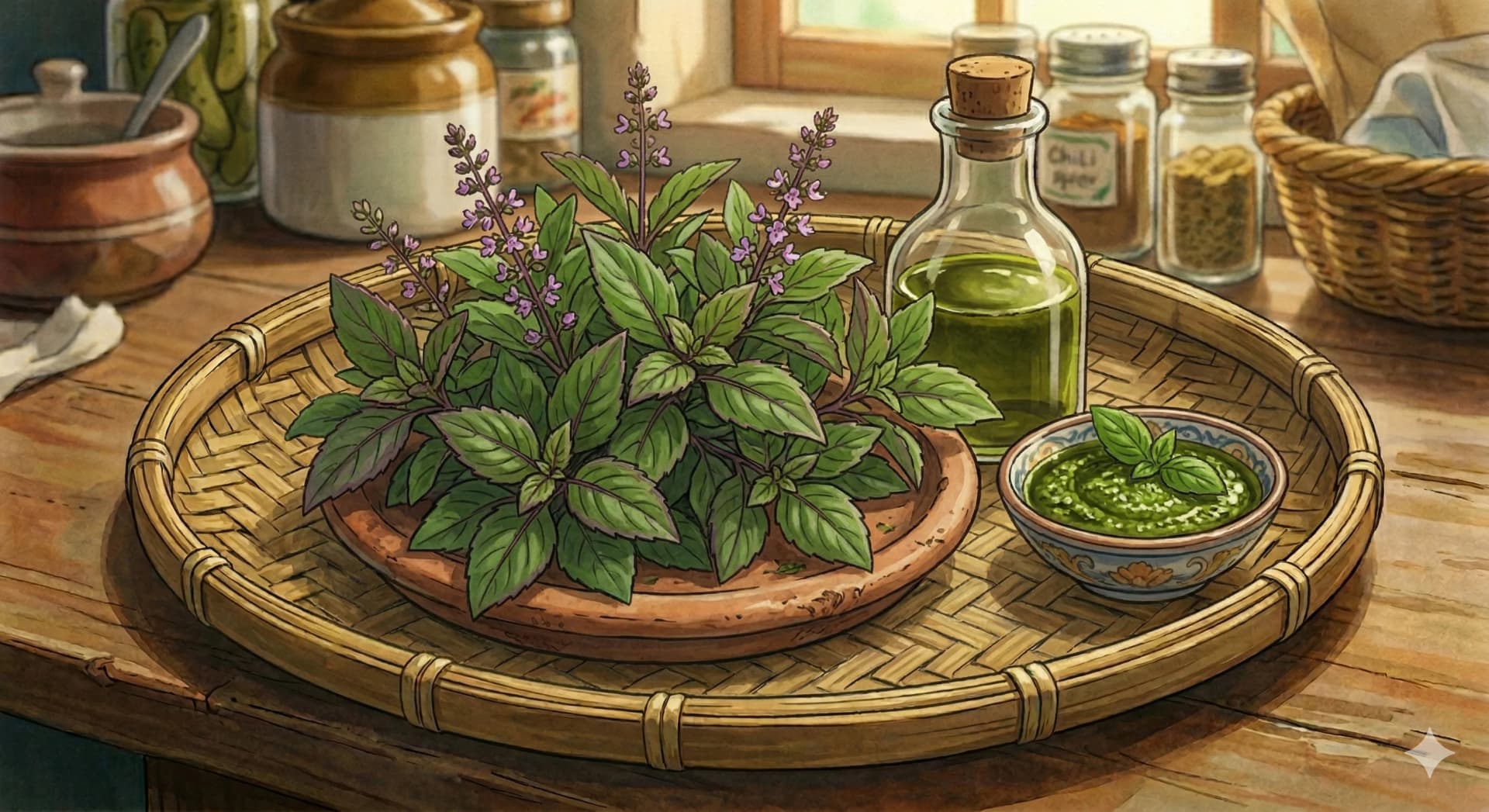
Holy Basil
Also known as: Tulsi, Ocimum tenuiflorum, Sacred Basil, Queen of Herbs
Holy basil — known as tulsi throughout South Asia — holds a sacred position that goes far beyond its culinary uses. Found growing in most Hindu households, often in a dedicated pot or garden shrine, it is both a religious plant and one of Ayurveda's most revered medicinal herbs.
Its flavor is distinct from Italian sweet basil — more complex, with notes of clove, pepper, and mint woven through a bright herbaceous base.
Key facts at a glance:
- Sacred plant — revered in Hinduism, associated with the goddess Lakshmi
- Adaptogenic herb — one of Ayurveda's most studied stress-reducing plants
- Distinct flavor — notes of clove, pepper, and mint, unlike Italian sweet basil
- Heat-tolerant — holds flavor better under heat than Italian basil
Flavor Profile
Origin
South Asia, Southeast Asia, India
Traditional Medicine Perspectives
Ayurveda
Tulsi is classified in Ayurveda as a rasayana — a rejuvenating herb that promotes longevity and vitality. It is considered kapha and vata reducing, making it valuable for respiratory conditions, colds, and stress. It is used to support immunity, clear the mind, and balance the nervous system. Daily consumption of tulsi tea is recommended in Ayurvedic practice as a general health tonic.
Modern Scientific Research
Holy basil has been studied extensively as an adaptogen. Clinical trials show it reduces cortisol, anxiety, and stress markers comparably to some pharmaceutical interventions, without side effects.
Research demonstrates antibacterial activity against a wide range of pathogens including antibiotic-resistant strains. Tulsi's eugenol content (also found in cloves) is responsible for anti-inflammatory effects comparable to ibuprofen in some studies.
Research also shows benefits for blood sugar regulation and cognitive function.
Cultural History
Tulsi is one of the most sacred plants in Hinduism, associated with the goddess Lakshmi. In millions of Indian households, tending the tulsi plant is a daily ritual — watering it, offering prayers, and harvesting leaves with reverence.
The tradition of consuming tulsi daily predates Ayurvedic texts and represents one of the oldest examples of a functional food woven into religious practice.
Culinary Uses
In South Asian cooking, holy basil leaves are added to curries and stir-fries toward the end of cooking. In Thai cuisine, the closely related Thai basil (and occasionally holy basil) is used in stir-fries and curries.
The leaves are commonly brewed as tea, steeped alone or with ginger and honey.
Unlike Italian basil, holy basil holds its flavor better under heat.
Preparation Methods
For tulsi tea: steep 4 to 6 fresh leaves (or 1 teaspoon dried) in hot water for 5 to 7 minutes. Add ginger and honey. Drink daily for adaptogenic benefits.
When cooking, add at the end of cooking to preserve delicate volatile compounds.
Traditional Dishes
- Tulsi chai
- Tulsi honey tea
- Thai stir-fries
- Rasam
Comments
Share your thoughts on this ingredient.
Sign in to comment0 Comments