Mace
Also known as: Javitri, Myristica fragrans (the aril), Fleur de Muscade
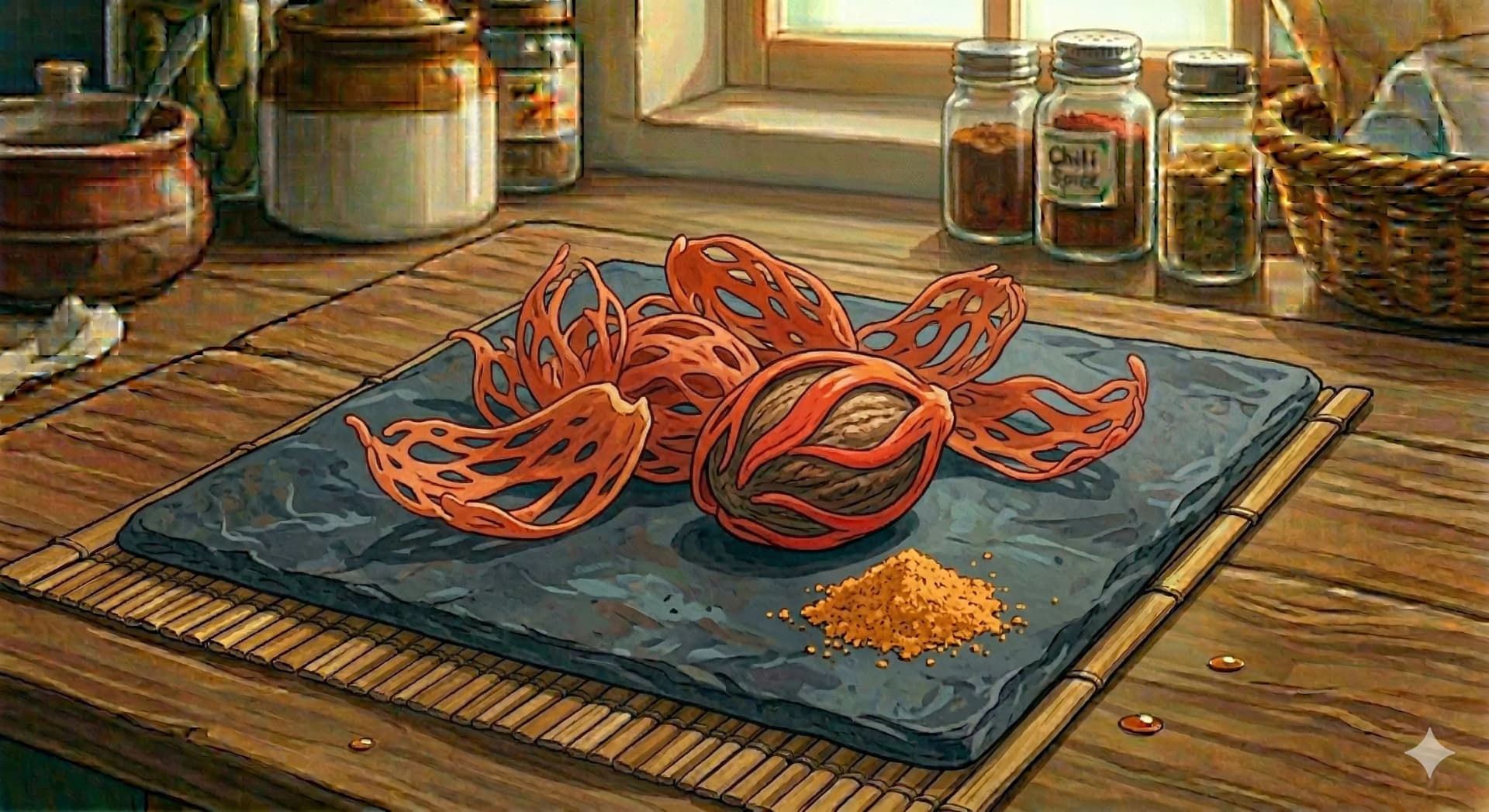
Mace is one of the most extraordinary spices in the world for a reason that surprises most people: it is not a seed, a bark, or a berry. It is the lacy, crimson-red aril — a delicate net-like membrane that wraps directly around the nutmeg seed inside the fruit of Myristica fragrans.
A single fruit yields both mace and nutmeg simultaneously, making them the only two commercially important spices that come from the same plant. When the fruit is harvested and split open, the vivid red mace is peeled away carefully by hand, then dried until it turns a warm amber-orange. This physical rarity — less mace per fruit than nutmeg — is one reason mace has historically cost more.
The flavor of mace shares the same essential compounds as nutmeg, including myristicin, elemicin, and eugenol, but the balance is different. Mace is softer, more floral, and more refined. Where nutmeg can be bold and slightly woody, mace carries a sweet delicacy better suited for light-colored dishes, cream sauces, and delicate spice blends.
In Indian cooking, mace is most associated with Mughlai cuisine — appearing in garam masala blends, biryanis, and the slow-cooked kormas and nihari that define the cuisine of Lucknow, Hyderabad, and old Delhi.
Key facts at a glance:
- Crimson aril — the lacy membrane wrapping the nutmeg seed, not a separate plant
- Same fruit as nutmeg — both from Myristica fragrans, the only spice pair from one plant
- Softer and more floral — refined compared to nutmeg's bolder, woodier character
- Mughlai essential — a prestige ingredient in biryanis, kormas, and garam masala
- Whole blades preferred — retain flavor far longer than pre-ground
Flavor Profile
Origin
Banda Islands (Indonesia), Maluku (Spice Islands), Grenada, Kerala
Traditional Medicine Perspectives
Ayurveda:
Mace (Javitri) is considered a warming spice in Ayurvedic medicine, with properties closely related to those of nutmeg (Jaiphal), since both come from the same plant. It is classified as having a hot potency (ushna virya), making it useful for Vata and Kapha imbalances while potentially aggravating Pitta when used in excess. Traditionally it has been used to support digestion, stimulate appetite, and address cold-type digestive complaints including sluggish digestion, bloating, and nausea. It appears in traditional formulations for treating colds and respiratory congestion due to its warming and mucus-clearing properties. It has been historically listed as an aphrodisiac in several classical texts, though modern evidence for this is limited. Small amounts in cooking are considered beneficial for most constitutions.
Traditional Chinese Medicine:
In TCM, mace is often grouped with nutmeg under the category of Rou Dou Kou. The seed (nutmeg) is the more primary medicine, but the aril shares many of the same properties. Both are considered warming, entering the spleen, large intestine, and stomach meridians. The primary TCM application for Rou Dou Kou is warming the middle jiao to stop diarrhea from cold-deficiency patterns, and warming the stomach to relieve cold-induced abdominal pain and vomiting. It is contraindicated in heat patterns and used with care in those with excess fire constitutions.
Modern Scientific Research
Mace and nutmeg share a nearly identical phytochemical profile, with myristicin and elemicin being the primary volatile compounds of interest. At extremely high doses, myristicin has hallucinogenic and psychoactive effects — documented since at least the 17th century. This is relevant only at doses far exceeding culinary use: a typical serving contains a small fraction of what would produce any psychoactive effect.
Research into antimicrobial properties has shown activity against several bacteria and fungi. Studies have also explored mace extracts for anti-inflammatory activity, with in-vitro results suggesting moderation of inflammatory signaling.
Myristicin has been investigated in preliminary cancer research for potential pro-apoptotic activity in certain cell lines, though this research remains early-stage.
Cultural History
The Banda Islands of Eastern Indonesia, a tiny volcanic archipelago in the Banda Sea, were for centuries the only place on earth where nutmeg and mace could be obtained. Arab traders controlled the overland routes for centuries, selling mace and nutmeg to Venice and Genoa at extraordinary markups.
Europeans had no idea where these spices came from until the Portuguese navigator Francisco Serrão reached the Banda Islands in 1512. The Dutch East India Company (VOC) secured control in 1621, and what followed was one of the most violent acts of early colonial history — the indigenous Bandanese population was massacred, enslaved, or forced to flee to establish monopoly control.
For nearly two centuries, the Dutch controlled the global supply of both spices through this monopoly, enforcing it with violence against any island found trading independently.
Mace found its way into Mughal court cooking through Persian and Arab trade networks. The Mughal emperors presided over a culinary tradition blending Central Asian, Persian, and Indian ingredients. In European cooking, mace was prized in potted meats, baked goods, and cream sauces where its pale gold color would not darken a white sauce the way nutmeg might.
Culinary Uses
Mace's most important culinary role in Indian cooking is in whole blade form simmered in ghee or oil at the beginning of cooking, where it contributes a rounded, floral warmth. This method is central to Mughlai preparations: a biryani base or korma will often begin with whole spices including mace blades, cardamom, cloves, and bay leaf.
In European cooking, mace's pale color makes it the preferred choice over nutmeg for béchamel sauce, potato gratins, and cream-based applications. It pairs well with pork, veal, and fish.
The key to using mace effectively is restraint: a small amount is all that is needed, and more will push the dish toward medicinal rather than culinary territory.
Preparation Methods
Whole blades in hot oil or ghee: Add 1-2 blades to medium-hot ghee at the beginning of cooking, along with other whole spices. They will darken slightly and become fragrant within 30-60 seconds. Remove before serving, or leave in and inform diners.
Ground mace at finish: If using ground mace, add in the last few minutes of cooking to preserve its volatile floral top notes. A small pinch, roughly 1/8 teaspoon per serving, is sufficient.
Garam masala blending: Combine ground mace with green cardamom, cloves, black pepper, cinnamon, and bay leaf for a Mughlai-style garam masala. Mace should be around 5-10% of the total blend.
Storage: Whole blades keep for 2-3 years in an airtight container away from light. Ground mace loses its character within 6-12 months.
Traditional Dishes
- Biryani
- Mughlai Korma
- Nihari
- Garam Masala
- Béchamel Sauce
- Potted Meats
- Mulled Wine
- Spiced Pound Cake
- Lamb Rogan Josh
- Shahi Paneer
Comments
Share your thoughts on this ingredient.
Sign in to comment0 Comments