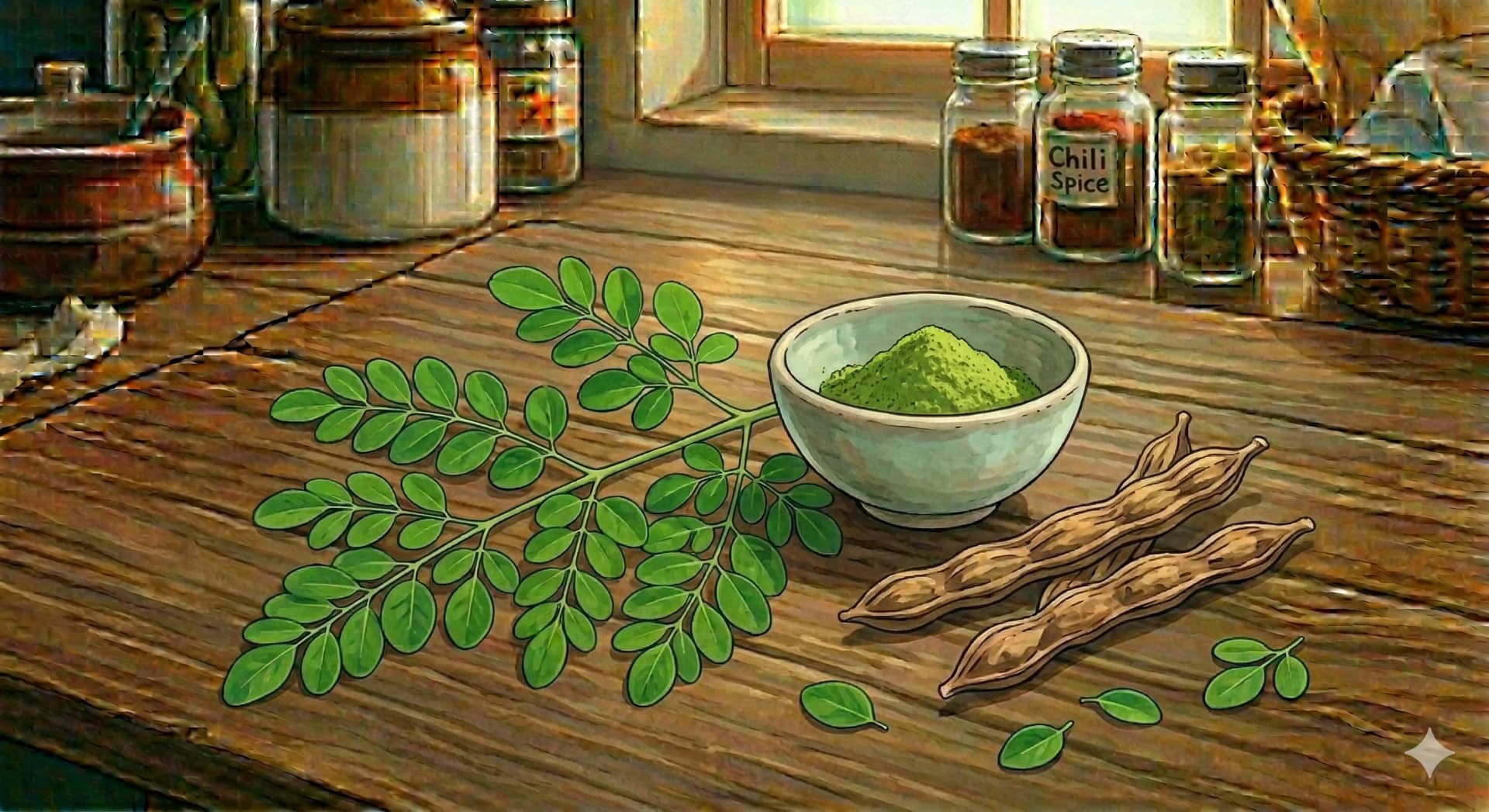
Moringa
Also known as: Drumstick Tree, Moringa oleifera, Miracle Tree, Sahjan
Moringa is a fast-growing tropical tree native to South Asia whose leaves, pods, seeds, and roots are all used as food and medicine. It holds an unusual position in nutrition: gram for gram, the dried leaves contain more vitamin C than oranges, more calcium than milk, more iron than spinach, and more protein than yogurt.
For this reason, it has been used as a nutritional intervention in food-insecure regions and is now widely studied as a functional food.
Key facts at a glance:
- Fast-growing tropical tree — native to South Asia, all parts edible
- Exceptional nutrient density — more vitamin C, calcium, iron, and protein gram-for-gram than common reference foods
- Over 90 nutrients — including 46 antioxidants in the leaves alone
- Anti-hyperglycemic effects — reduces postprandial blood sugar in clinical studies
- Ancient Ayurvedic use — referenced as a remedy for over 300 conditions
Flavor Profile
Origin
South Asia, Sub-Saharan Africa, India, Sri Lanka
Traditional Medicine Perspectives
Ayurveda
Moringa (Shigru) is classified as pungent, hot, and light in Ayurveda. It is used to pacify Kapha and Vata doshas. The leaves are prescribed for nutritional deficiencies, anemia, and inflammatory conditions. It is considered particularly beneficial for joint health — traditionally used for arthritis and swelling. Moringa seeds are used as a water purifier in some traditional practices.
Modern Scientific Research
Moringa leaves are exceptionally nutrient-dense and contain over 90 nutrients and 46 antioxidants. Clinical studies show moringa supplementation significantly increases blood hemoglobin and ferritin in iron-deficient women.
Research demonstrates anti-hyperglycemic effects — moringa leaf powder reduces postprandial blood sugar comparable to some pharmaceutical interventions. Animal studies show potent anti-inflammatory and hepatoprotective effects.
The isothiocyanates in moringa are under investigation for anti-cancer properties.
Cultural History
Moringa has been used in South Asian cooking and medicine for over two thousand years. Ancient Ayurvedic texts reference it as a remedy for over 300 conditions.
Its drumstick pods are a staple in Tamil Nadu and throughout South India, used in sambar and other dishes. The tree's ability to grow in poor soil with minimal water made it a survival food across dry tropical regions.
Modern nutritional science has confirmed what traditional cultures intuited: moringa is exceptionally nutrient-dense.
Culinary Uses
Moringa leaf powder is stirred into smoothies, soups, and sauces. Fresh leaves are used like spinach in South Indian cooking — wilted into dals, curries, and rice dishes.
Drumstick pods are cooked in sambar and South Indian curries. Moringa seeds can be roasted and eaten like peanuts. The powder has a strong flavor — start with a small amount.
Preparation Methods
Stir moringa powder into warm (not hot) liquids to preserve vitamins. Use 1 teaspoon per serving.
Fresh leaves can be added to any cooked green preparation. Drumstick pods are added to liquid dishes and the flesh is scraped from the fibrous outer skin when eating.
Traditional Dishes
- Sambar
- Moringa dal
- Drumstick curry
- South Indian rice dishes
Comments
Share your thoughts on this ingredient.
Sign in to comment0 Comments