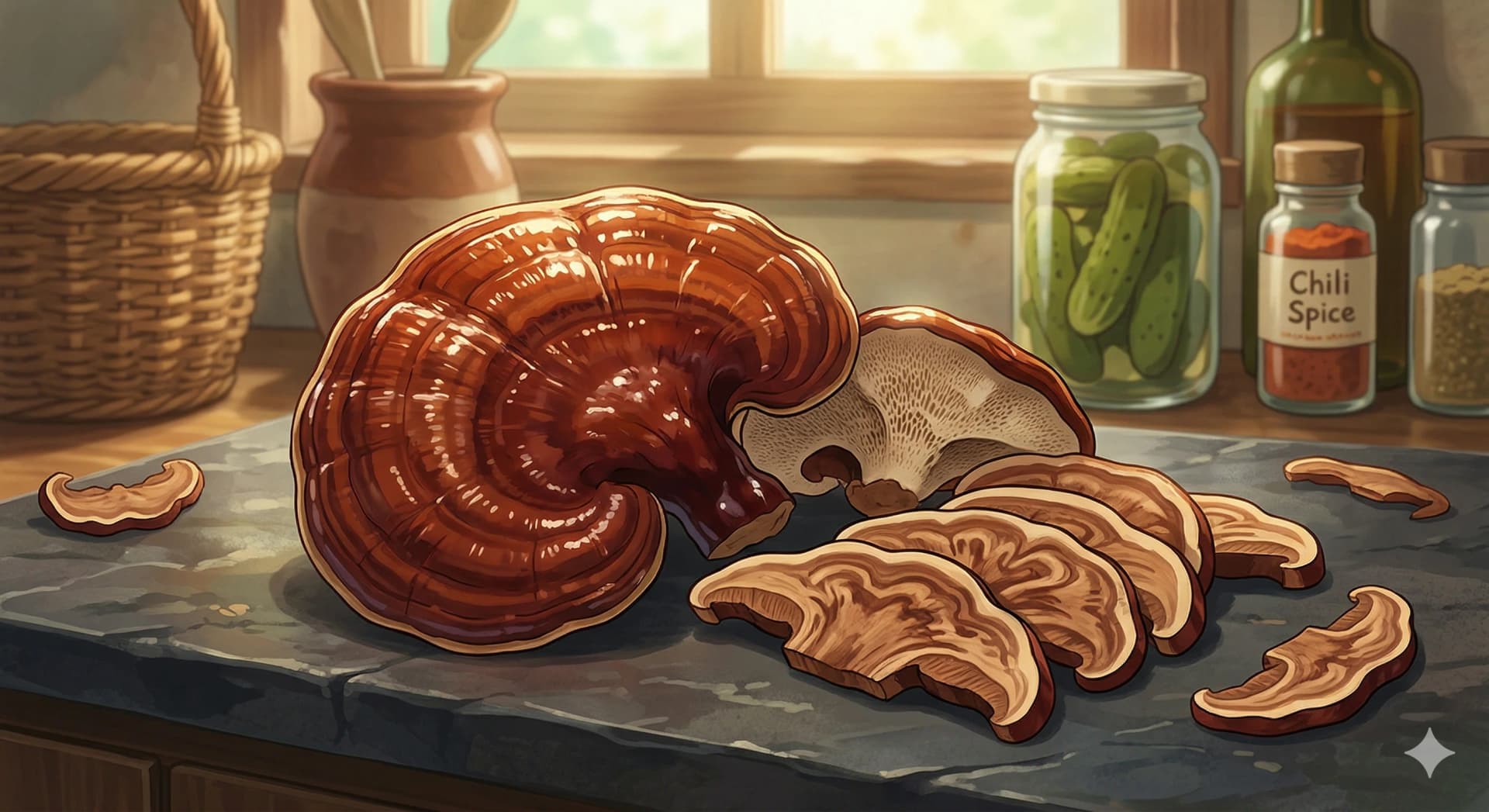
Reishi Mushroom
Also known as: Lingzhi, Ganoderma lucidum, Mushroom of Immortality, Spirit Mushroom
Reishi mushroom has occupied the apex of Traditional Chinese Medicine's pharmacopoeia for over two thousand years. In ancient texts, it was classified as a superior tonic — herbs that extend life without toxicity, even at high doses.
It is bitter and woody when consumed directly, which is why it is typically prepared as a tea, broth, or extract rather than eaten. In modern wellness contexts it is widely sold as a supplement and added to coffee, hot chocolate, and functional foods.
Key facts at a glance:
- Apex of TCM pharmacopoeia — classified as a superior tonic for over 2,000 years
- Immunomodulatory beta-glucans — help the immune system self-regulate
- Triterpenes — anti-inflammatory, anti-hypertensive, and liver-protective
- Too bitter to eat directly — prepared as tea, broth, or extract
- Symbol of longevity — depicted in imperial robes, paintings, and Taoist art
Flavor Profile
Origin
China, Japan, Korea, East Asia
Traditional Medicine Perspectives
Traditional Chinese Medicine
Reishi (Lingzhi) is classified in TCM as sweet, neutral, and non-toxic — a superior tonic herb that can be taken indefinitely without harm. It enters the Heart, Lung, and Liver meridians. It is prescribed to calm the Shen (spirit/mind), tonify Qi, nourish Blood, and support the immune system. It is one of the most widely prescribed herbs in TCM for cancer support, chronic fatigue, and anxiety.
Modern Scientific Research
Reishi is one of the most extensively researched medicinal mushrooms. Its polysaccharides (particularly beta-glucans) show immunomodulatory effects — they neither simply stimulate nor suppress the immune system but help it self-regulate.
Clinical studies demonstrate improvements in fatigue and quality of life in cancer patients undergoing treatment. Triterpenes in reishi show anti-inflammatory, anti-hypertensive, and liver-protective properties.
Research suggests potential benefits for sleep quality, anxiety, and blood sugar regulation.
Cultural History
Reishi appears extensively in Chinese art and literature — it is depicted in ancient paintings, embroidered onto imperial robes, and carved into decorative objects as a symbol of longevity and spiritual power.
The Taoists considered it a plant of immortality. Its rarity in the wild (it grows on the base of specific hardwood trees and was difficult to find) gave it mystical status — emperors sought it and poets wrote about it.
Modern cultivation techniques have made reishi widely available, but its historical mystique as a rare, sacred medicine persists in Chinese culture.
Culinary Uses
Reishi is too bitter and tough to eat directly as a cooked mushroom. It is prepared as a decoction (simmered in water for 30 to 60 minutes), as part of a long-cooked broth or congee, or consumed as a powder extract.
The bitter flavor is significant — it signals the presence of triterpenes, which are among its most bioactive compounds.
Preparation Methods
For reishi tea: simmer 3 to 5 grams of dried sliced reishi in 4 cups of water for 45 to 60 minutes. Strain and drink.
For broth: add dried reishi pieces to a bone broth or vegetable stock and simmer for at least 2 hours before straining. Start with small amounts — the bitterness can be intense.
Traditional Dishes
- Reishi tea
- Medicinal bone broth
- Congee
- Herbal soups
Comments
Share your thoughts on this ingredient.
Sign in to comment0 Comments