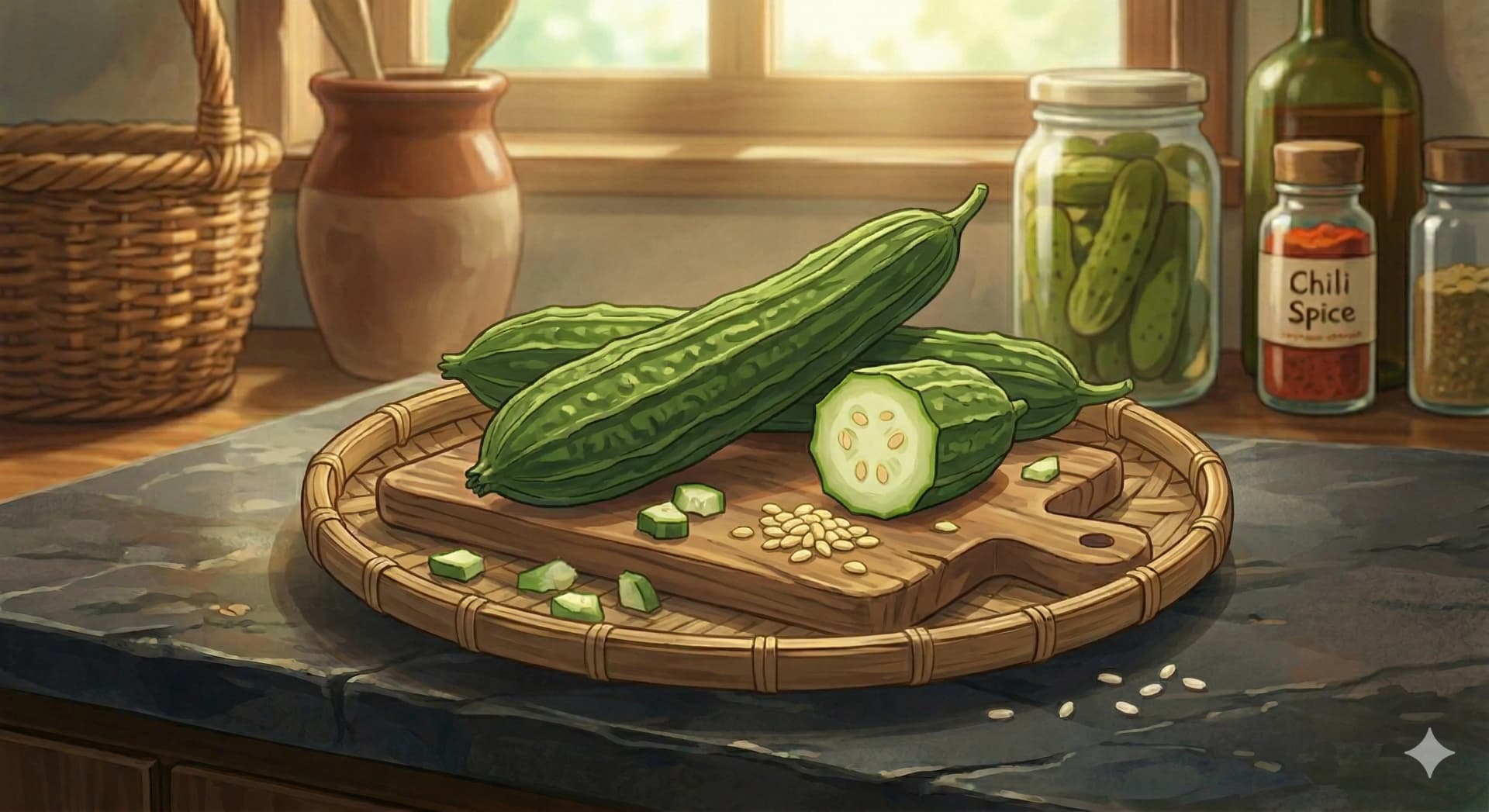
Ridge Gourd
Also known as: Turai, Turiya, Luffa acutangula, Ribbed Gourd, Silk Squash, Torai, Jhinge
Ridge gourd and the bathroom loofah sponge are the same plant at different stages of life. Luffa acutangula, the angular or ribbed luffa, is harvested young and tender as a vegetable across South and Southeast Asia. If the pod is allowed to remain on the vine into full maturity, it dries out completely: the outer skin crumbles away, the water evaporates, and the fibrous vascular network inside hardens into the rough, porous scrubbing sponge sold in bath and kitchen stores worldwide.
As food, ridge gourd is mild, slightly sweet, and distinctly spongy in texture. That sponginess is its defining culinary characteristic. The flesh absorbs cooking liquid and aromatics with unusual efficiency, taking on the character of whatever it is surrounded by without contributing strong flavors of its own. This makes it, like bottle gourd, primarily a carrier ingredient. The difference is texture: bottle gourd becomes soft and almost melting when cooked, while ridge gourd retains more structure and a slightly spongy bite that holds up in longer-cooked preparations.
The exterior of the ridge gourd is its most visually distinctive feature: dark green skin with prominent, hard ridges running the length of the pod. Those ridges are inedible and must be removed before cooking. The technique is to run a vegetable peeler along the ridges only, removing the tough raised portions while leaving the green skin of the valleys intact. This partial peeling gives the sliced rounds a characteristic striped appearance, alternating green and pale.
Key facts at a glance:
- Same plant as the loofah sponge — Luffa acutangula at different stages of life
- Carrier ingredient — absorbs cooking liquid and aromatics exceptionally well
- Partial peeling technique — remove only the hard ridges, leave skin between
- Cooks in 5-8 minutes — notably faster than bottle gourd or most other gourds
- Bengali jhinge posto — the signature preparation with white poppy seed paste
- Zero-waste potential — removed skin can be made into Andhra-style chutney
Flavor Profile
Origin
South Asia, Southeast Asia, Tropical Asia
Traditional Medicine Perspectives
Ayurveda:
Ridge gourd is classified as a cooling, light, and easily digestible vegetable, making it one of the recommended foods for summer and for individuals with pitta imbalances. It is considered beneficial for the liver, and traditional preparations made from the plant's leaves and roots have been used for liver conditions. The vegetable is thought to support healthy skin due to its high silica content and antioxidant compounds. As a cooling food, it is recommended for conditions involving inflammation, fever, and heat-related discomfort. Ayurvedic texts also reference the dried, mature luffa fiber as having therapeutic applications in topical preparations.
Traditional Chinese Medicine:
In Chinese medicine, luffa (si gua) is classified as a food that clears heat, dissolves phlegm, and promotes the movement of qi through the meridians. It is particularly associated with resolving heat in the lungs and stomach, making it a recommended food during summer and in febrile conditions. The dried luffa fiber (si gua luo) is used in Chinese medicine as a medicinal material to unblock channels and relieve pain from damp-heat conditions.
Modern Scientific Research
Ridge gourd contains vitamin C, B vitamins, iron, calcium, and significant dietary fiber. Like other members of the Cucurbitaceae family, it contains flavonoid antioxidants and compounds with documented anti-inflammatory activity.
Research on luffa extracts has investigated anti-tumor, anti-diabetic, and hepatoprotective properties, with preliminary findings supporting the traditional classifications of the plant as liver-protective and anti-inflammatory.
The sponge material from mature luffa has attracted research interest as a biodegradable scaffold material in tissue engineering — illustrating the plant's versatility far beyond the kitchen.
Cultural History
Luffa acutangula is native to tropical Asia and has been cultivated in South and Southeast Asia for thousands of years. Ancient Sanskrit texts reference the plant, and it appears in early Indian agricultural literature as both a food crop and a source of fiber. Cultivation spread from South Asia through Southeast Asia, across China, into the Middle East and East Africa, and eventually to the Americas following European contact.
In Bengal, the vegetable (called jhinge) is most celebrated in jhinge posto: grated white poppy seed paste cooked with the ridge gourd in a preparation that is considered quintessentially Bengali, paired with steamed rice for a simple, deeply comforting meal. The poppy seed paste adds richness, a slight nuttiness, and a thickened sauce that clings to the cooked gourd, transforming a mild vegetable into something memorable.
In Andhra Pradesh and Tamil Nadu, the outer skin, when removed and not discarded, can be used to make a chutney with lentils, chilies, and tamarind — a resourceful technique that uses what would otherwise be waste.
In Maharashtra and Gujarat, turai sabzi is an everyday home cooking staple, simple and unfussy. The vegetable's availability across the monsoon and summer seasons makes it a seasonal constant in South Asian home kitchens.
Culinary Uses
The preparation of ridge gourd follows a straightforward logic once the peeling technique is understood. After removing the ridges (and optionally the remaining skin), the gourd is sliced into rounds for most preparations, or cut into half-rounds or strips for certain dishes. The flesh cooks quickly, reaching tenderness in 5 to 8 minutes in an active pan, which is notably faster than bottle gourd or most other gourds.
Bengali jhinge posto is the preparation that most fully exploits the absorptive quality of the vegetable. White poppy seeds (posto) are soaked, then ground or blended into a paste. This paste is cooked in mustard oil with green chilies, added to the pan after the ridge gourd has softened, and the whole preparation is finished until the paste coats the gourd evenly. The mustard oil contributes a sharp, assertive base; the poppy seed paste adds richness and a subtle bitterness; the ridge gourd absorbs both and provides the bulk and texture.
South Indian preparations typically involve a tempering of mustard seeds, dried red chilies, and curry leaves in coconut oil, with grated coconut added toward the end — the freshness of the coconut lifts the mild vegetable.
Andhra preparations lean toward dried red chili and peanut combinations that give the dish heat and body. In dal-based preparations across regions, ridge gourd is added to the cooking lentils and simmers until both are soft, producing a unified dish where the gourd has fully taken on the flavor of the spiced lentil liquid.
Preparation Methods
Selecting: Choose ridge gourds that are medium-sized, firm, and uniformly dark green. The ridges should be prominent and sharp. Oversized gourds with yellowing or very tough ridges are past their edible peak. Fresh ridge gourd should feel slightly heavy for its size.
Peeling: Hold the gourd firmly. Use a vegetable peeler or paring knife to remove only the raised ridges, running along each ridge from stem to tip. Leave the skin between the ridges intact. This partial peeling is the standard technique for most preparations. Full peeling is an option if the skin seems very tough or the recipe requires a smoother texture.
Cutting: Slice into rounds of about 1 cm for sabzi and stir-fries. Larger, uneven pieces work well in dal. For Bengali posto, some cooks cut into slightly larger pieces that hold their shape as the poppy paste cooks around them.
Handling the skin: The removed ridges and remaining skin can be set aside and used for ridge gourd skin chutney (common in Andhra Pradesh), where the skin is sautéed with lentils, tamarind, and chilies and ground into a coarse paste. This is a practical, resourceful technique that wastes nothing.
Traditional Dishes
- Turai sabzi (North Indian)
- Bengali jhinge posto (with white poppy seed paste)
- Turai chana dal
- Ridge gourd with coconut (South Indian)
- Andhra ridge gourd fry with peanuts
- Turai chutney (Gujarati)
- Ridge gourd skin chutney (Andhra)
- Ridge gourd raita
- Jhinge aloo (Bengali ridge gourd with potato)
Comments
Share your thoughts on this ingredient.
Sign in to comment0 Comments