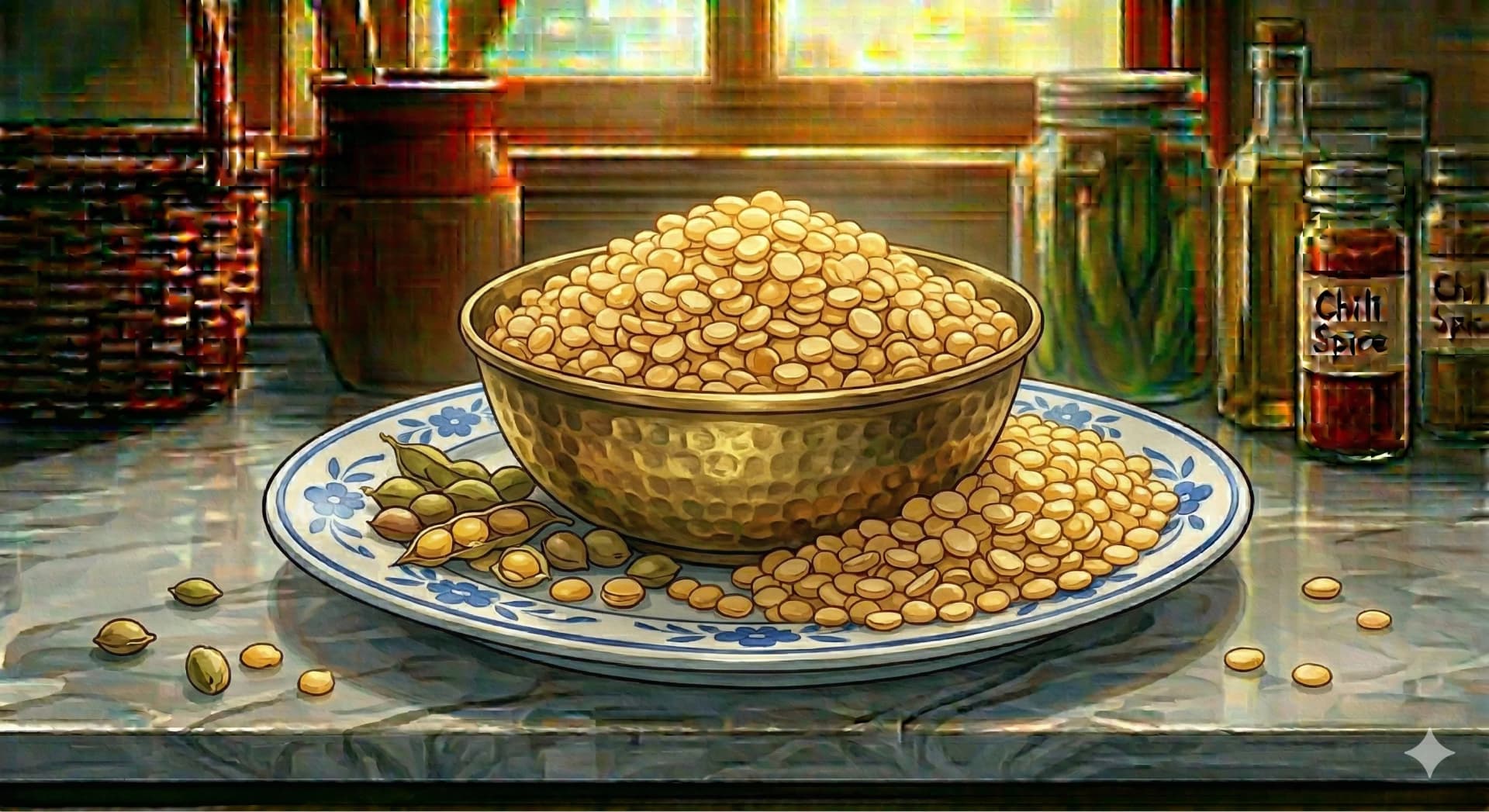
Toor Dal
Also known as: Arhar Dal, Split Pigeon Peas, Cajanus cajan, Yellow Pigeon Peas
Toor dal, also known as arhar dal in North India, is the most widely consumed dal in India by volume. It is the split and partially husked form of the pigeon pea, a legume native to the Indian subcontinent and East Africa, and it appears daily on tables from Kerala to Kashmir, though in strikingly different forms depending on the region.
The cooked dal has a characteristic earthiness layered over a gentle natural sweetness, and when fully cooked it takes on a soft, slightly gelatinous quality that distinguishes it from the firmer bite of chana dal or the complete dissolution of masoor dal. This gel-like consistency, produced by the natural starches in pigeon peas, is part of what gives sambar its body.
Toor dal appears in two forms in Indian markets: plain (dry) and oily. The oily variety is coated in castor oil or petroleum oil as a preservative to extend shelf life and prevent moisture absorption. The oily variety requires thorough washing before cooking to remove the coating, which otherwise imparts an unpleasant taste and oily foam to the cooking water.
Even though toor dal is sold split, it benefits meaningfully from soaking before cooking. A 30-minute soak reduces cooking time and improves the final texture, producing a more evenly cooked dal without the hard-centered, mushy-outside inconsistency that can result from cooking unsoaked split peas.
Key facts at a glance:
- Most widely consumed dal in India — appears daily from Kerala to Kashmir
- Split pigeon pea — native to the Indian subcontinent and East Africa
- Gel-like consistency from natural starches — gives sambar its characteristic body
- Available plain or oily — oily variety requires thorough washing before cooking
- Approximately 22g protein per 100g dry — with significant iron at 5mg per 100g
- Exceptional drought tolerance — fixes 40kg atmospheric nitrogen per hectare annually
Flavor Profile
Origin
India, East Africa
Traditional Medicine Perspectives
Ayurveda:
Toor dal is considered tri-doshic in small amounts, meaning it is generally balancing across Vata, Pitta, and Kapha constitutions, though in excess it can aggravate Vata. It is considered lighter and more digestible than whole pigeon peas, and its mildly sweet, slightly astringent taste is considered nourishing to tissue (dhatu) formation. Cooking with turmeric, ghee, and asafoetida is the standard Ayurvedic approach to making toor dal easier to digest. It is not considered suitable for very delicate constitutions; moong dal is preferred for convalescence.
Traditional Chinese Medicine:
Pigeon peas are considered sweet and neutral, tonifying to the Kidney and Stomach. They are used in some traditional preparations for edema and urinary difficulty, and their mild diuretic properties are acknowledged in classical texts.
Modern Scientific Research
Toor dal is a significant source of plant protein (approximately 22 grams per 100g dry weight) and contains all essential amino acids, though it is limiting in methionine, which is supplemented by grain-based foods in the traditional dal-rice or dal-roti combination.
The resistant starch and fiber in pigeon peas produce a moderate glycemic index, making toor dal a better choice for blood sugar management than refined grains.
Studies at the International Crops Research Institute for the Semi-Arid Tropics (ICRISAT) have confirmed the pigeon pea's exceptional drought tolerance and its capacity to fix 40 kilograms of atmospheric nitrogen per hectare annually, making it ecologically valuable as well as nutritious.
Iron content is significant, at around 5mg per 100g dry weight, making toor dal an important dietary iron source in populations where meat consumption is low. As with all leguminous iron, pairing with vitamin C sources enhances absorption. The tamarind in sambar provides some vitamin C, and tomatoes in North Indian preparations contribute further.
Cultural History
The pigeon pea has been cultivated on the Indian subcontinent for at least 3,500 years. Archaeological evidence from Neolithic sites in Maharashtra suggests cultivation as far back as 1500 BCE, and the crop appears in ancient Sanskrit agricultural texts.
Its resilience as a crop, tolerant of drought, capable of nitrogen-fixing, and productive in low-rainfall conditions, made it a reliable food source across the dry interior of the subcontinent. It remains a critical food security crop in rain-shadow regions of Maharashtra, Karnataka, and Andhra Pradesh.
In South India, toor dal's role is inseparable from sambar, the thin, tamarind-spiked lentil soup that appears at virtually every meal in Tamil Nadu, Karnataka, Kerala, and Andhra Pradesh. Sambar is not simply a dish; it is a daily ritual, a flavor baseline, and a vehicle for seasonal vegetables.
The word sambar is said to derive from the Marathi word "sambhar," and there are competing origin stories involving the Maratha courts and the colonial period, but the dish in some form predates written records.
What is certain is that toor dal is its foundation: cooked to softness, then diluted and seasoned with tamarind water, tomato, sambar powder, and a mustard-curry leaf tadka.
In Gujarat, toor dal is cooked in a distinctly different style. Gujarati dal is slightly sweet (jaggery is added), thin in consistency, and very aromatic, with curry leaves, dried red chilies, tomatoes, and sometimes peanuts. It is meant to be sipped rather than eaten with a spoon. The sweet-sour-spicy balance of Gujarati dal is one of the more complex flavor constructions in Indian regional cooking.
In Maharashtra, the equivalent is varan, a plain, lightly seasoned toor dal that is the simplest, most comforting version of the ingredient.
Culinary Uses
For sambar, toor dal is cooked very soft, almost overcooked by dal tadka standards, to the point where it can be whisked or stirred into a smooth consistency. It is then combined with tamarind water, tomatoes, sambar powder (a complex spice blend), and whatever vegetables are in season: drumsticks, brinjal, pearl onions, radish, or potato.
The final tadka of black mustard seeds, curry leaves, dried red chilies, and asafoetida in ghee is added at the end and transforms the flavor.
For North Indian dal tadka or dal fry, toor dal is cooked to a looser, more textured consistency where individual dal pieces are visible but fully soft. A bhunoed masala of onion, tomato, ginger, and garlic is prepared separately and combined with the cooked dal, then finished with a ghee tadka.
Dal dhokli, the Gujarati preparation of pasta squares simmered in seasoned toor dal, uses the cooked dal as both cooking medium and sauce.
Preparation Methods
Washing (oily variety): Rinse under running water, rubbing the dal between your palms, until the water runs clear and no longer feels slick. This may take 5 to 7 rinses.
Soaking: Soak washed dal in cold water for 30 minutes before cooking. Drain and use fresh water for cooking.
Pressure cooker: 1 cup dal to 2.5 cups water. 2 to 3 whistles on a stovetop cooker (or 8 to 10 minutes high pressure, natural release, on an electric cooker). The dal should be completely soft and beginning to break down. For sambar, cook a few minutes longer.
Stovetop: In a heavy pot, soak-drained dal with 3 cups water, brought to a boil, skimmed, then simmered covered for 40 to 50 minutes. Less reliable than pressure cooking for even texture.
Tadka: For North Indian preparations, heat 2 tablespoons ghee in a small pan, add cumin seeds, then minced onion, ginger, and garlic, then tomato and spices. Cook the masala down until oil separates. Combine with cooked dal and simmer 10 minutes together.
Traditional Dishes
- Sambar
- Dal tadka (Punjabi style)
- Gujarati dal
- Dal fry
- Varan (Maharashtrian plain toor dal)
- Pappu (Andhra style)
- Dal dhokli
- Rasam (uses toor dal water)
- Dal bati (Rajasthani)
- Saaru (Karnataka thin rasam-style preparation)
Comments
Share your thoughts on this ingredient.
Sign in to comment0 Comments