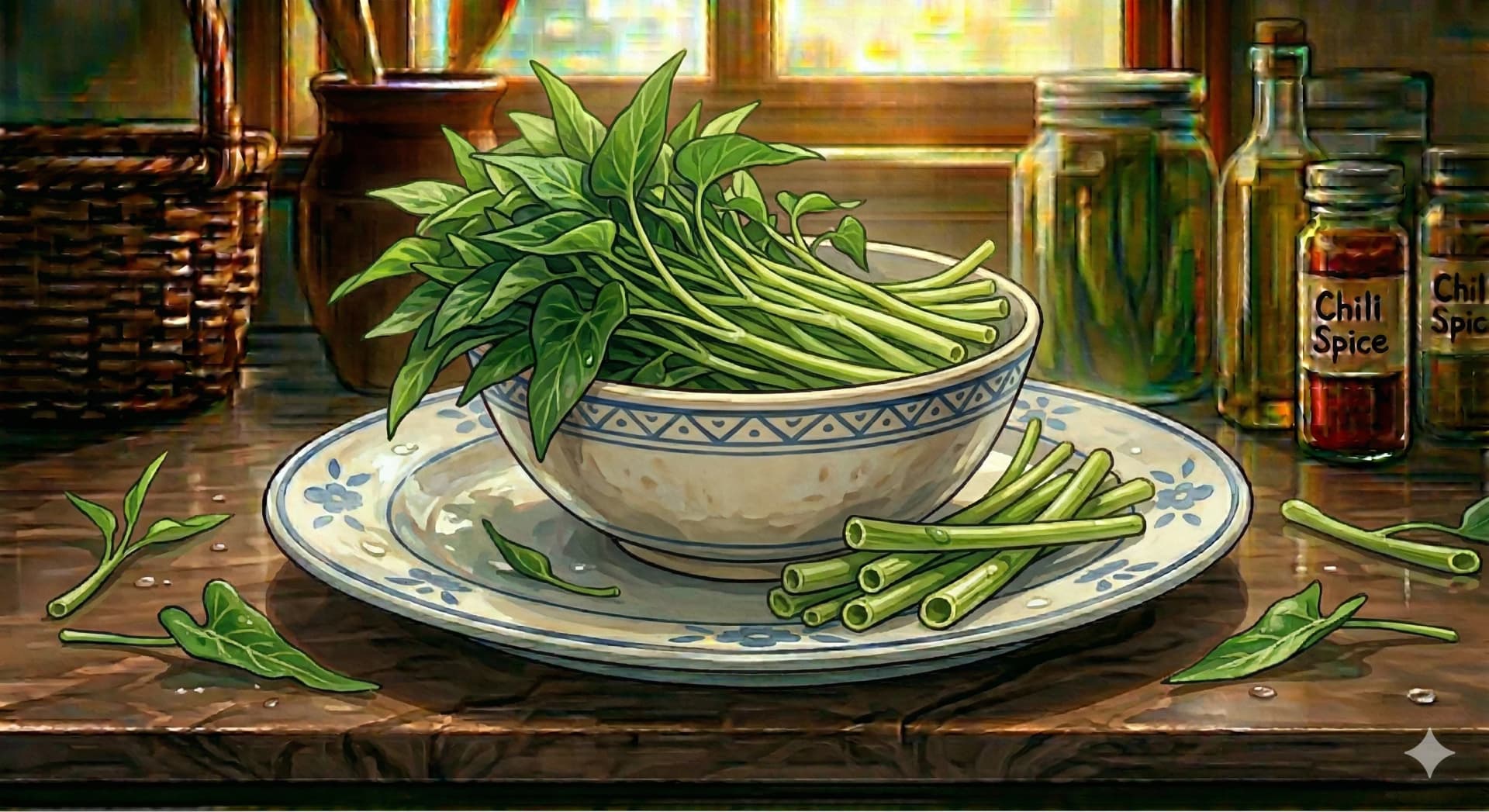
Water Spinach
Also known as: Kong Xin Cai, Morning Glory, Ong Choy, Ipomoea aquatica, Hollow Vegetable, Kangkong
Water spinach is a semi-aquatic leafy vegetable with hollow stems and arrow-shaped leaves that is beloved across Chinese and Southeast Asian cooking for its light, clean flavor and satisfying crunch.
Its name in Chinese — kong xin cai (hollow-stemmed vegetable) — refers to the characteristic hollow stems that stay crisp even after cooking.
It wilts instantly in a screaming hot wok and is one of the few vegetables that genuinely benefits from extremely high heat.
Key facts at a glance:
- Semi-aquatic leafy vegetable — hollow stems and arrow-shaped leaves
- Kong xin cai — Chinese name meaning 'hollow-stemmed vegetable'
- Benefits from extremely high heat — wilts instantly in a screaming hot wok
- Central to Cantonese, Vietnamese, Thai, and Malay cuisines — over two thousand years of cultivation
- Rich in iron, vitamins A and C — nutritionally significant as a primary leafy green
- Sambal kangkong — a hawker staple in Singapore and Malaysia
Flavor Profile
Origin
Tropical Asia, Southern China, Guangdong, Southeast Asia
Traditional Medicine Perspectives
Traditional Chinese Medicine
Water spinach (Kong Xin Cai) is classified as cool and sweet in TCM, associated with the Stomach, Small Intestine, and Large Intestine meridians. It is used to clear heat, cool the Blood, detoxify, promote urination, and moisten the intestines. It is prescribed for heat conditions affecting the intestines and is considered particularly useful for constipation from heat and dryness. It is also used topically for snake bites and skin inflammations in folk medicine.
Modern Scientific Research
Water spinach is rich in iron, vitamins A and C, and beta-carotene — making it nutritionally significant in the diets of communities that rely on it as a primary leafy green.
Research shows antioxidant properties from its polyphenol content and potential blood sugar-modulating effects from compounds that inhibit alpha-glucosidase.
The iron content, while high, is non-heme iron (less bioavailable than heme iron), and vitamin C in the same dish enhances absorption.
Cultural History
Water spinach has been cultivated across tropical and subtropical Asia for over two thousand years. It is particularly central to Cantonese, Teochew, Vietnamese, Thai, and Malay cuisines.
The Cantonese preparation — stir-fried in fermented tofu (jiang doufu) with garlic — is one of the classic street food and restaurant preparations of southern China and Hong Kong.
In Singapore and Malaysia, sambal kangkong (water spinach with shrimp paste and chili) is a hawker staple. Its rapid growth in water makes it an important food crop in flooded paddy fields.
Culinary Uses
Stir-fry at the highest heat possible with fermented tofu and garlic for the classic Cantonese preparation.
Stir-fry with shrimp paste for the Southeast Asian version. Blanch briefly and dress with sauce.
Add to hot pots. Water spinach wilts dramatically — use much more than you think you need.
Preparation Methods
Separate stems from leaves — stems take longer to cook. Snap or cut into 2–3 inch sections.
Heat the wok until smoking before adding oil and aromatics — water spinach needs high heat to stir-fry rather than steam.
Add stems first, then leaves.
Traditional Dishes
- Cantonese stir-fried water spinach with fermented tofu
- Sambal kangkong (Southeast Asian)
- Ong choy with garlic
- Vietnamese morning glory stir-fry
- Hot pot vegetable
Comments
Share your thoughts on this ingredient.
Sign in to comment0 Comments