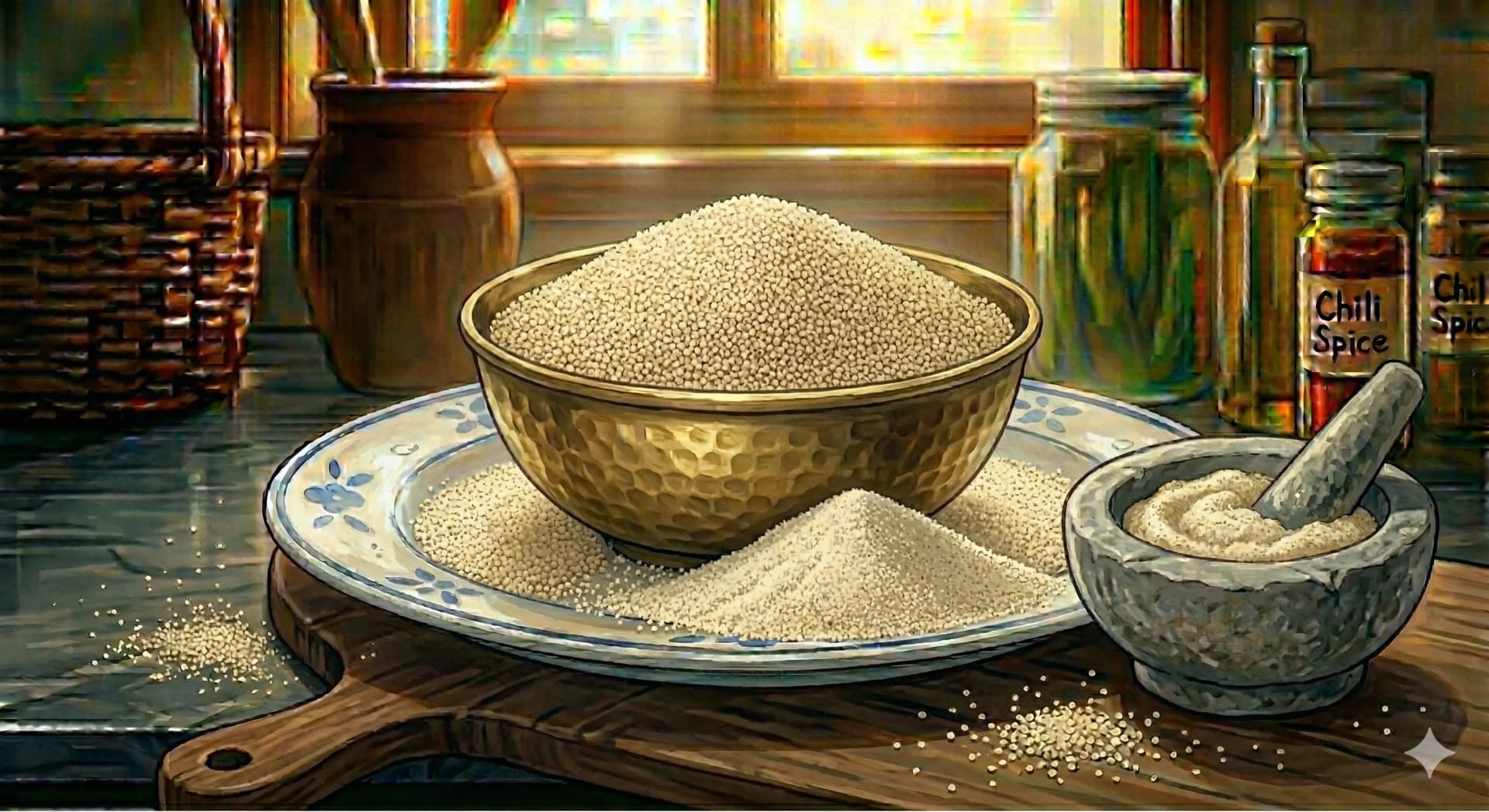
White Poppy Seeds
Also known as: Khus Khus, Khas Khas, Posto (Bengali), Papaver somniferum
White poppy seeds come from Papaver somniferum, the opium poppy, which creates an immediate and understandable pause for most people encountering them for the first time. The important clarification is this: the seeds of the opium poppy contain no morphine, no codeine, and no alkaloids of any kind. The narcotic compounds in the opium poppy are produced in the latex of the unripe seed capsule and are concentrated in the sap of the plant's vegetative tissues, not in the mature, fully dried seeds.
Culinary poppy seeds, whether white or the more familiar blue-grey European variety, are entirely safe to eat in food quantities and have been used across multiple food cultures for thousands of years without concern.
In Indian cooking, white poppy seeds have a culinary role that is quite different from simply flavoring a dish. Their most important function is as a thickener and body-builder for gravies. When soaked in warm water and ground to a smooth paste, white poppy seeds release a creamy, starchy emulsion that, when cooked into a sauce, produces a characteristic silky, rich, subtly thick texture that cannot be replicated by other thickeners.
This quality makes them indispensable in Mughlai korma gravies and other rich North Indian preparations, where they are combined with cashews, blanched almonds, and sometimes melon seeds to build the luxurious, cream-colored base.
The seeds themselves have a mild, faintly nutty flavor before any preparation. Dry-roasting deepens this nuttiness significantly, creating a toasted quality that improves both their flavor contribution and their thickening efficiency.
Key facts at a glance:
- From Papaver somniferum — but mature seeds contain no alkaloids or narcotic compounds
- Primary function as a thickener — soaked and ground into paste for gravies
- Indispensable in Mughlai korma gravies — combined with cashews and almonds for luxurious base
- Posto in Bengali cooking — a culinary category unto itself, not merely an ingredient
- Excellent source of calcium, zinc, and magnesium — minerals frequently deficient in modern diets
- Archaeological evidence of cultivation — dating back 6,000 years at Neolithic European sites
Flavor Profile
Origin
Mediterranean, Middle East, South Asia
Traditional Medicine Perspectives
Ayurveda:
White poppy seeds are classified as cooling (sheeta virya) in Ayurveda, which aligns with their traditional applications. They are considered calming and sedative in larger amounts, and this property has been used in traditional contexts for treating insomnia, anxiety, and pain, though always with the understanding that larger medicinal doses operate differently from small culinary quantities. Ayurvedic texts describe uses for poppy seeds in treating diarrhea (their astringent and binding properties), urinary disorders, and as a general tonic for nervous system conditions. The cooling property makes them beneficial for Pitta conditions, and they are considered nourishing and building (santarpana) in nature.
Traditional Chinese Medicine:
TCM uses poppy seeds and poppy capsule preparations primarily for their astringent and binding properties. The seed head and capsule are used more medicinally than the seeds themselves. Properties attributed include settling the stomach and intestines, binding intestinal fluid to stop diarrhea, and calming the mind. The sedative properties recognized across traditional systems reflect the real, if modest, physiological effect of certain compounds present in very small amounts in the seeds.
Modern Scientific Research
The key research question about white poppy seeds is the one that most people ask first: do they contain opiates? The scientific consensus is clear that commercially processed, washed, and dried culinary poppy seeds contain negligible or undetectable levels of morphine and codeine.
The alkaloids are present in the sap of the living plant, not in the mature seed itself, and proper processing further reduces any trace amounts. Drug tests have occasionally flagged consumption of large quantities of poppy seeds (particularly unwashed varieties) as false positives, and this has been studied extensively in forensic toxicology, but at normal culinary quantities the issue is not relevant.
On the nutritional and therapeutic side, white poppy seeds are an excellent source of calcium, zinc, and magnesium, three minerals frequently deficient in modern diets. They are rich in linoleic acid (an omega-6 fatty acid) and contain a range of antioxidant compounds.
The sedative effects observed in animal models at higher doses have been attributed to trace alkaloid precursors and potentially to the high concentration of certain fatty acids and their metabolic effects on neurotransmitter systems. Research into poppy seed extract for anti-inflammatory activity has shown modest results.
Cultural History
Poppy cultivation is ancient, with archaeological evidence of Papaver somniferum cultivation at Neolithic European sites dating back 6,000 years. The plant spread throughout the ancient Mediterranean world and eastward through Persia and Central Asia. In the culinary tradition, poppy seeds appear in ancient Egyptian, Greek, and Roman food records as both a seasoning and a thickening agent.
Poppy seeds arrived in South Asia through trade and cultivation and found significantly different culinary expressions in different regions.
In Bengal, white poppy seeds, called posto, achieved a culinary importance that is unique in the subcontinent and possibly in the world. Posto is not merely an ingredient in Bengali cooking: it is a category. Aloo posto (potato with poppy seed paste), posto bora (poppy seed fritters), chingri posto (shrimp in poppy paste), and other posto dishes constitute a distinct segment of the Bengali culinary tradition, beloved with an intensity that Bengalis discuss with visible pride.
The poppy seed paste in Bengali cooking is used differently than in Mughlai cooking: it is typically the primary and dominant flavor, a white, slightly astringent paste used in larger quantities with mustard oil and green chilies.
In Mughlai and North Indian court cooking, white poppy seeds entered as one of several nut and seed pastes used to build rich, creamy korma bases. The Mughal culinary tradition inherited Persian techniques and adapted them with local ingredients, and the combination of cashew paste, poppy seed paste, and cream in a korma represents one of the most sophisticated and labor-intensive base-building methods in any world cuisine.
Culinary Uses
The critical technique for using white poppy seeds in cooking is soaking followed by grinding. Dry poppy seeds are too hard and too small to grind effectively into a smooth paste without prior hydration. Soaking in warm water for 30-60 minutes causes the seeds to swell and soften, allowing a blender or wet grinder to produce a truly smooth, creamy paste.
This paste is the form in which white poppy seeds contribute their thickening and flavor to Mughlai gravies and Bengali posto dishes.
In a Mughlai korma base, the poppy seed paste is combined with cashew paste and often almond paste. These are cooked together in ghee, then onion paste is added and cooked down, then the nut-seed paste combination goes in to cook until it turns golden and fragrant and releases fat back into the pan.
At this stage, the base is ready to receive the protein, yogurt, and aromatics. The thickening effect of the poppy seed paste comes from its high starch and protein content, which gelatinizes during cooking to produce a smooth, luxurious texture.
Preparation Methods
Soaking and grinding into paste: Cover white poppy seeds with warm water and soak for 30-60 minutes until they swell. Drain and add to a blender with just enough water to allow the blades to catch (as little as possible). Blend, stopping to scrape down, until a completely smooth white paste forms. Use immediately in the dish or store refrigerated for up to 2 days.
Dry-roasting before grinding (Bengali style): Toast dry seeds in a dry pan over medium heat, stirring constantly, for 3-4 minutes until they turn very lightly golden and fragrant. Cool completely before soaking and grinding. This increases the nutty depth in the final paste.
Sprinkling whole seeds: Unsoaked, unground seeds can be sprinkled onto flatbreads, sweet rolls, or used as a garnish, where they contribute mild nuttiness and textural interest without thickening.
Korma base ratio: For a korma serving 4-6, use 2-3 tablespoons of white poppy seeds (dry weight) soaked and ground smooth, combined with 1/4 cup cashews (also soaked and ground). This combination provides both the smooth texture and the creamy, pale color of a classic korma base.
Storage: Whole seeds keep well in an airtight container for 1-2 years. Ground paste should be used within 48 hours as it deteriorates quickly.
Traditional Dishes
- Korma (Mughlai)
- Aloo Posto
- Bengali Posto Bora
- Chingri Posto
- Khus Khus Halwa
- Mughlai Gravy
- Vegetable Korma
- Shahi Chicken
- Posto Rice
- Navratan Korma
Comments
Share your thoughts on this ingredient.
Sign in to comment0 Comments