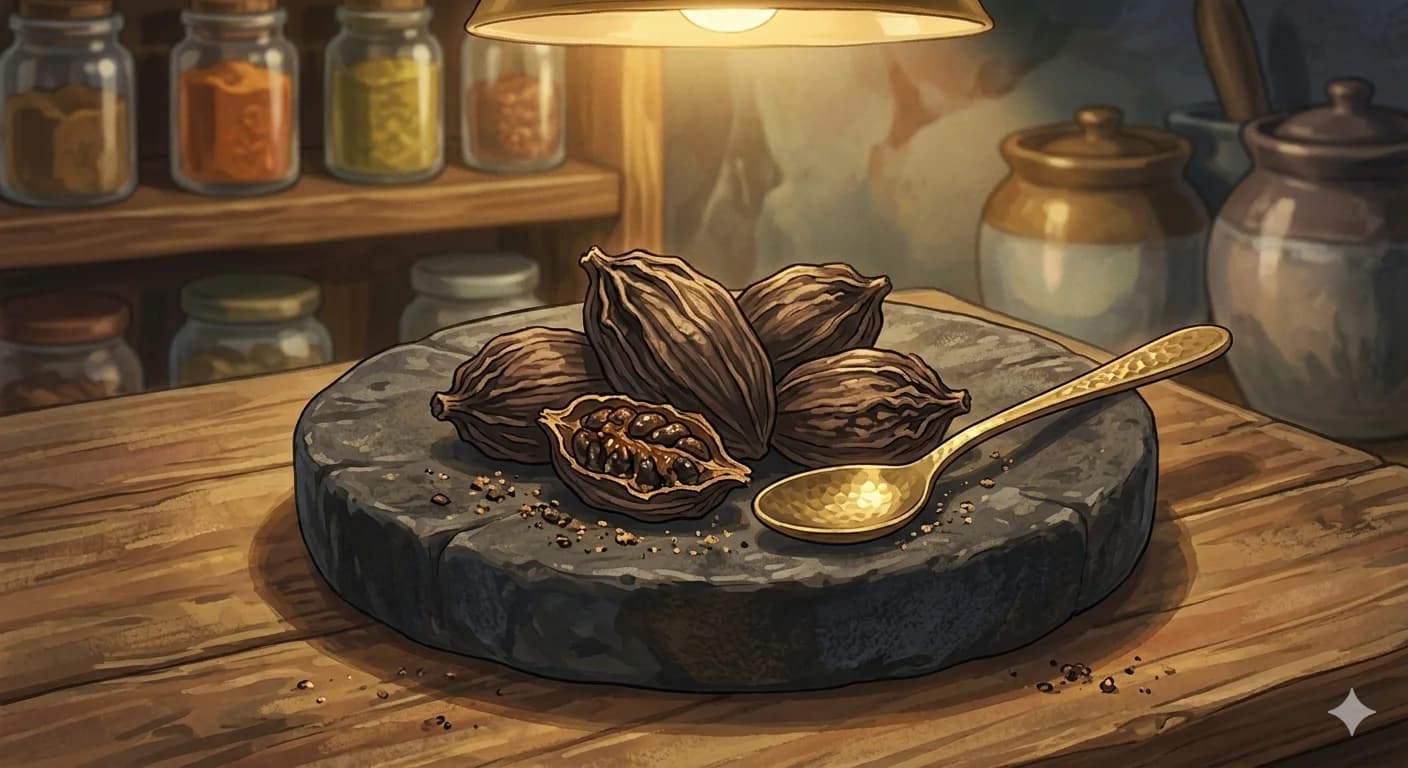
Black Cardamom
Also known as: Badi Elaichi, Kali Elaichi, Amomum subulatum, Nepal Cardamom, Brown Cardamom
Black cardamom is an entirely different plant from the green cardamom found in most Western spice racks. While green cardamom (Elettaria cardamomum) is prized for its delicate floral sweetness, black cardamom (Amomum subulatum) carries a bold, camphoraceous smokiness that places it in another flavor category entirely. The pods are large, fibrous, and dark brown, with a rough, wrinkled exterior and a cluster of small black seeds inside.
It belongs to the ginger family but shares little in common, taste-wise, with its more famous relatives.
The defining characteristic of black cardamom, the quality that sets it apart from every other spice in the Indian pantry, is its deeply smoky note. This smokiness is not an accident: the pods are traditionally dried over open fire or wood-burning kilns in the foothills of Nepal, Sikkim, and Bhutan, rather than being sun-dried as most spices are. This smoking process imparts the distinctive earthy, tarry depth that makes black cardamom irreplaceable in certain applications.
No amount of green cardamom, smoked paprika, or any combination of spices replicates it.
Black cardamom is a spice of the high Himalayas and the trade routes descending from them. It grows wild and in cultivation at elevations between 1,000 and 2,000 meters in the eastern Himalayan region, with Nepal and Sikkim being the primary producers. From there, it traveled the spice routes into the great Mughal kitchens of North India, where it became a cornerstone of slow-cooked meat preparations and the rice dishes that defined imperial cuisine.
Key facts at a glance:
- It belongs — To the ginger family but shares little in common, taste-wise, with its more famous relatives.
- Black cardamom — Is an entirely different plant from the green cardamom found in most Western spice racks.
- The pods — Are large, fibrous, and dark brown, with a rough, wrinkled exterior and a cluster of small black seeds inside.
- The defining — Characteristic of black cardamom, the quality that sets it apart from every other spice in the Indian pantry, is its deeply smoky note.
- This smoking — Process imparts the distinctive earthy, tarry depth that makes black cardamom irreplaceable in certain applications.
- No amount — Of green cardamom, smoked paprika, or any combination of spices replicates it.
Flavor Profile
Origin
Eastern Himalayas, Nepal, Sikkim, Bhutan
Traditional Medicine Perspectives
Ayurveda:
Black cardamom is classified as katu (pungent) and tikta (bitter) in taste, with a warming virya (potency). It is considered strongly kapha-reducing and moderately vata-reducing, making it particularly appropriate in cold, damp conditions. Classical texts use it to support respiratory function: the camphoraceous volatile oils are understood to open the channels of the lungs and clear accumulated mucus. It is prescribed in conditions involving congestion, cough, and heaviness associated with excess kapha. As a digestive, it is valued for its deepana (kindling digestive fire) and pachana (digesting toxins) qualities, and it is included in formulations for sluggish digestion, particularly when the sluggishness is cold in character. Its seeds are sometimes chewed after heavy meals to ease discomfort and freshen breath.
Traditional Chinese Medicine:
In TCM, black cardamom is used under the name Cao Guo (or Tsaoko). It is classified as acrid and warm in nature, associated with the spleen and stomach meridians. Its primary therapeutic function is to transform dampness and cold from the middle jiao, the digestive center. Cao Guo is used in formulations for abdominal distension, nausea, and the type of digestive weakness associated with cold and damp accumulation. It also appears in formulas for malaria and intermittent fever in historical TCM texts, used for its aromatic, damp-transforming properties. The distinction between Cao Guo and the related Cao Doukou (round cardamom) is maintained carefully in classical TCM herbalism.
Modern Scientific Research
Black cardamom's most pharmacologically significant compound is 1,8-cineole, also known as eucalyptol. This is the same compound responsible for the characteristic scent of eucalyptus oil, and it is present in high concentrations in the seeds. 1,8-cineole has been extensively studied as an expectorant, bronchodilator, and anti-inflammatory agent in the respiratory tract, lending scientific support to the traditional Ayurvedic and TCM use of black cardamom for lung and sinus conditions.
Research has confirmed antimicrobial activity in essential oil extracts of Amomum subulatum against a range of bacteria and fungi, particularly oral pathogens, which explains the traditional practice of chewing the seeds for fresh breath and oral health.
It is important to note that the scientific literature on Amomum subulatum is far smaller than that on Elettaria cardamomum (green cardamom), and the two should not be conflated in interpreting research findings. Their chemical profiles are distinct: green cardamom's essential oil is dominated by alpha-terpinyl acetate and linalool, giving its floral character, while black cardamom's oil is dominated by 1,8-cineole, explaining its medicinal, camphoraceous quality. Researchers working on the health effects of cardamom should always specify which species is being studied, as results are not transferable between them.
Cultural History
The trade in black cardamom between the Himalayan foothills and the plains of North India predates recorded culinary history. Nepali and Sikkimese farmers have been cultivating Amomum subulatum under the forest canopy for centuries, intercropping it alongside cardamom's natural host: the alder tree, which provides filtered shade and whose leaf fall fertilizes the soil. The intimate relationship between black cardamom cultivation and mountain forest ecology meant that trading this spice was simultaneously a trade in a specific mountain terroir.
When Mughal culinary culture reached its height between the 16th and 18th centuries, the great kitchens of the emperors in Agra, Delhi, and Lahore codified the use of black cardamom in ways that persist to this day. The dum pukht method, slow-cooking meat sealed inside a heavy pot over charcoal, relied on black cardamom's smoke-affinity to complement the low, patient heat. Whole pods were always added early, bloomed in ghee alongside other whole spices, so that their volatile oils could perfume the fat before meat was added.
This technique appears in Ain-i-Akbari, the administrative and cultural record of Emperor Akbar's court, which documented recipes and ingredients alongside the governance of the empire.
In the Himalayan communities that produce it, black cardamom holds a different cultural weight. In Sikkim and Nepal, it is an economic crop of significance, and the quality grading of pods, their size, color uniformity, and freedom from splitting, is a serious matter. The spice also appears in the traditional cooking of Tibetan-influenced communities at altitude, used not in the elaborate layered preparations of Mughal India but more directly in broths and meat stews that sustained communities through long winters.
Culinary Uses
Black cardamom is almost never ground and added late to a dish. Its essential oils are robust and resinous rather than delicate, and it requires fat and heat to fully release them. The correct technique is to add whole pods to hot oil or ghee at the very beginning of cooking, alongside other whole spices like cinnamon stick, cloves, and bay leaf, and to let them sizzle and bloom until the oil becomes fragrant.
The pods should be lightly crushed with the flat of a knife before adding, which cracks them open to expose the seeds inside. This blooming in fat is what transfers the spice's flavor into the base of a dish.
Black cardamom is not a background spice: it is a structural one. In biryani and dum pukht preparations, it provides the deep, smoky bass note that anchors the entire flavor profile. It is typically removed before eating, as the pod itself is not pleasant to bite into.
In garam masala blends intended for slow-cooked meat dishes, a small quantity of cracked black cardamom seeds may be ground in, but many North Indian cooks prefer to use the whole pod in cooking rather than in the final ground blend, reserving the ground blend for finishing. It is also used in slow-cooked dals and in the spiced tea traditions of North India.
Preparation Methods
Whole pod in hot oil: Lightly crack the pod by pressing with the flat of a knife. Add to hot ghee or neutral oil before any other ingredients, over medium-high heat. The pod will swell and the oil will become fragrant within 30 to 60 seconds. Proceed with the recipe immediately. Use 1 to 2 pods per serving of biryani or slow-cooked meat.
In braising liquid: Add 2 to 3 whole cracked pods directly to the pot when adding liquid for braising. The long, slow cooking time allows full extraction without any pre-blooming step. Remove before serving.
For garam masala blends (meat-focused blends): Separate the seeds from the pod by crushing and discarding the fibrous outer husk. Use only the small black seeds. Toast lightly in a dry pan before grinding with other spices. Use sparingly as the flavor is assertive.
Storing: Keep pods whole in an airtight container away from light. The whole pod protects the seeds inside and preserves volatile oils significantly longer than pre-ground or pre-cracked product. Whole pods stored correctly will hold flavor for up to two years.
Traditional Dishes
- Biryani
- Dum pukht gosht (slow-cooked sealed meat)
- Rogan josh
- Dal makhani
- Nihari (slow-cooked bone broth stew)
- Garam masala blends
- North Indian chai
- Yakhni (spiced stock)
- Qorma
- Paya (trotters curry)
Comments
Share your thoughts on this ingredient.
Sign in to comment0 Comments