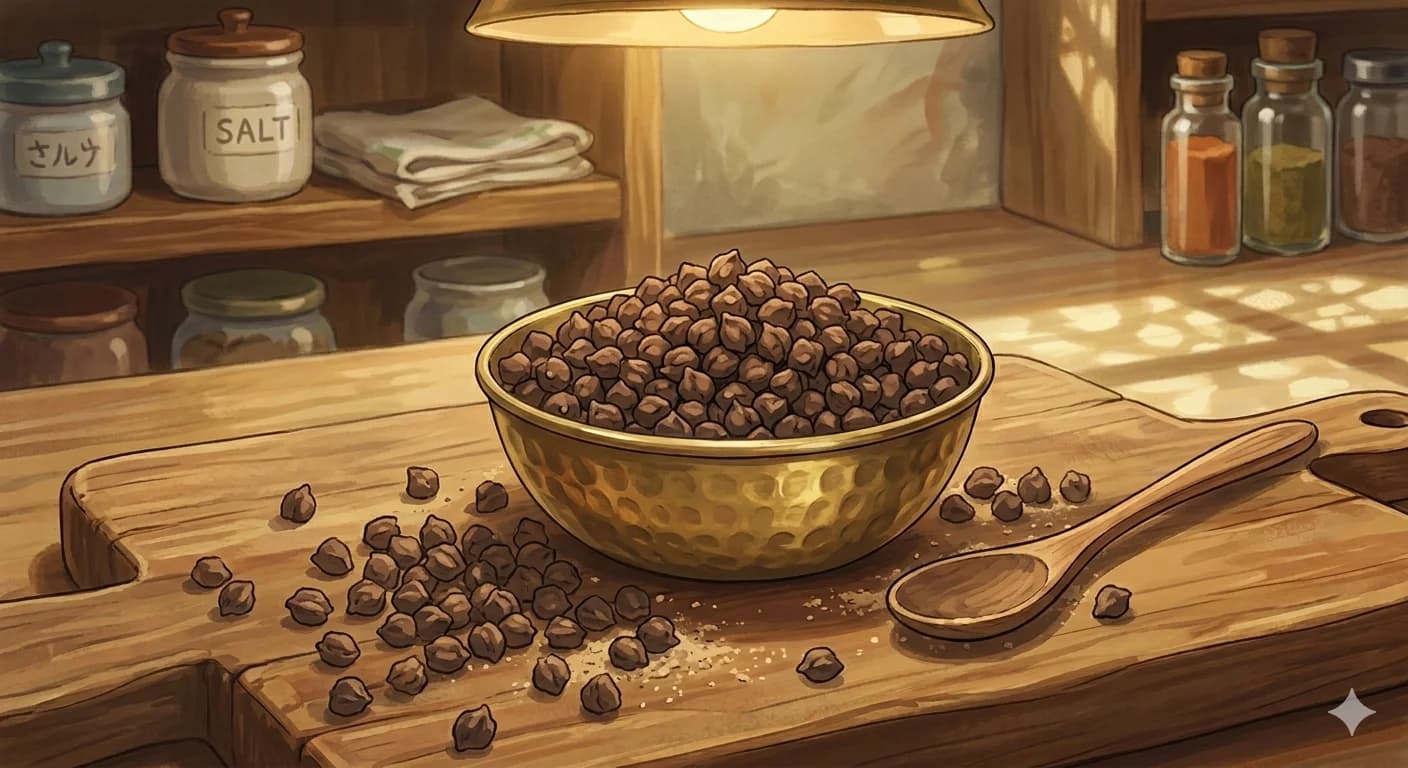
Black Chickpeas
Also known as: Kala Chana, Desi Chickpeas, Bengal Gram (whole), Brown Chickpeas, Cicer arietinum var. desi
Kala chana (black or desi chickpeas) and the kabuli chickpea (the large, cream-colored variety most familiar in Western cooking) are the same species, Cicer arietinum, but meaningfully different in character. Desi chickpeas are smaller, rounder, and darker, ranging from a dark tan to near-black depending on the variety and growing region. The skin is thicker and rougher, and the interior is darker yellow.
They are firmer when cooked, more intensely flavored, and nutritionally denser than kabuli chickpeas, with higher fiber content, more iron, and a lower glycemic index.
The flavor of fully cooked kala chana is one of the most distinctive among legumes. Where kabuli chickpeas are mild and creamy with a gentle nuttiness, kala chana is earthy and complex, with a slight smokiness and a firmness that persists even after long cooking. They will not dissolve or become mushy even with extended pressure cooking.
This firmness is part of their appeal: in a dry preparation like sukha kala chana or in a simple salad, the textural presence is satisfying in a way that softer legumes are not.
Understanding the relationship between whole kala chana and chana dal is useful. Chana dal is made from desi chickpeas that have been split and husked. The process removes the skin (which accounts for most of the fiber and much of the complexity) and splits the bean along its natural division, revealing the pale yellow interior.
Whole kala chana retains both the skin and the full nutritional package of the intact bean.
Key facts at a glance:
- The flavor — Of fully cooked kala chana is one of the most distinctive among legumes.
- They will — Not dissolve or become mushy even with extended pressure cooking.
- Desi chickpeas — Are smaller, rounder, and darker, ranging from a dark tan to near-black depending on the variety and growing region.
- The skin — Is thicker and rougher, and the interior is darker yellow.
- Understanding the — Relationship between whole kala chana and chana dal is useful.
- Chana dal — Is made from desi chickpeas that have been split and husked.
Flavor Profile
Origin
Indian subcontinent, Ethiopia, Iran
Traditional Medicine Perspectives
Ayurveda:
Kala chana is considered heavier and more Vata-aggravating than kabuli chickpeas, due to its thick skin and complex fiber content. It is also considered more strengthening (balya): the dense nutrition of the whole desi chickpea, including its skin's fiber and minerals, makes it more nourishing than the split and husked version. It is recommended for those with robust digestive fire (tikshna agni) and is not suitable in large amounts for those with Vata imbalances. Thorough soaking, discarding the soaking water, and cooking with digestive spices, particularly asafoetida and ginger, are the standard Ayurvedic preparation guidelines.
Traditional Chinese Medicine:
Chickpeas in TCM are considered sweet and neutral, tonifying to the Spleen and Stomach and supporting digestion and Qi production. The whole desi variety's higher fiber content and stronger flavor profile suggest more warming properties than the kabuli variety in some traditional assessments.
Modern Scientific Research
Compared to kabuli chickpeas, desi chickpeas have a significantly lower glycemic index (28 versus 33 for kabuli in some studies) attributed to their higher resistant starch and fiber content. The thick skin of desi chickpeas contributes substantially to this effect: it acts as a physical barrier slowing starch digestion and raising the proportion of fiber per gram of edible legume. Studies from the University of Saskatchewan have documented that desi chickpeas have higher polyphenol content (concentrated in the skin) with correspondingly higher antioxidant activity than kabuli varieties.
Iron content is notable: approximately 6mg per 100g dry weight for desi chickpeas, compared to about 4mg for kabuli. As with all non-heme iron in legumes, vitamin C from accompanying food or preparation (tamarind, tomatoes, lemon) significantly increases absorption.
Cultural History
The desi chickpea is the ancestral form of the chickpea, predating the large kabuli variety in South Asia by centuries. It was likely one of the first legumes brought under cultivation in the ancient Near East, and it has been grown continuously on the Indian subcontinent for at least 3,500 years. In India, it developed a cultural significance beyond nutrition: kala chana is one of the primary foods offered at religious festivals and has a specific, codified role in Navratri, the nine-night festival honoring the goddess Durga.
On the eighth or ninth day of Navratri (Ashtami or Navami), it is traditional in North Indian households to prepare kanjak prasad, the sacred food offered to young girls who represent the goddess. The standard elements of this prasad are halwa (semolina pudding), poori (fried bread), and sukha kala chana (dry spiced black chickpeas). The presence of kala chana in this religious context, rather than the more common kabuli variety, is significant.
The desi chickpea's earthiness, its age in Indian agriculture, and its robust character make it the appropriate offering. Kabuli chickpeas are a relative newcomer to South Asia; kala chana is ancient.
In Sindhi and Rajasthani cooking, kala chana appears in kadhi preparations that use the chickpea's own cooked and dried flour (kala chana besan) as the base for the yogurt-and-flour sauce. Sindhi kadhi, one of the more complex regional kadhis in Indian cooking, often incorporates boiled kala chana directly into the sauce as a textural element.
Culinary Uses
Kala chana requires both thorough soaking and longer cooking than kabuli chickpeas. Overnight soaking (8 to 12 hours) is essential. Even after soaking, they need 4 to 5 whistles in a pressure cooker (or 25 to 30 minutes high pressure with natural release) to become fully tender.
They will remain firmer than kabuli chickpeas at the same cooking time; this is expected and desirable.
For sukha kala chana (dry preparation), the cooked and drained chickpeas are tossed in a minimal amount of oil with dried spices: amchur (dry mango powder), cumin, coriander, chili, and salt. The goal is a dry, intensely spiced preparation with no gravy. This is the style used for Navratri prasad and as a dry snack.
For a curry preparation, the approach is similar to chana masala: a deeply cooked tomato-onion masala, combined with the boiled chickpeas and simmered together for 20 to 30 minutes to allow flavor absorption.
Preparation Methods
Soaking: Cover generously with cold water and soak 8 to 12 hours (overnight). Kala chana absorbs more water than kabuli due to its thicker skin; use ample water. Drain and discard soaking water. Rinse well.
Pressure cooker: 1 cup soaked kala chana to 2.5 cups fresh water, with a pinch of salt. 4 to 5 whistles on stovetop (or 25 to 30 minutes high pressure, natural release, on electric). Test a bean: it should be completely tender with no starchy center.
For sukha kala chana (dry): After pressure cooking, drain all liquid completely. Spread beans on a dry towel and pat dry. Heat 1 tablespoon oil in a wide pan on medium-high. Add drained chickpeas and cook, stirring, for 2 to 3 minutes until slightly dried out. Add spices (cumin, coriander, amchur, red chili powder, black salt, garam masala) and toss to coat. Cook 2 more minutes. Taste and adjust salt. Serve immediately or at room temperature.
For kala chana curry: Prepare a masala of pureed onion, tomato, ginger, and garlic cooked down with whole and ground spices until oil separates. Add cooked chickpeas with a small amount of cooking water. Simmer 20 to 30 minutes. Finish with a pinch of garam masala and fresh coriander.
Traditional Dishes
- Sukha kala chana (Navratri prasad)
- Kala chana curry (with gravy)
- Sindhi kadhi with chana
- Kala chana chaat
- Kala chana salad with raw onion and lemon
- Kala chana sundal (South Indian
- with coconut)
- Amritsari kala chana (Punjabi dry preparation)
Comments
Share your thoughts on this ingredient.
Sign in to comment0 Comments