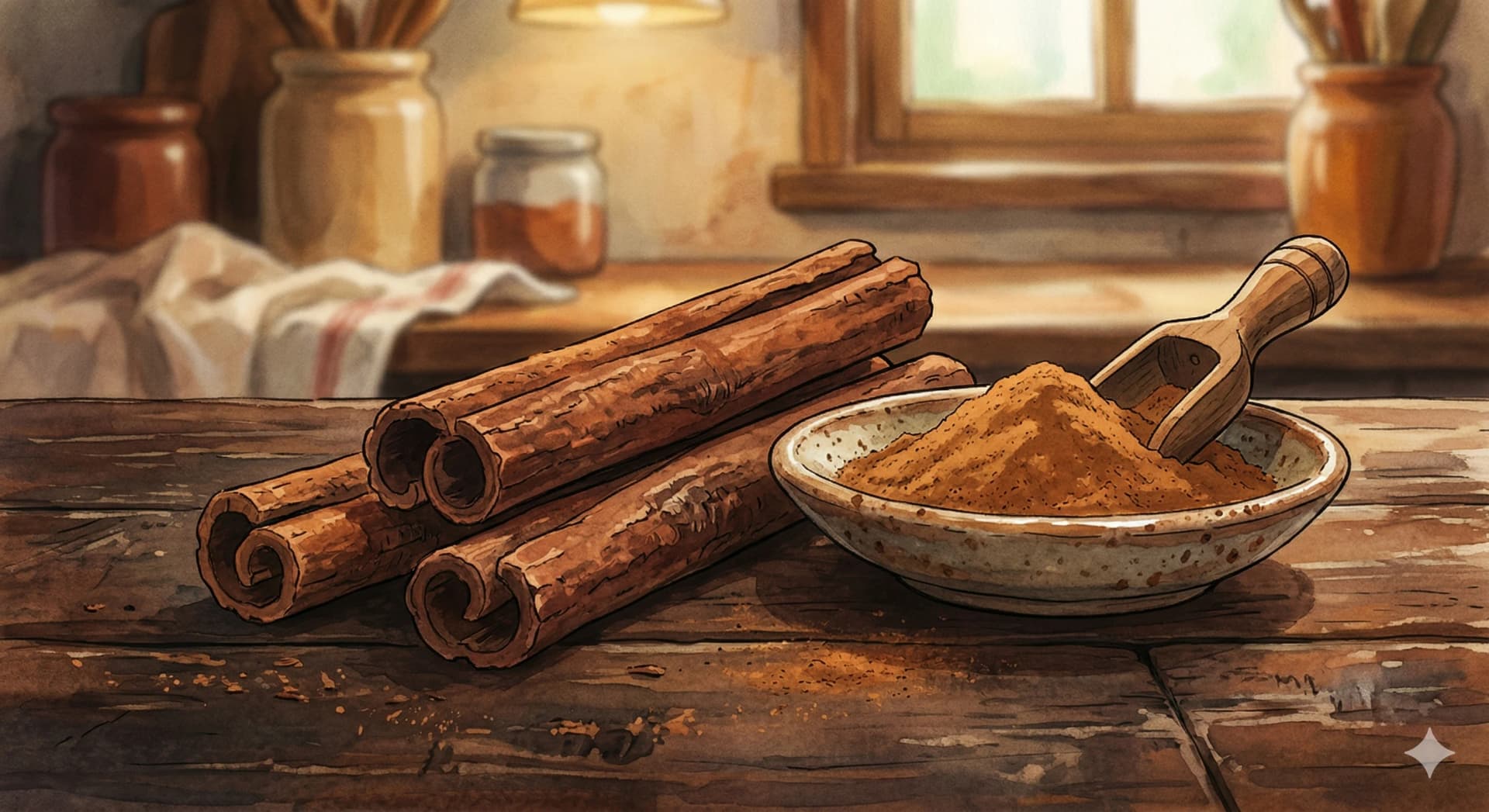
Cassia Cinnamon
Also known as: Rou Gui, Chinese Cinnamon, Cinnamomum cassia, Chinese Cassia, Gui Pi
Cassia cinnamon is the cinnamon of Chinese cooking — thicker, harder, and more assertively flavored than the Ceylon cinnamon common in Western baking. Its bark is used in braises, master stocks, and five-spice powder, contributing a deep, resinous warmth that Ceylon cinnamon cannot replicate. The two are botanically related but functionally distinct: cassia is bolder, spicier, and more savory in application.
Flavor Profile
Origin
Southern China, Vietnam, Guangdong, Guangxi
Traditional Medicine Perspectives
Traditional Chinese Medicine
Cassia (Rou Gui) is one of TCM's most important warming herbs, classified as hot, acrid, and sweet. It is associated with the Heart, Liver, Kidney, and Spleen meridians. It is used to tonify Kidney Yang and Ming Men fire, warm the middle burner, dispel cold and dampness, and invigorate Blood. It is prescribed for cold limbs, low libido, frequent urination, and abdominal pain caused by cold patterns. In herbal formulas, it is often combined with prepared aconite (Fu Zi) for severe Yang deficiency.
Modern Scientific Research
Cinnamaldehyde, the primary bioactive compound in cassia, has been studied for insulin-sensitizing effects — multiple clinical trials show modest reductions in fasting blood sugar in people with type 2 diabetes, though results are mixed. Cassia contains higher levels of coumarin than Ceylon cinnamon, which in large doses may affect the liver; culinary use presents minimal risk. Research also shows antimicrobial, antioxidant, and anti-inflammatory properties.
Cultural History
Cassia has been used in Chinese cooking and medicine for over four thousand years, appearing in the earliest Chinese medical texts as a warming, Yang-tonifying herb. It is one of the fifty fundamental herbs in traditional Chinese medicine. In cooking, cassia bark (as opposed to ground cassia) is used whole in slow braises and master stocks, where it contributes warmth and complexity to the cooking liquid without overpowering.
Most of the 'cinnamon' sold in the United States is actually cassia, though for Chinese culinary purposes, the bark form is essential.
Culinary Uses
Add bark pieces to braises, master stocks, red-cooked dishes, and spiced poaching liquids. Essential in five-spice powder. Use in spiced desserts and baked goods where bold cinnamon flavor is wanted.
Pair with star anise, cloves, and Sichuan peppercorn in braising liquids for pork and beef.
Preparation Methods
Use the bark in pieces for long-cooked dishes and remove before serving. Lightly toast before adding to release aroma. For spice blends, grind after toasting.
Do not substitute Ceylon cinnamon in Chinese recipes — the flavor and intensity are different.
Traditional Dishes
- Red-braised pork (hong shao rou)
- Master stock (lu shui)
- Spiced beef shank
- Five-spice preparations
- Braised lamb
Comments
Share your thoughts on this ingredient.
Sign in to comment0 Comments