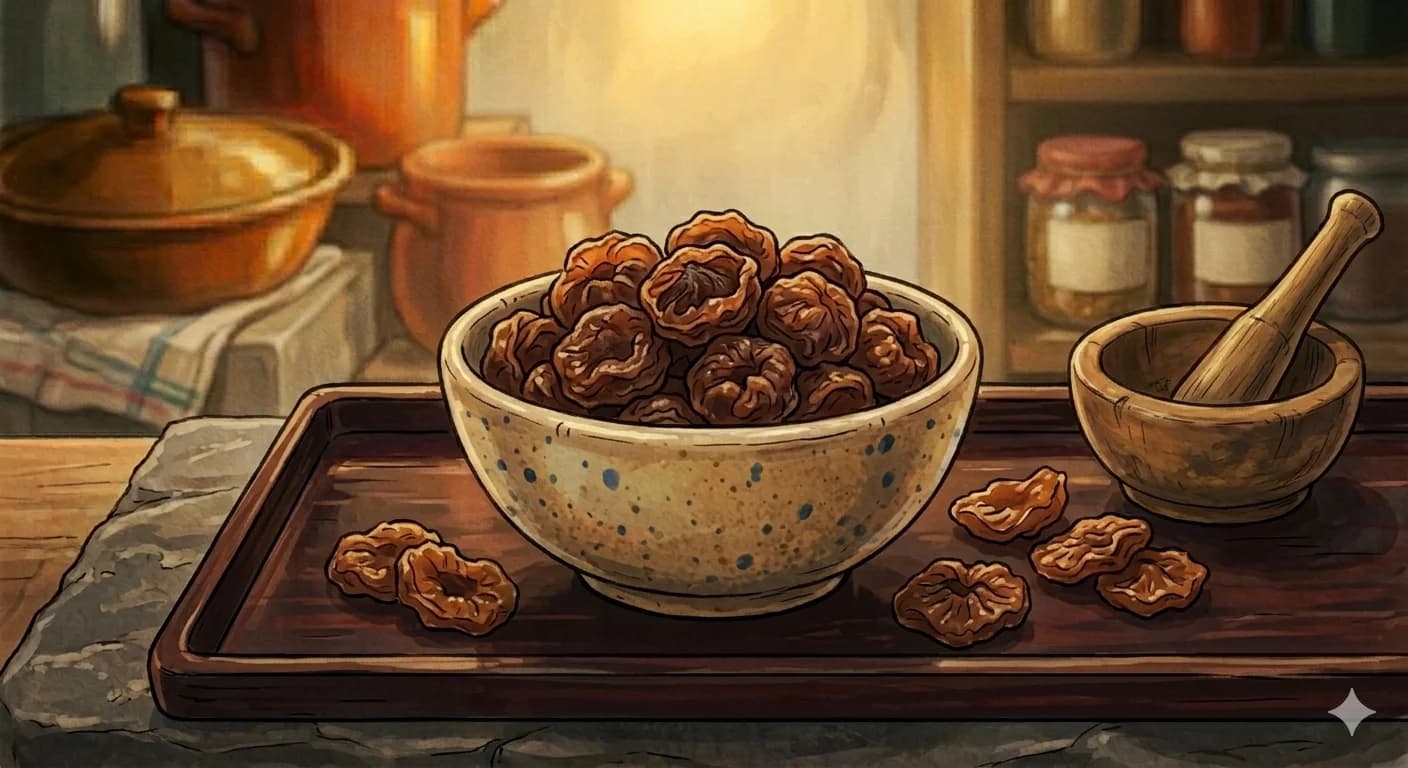
Dried Longan Flesh
Also known as: Long Yan Rou, 龙眼肉, Dragon Eye, Gui Yuan, 桂圆
Dried longan flesh — dark, wrinkled, intensely sweet morsels with a smoky, caramel-like depth — is one of the most beloved tonic ingredients in Chinese cooking, used in sweet soups, teas, and medicinal preparations for its warming, nourishing properties.
Fresh longan is a tropical fruit related to lychee, but it is the dried form that dominates in Chinese kitchens and apothecaries. Drying concentrates the fruit's natural sugars into an almost toffee-like sweetness, with subtle smoky, honeyed, and slightly musky undertones that make it far more complex than fresh.
The Chinese name "long yan" (龙眼) means "dragon eye" — a reference to the fruit's appearance when the thin shell is peeled away, revealing a translucent white flesh with a dark seed that resembles a pupil.
Key facts at a glance:
- Dried flesh of the longan fruit — related to lychee, but used primarily dried
- Intensely sweet with smoky depth — concentrated, toffee-like sweetness
- "Dragon eye" (long yan) — named for its appearance when peeled
- TCM blood and qi tonic — warming, nourishing, calming
- Essential in sweet soups and teas — one of the most common tong sui ingredients
Flavor Profile
Origin
Southern China, Fujian, Guangdong, Southeast Asia, Thailand
Traditional Medicine Perspectives
Traditional Chinese Medicine
Dried longan flesh (Long Yan Rou / Gui Yuan Rou) is classified as sweet and warm, entering the Heart and Spleen meridians. It is used to tonify the Heart and Spleen, nourish blood, and calm the spirit. It is prescribed for insomnia, palpitations, forgetfulness, dizziness from blood deficiency, and fatigue. It is a key ingredient in the classical formula Gui Pi Tang (Restore the Spleen Decoction).
Modern Scientific Research
Dried longan contains significant amounts of polyphenols, including gallic acid, ellagic acid, and corilagin, which have demonstrated antioxidant activity in laboratory studies.
The fruit provides iron, potassium, magnesium, and B vitamins, making it nutritionally substantial for a dried fruit. Its high natural sugar content (over 60% in dried form) makes it an effective natural sweetener in cooking.
Some research has investigated longan seed extracts (not the flesh) for potential anti-inflammatory and anti-cancer properties, though these studies use concentrated extracts rather than dietary amounts of the fruit.
Cultural History
Longan has been cultivated in southern China for over two thousand years and is closely associated with Fujian, Guangdong, and Guangxi provinces. The dried form (gui yuan, 桂圆) has been a prized trade commodity along China's internal trade routes for centuries.
Dried longan is deeply embedded in Chinese concepts of nourishment and self-care. It is one of the first ingredients a Chinese mother might add to a postpartum recovery soup, and it appears in teas and sweet soups consumed during winter months for warmth and energy.
In Cantonese culture, dried longan is an essential ingredient in the tong sui (sweet soup) tradition — combined with lotus seeds, snow fungus, jujubes, and goji berries in various combinations that form a repertoire of wellness desserts.
Culinary Uses
Add a handful of dried longan to sweet soups (tong sui) with jujubes, goji berries, lotus seeds, and rock sugar. The longan contributes both sweetness and a distinctive smoky depth to the dessert.
Steep dried longan with jujubes and goji berries in hot water for a simple longan tea — one of the most popular warming drinks in Chinese wellness culture. Add a few pieces to congee or porridge for natural sweetness.
Dried longan contributes both sweetness and a distinctive smoky, caramel-like depth — it is far more complex than refined sugar and adds character to any sweet preparation.
Use in braised and simmered dishes where a touch of natural sweetness is desired — dried longan works in savory-sweet braises and in stuffings for poultry. It also appears in the classic Cantonese dessert red bean soup.
Preparation Methods
Dried longan is ready to use — simply add to simmering liquid. No soaking required, though a brief rinse removes any dust.
For teas, lightly crush a few pieces to release more flavor. For sweet soups, add at the start of cooking so the flavor fully permeates the broth.
Select dried longan that is dark brown, pliable (not rock-hard), and intensely fragrant. Very dry, hard pieces may be old. Store in a cool, dry place in an airtight container — properly stored dried longan keeps for over a year.
Traditional Dishes
- Gui pi tang soup
- Longan jujube tea
- Red bean sweet soup
- Eight treasure congee
- Longan and lotus seed tong sui
Comments
Share your thoughts on this ingredient.
Sign in to comment0 Comments