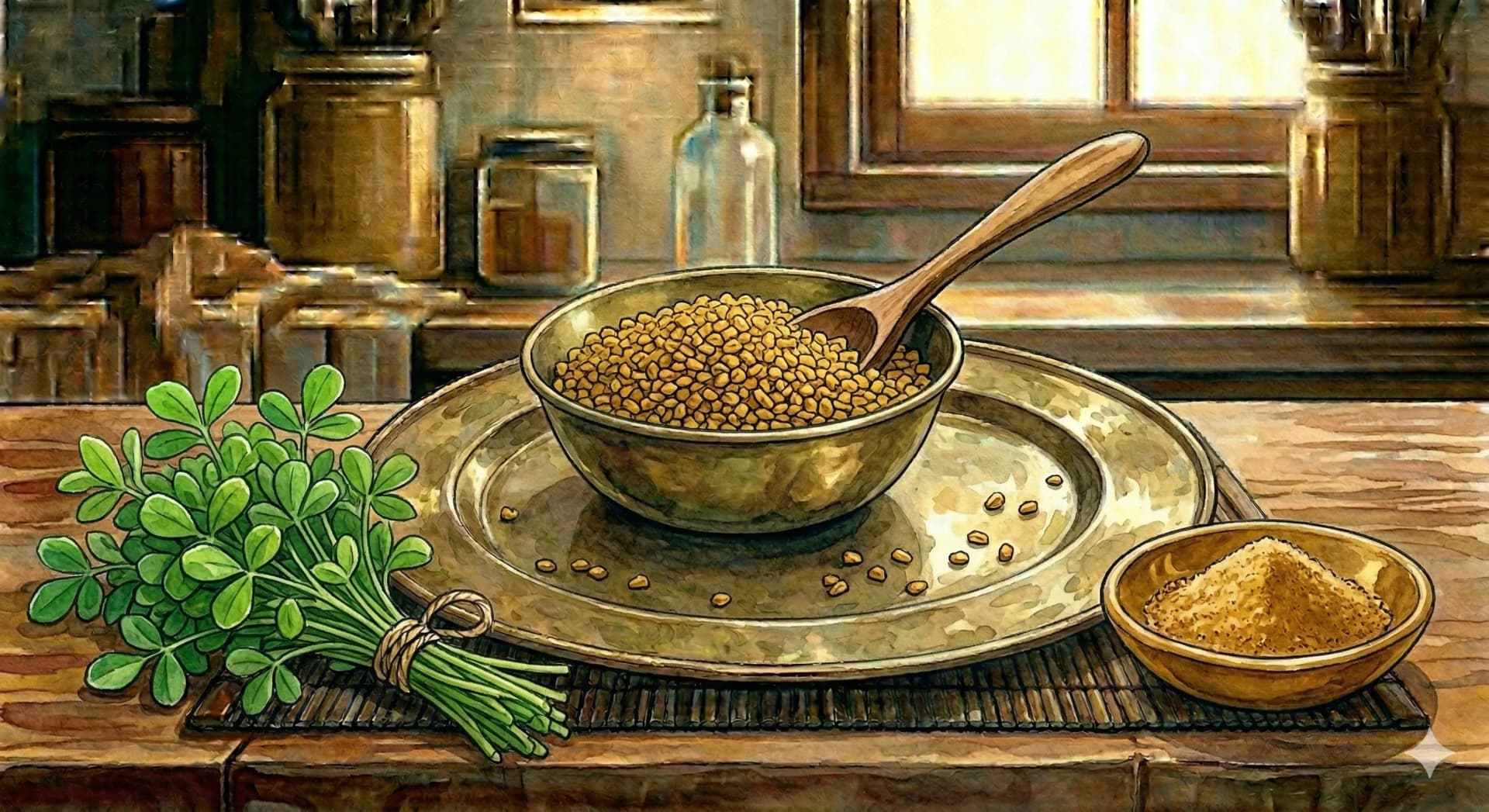
Fenugreek
Also known as: Methi, Trigonella foenum-graecum, Greek Hay
Fenugreek is a plant with a history in cooking and medicine that stretches back to ancient Egypt, where seeds have been found in Tutankhamun's tomb. The seeds carry a distinctive bitter, maple-like aroma — one of the few naturally occurring sources of sotolone, the compound responsible for the smell of maple syrup.
The fresh and dried leaves are used extensively in South Asian cooking, particularly in Indian flatbreads, leafy vegetable dishes, and dried herb blends.
Key facts at a glance:
- Sotolone compound — responsible for its distinctive maple-like aroma
- Ancient Egyptian origins — seeds found in Tutankhamun's tomb
- Dual use — both seeds and leaves are used in cooking
- South Asian staple — essential in flatbreads, vegetable dishes, and herb blends
Flavor Profile
Origin
Middle East, South Asia, Mediterranean, Ethiopia
Traditional Medicine Perspectives
Ayurveda
Fenugreek (Methi) is classified as heating, bitter, and pungent in Ayurveda. It is used to stimulate digestive fire, reduce Kapha conditions like mucus accumulation and sluggish digestion, and support women's health — particularly lactation. Methi seeds are a key ingredient in traditional postpartum recovery formulas. Daily consumption is considered beneficial for blood sugar management and joint health.
Traditional Chinese Medicine
In TCM, fenugreek seeds (Hu Lu Ba) are warm and bitter, entering the Kidney and Liver meridians. They are prescribed to warm the Kidney Yang, disperse cold, and relieve pain — specifically for cold-induced hernial pain and cold bi syndrome (painful obstruction). They are also used for impotence attributed to Kidney Yang deficiency.
Modern Scientific Research
Fenugreek is one of the most clinically studied plants for blood sugar management. Multiple randomized controlled trials show it reduces fasting glucose, postprandial glucose, and HbA1c in type 2 diabetic patients.
The mechanism is partly attributed to its high soluble fiber content (galactomannan) which slows carbohydrate absorption, and 4-hydroxyisoleucine, an unusual amino acid that may stimulate insulin secretion.
Research also supports its traditional use for lactation promotion and shows anti-inflammatory properties.
Cultural History
Fenugreek appears in ancient Egyptian medical papyri, in Greek and Roman texts, and throughout early Ayurvedic literature. Arabic traders spread it through North Africa and the Mediterranean.
In South Asia, both the seeds and leaves are considered medicinal foods rather than mere flavorings.
New mothers are traditionally given fenugreek-based preparations to promote milk production and aid postpartum recovery.
Culinary Uses
Fenugreek seeds are used in curry powders, spice blends, and pickling spices. They are bloomed in hot oil (carefully — they burn quickly and become intensely bitter) before other spices.
Dried leaves (kasuri methi) are a finishing herb used in North Indian cooking, scattered over dals, gravies, and breads.
Fresh leaves are used in saag, parathas, and salads.
Preparation Methods
Soak fenugreek seeds overnight before cooking to reduce bitterness and aid digestion. When blooming in oil, add last among dry spices and cook only 30 to 45 seconds — they turn bitter very quickly.
Toast seeds lightly before grinding. Kasuri methi (dried leaves) should be crushed between palms to release flavor before adding to dishes.
Traditional Dishes
- Methi thepla
- Saag
- Kasuri methi dal
- Aloo methi
- Panch phoron
Comments
Share your thoughts on this ingredient.
Sign in to comment0 Comments