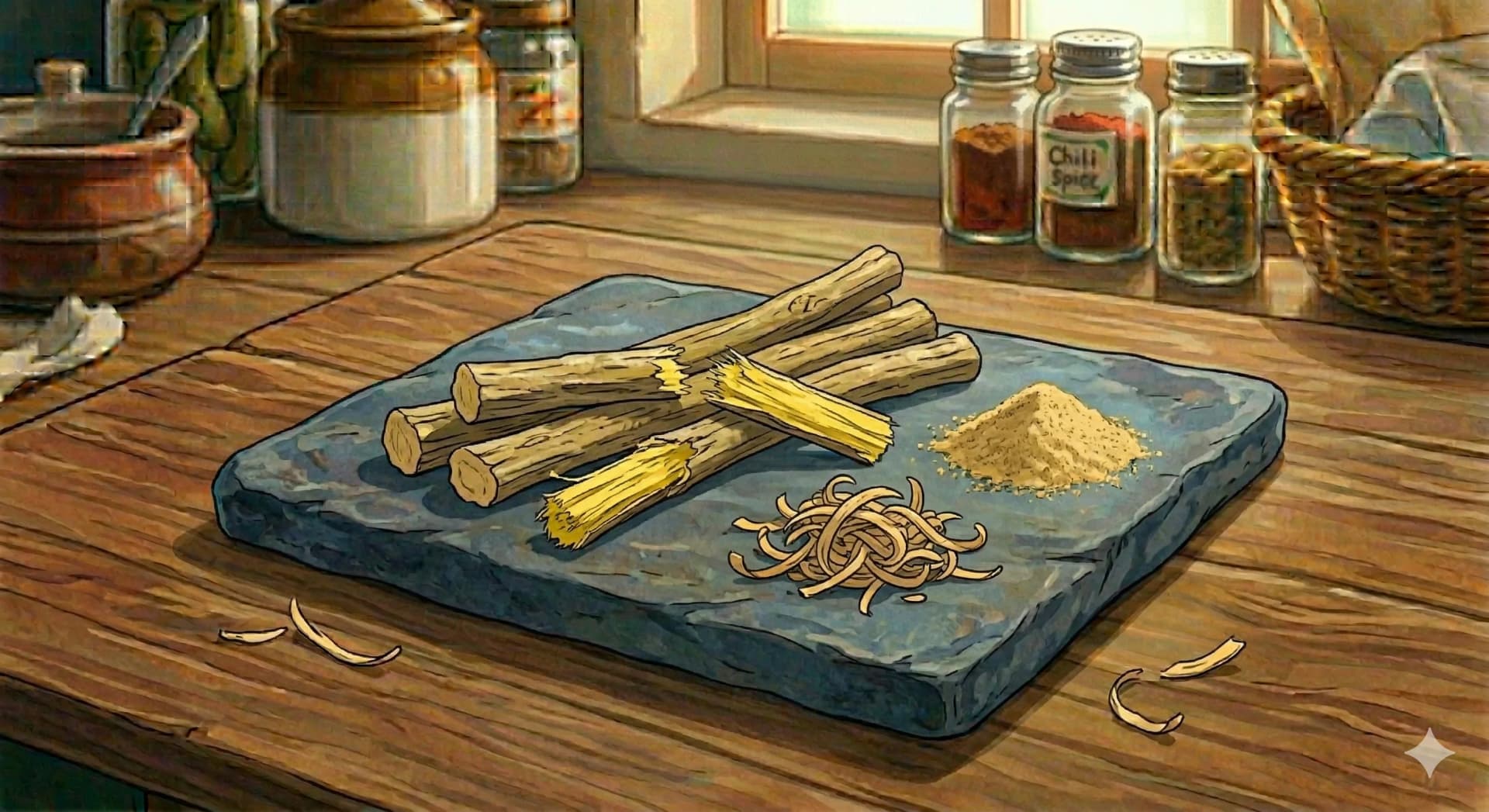
Licorice Root
Also known as: Mulethi, Yashtimadhu, Glycyrrhiza glabra, Sweet Root
Licorice root is one of the most widely used medicinal herbs in both Eastern and Western herbal traditions, and among the oldest documented. The root contains glycyrrhizin, a compound 30 to 50 times sweeter than sucrose, responsible for its distinctive flavor — simultaneously sweet, slightly bitter, and warm.
It has been found in the tombs of Egyptian pharaohs and appears in both ancient Chinese and Ayurvedic medical texts as a foundational medicine.
Key facts at a glance:
- Glycyrrhizin — 30 to 50 times sweeter than sucrose
- Dual tradition — foundational in both Chinese and Ayurvedic medicine
- Harmonizing agent — used in the majority of Chinese multi-herb formulas
- Caution required — large amounts can raise blood pressure and cause fluid retention
Flavor Profile
Origin
Central Asia, Mediterranean, Middle East, China
Traditional Medicine Perspectives
Ayurveda
Yashtimadhu is classified as sweet, slightly bitter, and cooling — one of the few sweet-tasting herbs considered medicinal in Ayurveda. It is used to soothe inflamed mucous membranes in the throat, lungs, and digestive tract. Particularly prescribed for Pitta conditions: inflammation, ulcers, acid reflux, and heat-related respiratory conditions.
Traditional Chinese Medicine
Gan Cao (licorice root) is one of TCM's most important herbs — used in an estimated 60% of all herbal formulas as a harmonizing agent that moderates the properties of other herbs and reduces toxicity. It tonifies the Spleen and Stomach Qi, moistens the Lungs, clears heat, and detoxifies. It is prescribed for cough, sore throat, fatigue, and digestive weakness.
Modern Scientific Research
Glycyrrhizin and glycyrrhizic acid from licorice root show potent anti-inflammatory and antiviral properties in research. Clinical studies demonstrate efficacy for viral infections, peptic ulcer disease, and chronic hepatitis.
DGL (deglycyrrhizinated licorice) is a processed form used to treat peptic ulcers without blood pressure side effects — multiple trials confirm its effectiveness.
Important caution: whole licorice root in large amounts raises blood pressure and can cause fluid retention due to glycyrrhizin's effects on cortisol metabolism.
Cultural History
Licorice root appears in Chinese medical texts over 2,000 years old, where it is called Gan Cao (sweet herb) and used in the majority of multi-herb formulas as a harmonizing agent.
In Ayurveda, Yashtimadhu has been used for sore throats, coughs, and digestive complaints for millennia. In the Western herbal tradition, it was used extensively in Greek and Roman medicine.
During the Crusades, European soldiers carried licorice root as a thirst-quencher.
Culinary Uses
Licorice root is used primarily as a tea, broth additive, or in spice blends. Chinese five-spice powder includes star anise (not licorice, but with a similar flavor).
Licorice root tea is commonly combined with ginger, cinnamon, and fennel. It is used as a natural sweetener in herbal preparations and some commercial foods.
Preparation Methods
Simmer 1 to 3 grams of dried licorice root in 2 cups of water for 15 to 20 minutes for tea.
Combine with ginger and fennel for a digestive formula. Use sparingly — the sweetness and active compounds are potent.
Traditional Dishes
- Herbal tea blends
- Chinese medicinal soups
- Five-spice preparations
Comments
Share your thoughts on this ingredient.
Sign in to comment0 Comments