Perilla Oil
Also known as: Deulgireum, 들기름, Egoma Oil, Egoma Abura, Perilla Seed Oil, Perilla frutescens oil
Perilla oil, deulgireum in Korean, is the other seed oil of the Korean kitchen. Sesame oil (chamgireum) gets the attention abroad, but a lot of Korean cooks keep both bottles and use them for different jobs: sesame for meat marinades, bibimbap and dipping salt, perilla for dried-vegetable namul, oil-brushed seaweed and the plain dishes of temple cooking. The names say a lot. Cham means true or proper. Deul means field, or wild.
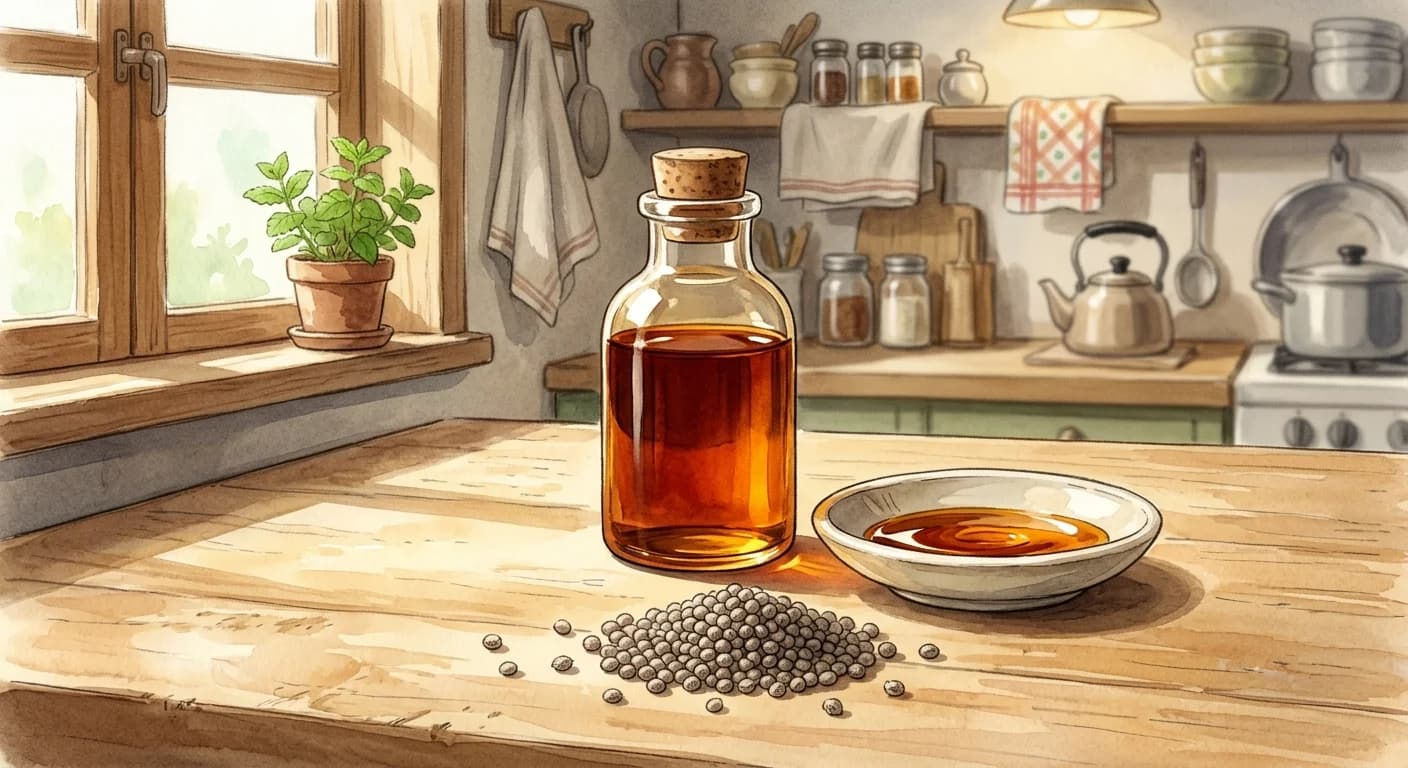
The oil is pressed from the small, round, grey-brown seeds of Perilla frutescens, the same plant whose leaves Koreans wrap around grilled pork as kkaennip. Roasted and pressed the traditional way, it comes out deep amber and smells nutty and toasted, with an herbal, faintly minty edge sesame doesn't have. Cold-pressed from raw seed, it is pale gold and grassier.
Key facts at a glance:
- Not a kind of sesame oil. Perilla belongs to the mint family. The two oils overlap only in their toasted note.
- One of the richest plant sources of ALA omega-3. Roughly 54 to 64% of the oil is alpha-linolenic acid, about 7.7 g in a tablespoon.
- Fragile. That omega-3 oxidizes quickly, so an open bottle lives in the fridge, and the oil is used raw or with brief, gentle heat.
- Smoke point around 160°C (320°F). It's an estimate, since no authoritative figure has been published, and either way this is not a frying oil.
Flavor Profile
Origin
Korea, Japan, China
Traditional Medicine Perspectives
Korean folk practice
Korean households have long treated deulgireum as a food with a reputation rather than a medicine. Many older Koreans take a spoonful of raw perilla oil on an empty stomach, believing it keeps digestion regular and the blood clean, and deulkkae juk, rice porridge made with perilla seed, is a traditional food for people recovering from illness. Korean herbal medicine follows the Chinese reading of the seed for cough and phlegm. These are household customs, not clinical advice.
Japanese folk tradition
In Tohoku the seed is called jūnen, "ten years," from the belief that eating it lengthens life. It is a proverb rather than a prescription, and it applies to the seed eaten ground over rice and mochi at least as much as to the oil.
Traditional Chinese Medicine
Chinese medicine uses three parts of the perilla plant, and the pressed oil is not one of them. The seed, Zi Su Zi, is classified as acrid and warm, entering the Lung and Large Intestine meridians. Its main action is to send Lung Qi downward, which in practice means it is given for cough and wheezing with plenty of phlegm, as in the classical formula Su Zi Jiang Qi Tang. Because the seed is oily, it is also said to moisten the intestines and ease dry constipation. The leaf, Zi Su Ye, is a separate medicinal, used at the start of a cold and to settle the stomach, and traditionally paired with fish and crab. The oil carries the seed's reputation by association, without a listing of its own.
Modern Scientific Research
Perilla oil gets studied almost entirely for its fat. Roughly 54 to 64% of it is alpha-linolenic acid (ALA), the plant form of omega-3, which puts it next to flaxseed oil at the top of the list among plant oils. A tablespoon carries about 7.7 g of ALA and only about 2 g of omega-6, so the balance runs strongly toward omega-3, the reverse of most cooking oils.
The catch is conversion. The body can turn ALA into EPA and DHA, the long-chain omega-3s found in oily fish, but only a small fraction makes that trip, and DHA least of all. Perilla oil is a good source of ALA. It does not stand in for fish.
The human research is small. A handful of trials, mostly from Japan and Korea, have looked at perilla oil and blood lipids, and some report modest drops in triglycerides. Others have measured memory or cognitive scores in older adults, with results too small and too mixed to support claims about the brain.
The double bonds that make ALA interesting also make the oil oxidize fast, especially with heat and light. That is the practical reason to keep it cold and use it raw: oxidized oil has lost some of the fatty acids people buy it for, and it tastes off. Roasted oil tends to hold a little longer than cold-pressed, but both belong in the fridge.
Cultural History
Perilla has been grown across Korea, China and Japan for a very long time, and for its seed as much as its leaf. Perilla seeds turn up at Jōmon-period sites in Japan, long before rice paddies reached the islands. Japanese shiso is the same species, a leafy variety grown for its scent; the oil comes from the seed-bearing variety the Japanese call egoma and Koreans call deulkkae.
Before rapeseed took over, egoma oil was Japan's lamp oil. In the medieval period the oil merchants of Ōyamazaki, between Kyoto and Osaka, held a guild monopoly on it under the protection of the Iwashimizu Hachimangū shrine, and the trade only faded when rapeseed oil replaced it in the Edo period. In parts of Tohoku the seed is still called jūnen, "ten years," after the old saying that eating it adds ten years to your life.
Korea kept perilla in the kitchen and in the house. Because the oil dries to a firm film, the way linseed oil does, deulgireum was brushed onto hanji paper to make oiled paper that sheds water.
At the table, it belongs to a few specific moments. On Jeongwol Daeboreum, the first full moon of the lunar year, households eat five-grain rice with mugeun namul, dried vegetables saved from the previous summer, soaked and softened in a pan with perilla oil. Korean Buddhist temple cooking, which leaves out garlic, onions and their relatives, leans on perilla oil and ground perilla seed for richness. And in the early 2020s, deulgireum makguksu, buckwheat noodles dressed with little more than perilla oil, soy sauce and crushed seaweed, became one of the most talked-about noodle dishes in Korea.
Culinary Uses
In Korean cooking, perilla oil's home is namul, especially the dried kind. Gosari (bracken fern), siraegi (dried radish greens) and chwinamul are soaked, simmered until tender, then tossed in a pan over low heat with soup soy sauce, a little garlic and a generous spoonful of deulgireum, often with a splash of water so they steam rather than fry. Sesame oil would work, but the grassy edge of perilla suits the earthiness of dried greens, and plenty of cooks won't swap them.
Gim-gui, sheets of laver brushed with oil, salted and toasted over a flame until they crisp and turn green, was made with either oil, and perilla-brushed gim has its own following. Deulgireum makguksu is the most stripped-down use of all: cold buckwheat noodles tossed with perilla oil, soy sauce, a little sugar, crushed toasted gim and toasted sesame seeds, with nothing else to hide behind.
Home and temple cooks drizzle it over hot rice with soy sauce, stir it into tofu dishes at the end, and finish soups thickened with ground perilla seed (deulkkae tang, deulkkae kalguksu, and the seed stirred into gamjatang) with a few drops, so the oil and the seed back each other up.
In Japan, egoma abura is usually sold cold-pressed and used raw: a teaspoon over natto, miso soup, salad or tofu, or whisked into a dressing. It gets poured over finished food far more often than it goes into a pan.
Preparation Methods
Keep the heat low and short. The smoke point sits around 160°C (320°F), and the omega-3 starts breaking down well before the oil smokes, so perilla oil is not for searing, stir-frying or deep-frying. The namul method is the model to copy: a low pan, the oil and seasoning added with the vegetables, a lid or a splash of water, a few minutes at most. For the cleanest flavor, hold back part of the oil and add it off the heat.
Pick the bottle by the job. Roasted deulgireum, deep amber and toasty, is the one for namul, gim and noodles. Cold-pressed oil, sold in Korea as saeng-deulgireum, is pale gold and grassy, and it's the one to buy if you're after the omega-3 and plan to use it raw.
Refrigerate it once it's open. Korean kitchens follow a simple rule: sesame oil in the cupboard, perilla oil in the fridge. Sesame oil carries its own antioxidants and keeps for months at room temperature. Perilla oil does not. Buy small bottles, keep them cold and dark, and plan to finish an open one within a month or two.
Smell it before you pour. Fresh perilla oil smells nutty and green. Once it turns, it smells sharp and fishy, a little like oil paint, and leaves a bitter scratch at the back of the throat. There is no rescuing that bottle.
Traditional Dishes
- Mugeun namul (Daeboreum dried vegetables)
- Gosari namul
- Siraegi namul
- Gim-gui (oil-brushed toasted laver)
- Deulgireum makguksu
- Deulkkae tang
Comments
Share your thoughts on this ingredient.
Sign in to comment0 Comments