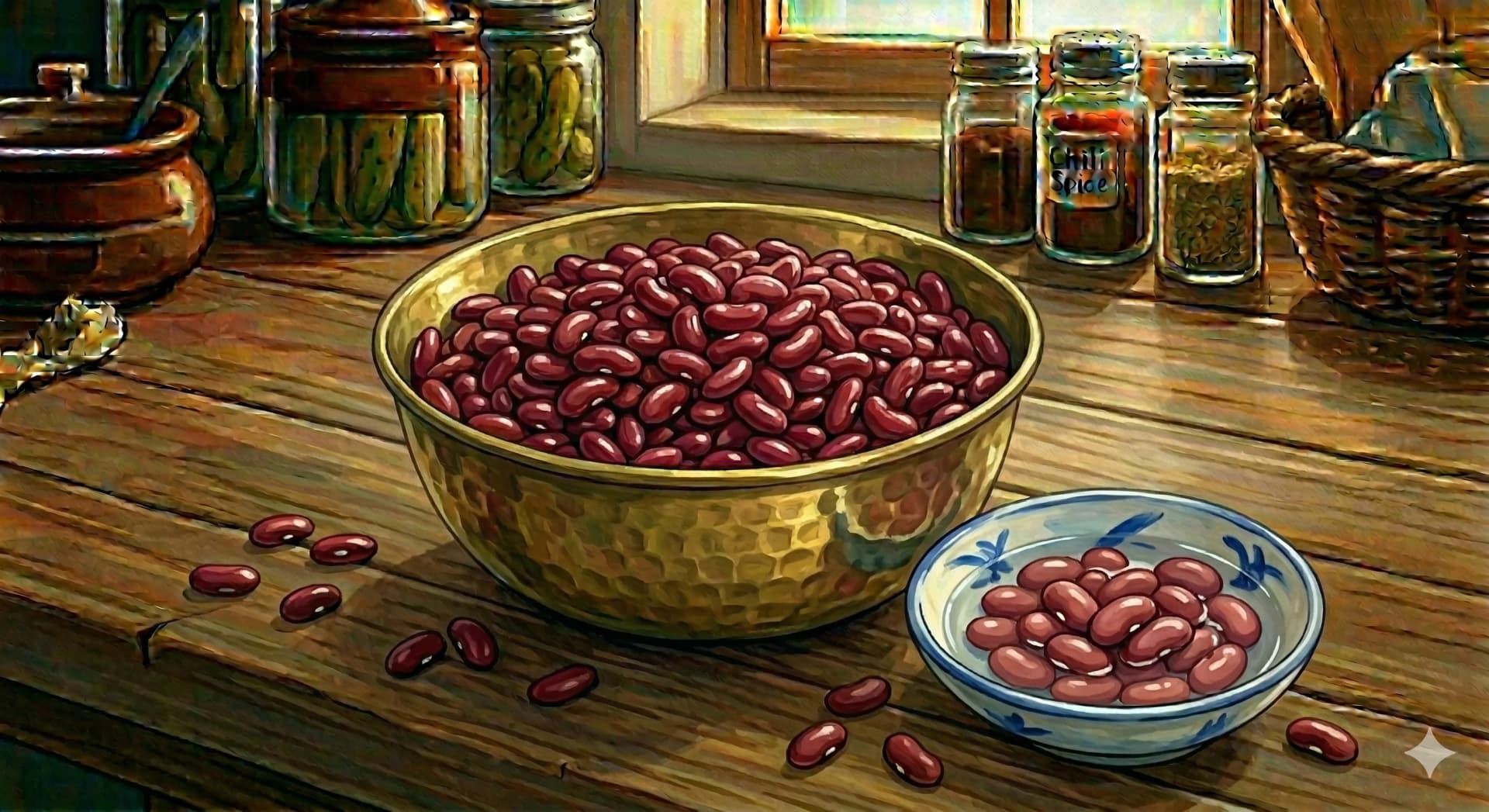
Rajma
Also known as: Red Kidney Beans, Phaseolus vulgaris, Rajmah
Rajma occupies a peculiar and instructive position in Indian food culture: it is one of the few New World ingredients, native to Central America and domesticated by Mesoamerican civilizations long before European contact, that has been so thoroughly absorbed into the North Indian and specifically Punjabi culinary identity that most people who grew up eating it never gave its origins a second thought.
Red kidney beans arrived in India with Portuguese and later British trade, sometime in the 16th to 17th centuries. In less than four centuries, they became the bean of Punjab, the centerpiece of rajma chawal, and a genuine cultural touchstone in a way that other New World introductions (tomato, potato, chili) took several centuries to fully achieve.
The cooked kidney bean has a flavor and texture unlike other legumes commonly used in Indian cooking. It is meatier, with a dense, almost starchy interior and a skin that becomes soft but never disintegrates. When cooked in a well-developed masala, the beans absorb the surrounding flavors deeply while also releasing their own earthy richness into the gravy, thickening it and giving it body. The masala clings to kidney beans in a way it does not to chickpeas or lentils, producing a saucy, clingy consistency that makes rajma almost inseparable from rice.
There are two main varieties in Indian markets. Dark red kidney beans are the more common type, with an intense color and slightly more robust flavor. The lighter Kashmiri variety (Jammu-Kashmiri rajma), smaller and speckled with a distinct pale red and white pattern, is considered by many North Indian cooks to be superior in flavor, more delicate, and less prone to toughening.
Key facts at a glance:
- New World origin — native to Central America, arrived in India in the 16th-17th centuries
- Centerpiece of rajma chawal — the quintessential Punjabi Sunday family meal
- Contains phytohaemagglutinin — raw or undercooked beans are toxic; must be boiled vigorously
- 15g protein and 13g fiber per cup — with a low glycemic index of ~29
- Kashmiri variety — smaller, speckled, considered superior in flavor
- Masala-absorbent — the beans take on surrounding flavors more deeply than chickpeas or lentils
Flavor Profile
Origin
Mesoamerica, North India, Punjab
Traditional Medicine Perspectives
Ayurveda:
Rajma is considered heavy, Vata-aggravating, and not recommended in the Ayurvedic framework for those with weak digestion or Vata imbalances. Its thick skin and dense starch content make it harder to digest than most Indian dals, and it is most often classified similarly to other heavy legumes: beneficial in moderation, for those with strong digestive fire, cooked with adequate digestive spices. Asafoetida, ginger, and cumin are the standard Ayurvedic accompaniments for kidney bean preparations.
Traditional Chinese Medicine:
Kidney beans are considered sweet and neutral, strengthening to the Kidney (the organ system, not the anatomical organ) and supportive of Qi. They are recommended in TCM preparations for lower back weakness, edema, and general deficiency states, though their heavy nature means they are prescribed carefully for those with digestive weakness.
Modern Scientific Research
Kidney beans require careful preparation because raw or undercooked kidney beans contain high concentrations of phytohaemagglutinin (PHA), a lectin that causes severe gastrointestinal distress within 1 to 3 hours of consumption. Symptoms include intense nausea, vomiting, and diarrhea. The FDA and WHO document kidney bean toxicity as a significant food safety concern. Critically, slow cookers (crockpots) do not reach a high enough temperature to destroy PHA effectively; kidney beans must be boiled vigorously for at least 10 minutes before slow cooking. Thorough boiling completely destroys PHA, and properly cooked kidney beans are safe and highly nutritious.
Kidney beans provide approximately 15 grams of protein and 13 grams of fiber per cooked cup, with a glycemic index of approximately 29 — comparable to chickpeas.
Beyond this safety note, kidney beans have an excellent nutritional profile with high levels of molybdenum (critical for sulfite metabolism), folate, and iron. Their resistant starch content makes them one of the lower glycemic legumes despite their starchy interior.
Cultural History
In its homeland of Mesoamerica, Phaseolus vulgaris was cultivated for at least 7,000 years before European contact. The "Three Sisters" agricultural system of the indigenous Americas, corn, beans, and squash grown together, was one of the most sophisticated companion planting systems in agricultural history, with the nitrogen-fixing beans enriching the soil depleted by corn.
In India, kidney beans found their most devoted audience in the Punjab region, now split between India and Pakistan. The reason is partly agricultural (the Punjab's cooler winters were suitable for legume cultivation) and partly cultural: Punjabi cuisine has an appetite for rich, substantial, bean and lentil preparations cooked in generous amounts of fat with bold spicing. Rajma chawal, kidney beans cooked in a tomato-onion masala served with plain basmati rice, became the quintessential Sunday family meal across Punjabi households, university cafeterias, and dhabas (roadside restaurants) throughout North India. It is the dish associated with homesickness, with mothers, with the uncomplicated pleasure of familiar food.
After the Partition of 1947, rajma chawal became particularly loaded with meaning for Punjabi families displaced from what is now Pakistan — one of the dishes that crossed the border in family memories, reconstructed in new kitchens, a culinary continuity in a period of profound dislocation.
Culinary Uses
Rajma's success in Indian cooking depends almost entirely on the masala. Unlike toor dal, which provides its own flavor to sambar, or chana masala, where the chickpeas can hold their own, kidney beans are relatively neutral and need a properly developed masala to taste like anything.
The masala for rajma is typically onion-forward (more onion than tomato), deeply cooked with ginger and garlic paste, and spiced with standard North Indian whole and ground spices. The key technique is bhunoing the masala to the point of oil separation before adding the soaked and boiled beans, then simmering the two together for at least 20 to 30 minutes. This extended simmer is what allows the masala to penetrate the beans and build the clingy, glossy gravy.
Achieving the correct consistency is a matter of adjustment: mashing a few beans against the side of the pot releases starch to thicken the gravy without making it pasty.
Preparation Methods
Soaking (essential): Cover dried rajma with at least twice their volume of cold water. Soak for 8 to 12 hours (overnight minimum). The beans will roughly double in size. Drain and discard the soaking water.
SAFETY: Pre-boiling: After soaking, add beans to fresh water in a pot. Bring to a vigorous boil and boil hard for at least 10 to 15 minutes. This destroys the phytohaemagglutinin. After this boil, the beans can be transferred to a pressure cooker or slow cooker safely.
Pressure cooker: After soaking and pre-boiling (or skipping stovetop boil if using pressure cooker directly), pressure cook rajma with fresh water for 3 to 4 whistles on a stovetop cooker, or 25 to 30 minutes high pressure with natural release on an electric model. Beans should be very tender: a bean pressed between two fingers should offer no resistance.
For rajma masala: Fry sliced or pureed onions in oil until deeply golden (8 to 10 minutes). Add ginger-garlic paste and cook 2 minutes. Add tomato puree or chopped tomatoes and cook down with spices until oil separates (10 to 15 minutes). Add cooked beans with 1 cup of their cooking liquid. Simmer 20 to 30 minutes on low. Adjust salt and finish with a pinch of garam masala.
Comments
Share your thoughts on this ingredient.
Sign in to comment0 Comments