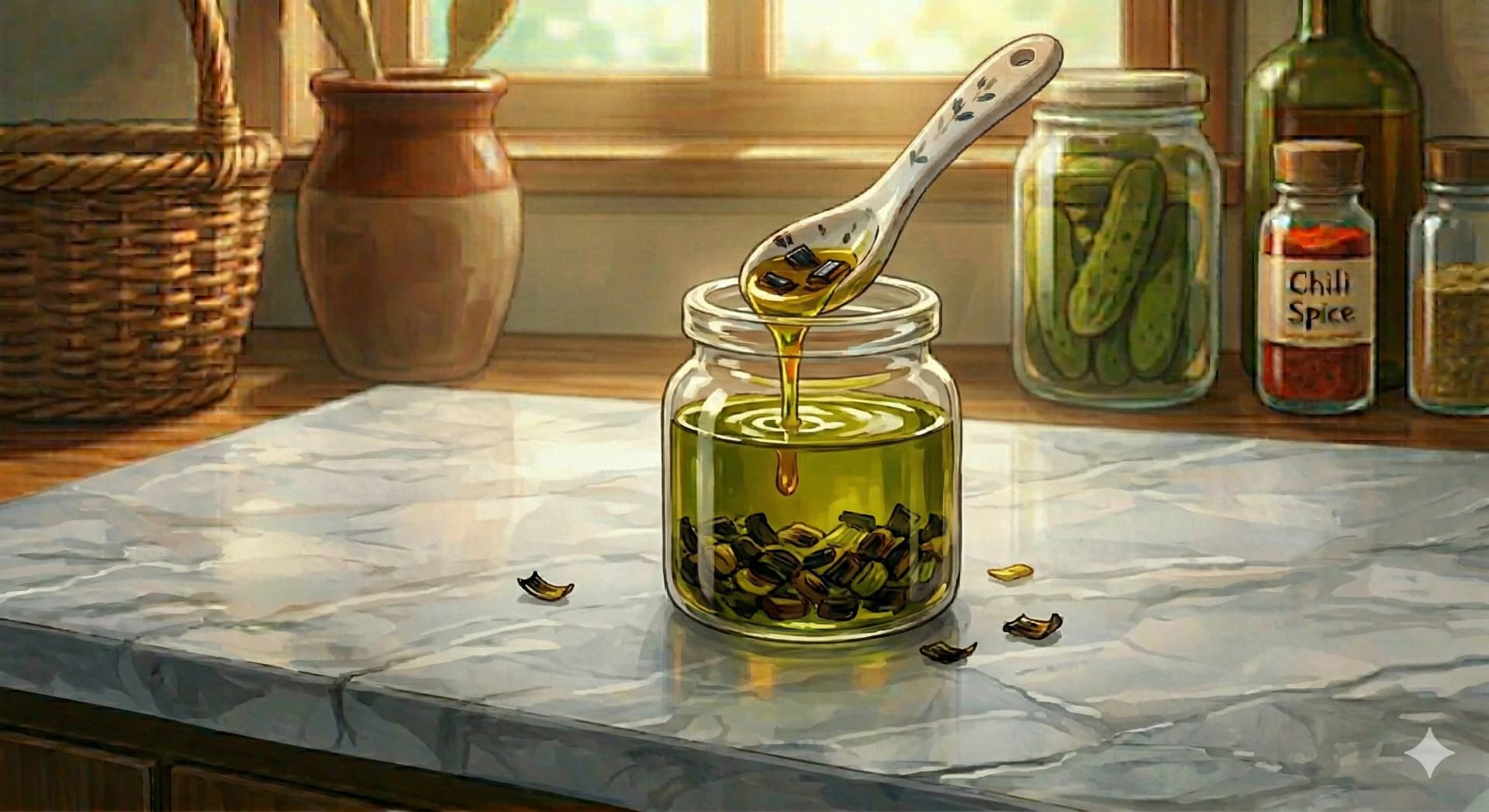
Scallion Oil
Also known as: Cong You, Spring Onion Oil, Green Onion Oil
Scallion oil is not an extracted or pressed oil in the conventional sense. It is a prepared condiment: neutral oil slowly infused with scallions (and often shallots and ginger) over low heat until the aromatics are deeply caramelized, golden, and crisp. What results is an oil saturated with sweet, savory, smoky-edged flavor, alongside the rendered scallion solids themselves, which are just as valuable as the oil they swim in. The two components together constitute one of the most transformative pantry condiments in Chinese cooking.
Its role in Shanghainese cuisine is difficult to overstate. A modest portion of scallion oil and its crispy bits, tossed with freshly boiled noodles and a splash of soy sauce and sugar, constitutes cong you ban mian: scallion oil noodles. This dish is deceptively simple and devastatingly good. The oil coats every strand, the caramelized scallion brings sweetness and depth, and the soy sauce ties it together with saline umami.
It is a dish eaten at breakfast stalls, in home kitchens, and in nostalgic memory across the Shanghainese diaspora.
The condiment also travels beyond noodles. Spooned over steamed fish, drizzled on plain rice, stirred into congee, or used as the fat base for a quick stir-fry, scallion oil adds a complexity that takes far more elaborate preparations to approximate by other means.
Key facts at a glance:
- Prepared condiment — neutral oil slowly infused with caramelized scallions
- Both oil and solids are valuable — the crispy bits are as important as the oil
- Defines cong you ban mian — Shanghainese scallion oil noodles
- 20-30 minutes of patient low heat — the key to sweetness and depth, not bitterness
- Versatile finishing oil — improves rice, steamed fish, congee, and stir-fries
Flavor Profile
Origin
China, Shanghai, Jiangnan
Traditional Medicine Perspectives
Ayurveda:
Scallions share qualities with other Allium plants in Ayurvedic thought. They are considered warming (ushna) and stimulating to digestion. They increase Pitta and reduce Kapha and Vata, making them best suited to those with cold, sluggish, or Vata-dominant constitutions. Excess can aggravate Pitta types. The infused oil form moderates the rawness of these effects somewhat, making scallion oil more broadly tolerated than raw scallion.
Traditional Chinese Medicine:
Scallions (Cong Bai, referring particularly to the white bulb) are a recognized medicinal herb in TCM. They are classified as warm in temperature and pungent in flavor, associated with the Lung and Stomach meridians. Their primary actions are releasing the exterior and dissipating cold, making them a classic first response to early-stage wind-cold invasions (the common cold with chills). Scallions are also said to move Qi and warm the middle, supporting digestive function and relieving bloating. When cooked slowly in oil, the pungent volatile compounds are transformed but the warming, Qi-moving character of the plant persists in a gentler form. Scallion oil is considered warming and nourishing, appropriate in moderate quantities for those with cold constitutions or Spleen Qi deficiency.
Modern Scientific Research
Scallions and the broader Allium family contain a range of bioactive compounds. Allicin and related organosulfur compounds form when Allium cells are damaged and enzymatic reactions occur. These compounds have demonstrated antimicrobial, antifungal, and antioxidant properties in laboratory studies. The slow cooking process involved in making scallion oil transforms allicin into a range of secondary sulfur compounds, some of which retain antioxidant and anti-inflammatory activity in a more stable, less volatile form.
Quercetin, a flavonoid present in meaningful quantities in scallions, is of interest for its anti-inflammatory and antioxidant properties. It is fat-soluble in some of its forms, meaning that infusing scallions in oil may actually improve the extraction and bioavailability of certain quercetin compounds compared to boiling scallions in water.
Research into the specific health implications of scallion oil as a prepared condiment is limited, but the underlying phytochemistry of its ingredients supports its traditional status as a functional food.
Cultural History
Scallions (Allium fistulosum) have been cultivated in China for more than two thousand years and are one of the most fundamental aromatics in the Chinese kitchen. The technique of slowly frying aromatics in oil to extract and preserve their flavor is a cornerstone of Chinese cooking, applied across regions with garlic, ginger, chili, and other aromatics. Scallion oil represents this technique in its most refined and dedicated form.
Shanghai and the broader Jiangnan region developed a cuisine characterized by sweetness, refinement, and a deep appreciation for texturally complex condiments and sauces. Cong you ban mian became iconic in this context: a food that working people could assemble quickly from pantry staples and that restaurant cooks could elevate with proper technique. The dish was common street food in Shanghai from at least the late Qing dynasty onward and remains one of the city's most beloved culinary signatures.
Cantonese cooks also adopted the technique, using scallion oil as a finishing drizzle on steamed fish and whole poached chicken — the oil is often poured sizzling directly over the dish at the moment of serving, blooming the aromatics and providing both flavor and dramatic sensory experience.
Culinary Uses
The key to great scallion oil is patience and low heat. The scallions must not fry hard and fast; they must slowly give up their moisture and caramelize over 20 to 30 minutes, developing sweetness and depth rather than acrid bitterness. Shallots added alongside contribute a rounder, more complex base. Ginger slices are optional but add warmth. The finished oil should be a clear amber with floating gold-and-brown scallion bits; it should smell sweet, nutty, and deeply savory.
For cong you ban mian, the formula is simple and specific: freshly boiled noodles (thin wheat noodles, fresh preferred), 2 tablespoons of scallion oil with its bits, 1 tablespoon of light soy sauce, 1 teaspoon of dark soy sauce, 1 teaspoon of sugar. Toss immediately. Eat immediately. The dish does not wait.
As a finishing condiment, scallion oil improves nearly any bowl of rice, any piece of steamed fish, or any simple soup.
Preparation Methods
Combine 1 cup neutral oil (such as vegetable or peanut oil) with 6-8 scallions cut into 2-inch pieces, 3-4 shallots halved, and optionally 4-5 slices of fresh ginger in a small saucepan.
Bring to a bare simmer over medium-low heat, then reduce to low. Cook undisturbed for 20-30 minutes until scallions and shallots are deep golden-brown and crispy, watching closely to prevent burning in the final minutes.
Remove from heat, cool slightly, and strain into a jar, reserving all the crispy bits. Store the oil and solids together or separately, covered, in the refrigerator for up to 2 weeks. The oil will solidify slightly when cold; bring to room temperature before use.
Traditional Dishes
- Scallion Oil Noodles (Cong You Ban Mian)
- Shanghai Cold Noodles
- Scallion Oil Rice
- Cantonese Steamed Fish
- Poached Chicken with Scallion Oil
- Plain Congee with Scallion Oil
Comments
Share your thoughts on this ingredient.
Sign in to comment0 Comments