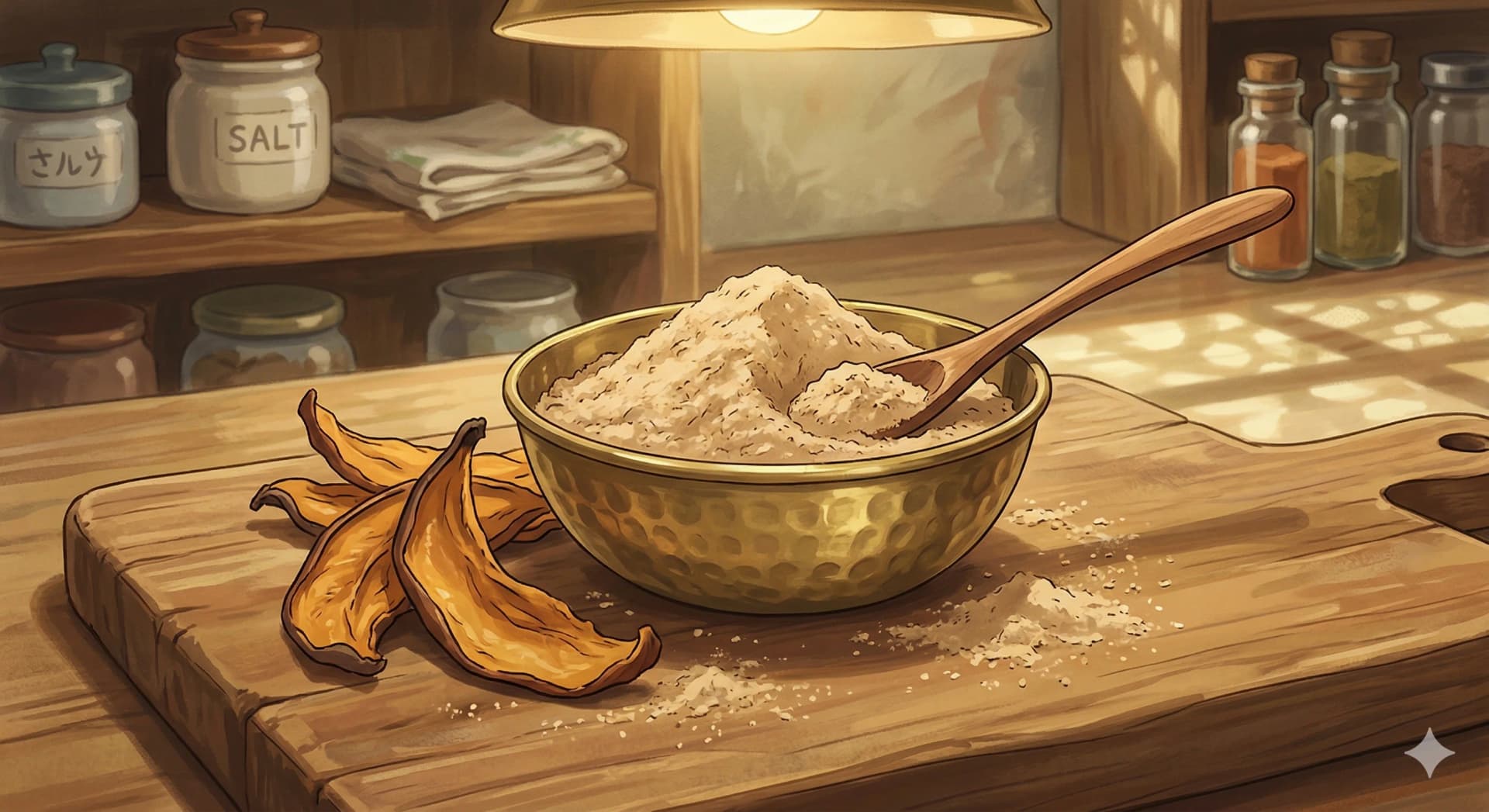
Amchoor
Also known as: Aamchur, Dried Mango Powder, Mangifera indica (dried)
Amchoor is the dried and powdered form of raw, unripe green mangoes. The mangoes are sliced while still hard and sour, sun-dried over several days, and then ground into a fine beige-tan powder with a sharply fruity tartness.
What makes amchoor irreplaceable in North Indian cooking is the quality of its sourness. Unlike fresh lemon or lime juice, amchoor adds tartness without adding moisture. This is critical in dry preparations where liquid would ruin the texture — a samosa filling seasoned with amchoor stays crisp and dry, and aloo tikki crust stays firm.
The powder is deeply embedded in the vocabulary of North Indian spice blending. Chaat masala, the complex, tangy, slightly funky spice blend sprinkled over practically every form of street food from Delhi to Lahore, has amchoor as one of its structural pillars. Without it, chaat masala loses the fruity depth that distinguishes it from a simple salt-and-spice mixture.
Key facts at a glance:
- Adds sourness without moisture — essential for fried and dry preparations
- Foundation of chaat masala — the signature North Indian street food spice blend
- Contains mangiferin, a potent antioxidant compound unique to mango
- Used in Ayurveda as a mild digestive stimulant
- Best added at the end of cooking to preserve its fruity brightness
Flavor Profile
Origin
North India, Punjab, Uttar Pradesh
Traditional Medicine Perspectives
Ayurveda:
Amchoor occupies an interesting place in Ayurvedic thinking. The unripe mango itself is considered highly sour and heating, with particular effects on pitta. However, in dried and powdered form, the sourness transforms and becomes more cooling and digestive. Amchoor is used as a mild digestive stimulant, believed to activate agni (digestive fire) and encourage proper breakdown of food. It is considered beneficial for stimulating appetite and relieving mild nausea. Because it provides sourness without the heating quality of fresh citrus, it is sometimes recommended in moderate amounts even for pitta constitutions when digestive support is needed. The vitamin C content, preserved in part through the drying process, was traditionally recognized in the form of its antiscorbutic properties, even before the vitamin itself was isolated.
Modern Scientific Research
Raw mangoes are exceptionally high in Vitamin C, and research has confirmed that the drying process, while reducing total content, preserves a meaningful portion of ascorbic acid relative to the weight of powder used.
More significantly, amchoor contains mangiferin, a polyphenolic xanthone compound with well-documented antioxidant and anti-inflammatory activity in laboratory studies. Mangiferin has shown promise in research settings for antimicrobial effects, blood sugar regulation, and cellular protection from oxidative stress, though most studies remain in vitro or in animal models.
The organic acids in amchoor — primarily citric and malic acid — activate digestive enzymes, supporting its traditional Ayurvedic use as a digestive stimulant.
The acidic environment created by these compounds also assists in marinating proteins: amchoor is used in tandoori marinades partly because its acids help tenderize meat by partially denaturing surface proteins, in the same way that any acid-based marinade does, but with the additional aromatic complexity of mango.
Cultural History
The mango has been cultivated on the Indian subcontinent for at least 4,000 years, and the practice of preserving unripe mangoes in dried forms is nearly as ancient. The drying of raw mango slices, called kairi, was a practical preservation strategy: the summer mango season is brief, but the desire for sour flavor in cooking is year-round.
The heartland of amchoor production is Punjab and Uttar Pradesh, the states that also produce the finest mangoes in India, including the legendary Alphonso and Langra varieties. The best amchoor comes from specific cultivars grown in the foothills of the Himalayas, where the soil and climate produce fruit with intense flavor even before it ripens.
Local production remains cottage-scale in many areas, with farmers slicing and drying the mangoes on rooftop platforms during the dry spring months.
Amchoor rose to particular prominence with the development of chaat, the street food tradition that became the dominant food culture of North Indian cities. Chaat masala, which requires amchoor as a foundational ingredient, became so associated with Indian street food identity that it spread across the diaspora as a pantry essential. Today, wherever Indian cooking is practiced, amchoor is found.
Culinary Uses
Amchoor functions primarily as a souring agent added at the end of cooking, not at the beginning. Unlike tamarind, which is added early and cooked into a dish, amchoor is typically stirred in during the final minutes or used as a finishing powder. Heat dulls its fruity brightness, so it is treated more like a finishing salt than a cooking ingredient.
The exception is marinades, where it is combined with yogurt, spices, and oil and applied raw to meat or paneer before cooking.
In chaat masala, amchoor works alongside black salt, cumin, coriander, and dried ginger to create the signature puckering, savory-sour profile of Indian street food. Sprinkled over cut fruit, fried snacks, papri chaat, or dahi puri, it provides the sour counterpoint that makes the whole mixture come alive.
In chickpea-based preparations like chole, amchoor deepens the tartness of the tomato base without adding more liquid.
In samosa and kachori fillings, it seasons the spiced potato mixture with sourness that stays sharp even after frying.
Preparation Methods
Amchoor requires no preparation beyond measuring. It is a dry powder ready to use straight from the jar.
For dishes where even moisture would be a concern, it can be briefly dry-roasted in a pan over low heat for 30 to 60 seconds to intensify the aroma before adding to a spice blend, though this is optional.
Storage: Keep in an airtight container, away from light and moisture. It absorbs moisture readily and can clump, which does not affect flavor but makes measuring more difficult. A tight-lidded glass jar in a cool cupboard will keep it fresh for up to a year. The color should remain a warm beige-tan — a grayish color indicates aging and loss of potency.
Substitutions: Fresh lemon juice is the closest approximation for flavor, though it will add moisture. For dry applications, citric acid powder can substitute in a pinch, but lacks the fruity complexity of amchoor.
Traditional Dishes
- Aloo tikki
- Chaat masala blend
- Samosa filling
- Chole (chickpea curry)
- Tandoori chicken marinade
- Papri chaat
- Dahi puri
- Kachori filling
- Mango pickle (aam ka achar)
- Pani puri water
Comments
Share your thoughts on this ingredient.
Sign in to comment0 Comments