Indian Cuisine
Samosa
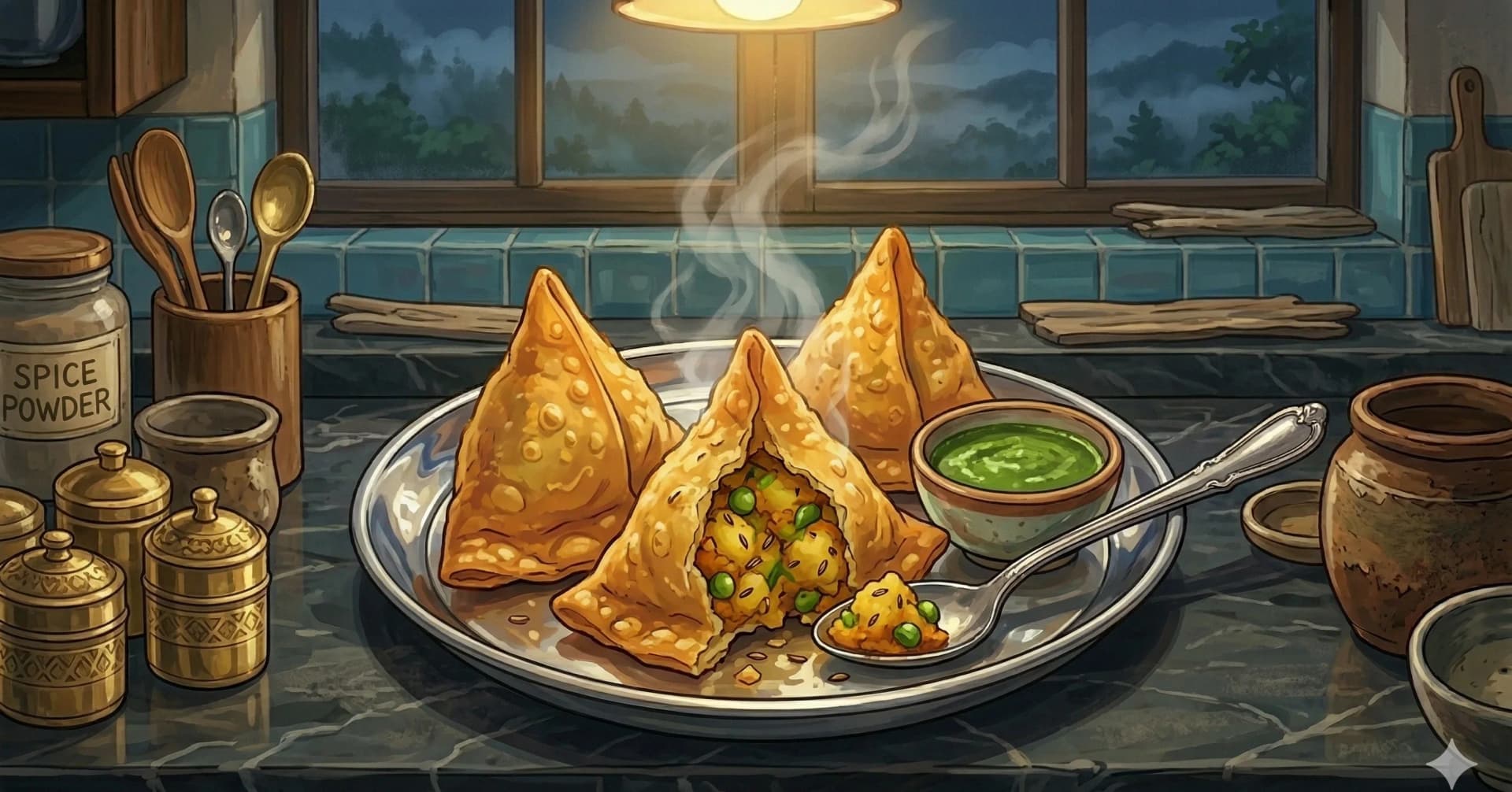
The definitive spiced potato samosa, pastry shatters, filling sings
There is no snack in the Indian subcontinent more traveled, more argued over, or more universally loved than the samosa. Every region has its version: tiny Punjabi samosas fried until blistered; large, thin-skinned Lucknowi versions with minced meat filling; Bengali shingara with peanuts and cauliflower; the flat, triangular samosas of the south. But the form that has become ubiquitous, the tetrahedral, potato-and-pea-filled, pastry-shell samosa, belongs primarily to the North Indian street food tradition, and it is this version that has become one of India's most recognisable foods worldwide.
The pastry is the thing most home cooks get wrong. It must be stiff, made with far less water than you might expect, and worked until smooth. This stiffness is deliberate: it produces the flaky, slightly layered shell that shatters when you bite into it rather than bending like a dumpling. Oil rubbed through the flour (a technique called moyen, or shortening) coats the gluten strands and inhibits their development, keeping the pastry short and crisp.
The filling is an exercise in controlled spicing. Amchoor (dried mango powder) provides a sharp, fruity sourness that brightens the whole thing and defines the North Indian samosa flavour. Ajwain in the pastry adds its unmistakable thyme-adjacent, slightly medicinal warmth. Garam masala goes in last, off the heat, so its volatile top notes aren't cooked off. The potato should be mashed but not completely smooth. Small lumps give the filling texture and interest.
Fry at a patient medium heat. High heat browns the outside before the pastry crisps through; low heat makes them greasy. The samosa should take 10–12 minutes in the oil.
At a Glance
Yield
12–14 samosas
Prep
50 minutes (including 30-minute rest)
Cook
30 minutes
Total
1 hour 20 minutes
Difficulty
Medium
Ingredients
Dough Ingredients
- 4 cupplain flour (maida)
- 3⅓ tbspneutral oil (or melted ghee)
- 1 tspajwain (carom seeds)
- 1 tspsalt
- ⅔ cupcold water
Filling Ingredients
- 1 lbpotatoes (about 3–3½ potatoes), boiled and cooled
- 3½ ozgreen peas (fresh or frozen, briefly cooked)
- 3¼ tbspgreen chillies (2–3 chillies), finely chopped
- 3¼ tbspfresh ginger, finely grated
- 1½ tbspcumin seeds
- 1¾ tbspcoriander powder
- 1⅔ tspgaram masala
- 2 tspamchoor (dried mango powder)
- ½ cupfresh coriander, chopped
- ⅞ tspsalt, or to taste
- 1 tbspoil, for tempering
For Frying
- 2 cupsneutral oil
Method
- 1
Make the pastry dough. Combine flour (500 g), ajwain (1 tsp), and salt (1 tsp) in a large bowl. Add the oil (or ghee) and rub it into the flour with your fingertips until the mixture resembles fine breadcrumbs and no dry streaks of flour remain. This is the moyen technique, and it is what gives the pastry its crispness. Add cold water a little at a time, mixing until a stiff, smooth dough comes together. It should feel much firmer than bread dough. Knead briefly until smooth. Cover and rest for 30 minutes.
- 2
Make the filling. Heat 1 tablespoon of oil (1 tbsp) in a pan over medium heat. Add the cumin seeds (10 g) and let them sizzle for 30 seconds until fragrant. Add ginger (20 g) and green chillies (20 g); cook for 1 minute. Add coriander (10 g) powder (10 g) and cook for 30 seconds. Add the boiled peas (100 g) and stir to coat. Remove from heat.
- 3
Add potatoes (500 g) and season. Roughly mash the boiled potatoes — you want some texture, not a smooth purée. Add to the pan along with amchoor (5 g), garam masala (5 g), salt (5 g), and fresh coriander. Mix well. Taste and adjust: the filling should be distinctly tangy from the amchoor, warmly spiced, and properly seasoned. Allow to cool completely before filling.
- 4
Shape the samosas. Divide the dough into 6–7 equal portions. Roll each into a thin oval, roughly 18–20 cm long and 10–12 cm wide, about 2–3 mm thick. Cut each oval in half across its width to make two semicircles. Form each semicircle into a cone: bring the two cut edges together and overlap them slightly, pressing firmly to seal with a little water. The result should be a neat cone with no gaps.
- 5
Fill and seal. Hold the cone in one hand, open end up. Fill with 2–3 tablespoons of the potato mixture. Do not overfill. Pinch the open top edge together, pressing firmly and crimping to create a tight seal. The samosa should be a plump triangle with no filling visible at the seams.
- 6
Fry. Heat oil in a deep pan or karahi to 150–160°C (medium heat; not so hot that the oil shimmers aggressively). Lower the samosas in gently, in batches of 3–4, and fry for 10–13 minutes, turning occasionally, until evenly golden and the pastry is blistered and crisp all over. Do not rush the heat; slow frying is what gives the pastry its characteristic texture.
- 7
Drain and serve. Remove with a slotted spoon and drain briefly on paper. Serve hot.
Key Ingredient Benefits
Amchoor (dried mango powder) is the defining ingredient of North Indian samosa filling. Made from dried unripe mangoes, it provides tartaric and citric acids in a dry, spoonable form. Its sourness is bright and sharp without adding moisture to the filling. Traditionally used across North Indian cooking as a souring agent, and associated with digestive stimulation in Ayurvedic practice.
Ajwain (carom seeds) has a powerful, thyme-like flavour with sharp medicinal notes. Traditionally used as a digestive in Indian cooking. Thymol, its primary volatile compound, has well-documented antispasmodic and carminative properties, which perhaps explains why it appears so frequently in fried foods.
Cumin seeds tempered in oil form the aromatic base of the filling. Toasting whole cumin seeds in fat unlocks their essential oils, giving the distinctive earthy, slightly bitter warmth that defines North Indian street food spicing.
Green peas add sweetness, colour, and a gentle starchiness that balances the filling. Their natural sweetness provides contrast against the sharp amchoor.
Potato is the filling's foundation. Its mild, absorbent starch takes on flavour readily and provides the soft, yielding interior that contrasts with the crisp pastry shell.
Why This Works
The moyen technique, rubbing fat through flour before adding water, is the engineering key to the pastry. When fat coats flour proteins before hydration, it physically prevents those proteins from linking up into long, elastic gluten strands. The result is a pastry with shorter gluten chains: it rolls without snapping back, and when fried, it shatters into flakes rather than chewing like bread.
Cold water (rather than warm) is used in the pastry for a related reason. Warm water encourages gluten development and produces a more elastic, chewy dough. Cold water minimises gluten formation, reinforcing the shortening effect of the fat and keeping the pastry tender and crisp.
The slow frying temperature is critical. At 150–160°C, the moisture in the pastry drives off gradually, the surface dries and crisps evenly, and the interior of the pastry cooks through without the outside burning. Higher temperatures create a hard, dark crust before the inner layers of pastry have dried out, leading to a less flaky, tougher result. The samosa should be patient in the oil.
Substitutions & Variations
- Keema samosa: Replace potato filling with spiced minced lamb or beef cooked down until dry. A Punjabi and Lucknowi classic.
- Onion samosa (pyaaz samosa): Fill with a mixture of caramelised onion, dry lentils, and green chillies, popular at South Indian tea stalls.
- Whole wheat pastry: Replace maida with atta for a nuttier, more rustic pastry. The texture will be less shatteringly crisp but still good.
- Baked option: Brush with oil and bake at 200°C for 25–30 minutes, turning once. The result is less crisp and has a different texture but is lighter.
- Mini cocktail samosas: Roll dough thinner, make smaller cones, and use about a teaspoon of filling each. Fry at the same temperature for 7–8 minutes.
Serving Suggestions
Samosas are traditionally served with two chutneys: a vivid green coriander-mint chutney and a sweet-sour tamarind chutney. Both are necessary. The green chutney is sharp and herbal; the tamarind is deep and sweet. Serve chaat-style by plating samosas with a handful of sev, a spoon of each chutney, chopped onion, and a dusting of chaat masala for an elevated street food presentation. With chai, a cup of strong, ginger-spiked milky tea, is the canonical afternoon combination across North India.
Storage & Reheating
Uncooked, filled samosas can be refrigerated for up to 24 hours or frozen for up to 1 month. Freeze on a tray until solid before bagging. Fry from frozen, adding 3–4 minutes to the cooking time. Cooked samosas lose their crispness quickly; reheat in an air fryer at 180°C for 5–6 minutes or in an oven at 200°C for 8–10 minutes to restore much of the crunch. Do not reheat in a microwave. The filling can be made 2 days ahead and refrigerated, making same-day assembly faster.
Cultural Notes
Samosa (समोसा) is the deep-fried triangular pastry of crisp wheat-flour dough wrapped around a savory filling, most commonly a spiced mixture of mashed potato and peas in the North Indian version, or various meat and lentil variations across other regional traditions. The dish is one of the most internationally recognized Indian foods and one of the few South Asian dishes with a documented Middle Eastern origin: the form traveled to India via Persian and Central Asian traders along the Silk Road during the medieval period, with the earliest Indian references in the writings of the fourteenth-century historian Amir Khusrau, who described the sambusak served at the court of the Delhi Sultanate as a fried pastry stuffed with meat and spices.
The dish's evolution in India shifted the filling from the original Middle Eastern meat-and-onion version to the predominantly vegetable filling now associated with the Indian form. The Punjabi and Delhi version uses spiced mashed potato with green peas, cumin, ginger, green chilies, garam masala, and amchur (dried mango powder) for tang. The Hyderabadi version often uses minced lamb (keema samosa). The Bengali version is smaller and called singara, with a slightly different shape and a filling that may include coconut, cauliflower, or peanuts. The Gujarati and Maharashtrian versions can include lentils, jackfruit, or savory paneer fillings.
The dish has cultural significance as among the most accessible Indian foods both within India and globally. Samosas appear at street stalls, train station snack carts, tea shops, restaurant menus, wedding banquets, religious festivals, and home tables across every region of India. The standard accompaniment is a small dish each of green chutney (cilantro and mint with green chili) and tamarind chutney (sweet-sour), which the diner spoons over the broken samosa. The dish has spread through the South Asian diaspora to East and West Africa (where it appears in similar forms in Kenyan, Ugandan, and Tanzanian cuisines), the United Kingdom (where the samosa has become a top-selling ready-to-eat food at British supermarkets), and North America (where Indian and Pakistani groceries carry frozen samosas year-round). Pushpesh Pant's India: The Cookbook and Madhur Jaffrey's A Taste of India both document the dish's history and the major regional variations.
Nutrition Facts
Calories: 492kcal (25%)|Total Carbohydrates: 82.6g (30%)|Protein: 10.9g (22%)|Total Fat: 12.5g (16%)|Saturated Fat: 1.8g (9%)|Cholesterol: 0mg (0%)|Sodium: 1673mg (73%)|Dietary Fiber: 4.7g (17%)|Total Sugars: 1.2g
You Might Also Like
Ratings & Comments
Ratings & Comments
Ratings
Share your thoughts on this recipe.
Sign in to rate and comment