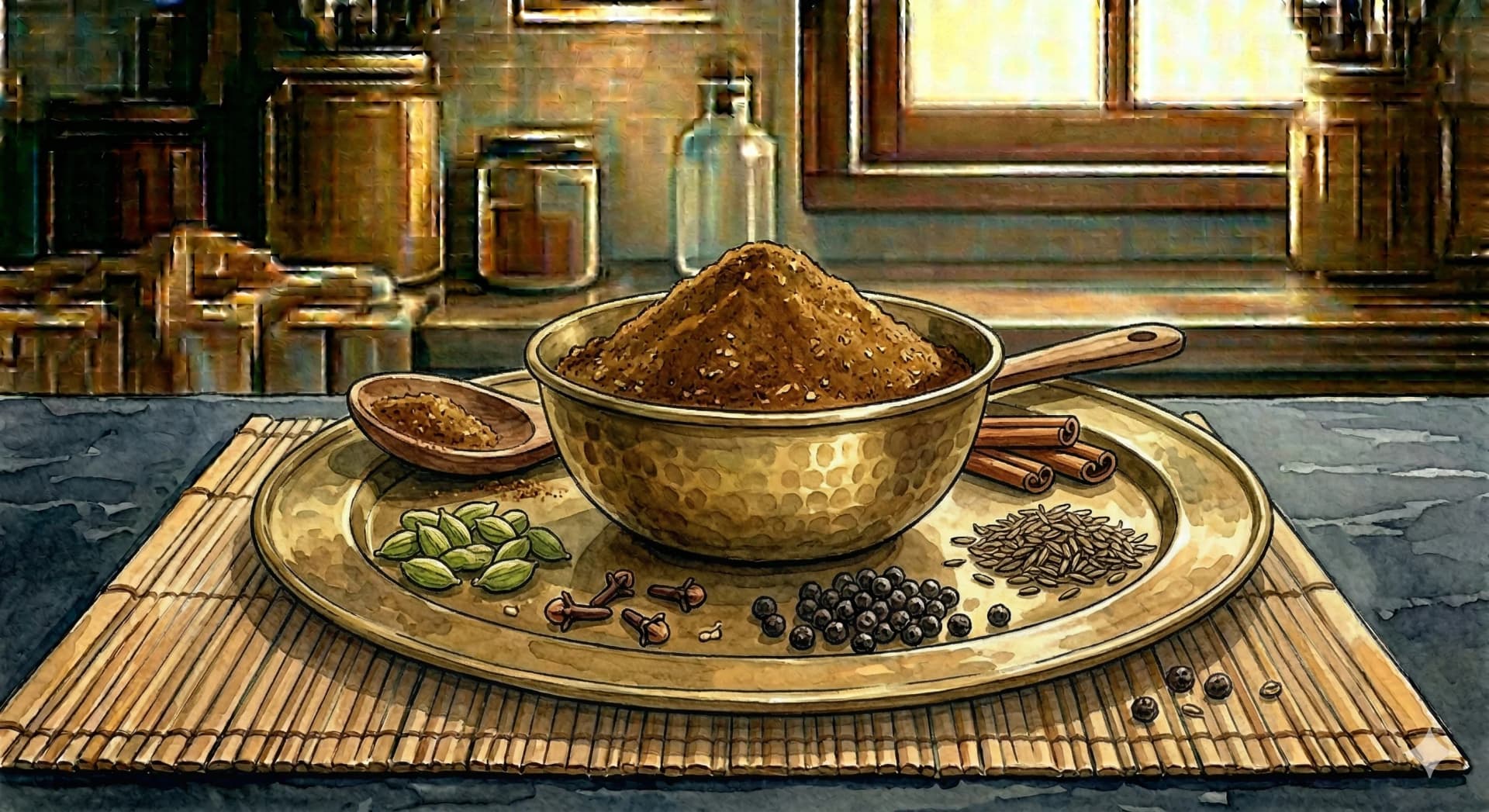
Garam Masala
Also known as: Whole Spice Mix, Hot Spice Blend, Warm Spice Mix
Garam masala is not one thing. It is a concept, a category of spice blend defined by a philosophy rather than a fixed recipe. The name comes from Persian, where garam means warm and masala means spice mixture. Critically, this warmth refers not to chili heat but to the Ayurvedic understanding of heating versus cooling foods.
Garam masala is designed to warm the body's internal constitution, to stoke digestive fire and promote circulation, and the specific combination of spices chosen reflects this therapeutic intention as much as a purely flavor-based rationale.
The most common components include some combination of the following: cinnamon, green cardamom pods or seeds, black cardamom, cloves, black peppercorns, cumin seeds, coriander seeds, star anise, bay leaves, mace, and nutmeg. The exact proportions and inclusion of specific ingredients varies by region, by family tradition, and by the dish being prepared.
A Kashmiri garam masala leans heavily on the camphoraceous warmth of cinnamon and black cardamom. A Hyderabadi blend might emphasize star anise. A Bengali garam masala (called phool masala or powdered bhaja masala) has its own distinct character. There is no authority that has standardized the recipe, and that is the point.
The commercial pre-ground garam masala sold in supermarkets gives a misleading impression of what this blend can be — a jar on a shelf for a year delivers only a fraction of the aromatic complexity of a blend made from freshly toasted and ground whole spices.
Making garam masala at home, or buying it from a spice shop that grinds to order, is a qualitative step up that transforms the ingredient.
Key facts at a glance:
- Name origin — Persian for "warm spice mixture," referring to Ayurvedic heating properties
- No fixed recipe — varies by region, family tradition, and dish
- Core spices — cinnamon, cardamom, cloves, peppercorns, cumin, coriander
- Fresh grinding essential — pre-ground loses volatile oils rapidly
- Dual use — whole spices bloomed in oil at start, ground powder added at finish
Flavor Profile
Origin
North India, Mughal culinary tradition
Traditional Medicine Perspectives
Ayurveda:
Garam masala is, at its core, an Ayurvedic formulation expressed through cooking rather than medicine. Each component spice is classified as heating (ushna) in Ayurvedic pharmacology, and the combination is understood to produce a synergistic warming effect on the digestive system. Cinnamon, cloves, black pepper, and cardamom are all considered digestive stimulants (deepana) individually. Together, they are thought to kindle agni (digestive fire), promote circulation, reduce heaviness after eating, and support the transformation of food into nutrition. The blend is considered broadly tridoshic in small culinary amounts: it reduces excess kapha (heaviness, congestion) and vata (cold, irregular energy) without excessively aggravating pitta (heat, acidity) when used judiciously. Classical Ayurvedic texts recommend warming spice combinations after meals, and the tradition of adding garam masala near the end of cooking, so it is present in the finished dish rather than cooked away, aligns with this post-meal therapeutic logic.
Modern Scientific Research
Modern research on garam masala as a combined blend is sparse: most studies investigate individual component spices separately. However, several research directions are relevant.
Antioxidant studies on spice blends have found that combining multiple spices can produce antioxidant totals significantly higher than predicted from individual components, suggesting potential synergistic effects.
The anti-inflammatory properties of individual garam masala spices — including curcumin-adjacent compounds, piperine from black pepper, eugenol from cloves, and cinnamaldehyde from cinnamon — have been extensively studied in isolation.
Piperine from black pepper is particularly notable for its role as a bioavailability enhancer: it inhibits certain hepatic enzymes, increasing the absorption of other compounds including polyphenols, suggesting the traditional pairing of multiple spices in a single blend may have pharmacological logic beyond flavor layering.
The field of spice synergy research is still young, but the evidence for non-additive interactions between spice compounds is growing.
Cultural History
The systematization of warming spice blends in North Indian cuisine is closely associated with Mughal court culture, which reached its height from the early 16th to late 17th centuries. Persian was the language of the Mughal court, and Persian culinary ideas, including the concept of hot and cold qualities in food derived from Galenic and Avicennan medicine, shaped how Indian cooks thought about spice combinations.
The precise spice blends used in the imperial kitchens were state-level knowledge. The Ain-i-Akbari, the administrative record of Emperor Akbar's court, documents recipes and spice preparations that give some indication of the complexity of spice use in 16th century Mughal cooking. While a specific "garam masala" recipe is not itemized in surviving texts under that name, the category of warming spice preparations used in meat cookery and rice dishes is clearly present.
What we call garam masala today is likely a democratization and codification of blending practices that were once more fluid and proprietary.
Over centuries of trade, migration, and the spread of North Indian culinary culture through the subcontinent and eventually the diaspora, garam masala became the closest thing Indian cooking has to a universal spice blend. When South Asian immigrants established restaurants in Britain in the mid-20th century, garam masala traveled as a defining flavor note. The British curry house pantry, which influenced Indian restaurant cooking globally, standardized garam masala as an ingredient category even as the specific recipes remained diverse.
Culinary Uses
The most important thing to understand about garam masala as a culinary tool is the distinction between two completely different uses: as a beginning-of-cooking whole spice base, and as a finishing ground spice added near the end. Both are valid, but they produce different effects, and confusing them produces poor results.
Whole garam masala (sabut garam masala), meaning the unground whole spices used at the start of cooking, is bloomed in hot oil or ghee before any other ingredients. Whole cinnamon sticks, black and green cardamom pods, cloves, bay leaves, and black peppercorns are added to hot fat and allowed to splutter and release their essential oils into the cooking medium. This is the foundation-building use: it perfumes the fat, which then coats every subsequent ingredient.
Adding ground garam masala early and cooking it for a long time produces a flat, slightly harsh flavor — the volatile terpenes cook off and the more bitter, less aromatic residues remain.
Ground garam masala, by contrast, is a finishing element. It is added in the final three to five minutes of cooking or stirred into a dish off the heat.
Preparation Methods
Classic North Indian garam masala (home blend): Dry-toast separately: 3 parts coriander seeds, 2 parts cumin, 1 part black peppercorns, 1 part green cardamom seeds (removed from pods), half part cinnamon (broken), half part cloves, quarter part black cardamom seeds, quarter part mace. Toast each until fragrant and just beginning to smoke. Combine and cool completely. Grind to a fine powder. Store in an airtight jar away from light. Use within three months for best flavor.
Whole spice blooming (sabut garam masala): To a vessel of hot ghee, add: 1 bay leaf, 1 stick cinnamon (broken), 2 green cardamom pods (lightly cracked), 1 black cardamom pod (cracked), 3 cloves, 4 black peppercorns. Stir and fry until the cloves swell slightly and the oil is fragrant, about 60 seconds. Proceed immediately with the recipe. These whole spices flavor the oil and are usually left in the dish but set aside on the plate when eating.
Quick finishing use: For dishes already in progress, add one half to one teaspoon of freshly ground garam masala per four servings in the final three minutes of cooking. Stir in and allow to cook briefly before finishing. This is the standard procedure for butter chicken, korma, and similar dishes.
Traditional Dishes
- Biryani
- Butter chicken (murgh makhani)
- Lamb korma
- Rogan josh
- Dal makhani
- Nihari
- Seekh kebab
- Shami kebab
- Dum pukht dishes
- Mughlai chicken
- Keema (spiced minced meat)
- Chole (spiced chickpeas)
Recipes Using Garam Masala
- Butter Chicken (Murgh Makhni)
- Tandoori Chicken
- Kare Raisu (Japanese Chicken Curry Rice)
- Slow-Cooked Duck (Dum Ki Batakh)
- Gobi Mussallam
- Goan Green-Spiced Chicken (Galinha Cafreal)
- Hyderabadi Royal Chicken (Murgh Nizami)
- Raw-Layered Biryani (Kachi Biryani)
- Spiced Minced Mutton (Mutton Keema)
- Bhindi Masala
- Chana Masala
- Mutton Seekh Kebab
- Kashmiri Dum Aloo
- Palak Paneer
- Fried Fish, Delhi-Style (Kaanta Gali Machli)
- Potato & Fenugreek Stir-Fry (Aloo Methi)
- Tandoori Gobi
- Paneer Makhni
- Egg Curry (Anda Curry)
- Slow-Cooked Quail, Green Spices (Dum Ka Bateyr Hara Masala)
- Shammi Kebab
- Chicken Korma
- Chicken 65
- Paneer Tikka
- Prawn Kabiraji Cutlet
- Samosa
- Dal Makhni
- Aloo Ki Tikki
- Slow-Cooked Meat & Wheat (Haleem)
- Bengali Dry Mutton Curry (Kasha Mangsho)
- Parsi Chicken with Potato Straws (Salli Murgi)
- Roganjosh
- Hyderabadi Biryani
- Mutter Paneer
- Kashmiri Fried Lamb Ribs (Tabak Maas)
- Tandoori Aloo
Comments
Share your thoughts on this ingredient.
Sign in to comment0 Comments