Kashmiri · Indian Cuisine
Kashmiri Dum Aloo
Baby Potatoes in Vivid Kashmiri Spice — The Brahmin Way, No Onion, No Garlic
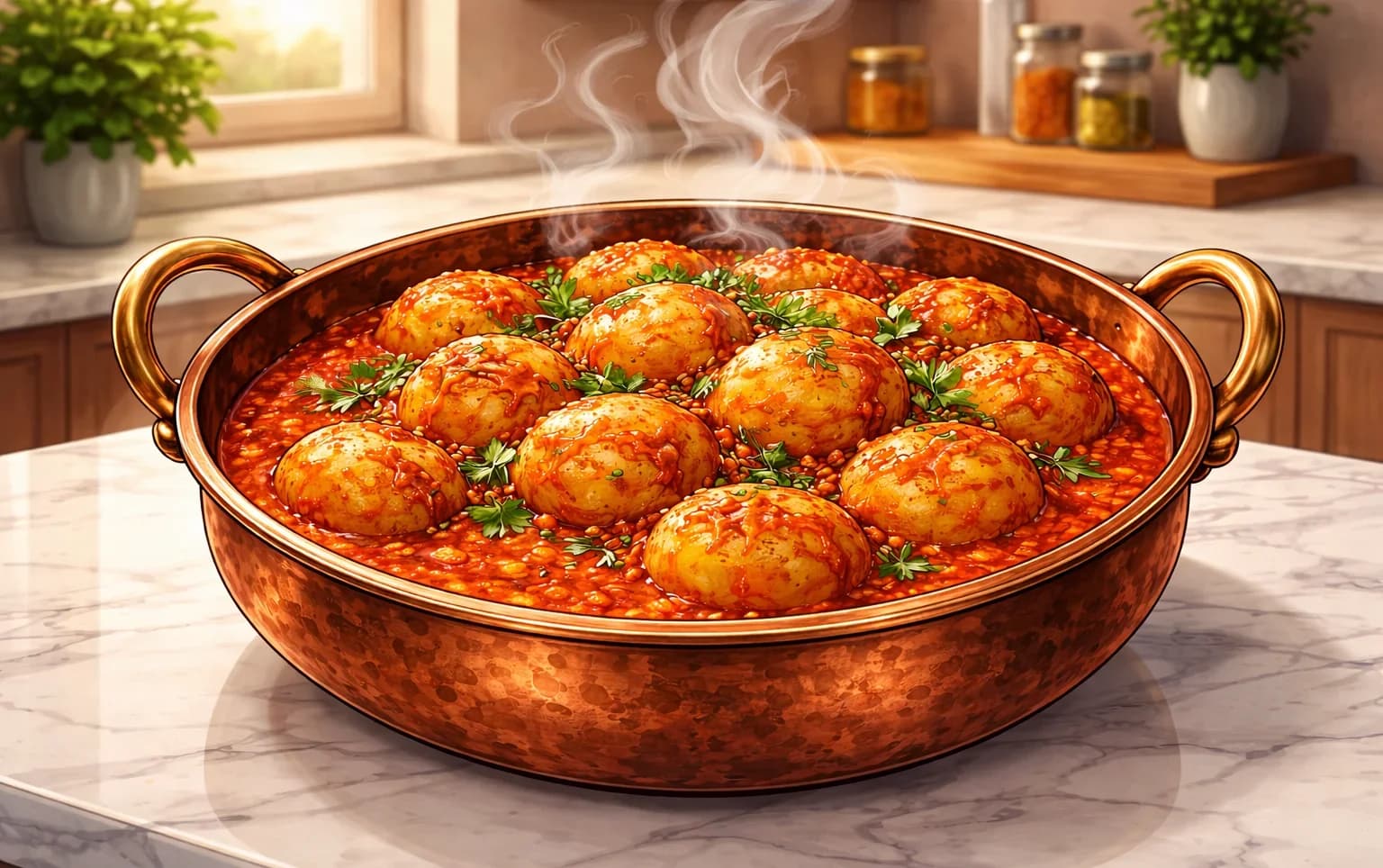
There is something quietly striking about a bowl of Kashmiri Dum Aloo. The potatoes are small and whole, their skins burnished from deep frying, and they sit in a gravy so vivid it looks almost unreal: a red that belongs to lacquer or pomegranate, not to something cooked. This is the color that Kashmiri red chilli produces when bloomed in good hot mustard oil, and it is one of those sights that tells you immediately you are eating something from a specific place and no other.
This version is the Kashmiri Pandit way — the cooking of the Hindu Brahmin community of the Kashmir Valley, whose cuisine is defined by its deliberate absence of onion and garlic. This is not a compromise. It is a philosophical position, rooted in the satvik tradition that avoids pungent alliums. What the dish loses in one kind of depth it gains in another: the spices speak directly, the fennel and dried ginger bring a coolness and warmth that never compete with sweetness, and the yogurt builds a sauce of remarkable complexity for something so elemental.
Dum cooking — covering tightly and cooking on the lowest possible heat — is the technique that finishes this dish. The potatoes, already fried golden and coated in spiced sauce, go into a sealed environment where steam and heat work slowly to push the masala deep into every crack and pore. When you bite through the skin, the spice is not just on the surface.
The practical key to this recipe is the deep frying step. Pricking the baby potatoes with a fork before frying allows the oil to enter slightly, which then helps the masala penetrate when the dum begins. Do not skip it.
At a Glance
Yield
4 servings
Prep
20 minutes
Cook
50 minutes
Total
1 hour 10 minutes
Difficulty
Medium
Ingredients
- 1 lbbaby potatoes (about 3–3½ potatoes), skin on, washed and dried
- —oil for deep frying, neutral oil such as sunflower or refined groundnut
- ½ cupmustard oil
- 2⅓ tspwhole cloves, approximately 8–10
- ¼ ozblack cardamom pods, 2 pods, lightly crushed
- ⅞ tspcinnamon stick, one 5cm piece
- 2½ tbspKashmiri red chilli powder
- ¼ ozfennel powder, saunf powder
- 2¾ tspcoriander powder
- ¾ tspdried ginger powder, sonth
- 5½ ozfull-fat yogurt, whisked smooth and at room temperature
- ⅞ tspsalt, approximately 1 tsp, to taste
- ⅔ cupwater
- 1 tspgaram masala
Method
- 1
Prick and fry the potatoes. Prick each baby potato all over with a fork — 8–10 pricks per potato. This is important; it allows the oil and later the masala to penetrate. Heat oil for deep frying in a kadai or deep pot to approximately 170°C. Fry the potatoes in batches, turning occasionally, for 8–10 minutes until golden brown all over and cooked through. Remove with a slotted spoon and drain on kitchen paper. The potatoes should be cooked but not mushy.
- 2
Smoke the mustard oil. In a separate wide, heavy-bottomed pot (kadai or Dutch oven), heat the mustard oil (100 ml) over high heat until visibly smoking. Hold at smoking point for 30 seconds, then remove from heat and allow to cool for 3 minutes. This step removes the raw pungency of mustard oil.
- 3
Bloom the whole spices. Return the pot to medium heat. Add the cloves (5 g), black cardamom, and cinnamon. Let them sizzle in the oil for 60–90 seconds until aromatic.
- 4
Add the chilli and spice powders. Reduce heat to low. Add the Kashmiri red chilli powder (15 g) and fennel powder (5 g) to the hot oil and stir immediately and continuously for 45–60 seconds. The color of the oil will transform to a vivid deep red. Do not let the chilli powder burn — keep the heat low and keep stirring. The oil will become a stunning crimson.
- 5
Add yogurt. Still on low heat, add the whisked yogurt one large spoonful at a time, stirring vigorously after each addition to prevent curdling. Continue until all yogurt is incorporated and the sauce looks smooth and glossy. Add the coriander powder (5 g) and dried ginger powder (2 g) and stir to combine.
- 6
Add potatoes. Add the fried potatoes to the masala and stir gently to coat each potato thoroughly. Season with salt. Add 150ml water and stir to combine. The potatoes should be half-submerged in the sauce.
- 7
Dum cook. Bring to a gentle simmer. Place a flat griddle (tawa) or heavy cast iron pan under the pot to act as a heat diffuser. Reduce heat to the absolute lowest setting. Cover the pot tightly — place a piece of foil under the lid to seal it if needed, or weigh the lid down with something heavy. Cook on dum for 30–40 minutes. Check once halfway through; if the sauce is drying out, add a splash more water.
- 8
Finish. Remove the lid. The potatoes should have absorbed the masala deeply, the gravy should be thick and glossy and clinging to the potatoes, and the oil should have separated slightly to the surface — a sign the dum is complete. Add the garam masala (3 g), stir through gently, and cook uncovered for 2–3 minutes. Taste and adjust salt.
Key Ingredient Benefits
Baby potatoes: The traditional choice for this dish. Their small size, thin skin, and waxy texture suit the deep-fry + slow-braise technique. Baby potatoes contribute potassium, vitamin C, and resistant starch (which forms when cooked potatoes cool slightly — beneficial for gut health). The whole-potato presentation is part of the dish's visual signature.
Mustard oil: The defining cooking fat of Kashmiri cuisine. Made from pressed mustard seeds, mustard oil has a sharp, pungent character and is high in monounsaturated fats and omega-3 fatty acids. The oil must be heated to its smoke point and then cooled briefly before cooking — this "tempers" the harshness while preserving the character. Mustard oil contains erucic acid, which has been the subject of regulatory debate; cold-pressed variants and varieties bred for low erucic acid are now widely available.
Kashmiri red chili powder: The defining spice. Kashmiri chilies are large, deep red, and remarkably mild compared to other Indian chilies. They produce the vivid crimson color that makes this dish so visually distinctive, without aggressive heat. Capsaicin content is low (about 1,000-2,000 SHU vs. 30,000+ for typical cayenne).
Yogurt (curd): Provides the creamy body of the gravy and balances the spice heat. Whisk well before adding to prevent curdling. Full-fat yogurt is essential — low-fat versions break and produce a thinner sauce. The lactic acid bacteria contribute to digestion and the yogurt's calcium and protein content (about 8 g protein per cup).
Fennel powder (saunf): The most distinctive spice of Kashmiri cooking, providing a sweet, slightly licorice-like aroma. Fennel powder has digestive properties traditionally recognized in Ayurvedic medicine. The fennel-dried ginger combination is the spice signature of Kashmiri food.
Dried ginger powder (sonth): Used in significant quantity in Kashmiri cooking, often more than fresh ginger. Dried ginger has a warmer, more pungent character than fresh and traditional Ayurvedic warming properties.
Hing (asafoetida): A small pinch in the tempering. Provides an onion/garlic-like depth without using actual onion or garlic — essential for Kashmiri Pandit cooking (Brahmin cuisine), which avoids alliums.
Why This Works
The deep-frying step is non-negotiable for authentic Kashmiri dum aloo. Pricking the potatoes with a fork before frying allows hot oil to penetrate slightly, which then creates channels for the masala to enter during the long braise. Skipping the fry produces dum aloo with sauce only on the surface; properly fried-and-pricked potatoes are flavored throughout.
The mustard oil must be heated to its smoke point and then cooled briefly before adding any ingredients. This "tempering" eliminates the raw harshness and softens the pungency while preserving the oil's character. Cooking with un-tempered mustard oil produces an aggressive, bitter result. The smoke point is around 250°C (480°F); the oil should be allowed to cool to about 180°C (350°F) before proceeding.
Blooming the Kashmiri chili powder in the hot mustard oil is what produces the dish's vivid crimson color. The chili pigments (carotenoids) are oil-soluble; the brief high-heat exposure pulls them into the oil. Add the powder off-heat or to slightly cooled oil to prevent burning — burnt chili tastes acrid and turns brown rather than red.
The yogurt must be whisked thoroughly and added gradually to prevent curdling. Yogurt added in a single dump to hot oil and spices will break into a grainy, separated mess. Add a tablespoon at a time, whisking constantly between additions, until the yogurt is fully integrated. The mixture should become a smooth, creamy sauce.
The dum cooking technique is what distinguishes this from generic Kashmiri potato curry. Dum means "to breathe" — the pot is sealed (traditionally with dough around the lid; modern home cooks use foil) and the dish cooks on the lowest possible heat for 25 to 30 minutes. The sealed environment traps all aromatics, and the slow heat allows the masala to penetrate deep into the fried-and-pricked potatoes. Without dum, you have potato curry; with dum, you have Kashmiri dum aloo.
The fennel-dried ginger combination is the spice signature. Both spices are added in larger quantities than most Indian regional cuisines. The fennel provides a sweet, slightly cooling note; the dried ginger provides warmth. Together they create the Kashmiri flavor profile that distinguishes this from Punjabi or Bengali potato preparations.
Substitutions & Variations
Baby potatoes: Cannot really be substituted — the whole-potato presentation is essential. Regular potatoes cut into 1-inch chunks work but produce a different dish. Fingerling potatoes work and produce an interesting variation.
Mustard oil: Essential to the Kashmiri character. Cannot really be substituted without losing the regional identity. Vegetable oil works for a non-Kashmiri version but the result is essentially a different dish. Ghee can be used but produces a richer, more Punjabi-leaning result.
Kashmiri red chili powder: Cannot really be substituted for the color. Paprika provides color without heat. Regular red chili powder is too spicy and the wrong color. A combination of paprika (for color) and cayenne (for heat) approximates if Kashmiri chili is unavailable.
Yogurt: Greek yogurt thinned with water works. Whole-milk yogurt is essential. Plant-based yogurts (cashew or coconut) can substitute for a vegan version, but the character changes. Sour cream is not appropriate.
Fennel powder: Cannot really be substituted authentically. Anise seed powder works but is more strongly licorice-flavored. Cumin is too different.
Dried ginger powder: Fresh ginger substitutes (use 3 times the amount), but the character is different. Ground ginger from a spice jar works.
Hing (asafoetida): Cannot really be substituted with onion or garlic — that would defeat the purpose of the Brahmin Kashmiri Pandit recipe. Skip if unavailable; the dish loses some depth.
Non-Brahmin variations: Kashmiri Muslim versions of dum aloo do include onion and garlic and have a slightly different character. Both styles are authentic Kashmiri cooking.
Spice additions: Some versions include a pinch of cardamom, a small piece of cassia bark, or 1 to 2 whole cloves in the tempering. The minimalist version (just Kashmiri chili, fennel, dried ginger, hing) is the most traditional Pandit-style.
Cooking medium variations: Some Kashmiri families use a combination of mustard oil and ghee (about 3:1) for additional richness. This is non-traditional but produces an excellent result.
Serving Suggestions
Kashmiri dum aloo is a centerpiece dish in Kashmiri cuisine, typically served at the formal Kashmiri feast called wazwan (Kashmiri Muslim) or kashmiri pandit thali (Hindu Brahmin). The vivid crimson color makes it visually striking on any table.
Traditional Kashmiri thali pairings: Serve alongside Kashmiri rajma (kidney beans), haakh (Kashmiri collard greens), yakhni (yogurt-based gravy), nadru yakhni (lotus stem in yogurt), and steamed Basmati rice. The combination is the foundational Kashmiri Pandit meal.
For a Pandit feast: The dish appears as part of a vyuga, the traditional Kashmiri Hindu vegetarian feast. Other dishes include various paneer preparations, dal, and several vegetable dishes — all without onion or garlic. The dum aloo is often the visual centerpiece.
Casual home meal: Pair with basmati rice or naan, a raita (cooling yogurt sauce), and a simple salad. The dum aloo provides the warm spice and the raita provides cooling contrast.
Bread pairings: Kashmiri roti or lavasa (Kashmiri flatbread) is traditional. Naan, tandoori roti, or even simple chapati all work. The bread is used to scoop up potatoes and sauce.
Single-dish meal: Over hot Basmati rice with a dollop of yogurt and a squeeze of fresh lemon — surprisingly satisfying for a one-bowl dinner.
Garnish with fresh cilantro (some Brahmin households omit this; others include it), a final drizzle of mustard oil for sheen, and a few strands of saffron for elegance on special occasions.
Pair with Kashmiri kahwa (saffron-cardamom-almond tea), masala chai, or chilled water. Avoid wine and beer at traditional Pandit meals (the cuisine is typically alcohol-free in religious context).
Storage & Reheating
Refrigerator: Stores excellently for up to 5 days in an airtight container. The flavor genuinely improves over 24 to 48 hours as the masala continues to penetrate the potatoes. Many Kashmiri families consider day-old dum aloo better than fresh.
Reheating: Stovetop with a splash of water for 5 to 7 minutes is the best method. The sauce thickens further during storage and benefits from slight dilution when reheating. Microwave works in a pinch but the texture suffers slightly.
Make-ahead: Designed to be made ahead — the dum technique itself takes 25 to 30 minutes plus the prep time. Many Kashmiri families make this for festivals and family gatherings 1 to 2 days in advance.
Freezing: Acceptable for up to 2 months but the potato texture suffers slightly on thawing. The yogurt-based gravy can become slightly grainy. Whisk vigorously during reheating to restore smoothness.
Yogurt curdling on reheat: The gravy can sometimes appear to separate when reheated. Whisk in a tablespoon of fresh yogurt and bring back to a simmer to restore the creamy texture.
Make-ahead component: The fried potatoes can be prepared up to 24 hours in advance and refrigerated separately. Finish the masala and dum cooking just before serving for the freshest result.
Restaurant trick: Kashmiri restaurants often prepare the masala base in large batches and add the fried potatoes to order. This works at home — make a large batch of masala, freeze in portions, and finish with fresh-fried potatoes for quick weeknight meals.
Cultural Notes
Kashmiri dum aloo (कश्मीरी दम आलू) is one of the defining dishes of Kashmiri cuisine, a regional Indian culinary tradition from the Kashmir Valley in the Himalayas. Kashmiri cooking exists at the intersection of multiple influences: indigenous Himalayan ingredients, Persian techniques from medieval Islamic rule, Mughal court refinement, and the religious dietary practices of both Hindu Brahmin (Pandit) and Muslim communities.
The dish exists in two main styles reflecting the valley's two major communities. Kashmiri Pandit (Hindu Brahmin) dum aloo, the version represented here, is satvik (pure) by religious tradition — it excludes onion and garlic, which are considered tamasic (impure) and unsuitable for ritual purity. The Pandit version uses yogurt, mustard oil, and the distinctive Kashmiri spices (fennel, dried ginger, Kashmiri chili, hing) to create depth without alliums. Kashmiri Muslim versions include onion and garlic and represent a different but equally authentic culinary tradition.
The Kashmiri Pandit prohibition on onion and garlic is rooted in Vedic tradition and reflects a broader pattern in classical Indian Brahmin cooking. The same principle drives the cuisine of Jain and certain Vaishnavite traditions. Far from being restrictive, this cooking style developed extraordinary technique and ingredient mastery to compensate — Kashmiri Pandit cuisine is widely considered one of India's most refined regional traditions specifically because of how it achieves depth without the alliums most other cuisines rely on.
The wazwan (Kashmiri Muslim ceremonial feast) and kashmiri pandit vyuga (Brahmin feast) are among India's most elaborate culinary traditions. Each can include 15 to 30 dishes served in succession on a trami (large copper platter shared by four diners). Dum aloo appears in both, though prepared in slightly different styles by the two communities. The dish's vivid crimson color makes it visually central to these feasts.
The dum cooking technique itself has Mughal origins and reflects the broader influence of Persian/Central Asian cooking on Kashmiri cuisine. Dum pukht (literally "breathing cooking") was perfected in the royal kitchens of the Mughal Empire and Awadh (modern Lucknow), where it was used for biryani, korma, and similar slow-cooked preparations. Kashmiri cuisine adapted the technique for its own ingredients and regional flavor profiles.
The use of mustard oil as the primary cooking fat distinguishes Kashmiri cuisine from many other North Indian traditions (which favor ghee) and from South Indian cuisines (which favor coconut oil). Mustard oil's sharp character was historically the most readily available cooking fat in the Kashmir Valley and Bengal regions. Modern Kashmiri families often combine mustard oil with ghee for festive occasions, but the everyday cooking medium remains mustard oil.
Kashmiri red chili (kashmiri lal mirch) deserves special mention. These chilies are grown in the Kashmir Valley and surrounding regions and have been awarded Geographical Indication (GI) status protecting the regional designation. The chilies are unique in providing intense red color with mild heat — about 1/20th the heat of typical cayenne. This characteristic is what allows Kashmiri food to look spectacular without being aggressively spicy, a balance that distinguishes the cuisine from neighboring Punjabi or Rajasthani traditions.
The dish has also been affected by the geopolitical situation in Kashmir. Many Kashmiri Pandits left the valley in 1990 during the insurgency, creating a global Kashmiri Pandit diaspora that has preserved and adapted the cuisine. Kashmiri Pandit restaurants now exist in major cities across India and internationally, keeping these culinary traditions alive even as the in-valley community has dwindled.
Nutrition Facts
Calories: 459kcal (23%)|Total Carbohydrates: 30g (11%)|Protein: 6g (12%)|Total Fat: 35g (45%)|Saturated Fat: 4g (20%)|Cholesterol: 5mg (2%)|Sodium: 310mg (13%)|Dietary Fiber: 3g (11%)|Total Sugars: 4g
You Might Also Like
Ratings & Comments
Ratings & Comments
Ratings
Share your thoughts on this recipe.
Sign in to rate and comment