Mustard Oil
Also known as: Sarson Ka Tel, Shorshe Tel, Kadugu Ennai, Rai Ka Tel, Brassica Oil
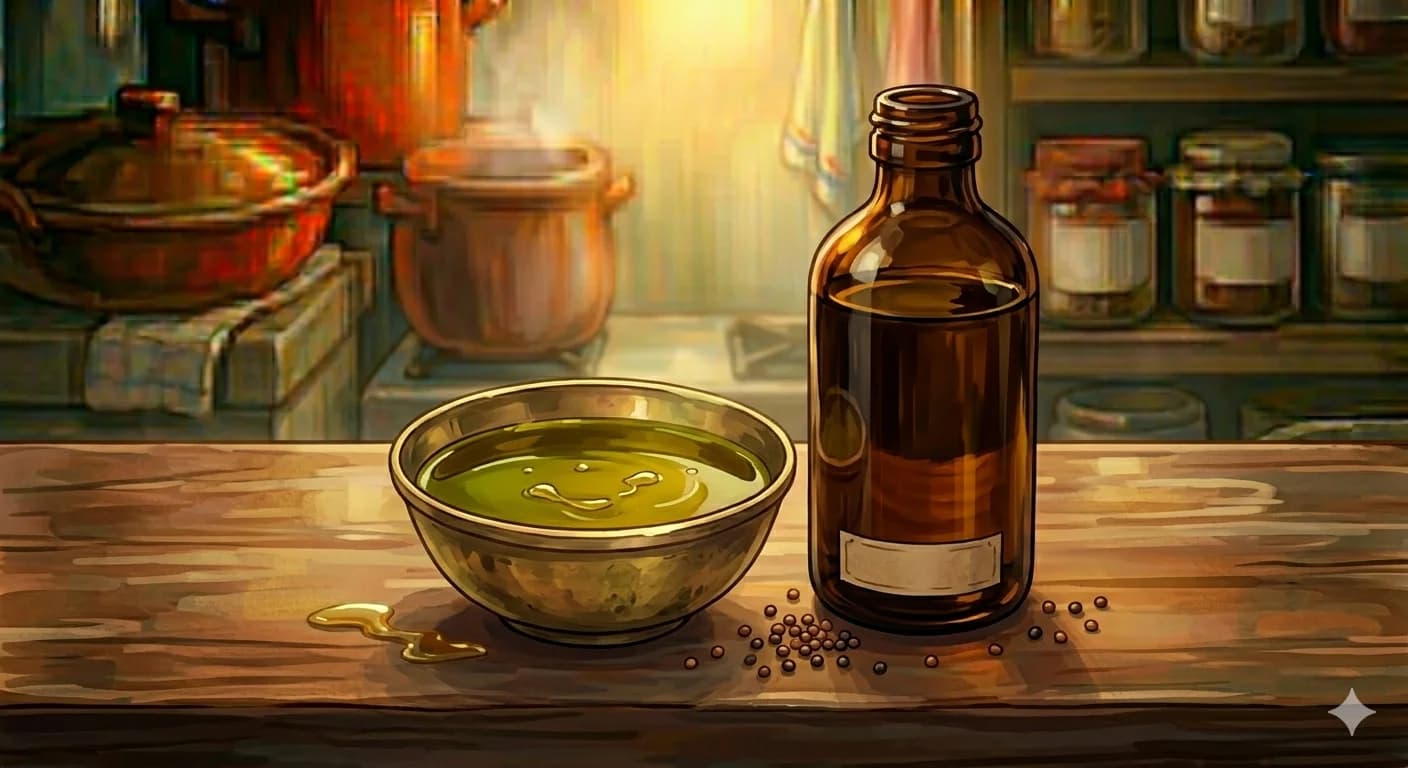
Mustard oil is the fierce, golden-amber oil pressed from mustard seeds that forms the cooking backbone of Bengali, Bihari, and much of North and East Indian cuisine. Its aroma is unmistakable — sharp, sinus-clearing, almost aggressive when raw, but transforming into something warm, nutty, and deeply savory when heated past its smoke point.
No other cooking oil behaves quite like this. Mustard oil has a pungency that comes from allyl isothiocyanate, the same compound that gives wasabi and horseradish their kick. Raw, it can make your eyes water. Heated to its smoke point and then cooled slightly (a technique Bengali cooks call kachi ghani), it mellows dramatically and becomes the ideal medium for frying fish, tempering spices, and dressing raw salads.
In Bengal, mustard oil is not merely preferred — it is non-negotiable. A Bengali kitchen without mustard oil is unthinkable. The same holds across Bihar, Odisha, Assam, and parts of Uttar Pradesh. It is also essential in Kashmiri cooking and widely used in pickling across the subcontinent.
Key facts at a glance:
- Cold-pressed from brown or black mustard seeds (Brassica juncea or Brassica nigra)
- Allyl isothiocyanate — the pungent compound shared with wasabi and horseradish
- Must be heated to smoke point first — this mellows the raw pungency
- Backbone of Bengali, Bihari, and East Indian cooking
- Essential for Indian pickling (achaar) due to its preservative properties
Flavor Profile
Origin
Bengal, Bihar, North India, East India, Kashmir, Nepal, Bangladesh
Traditional Medicine Perspectives
Ayurveda
Mustard oil (sarshapa taila) is classified as warming (ushna) with a pungent taste (katu rasa) in Ayurveda. It is traditionally used for abhyanga (oil massage) to stimulate circulation, warm the body, and support joint mobility. Applied to the scalp, it is believed to promote hair health. Internally, it is considered to kindle digestive fire (agni) and reduce kapha dosha. It is used in nasya (nasal administration) practices and is considered beneficial for vata-type conditions.
Bengali Folk Medicine
In Bengali folk tradition, mustard oil mixed with salt is applied to gums for oral health. Warm mustard oil is dripped into ears for earache relief. It is rubbed on the chest during colds and used as a base for herbal poultices. These practices are deeply embedded in domestic healthcare traditions across Bengal and Bangladesh.
Modern Scientific Research
Mustard oil contains high levels of erucic acid (a monounsaturated omega-9 fatty acid), which has been the subject of ongoing nutritional debate. Some animal studies raised concerns about erucic acid at very high doses, but epidemiological studies of populations that consume mustard oil regularly (such as in Bengal and Bihar) have not shown corresponding health problems, and some suggest cardiovascular benefits.
The oil is rich in alpha-linolenic acid (an omega-3 fatty acid) and has a favorable omega-3 to omega-6 ratio compared to many common cooking oils. Research has investigated its potential anti-inflammatory properties, linked to both the omega-3 content and the isothiocyanate compounds present in cold-pressed versions.
Allyl isothiocyanate (AITC), the compound responsible for mustard oil’s pungency, has been studied for antimicrobial activity against a range of foodborne pathogens. This may help explain the traditional use of mustard oil in Indian pickling (achaar), where it serves as both flavoring agent and preservative. Studies have also explored AITC’s potential anti-inflammatory and analgesic properties.
Cultural History
Mustard has been cultivated on the Indian subcontinent for at least three thousand years, and mustard oil extraction is one of the oldest oilseed processing traditions in the world. Archaeological evidence from the Indus Valley civilization suggests mustard was among the earliest cultivated crops in the region. In Bengal and Bihar, mustard oil has been the dominant cooking fat for centuries, long before refined vegetable oils entered the market.
The oil holds deep cultural significance beyond cooking. In Hindu tradition, mustard oil is lit in earthen lamps during Diwali and other festivals. It is used in Ayurvedic massage (abhyanga), applied to newborn babies, rubbed into scalps for hair care, and used in wedding rituals across North and East India. The phrase "sarson ka tel" evokes home, mother, and tradition for millions.
In a controversial regulatory episode, mustard oil was briefly banned for sale as cooking oil in India and several other countries due to concerns about erucic acid content. This ban was later relaxed with labeling requirements. Cold-pressed mustard oil from traditional wooden presses (ghani) remains the gold standard, with industrial solvent-extracted versions considered inferior in both flavor and tradition.
Culinary Uses
In Bengali cooking, mustard oil is the default cooking medium. Heat it in a kadai or wok until it just reaches its smoke point — you will see a faint wisp of smoke and the raw pungency will dissipate. Then add your tempering spices. This technique transforms the oil from aggressively sharp to warm and nutty, and it is the foundation of dishes like begun bhaja (fried eggplant), aloo posto (potatoes with poppy seed), and every Bengali fish curry.
For raw applications, mustard oil brings an entirely different character. Drizzled over steamed rice with a pinch of salt, it is comfort food in its simplest form. Mixed into shorshe bata (ground mustard paste), it creates the base for sorshe ilish and other mustard-sauce fish dishes that are the crown jewels of Bengali cuisine.
Mustard oil is essential for Indian pickling. Its antimicrobial properties and strong flavor make it the ideal medium for achaar. The raw oil is mixed with spice-coated vegetables or fruits, and the pungency mellows over days as the pickle matures. Mango pickle, lime pickle, and mixed vegetable pickle all traditionally rely on mustard oil.
In Kashmiri cooking, mustard oil is used for frying and in the preparation of wazwan feast dishes. In Bihar and UP, it appears in litti chokha, sattu preparations, and as a finishing oil for dal.
Preparation Methods
The most important technique with mustard oil is heating it to its smoke point before cooking. Pour the oil into your pan and heat it over high flame until you see a thin wisp of smoke and the sharp, raw smell fades. Then reduce the heat to your cooking temperature and proceed. This step is not optional — cooking with un-smoked mustard oil gives food a harsh, acrid taste.
For raw use in salads, chutneys, and drizzling, the oil goes straight from the bottle without heating. The pungency is the point here. Mix it with lime juice, green chilies, and salt for a simple Bengali-style dressing. Or use it raw in mustard paste preparations where heating would destroy the volatile compounds that give the dish its character.
When making pickles (achaar), use raw, cold-pressed mustard oil. The oil should be golden-amber, not pale or refined. Pour it generously over your spiced vegetables — the oil should cover the ingredients completely, acting as both preservative and flavoring. Store mustard oil in a cool, dark place; it keeps well due to its natural antimicrobial properties but should be used within 6–12 months for best flavor.
Traditional Dishes
Recipes Using Mustard Oil
- Chicken Achar
- Prawns in Coconut Cream (Chingri Malai Curry)
- Carom-Spiced Fish Curry (Ajwaini Machi Curry)
- Slow-Cooked Okra (Dum Bhindi)
- Kashmiri Collard Greens (Haak)
- Kashmiri Dum Aloo
- Fried Fish, Delhi-Style (Kaanta Gali Machli)
- Potato in Poppy Paste (Aloo Posto)
- Slow-Cooked Vegetables (Dum Ki Subziyan)
- Bengali Dry Mutton Curry (Kasha Mangsho)
- Hilsa in Mustard Sauce (Sorshe Ilish)
- Roganjosh
- Kashmiri Fried Lamb Ribs (Tabak Maas)
Comments
Share your thoughts on this ingredient.
Sign in to comment0 Comments