Kashmiri · Indian Cuisine
Roganjosh
Kashmir's Most Iconic Lamb Curry — Deep Red, Deeply Aromatic, No Tomatoes
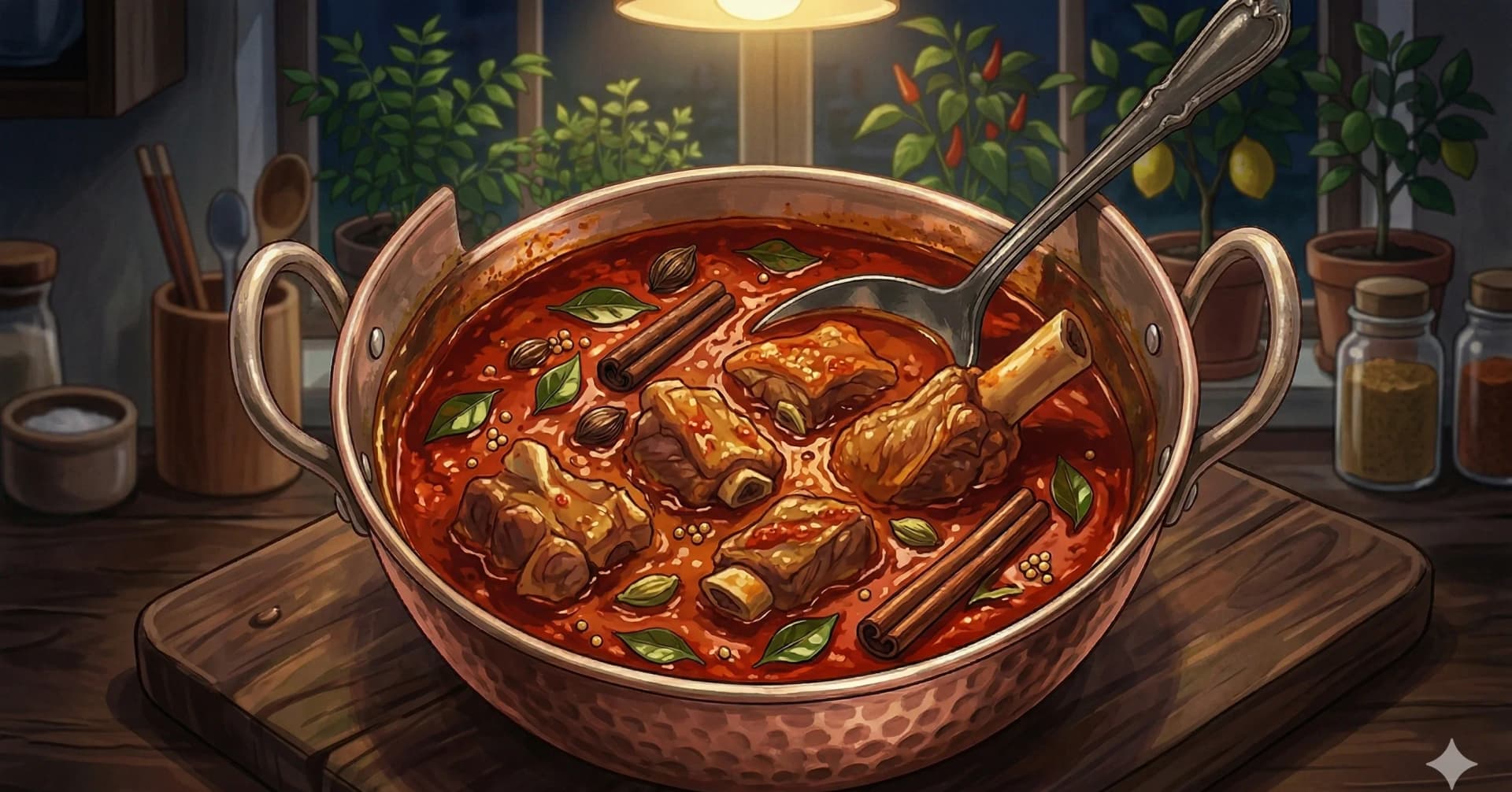
The color of a proper Roganjosh stops you. It is a deep, saturated brick-red, the kind of red that looks lit from within, and it comes not from tomatoes (which have no place here) but from the particular brilliance of Kashmiri red chilli and, in the traditional method, from ratan jot, the dried root of alkanet that bleeds a deep carmine into hot oil. The name itself points to this: "rogan" means fat or oil in Persian, and "josh" means heat, intensity, ardor. This is a dish of hot, colored oil and the lamb that cooks slowly within it.
Roganjosh belongs to the Wazwan — the great ceremonial feast of Kashmir, a multi-course spread that can run to thirty-six dishes, prepared by hereditary cooks called Wazas over two days for weddings and celebrations. Within the Wazwan, Roganjosh holds a place of honor. The Waza version uses bone-in lamb from the shoulder or leg, cooked low and slow until the meat pulls from the bone and the gravy reduces to something almost syrupy with spice.
What this dish delivers is warmth with complexity: the heat of chilli tempered by the coolness of fennel, the brightness of dried ginger, the deep bass note of black cardamom. There are no onions in the most traditional Kashmiri Muslim version (the Kashmiri Pandit version differs). The yogurt goes in slowly and is coaxed into the sauce rather than dumped in.
The practical key: smoke your mustard oil until it reaches its smoking point, then let it cool slightly before adding spices. This step tames mustard oil's sharpness and transforms it into something mellower and more complex.
At a Glance
Yield
4 servings
Prep
20 minutes
Cook
1 hour 30 minutes
Total
1 hour 50 minutes
Difficulty
Medium
Ingredients
- 2¼ lbbone-in lamb, shoulder or leg, cut into large pieces on the bone
- ⅞ tspsalt, approximately 1 tsp, to taste
- ¾ cupmustard oil
- 2⅓ tspwhole cloves, approximately 8–10
- ¼ ozblack cardamom pods, approximately 2–3 pods, lightly crushed
- ⅞ tspcinnamon stick, one 5cm piece
- ¼ ozdried bay leaves, 2 leaves
- 3¼ tbspKashmiri red chilli powder, mild, provides color as much as heat
- 1¼ tbspdried ginger powder, sonth
- ¼ ozfennel powder, saunf powder
- 1⅔ tspgaram masala, added at the end
- 7 ozfull-fat yogurt, whisked smooth and at room temperature
- ⅞ cupwater
- —ratan jot (alkanet root), a small piece, optional but traditional — infuse in hot oil before adding spices (optional)
Method
- 1
Smoke the mustard oil. Pour the mustard oil (200 ml) into a wide, heavy-bottomed pot or Dutch oven. Heat over high heat until the oil begins to smoke visibly — you will see a faint haze rise from the surface. This is the smoking point. Hold it there for 30 seconds, then remove from heat and allow to cool for 3–4 minutes. This process removes the raw pungency from the mustard oil and transforms its flavor.
- 2
Infuse ratan jot (if using). Return the cooled oil to medium heat. If using ratan jot, add the small piece now and let it infuse for 1–2 minutes until the oil turns a deep reddish-orange. Remove and discard the ratan jot before proceeding. This step is what gives the most traditional Roganjosh its distinctive color depth.
- 3
Bloom the whole spices. Add the cloves (5 g), black cardamom, cinnamon, and bay leaves (2 g) to the oil. Let them sizzle and bloom for 60–90 seconds until fragrant. The black cardamom will puff slightly.
- 4
Sear the lamb. Increase heat to high. Add the lamb pieces in a single layer (work in batches if needed). Sear without moving for 3–4 minutes per side until deeply browned. Good browning here builds flavor that carries through the entire dish. Season with salt during searing.
- 5
Add the spice powders. Reduce heat to medium. Add the dried ginger powder (10 g), fennel powder (5 g), and Kashmiri red chilli powder (20 g) directly to the lamb and fat in the pot. Stir continuously for 2 minutes, coating the meat thoroughly. The mixture will be dry and fragrant. The chilli powder will begin to deepen the color of everything it touches.
- 6
Add yogurt. Reduce heat to medium-low. Add the whisked yogurt, one large spoonful at a time, stirring vigorously after each addition to incorporate it into the spiced fat before adding the next. Do not add the yogurt all at once or it will curdle in the hot oil. Stir continuously until all the yogurt is incorporated and the sauce looks cohesive and glossy, approximately 5 minutes.
- 7
Slow cook. Add 200ml water. Stir to combine. Bring to a gentle simmer, then reduce heat to the lowest setting. Cover and cook for 1 to 1.5 hours, checking every 20 minutes and adding a splash of water if the sauce reduces too quickly. The lamb is ready when it is completely tender and pulls easily from the bone, and the gravy has thickened to a deep, glossy red.
- 8
Finish. Remove the lid, increase heat to medium, and simmer uncovered for 3–4 minutes to tighten the sauce if needed. Add the garam masala (5 g), stir through, and cook for a final 2 minutes. Taste and adjust salt. Remove bay leaves and cinnamon stick before serving.
Key Ingredient Benefits
Bone-in lamb (shoulder or leg): The traditional choice. Bone-in cuts deliver dramatically more flavor than boneless — the bones release collagen and marrow into the braise, creating a rich, gelatin-heavy gravy. Lamb shoulder is the most forgiving cut, with enough fat and connective tissue to handle the long, slow braise. Provides complete protein (about 25 g per 100 g), iron, zinc, B12, and conjugated linoleic acid.
Mustard oil: The defining cooking fat of Kashmiri cuisine, providing the dish's slightly pungent, almost mustard-greens-like backbone. Must be heated to its smoke point and cooled briefly before cooking ("tempering") to soften the harsh raw character. High in monounsaturated fats and omega-3 fatty acids.
Kashmiri red chili powder: The dish's defining spice. Kashmiri chilies provide intense red color with mild heat (~1,000-2,000 SHU). The vivid carmine color comes from carotenoid pigments that are oil-soluble and release dramatically in hot mustard oil.
Ratan jot (alkanet root): Traditional natural coloring agent for the most authentic version. Dried alkanet root releases a deep red carmine pigment when bloomed in hot oil. This is the historical source of roganjosh's signature color — long before Kashmiri chilies became widely available, ratan jot provided the brick-red appearance. Optional in modern recipes (Kashmiri chili alone produces excellent color), but traditional Wazwan cooks consider it essential.
Yogurt (full-fat curd): Tenderizes the lamb during the long braise and creates the gravy's creamy body. The lactic acid breaks down meat proteins; the milk fats integrate into the sauce. Must be whisked thoroughly and added gradually to prevent curdling.
Whole spices (cardamom, cloves, cassia bark, black cardamom): Bloomed in the hot oil at the start. The whole spices provide layered, slowly-released aromatic depth. Black cardamom (badi elaichi) contributes a smoky, almost camphor-like note that distinguishes Kashmiri cooking from other regional Indian traditions.
Fennel powder (saunf): Used in significant quantity. One of the defining spices of Kashmiri cuisine, providing a sweet, slightly licorice-like depth that pairs particularly well with lamb.
Dried ginger powder (sonth): The other defining Kashmiri spice. Provides warmth and an earthy depth different from fresh ginger.
Hing (asafoetida): A small pinch at the start. Provides an onion/garlic-like depth without using actual onion or garlic — though Muslim Kashmiri versions of roganjosh do use onion, the Kashmiri Pandit version omits both onion and garlic in favor of hing.
Why This Works
Tempering the mustard oil is the foundation. The oil is heated until it reaches its smoke point (around 250°C / 480°F) and visible smoke rises. The pan is removed from heat for 30 to 60 seconds to cool slightly. This tempering eliminates the raw harsh pungency while preserving the oil's distinctive character. Cooking with un-tempered mustard oil produces an aggressive, bitter result.
Browning the lamb in the tempered mustard oil develops Maillard-derived flavor compounds that no other cooking technique produces. The lamb pieces should be browned in batches if needed — overcrowding produces steamed rather than browned meat. The browned surface contributes the deep, savory backbone of the finished dish.
Blooming the whole spices and Kashmiri chili powder in the hot oil is what produces the dish's vivid color and aromatic depth. The chili pigments (carotenoids) are oil-soluble and release dramatically; the whole spices' volatile aromatic compounds infuse into the cooking fat. Skipping this step produces a flat, one-dimensional curry.
Adding yogurt gradually (a tablespoon at a time, with constant whisking) is essential to prevent curdling. Yogurt added in a single dump to hot oil and spices will break into a grainy mess. The proper technique: bring the heat down slightly, add a tablespoon of yogurt, whisk vigorously until incorporated, repeat. This takes 5 to 8 minutes total but produces the smooth, creamy gravy that defines a great roganjosh.
The long, slow simmer is what tenderizes the lamb and develops the gravy. Roganjosh is not a quick dish — proper preparation takes 1.5 to 2 hours of gentle braising after the initial browning. The collagen in the lamb shoulder converts to gelatin during this time, producing both tender meat and a silky, gelatin-rich gravy. Speed-cooking roganjosh in a pressure cooker is technically possible but produces a noticeably less developed result.
The fennel-dried ginger combination provides the spice signature that distinguishes Kashmiri cooking from other regional Indian traditions. Both spices are added in larger quantities than most cuisines would. The combination creates a complex sweet-warm profile that pairs beautifully with the rich lamb and the slightly mustardy mustard oil base.
The brick-red color comes from three sources: Kashmiri chili (mainly), ratan jot (traditional), and the natural color of the long-cooked tomato-free gravy. The fact that the gravy contains no tomatoes is one of its defining characteristics — Kashmiri roganjosh's red color is entirely from chilies and traditional natural colorants, never tomato.
Substitutions & Variations
Lamb: Bone-in lamb shoulder or leg is the traditional choice. Goat works identically (and is more authentic to some Kashmiri Muslim versions). Boneless lamb stew meat works but produces less rich gravy. Beef chuck can substitute but produces a different dish — not authentically roganjosh.
Mustard oil: Cannot really be substituted for the authentic Kashmiri character. Ghee produces a richer but non-Kashmiri result. Vegetable oil works for a generic Indian-style lamb curry but loses the regional identity.
Kashmiri red chili powder: Essential for the color. Paprika provides color without heat (combine with cayenne for some heat). Regular red chili powder is too spicy and the wrong color.
Ratan jot: Optional. Cannot be substituted but can be omitted — Kashmiri chili alone produces good color, just slightly less brick-red than the ratan-jot-included version. Beet powder is sometimes used as a modern substitute (food-coloring purists object).
Yogurt: Whole-milk yogurt is essential. Greek yogurt thinned with water works. Plant-based yogurts (cashew or coconut) can substitute for a non-traditional version. Sour cream is not appropriate.
Fennel powder: Cannot really be substituted. Anise seed powder works but is more strongly licorice-flavored.
Dried ginger powder: Fresh ginger substitutes (use 3 times the amount), but the character is different.
Hing (asafoetida): Cannot be substituted with onion or garlic in the Pandit version. Skip if unavailable.
Onion (in Muslim Kashmiri version): Brown onion paste is added in some versions. The Pandit version (without onion) is the more refined, traditional Kashmiri Hindu preparation. The Muslim version (with onion) is more common in restaurants and the broader Kashmiri community.
Garam masala: A pinch at the end is sometimes added in modern versions. Not traditional in the most authentic Kashmiri preparations but appears in many modern recipes.
Bay leaves: Some versions include 1 to 2 bay leaves with the whole spices. Acceptable but not traditional.
Pressure cooker variation: Modern Kashmiri families often use pressure cookers to reduce cooking time. About 25 to 30 minutes in a pressure cooker substitutes for 90 minutes of stovetop braising. The result is acceptable but less developed than traditional slow braising.
Serving Suggestions
Roganjosh is the centerpiece dish of the Kashmiri Wazwan — the great ceremonial feast served at weddings, religious celebrations, and major family events. The dish's vivid brick-red color makes it visually striking and signals the seriousness of the occasion.
Traditional Wazwan presentation: Served as one of 12 to 36 dishes in the multi-course Wazwan feast. The roganjosh appears mid-meal, after the appetizer courses (like tabak maaz, fried lamb ribs) and before the closing dishes. Each diner shares a trami (large copper platter) with three others, and the roganjosh is placed prominently.
Casual Kashmiri home meal: Pair with basmati rice, kashmiri rajma, and haakh (Kashmiri collard greens) for a traditional home dinner. The rice catches the rich gravy, the rajma adds vegetarian protein, and the collards provide green contrast.
With bread: Kashmiri lavasa or roti is traditional. Naan, tandoori roti, or even simple chapati all work — the bread is for soaking up the rich gravy.
Single-dish meal: Over steamed basmati rice with a dollop of yogurt and a sprinkle of fresh cilantro. The dish is rich enough to anchor a complete meal alone.
Pairings for the broader Indian table: For non-Kashmiri Indian meals, roganjosh works alongside dal, a vegetable like aloo gobi, and raita for cooling contrast.
Garnishes: Fresh cilantro, a final drizzle of mustard oil for sheen, and a few strands of saffron for elegance. Some Kashmiri cooks finish with a sprinkle of fennel powder for additional aromatic impact.
Pair with: Kashmiri kahwa (saffron tea) for traditional Kashmiri context. Lassi works at home meals. For Western entertaining, full-bodied red wines (Syrah, Cabernet Sauvignon) pair beautifully with the rich lamb. Cold light beer works for casual meals.
Special occasion presentation: For festivals and celebrations, plate in a traditional Kashmiri copper bowl (kandi) with the gravy spooned generously over the lamb pieces. Garnish with a few sprigs of fresh mint and a few strands of saffron.
Storage & Reheating
Refrigerator: Stores excellently for up to 5 days in an airtight container. The flavor genuinely improves over 24 to 48 hours as the spices continue to develop and the gravy thickens slightly. Many Kashmiri families consider day-old roganjosh better than fresh.
Reheating: Stovetop with a splash of water for 8 to 10 minutes is the best method. Bring to a gentle simmer and stir occasionally. Microwave works in a pinch — heat in 2-minute intervals, stirring between, with a splash of water added.
Yogurt curdling on reheat: The gravy can sometimes appear to separate when reheated. Whisk in a tablespoon of fresh yogurt and bring back to a simmer to restore the smooth texture.
Make-ahead: Designed to be made ahead. Many Kashmiri families make roganjosh 1 to 2 days before festivals and family gatherings — the long-simmered, deeply-developed flavor is the entire point of the dish. Same-day roganjosh is acceptable but rested roganjosh is dramatically better.
Freezing: Excellent for up to 3 months. The lamb tenderizes further during the freeze-thaw cycle, and the flavor continues to develop. Thaw overnight in the refrigerator and reheat gently on the stovetop.
Make-ahead components: The whole lamb dish can be made in advance. Some Kashmiri cooks prepare the masala base (spices + yogurt + cooking fat) in larger batches and freeze in portions for quick subsequent preparations.
Wazwan tradition: In traditional Wazwan feasts, large quantities of roganjosh are prepared in massive copper pots called deg over open fires, sometimes for hundreds of diners at major celebrations. The Wazwan cooks (Wazas) are hereditary specialists who train for years to master the technique.
Restaurant trick: Many Kashmiri restaurants prepare roganjosh in massive daily batches and let it rest overnight, serving the next day's "aged" preparation. The flavor difference between same-day and next-day is significant, and most Kashmiri restaurants prefer the aged version.
Cultural Notes
Roganjosh (روغن جوش, roghan josh) is one of the most iconic dishes of Kashmiri cuisine and a defining preparation of South Asian Muslim culinary tradition. The name derives from Persian: roghan meaning fat/oil, josh meaning heat or intensity. The dish is fundamentally about hot, colored oil and the lamb that cooks slowly within it.
The dish traces its origins to Persian and Central Asian cooking traditions brought to Kashmir by Muslim invaders and traders beginning in the 14th century. The Mughal emperors who later ruled the region (16th-19th centuries) further developed and refined the dish, incorporating it into their elaborate court cuisine. Modern roganjosh reflects this layered history — fundamentally Persian in technique, refined through Mughal court traditions, adapted to local Kashmiri ingredients (mustard oil, Kashmiri chilies, the regional spice combinations).
The dish exists in two distinct styles reflecting Kashmir's two major communities. Kashmiri Muslim roganjosh (the more widely-known version, served at Wazwan feasts) uses onion-based masala paste, fennel, ratan jot, and Kashmiri chilies. Kashmiri Pandit roganjosh (the Brahmin Hindu version) omits onion and garlic in keeping with the satvik cooking tradition, using hing, asafoetida, fennel, and dried ginger to create depth without alliums. Both versions are authentic; both are deeply embedded in Kashmiri cultural traditions.
The Wazwan (وازوان) — the formal Kashmiri Muslim ceremonial feast — is one of South Asia's most elaborate culinary traditions. A full Wazwan can include 36 dishes served in succession on a trami (large copper platter shared by 4 diners). The feast is prepared by hereditary cooks called Wazas (singular Waza), who train for years and pass their knowledge through family lineages. Roganjosh appears as one of the most prominent dishes in the Wazwan, and the quality of a family's Wazwan is often judged by the quality of their roganjosh.
The use of mustard oil as the primary cooking fat is one of the defining characteristics of Kashmiri cuisine and distinguishes it from most other Indian regional traditions (which use ghee, vegetable oil, or coconut oil). Mustard oil's sharp, almost peppery character was historically the most available cooking fat in the Kashmir Valley, and Kashmiri cuisine developed around its specific properties. Modern Kashmiri families sometimes combine mustard oil with ghee for festive occasions, but the everyday cooking medium remains mustard oil.
Ratan jot (alkanet root, also called gao zaban or alkanna tinctoria) deserves special mention. This dried root has been used as a natural food coloring agent for centuries in Persian and Indian cooking. When bloomed in hot oil, ratan jot releases a deep red carmine pigment that produces the characteristic brick-red color of traditional roganjosh. The color is purely cosmetic — ratan jot contributes no flavor — but is considered essential by traditional Wazwan cooks. Modern recipes often skip ratan jot, relying on Kashmiri chili alone for color, but purists insist on the traditional inclusion.
The dish's absence of tomatoes is a defining characteristic and a frequent source of misunderstanding. Tomatoes are New World plants that arrived in India in the 17th-18th centuries via Portuguese traders. They were not part of the original Kashmiri culinary tradition, which had been established for centuries before tomato availability. Traditional roganjosh contains no tomatoes — the red color comes entirely from chilies and ratan jot. Many modern non-Kashmiri restaurants add tomatoes to roganjosh, but Kashmiri cooks and traditional recipes reject this addition.
The dish has spread far beyond Kashmir. Roganjosh is now considered one of the defining dishes of broader North Indian Muslim cuisine and appears at Indian restaurants worldwide. The Indian-British curry house tradition (which is largely Bangladeshi in origin) has its own version of roganjosh that is significantly different from the traditional Kashmiri preparation — sweeter, often with tomato, and missing many of the regional spices. Both versions exist in modern Indian cooking, though traditionalists prefer the authentic Kashmiri version.
The dish has also acquired symbolic importance in Kashmiri cultural identity. As Kashmir has experienced political conflict and significant migration of its Hindu population over recent decades, roganjosh has become one of the cultural touchstones that diaspora Kashmiris maintain to preserve their heritage. Restaurants serving authentic Kashmiri food (Pandit-style or Wazwan-style) have emerged in major cities across India and internationally, often run by displaced Kashmiri families who view the cuisine as an essential link to their homeland.
Nutrition Facts
Calories: 708kcal (35%)|Total Carbohydrates: 6g (2%)|Protein: 40g (80%)|Total Fat: 58g (74%)|Saturated Fat: 18g (90%)|Cholesterol: 140mg (47%)|Sodium: 380mg (17%)|Dietary Fiber: 1g (4%)|Total Sugars: 3g
You Might Also Like
Ratings & Comments
Ratings & Comments
Ratings
Share your thoughts on this recipe.
Sign in to rate and comment