Indian Cuisine
Naan
Leavened tandoor flatbread — airy, blistered, and brushed with ghee
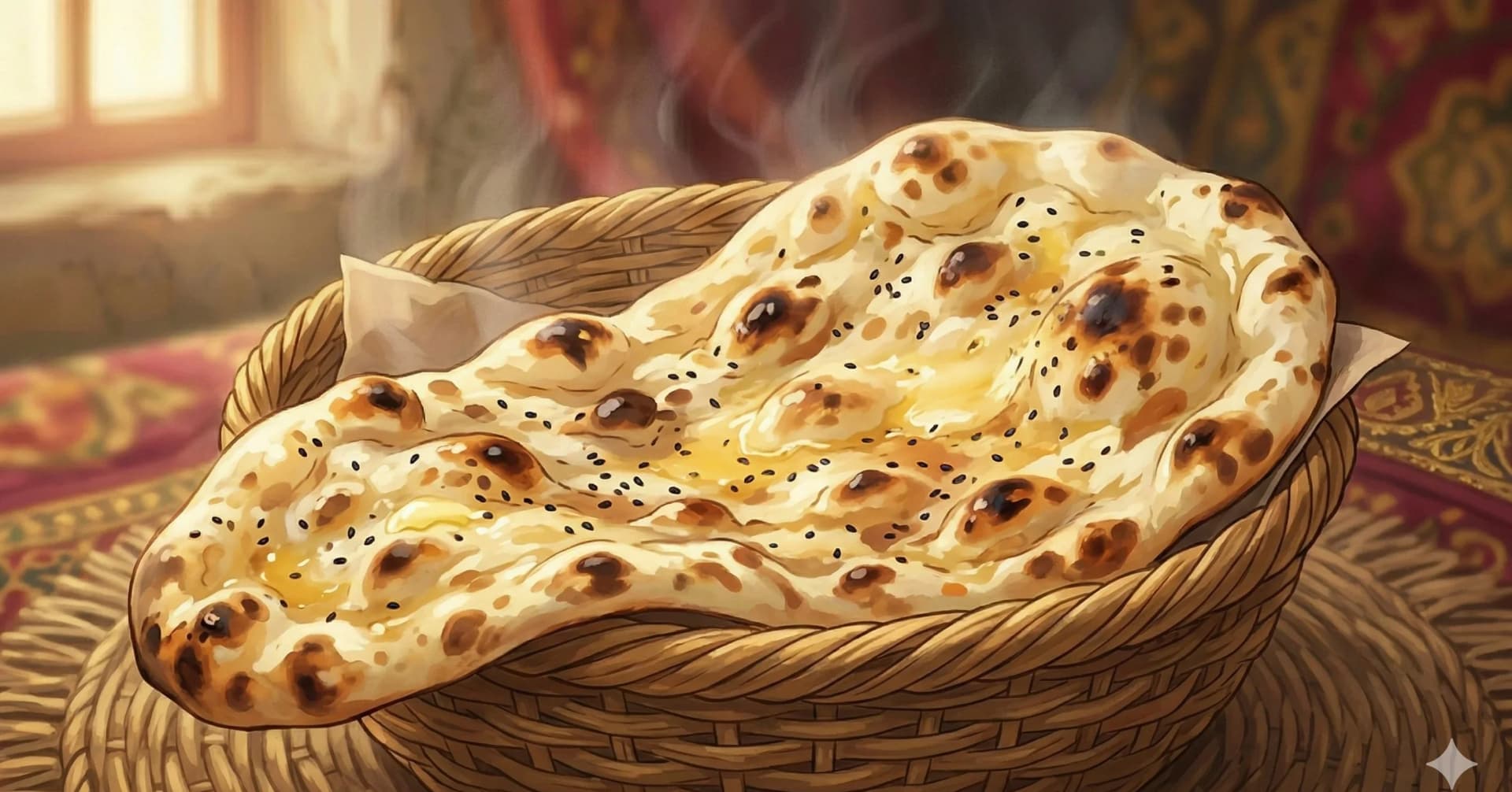
A tandoor operates at temperatures between 400°C and 480°C — an environment so intensely hot that a disc of raw dough slapped against the clay wall cooks in under two minutes. The moisture inside flash-vaporises into steam that inflates the bread from within, while the surface in contact with the clay develops that signature leopard-spotting: irregular dark patches of char against a pale, puffed, slightly translucent crumb. This is what gives naan its character. Outside: lightly scorched, faintly smoky, with a crispness that yields almost immediately to the soft, airy interior beneath.
In the home kitchen, that 480°C clay wall is unavailable. But a cast-iron pan, preheated empty over the highest possible heat for a full ten minutes, can get remarkably close. The pan surface will reach somewhere around 250–300°C — not a tandoor, but hot enough to produce genuine blistering, a little char, and the steam-puffed interior that distinguishes naan from an ordinary flatbread. Briefly covering the pan with a lid during the first side creates a small pocket of steam, helping the bread to puff before the surface locks in place. Uncover, flip, and let the second side develop its own char directly on the dry iron.
Naan is North Indian in its current form but has antecedents that reach back through Persia — the word itself likely derives from the Persian nan, a generic term for bread. What distinguishes it from other South Asian flatbreads is the leavening: both yeast for rise and yogurt for tenderness and a faint sourness. The yogurt's lactic acid tenderises the gluten, keeping the crumb soft even as the surface takes on colour and char. Maida — finely milled, low-ash wheat flour — is traditional and produces the whitest, most extensible dough. Plain all-purpose flour is a perfectly acceptable substitute.
Resist rolling the naan into a perfect circle. The teardrop or irregular oval shape is partly aesthetic and partly functional — the thicker rounded end stays soft and doughy while the tapered tip crisps and chars, giving you two textures in a single piece of bread.
At a Glance
Yield
8 naan (serves 4)
Prep
20 minutes active, plus 1–2 hours proving
Cook
20–25 minutes total (about 3 minutes per naan)
Total
1 hour 45 minutes minimum
Difficulty
Easy
Ingredients
- 3¼ cupmaida or plain all-purpose flour, plus extra for dusting
- ¼ ozactive dry yeast
- 2⅓ tspsugar
- ⅔ cupwarm water (approximately 38–40°C — warm to the wrist but not hot)
- ⅓ cupfull-fat yogurt, at room temperature
- 2 tbspneutral oil
- ⅞ tspfine salt
- —Nigella seeds (kalonji)
- —Minced garlic, for a garlic naan variation
- —Fresh coriander leaves, finely chopped
- 2⅔ tbspunsalted butter or ghee, melted, for brushing immediately after cooking
Method
- 1
Activate the yeast. In a small bowl or jug, combine the warm water (150 ml), sugar (2 teaspoons), and active dry yeast (1¾ teaspoons). Stir briefly and leave for 8–10 minutes. The mixture should become foamy and smell yeasty — a crown of froth at the surface tells you the yeast is alive and active. If nothing happens after 10 minutes, your water may have been too hot or the yeast too old. Start again with fresh yeast.
- 2
Make the dough. Combine the flour and salt (1 teaspoon) in a large bowl and make a well in the centre. Add the yogurt, oil, and the activated yeast mixture. Mix with one hand, drawing the flour from the edges of the well, until a shaggy dough comes together. Turn out onto a lightly floured surface and knead firmly for 8–10 minutes, pushing the dough away with the heel of your hand, folding it back, and turning a quarter turn each time. The finished dough should be smooth, elastic, and slightly tacky — it will spring back when pressed. If it sticks aggressively, dust lightly with flour; if it tears, keep kneading.
- 3
First prove. Shape the dough into a ball, rub the surface lightly with oil, and return to the bowl. Cover with a damp cloth or cling film. Leave in a warm place for 1–2 hours until the dough has doubled in size. In a cooler kitchen this may take up to 2½ hours; in a warm one, the dough may be ready in 45–60 minutes.
- 4
Divide and shape. Punch down the proved dough to release the gas, then turn out onto a lightly floured surface. Divide into 8 equal pieces (about 85–90 g each). Roll each piece into a smooth ball. Cover with a cloth and allow to rest for 10 minutes — this brief rest relaxes the gluten and makes shaping considerably easier.
- 5
Roll the naan. On a lightly floured surface, roll or stretch each ball into a teardrop or irregular oval shape approximately 22–24 cm long and 12–14 cm at its widest point, about 4–5 mm thick. The shape should be thicker at the rounded end and taper toward a slight point at the other. If using nigella seeds, press a small pinch onto the surface of each shaped naan and roll over once to press them in.
- 6
Cook — cast-iron pan method. Place a heavy cast-iron pan or tawa over the highest possible heat and preheat for a full 8–10 minutes until the surface is intensely hot — a few drops of water flicked on should evaporate instantly with a sharp hiss. Do not add oil. Lay one shaped naan flat on the dry pan. Immediately cover with a lid or an inverted tray and cook for 60–90 seconds. Bubbles will form and rise across the surface; the steam trapped under the lid inflates the bread from within. Remove the lid. The surface should be puffed and beginning to set. Flip the naan with tongs and cook the second side, uncovered, for a further 45–60 seconds, until dark blistered spots — genuinely dark brown to black at their centres, not merely golden — have formed. Remove from the pan.
- 7
Brush with ghee or butter immediately. As each naan comes off the pan, brush generously with melted butter or ghee while still steaming hot. The hot surface absorbs the fat immediately, transforming the texture from dry to glossy and rich. Stack finished naans in a clean cloth to stay warm while you cook the remaining ones.
- 8
Serve hot. Naan is at its best within the first five minutes. Once it cools, the surface softens to a less interesting uniformity.
Key Ingredient Benefits
Maida is refined wheat flour with the bran and germ removed, producing a fine, white, low-ash flour with a protein content of around 10–11%. This protein level produces a tender, pale crumb rather than the tougher bite of higher-protein bread flour. Plain all-purpose flour is structurally similar and a direct substitute. For a more nutritious naan, up to 30% of the maida can be replaced with wholemeal flour, with a small addition of extra water.
Yogurt provides lactic acid bacteria and live cultures in its raw state. In cooked breads, the bacteria are killed by heat, but the acidity they produced during fermentation remains in the dough, contributing both tenderness and a subtle sour depth of flavour. Research supports the role of live culture dairy in maintaining healthy gut microbiota when consumed uncooked.
Ghee (clarified butter) is the traditional finishing fat for naan. Its milk solids have been removed, giving it a higher smoke point and a concentrated, slightly nutty flavour. Research suggests ghee contains butyrate, a short-chain fatty acid that may support the integrity of the intestinal lining. In Ayurveda, ghee is traditionally regarded as one of the most nourishing and digestive-supporting dietary fats.
Nigella seeds (Nigella sativa), also called kalonji, contribute a faintly bitter, slightly onion-like flavour note. Research suggests the active compound thymoquinone in nigella sativa may have anti-inflammatory properties. In Indian cooking, they are used as an aromatic garnish on breads, pickles, and certain curries.
Why This Works
The combination of yeast and yogurt produces a dough that neither ingredient achieves alone. Yeast provides the primary rise — CO₂ bubbles form during proving and expand dramatically when the dough hits the hot surface. Yogurt contributes lactic acid, which weakens the gluten structure just enough to keep the crumb tender rather than chewy, and adds a subtle sour, milky depth that plain water cannot provide.
Cooking on a completely dry pan is essential. Fat on the surface would fry the dough, producing a golden, even base without char. The dry surface at extreme heat scorches and carbonises in irregular patches — this is the mechanism behind the leopard-spot pattern, and it is inseparable from the flavour of a well-made naan.
Covering the pan for the first side creates a steam chamber. The moisture in the dough vaporises rapidly with nowhere to go, inflating the interior and separating the crust from the crumb. When the lid is removed and the bread is flipped, the interior is already set and airy, and the second side takes its char without steaming.
The teardrop shape has a practical explanation beyond tradition. When a naan is pressed against a tandoor wall, it is held at one end and the weight of the dough pulls it downward, stretching it into a teardrop as it hangs and cooks. The rolled shape anticipates this stretching.
Substitutions & Variations
Instant yeast: Replace active dry yeast with 4 g instant (fast-action) yeast and skip the activation step — add it directly to the flour. Proving time may be 20–30 minutes shorter.
Garlic naan: Mix 4–5 finely minced garlic cloves with the melted butter or ghee used for finishing. Press minced garlic into the surface of each shaped naan before cooking if a more pronounced garlic flavour is wanted.
Peshwari naan: Flatten each proved ball, fill the centre with a mixture of desiccated coconut, ground almonds, and a little sugar (about 1 tablespoon per naan), fold the edges up and over, seal firmly, then roll gently into an oval. The filling caramelises slightly inside during cooking.
Keema naan: Fill with a small amount of cooked, spiced minced lamb — about 2 tablespoons per naan — sealed and rolled carefully. The filled naan will need an extra 30–45 seconds per side.
No-yeast version: Replace the yeast with 5 g baking powder and 2 g bicarbonate of soda. Skip the proving step and cook immediately after resting the dough for 15 minutes. The result is denser and flatter but still soft and satisfying in a different way.
Wholemeal naan: Replace up to 30–40% of the maida with wholemeal flour. Add an extra tablespoon of yogurt to compensate for the drier, more absorbent flour. The naan will be chewier and more nutty in flavour.
Serving Suggestions
Naan is the natural companion to most North Indian main courses — dal makhani, murgh makhani, paneer makhani, rogan josh, or any rich curry where the bread acts as both scoop and vehicle. At a tandoor meal, it sits alongside murgh malai kebab, paneer tikka, or tandoori murgh, where it can be used to wrap and scoop the charred protein off the skewer. For a lighter use, naan with raita and a simple kachumber salad is a complete and satisfying light meal.
Storage & Reheating
Uncooked proved dough can be refrigerated for up to 24 hours after the first prove — the cold slows but does not stop the yeast. Bring to room temperature for 30–45 minutes before shaping and cooking.
Cooked naan stales quickly and is best eaten fresh. Store at room temperature, wrapped in a clean cloth, for up to a few hours. Refrigerate for up to 2 days. To reheat, place directly on a hot dry pan for 30–60 seconds per side, or wrap in foil and warm in a 160°C oven for 8 minutes. Brushing with a little extra ghee before reheating restores much of the original richness. Naan does not freeze well — the crumb turns dry and crumbly on thawing.
Cultural Notes
Naan (नान) is the leavened wheat flatbread of the broader Central Asian and Persian culinary world, adapted into North Indian cuisine through the Mughal courts of the sixteenth and seventeenth centuries and now treated as one of the foundational breads of Punjabi and Delhi restaurant cooking. The bread is cooked in a tandoor (a vertical clay oven heated by a wood or charcoal fire at the bottom), with the dough pressed against the inner clay wall and cooked at temperatures of 480°C (900°F) or higher until it puffs, blisters in irregular dark spots, and develops the crisp-tender contrast that defines a properly cooked naan.
The word naan (from Persian nān, "bread") and the cooking technique both arrived in India with the Mughal armies and court cooks from Central Asia. The Mughal emperors maintained large court kitchens where Persian and Central Asian breadmaking traditions were practiced and refined, and the techniques spread out from the royal kitchens into commercial bakeries and eventually into the Punjabi and Delhi restaurant tradition that emerged in the late nineteenth and twentieth centuries. The wheat-based bread culture of north India absorbed and adapted naan into the regional repertoire alongside the older indigenous unleavened breads (roti, chapati, paratha), with naan occupying the "special occasion" or "restaurant" position rather than the everyday home bread role.
The technical foundation is the leavened dough. Wheat flour (maida, the refined flour preferred for restaurant naan; or whole wheat for home versions) is mixed with yogurt or milk, a small amount of sugar, salt, baking powder, and traditionally a small portion of yeast or a starter dough from a previous day. The dough is kneaded until elastic, allowed to rise for at least an hour, then divided into portions and rolled into elongated teardrop shapes about ten inches long. The shaped naan is slapped onto the tandoor wall (or, in home versions, onto a hot cast iron pan inverted over the flame), where it cooks in about ninety seconds. Variations are countless: garlic naan (with chopped raw garlic pressed into the dough), butter naan (brushed with melted butter or ghee at the end), onion-kulcha (a related Punjabi flatbread with stuffed onion filling), peshwari naan (with a sweet coconut-and-nut filling), and many regional and family variations.
Nutrition Facts
Calories: 536kcal (27%)|Total Carbohydrates: 80g (29%)|Protein: 11.3g (23%)|Total Fat: 18.4g (24%)|Saturated Fat: 7.4g (37%)|Cholesterol: 27mg (9%)|Sodium: 1264mg (55%)|Dietary Fiber: 2.7g (10%)|Total Sugars: 3.7g
You Might Also Like


Ratings & Comments
Ratings & Comments
Ratings
Share your thoughts on this recipe.
Sign in to rate and comment