Kerala · Indian Cuisine
Layered Flaky Flatbread (Kerala Paratha)
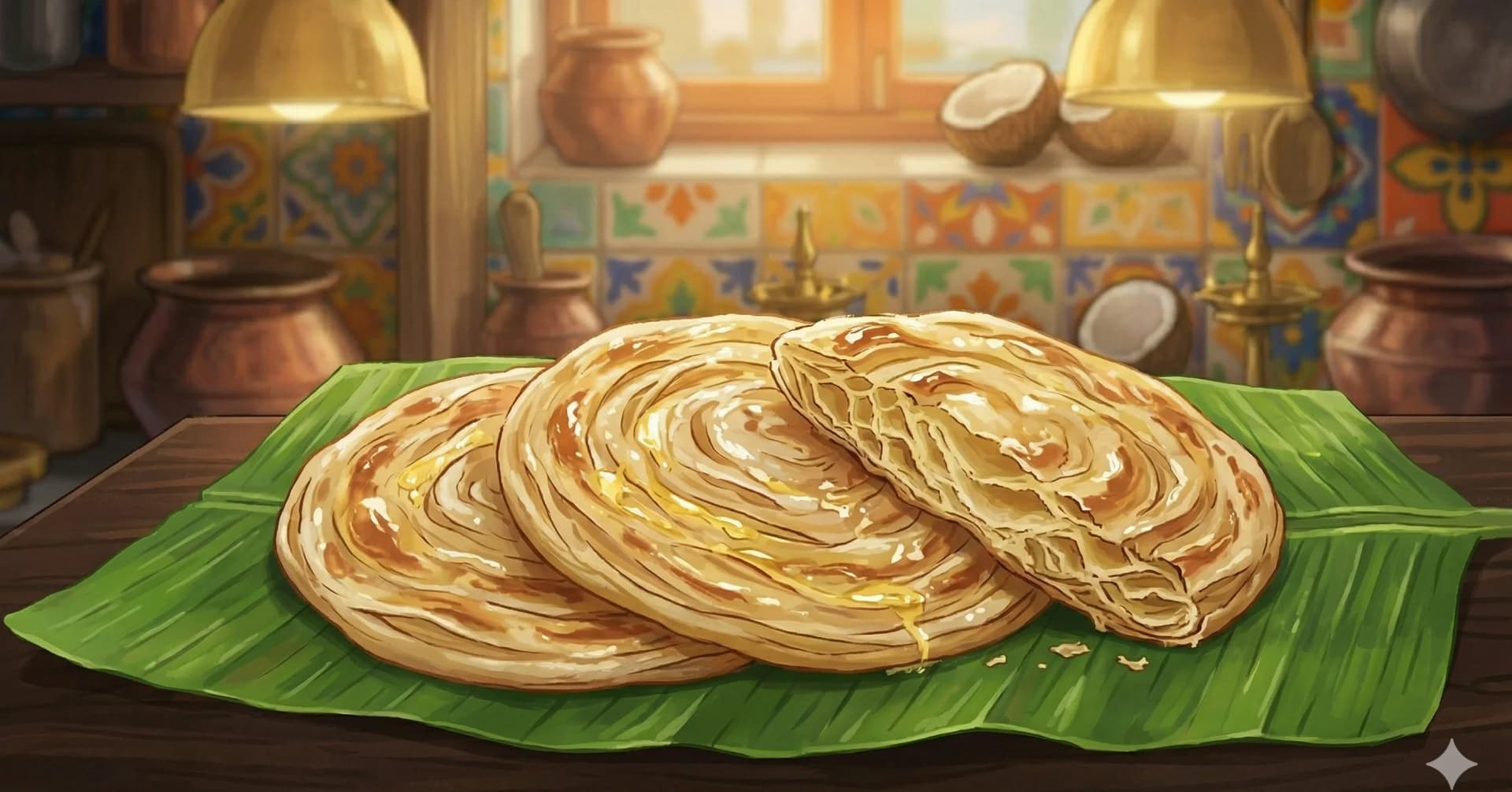
Flaky, layered maida flatbread with egg and milk — the technique of resting and oiling creates its characteristic crisp, honeycomb texture
A Kerala paratha (parotta in the vernacular) is not a roti and not a naan. It is its own thing: supple and flaky and slightly chewy, with a layered interior that is revealed when you press the cooked bread between your palms. This is the standard finishing technique that separates the layers and makes the honeycomb visible. You will see this done in every parotta shop in Kerala, in every roadside hotel, in every home that makes them. The pressing open is as much part of the experience as the eating.
The dough is made with refined flour (maida), eggs, milk, sugar, oil, and salt. Sugar contributes to the golden color on the griddle. Eggs add richness and structure, giving the layers their distinct definition. The dough must rest twice, because each rest allows the gluten to relax fully, which is what permits the rolling of such a thin, extensible sheet without tearing. Gluten that hasn't rested will snap back and resist.
The technique is the recipe. After the second rest, each dough ball is rolled as thin as possible on an oiled surface, then gathered into a loose ribbon (accordion-pleated or pulled into a strand) which is then wound into a tight coil. This coil rests once more before being pressed out into the final disc. When it cooks on the griddle, all those wound layers of oiled dough expand and separate in the heat, creating the characteristic flakiness.
A good parotta should be soft enough to tear with your fingers but firm enough to hold its layers when pressed.
At a Glance
Yield
15 parathas
Prep
30 minutes + 1.5 hours resting
Cook
30 minutes
Total
2.5 hours
Difficulty
Medium
Ingredients
- 8 cupmaida (refined wheat flour / all-purpose flour), plus more for dusting
- ¾ cupoil, plus more for coating and cooking
- 1 tbspsalt
- ⅓ cupsugar
- ½ lbeggs (approximately 4–5 medium eggs)
- 1¼ cupmilk
Method
- 1
Make the dough. Combine the maida, salt and sugar in a large bowl and mix so the salt and sugar are evenly distributed before any liquid goes in. Beat the eggs into the milk until smooth, then pour the mixture into the flour a little at a time, bringing it together with your hand as you go. The dough will look shaggy and dry at first. Keep working it.
- 2
Knead until supple. Turn the dough onto a clean surface and knead for a full 10 minutes. This is an enriched dough with no water in it, so it starts stiff and softens as the egg and milk work through. It is ready when it stretches without tearing and the surface has gone smooth and faintly glossy. Under-kneaded dough will fight you at the rolling stage and tear.
- 3
First rest, one hour. Rub the dough with a little oil, cover it with a damp cloth, and leave it at room temperature for 1 hour. The gluten is tight and elastic straight after kneading and will snap back the moment you try to roll it. The rest is what makes the tissue-thin rolling possible, so it is not a step to trim.
- 4
Divide and oil, second rest. Divide the rested dough into 15 equal balls, roughly 110 g each. Coat each ball generously in oil, set them on an oiled tray with space between them, cover, and rest for another 30 minutes. The oil soaks into the surface during this second rest and is what lets the dough stretch translucent later.
- 5
Roll as thin as you can. Working on a well-oiled surface rather than a floured one, roll and then stretch each ball into a large, very thin sheet, 35 to 40 cm across. Use the rolling pin to get it started and your hands to coax the edges outward. You are aiming for a sheet thin enough to see the surface through. A few small tears are acceptable; a thick sheet is not, because thickness is what stops the layers separating.
- 6
Pleat into a ribbon. Drizzle a thin film of oil over the sheet and spread it to the edges with your palm. Starting at one long edge, gather the sheet into loose accordion folds, working across until you have a long, crumpled ribbon. Lift the ribbon and stretch it gently along its length so it thins further. This is where the layers are actually made: alternating dough and oil, folded on themselves.
- 7
Coil and rest. Wind the ribbon into a tight spiral like a rope coil, tucking the loose end underneath so it holds. Set the coils back on the oiled tray and rest them for 15 to 20 minutes. Skipping this rest means the coil springs open when you press it.
- 8
Press and cook slowly. Flatten each coil with your palm into a disc about 15 cm across, pressing from the centre outward. Use your hand rather than a rolling pin so you do not crush the layers you just built. Heat a tawa or heavy griddle over medium-low. Cook each paratha for 2 to 3 minutes per side, drizzling oil around the edges, until golden brown patches appear and the surface looks dry and set. Low heat matters here: high heat colours the outside before the inside layers have cooked and puffed.
- 9
Clap to open the layers. Take the hot paratha off the griddle and clap it between your palms from both sides, or crush it gently by pushing in from the edges. The layers will loosen and separate visibly and the bread will look twice as tall. Serve at once, while it is still hot enough to steam when torn.
Key Ingredient Benefits
Maida (refined flour): Kerala paratha is specifically made with maida (high-gluten refined wheat flour) and the texture depends on this. Whole wheat flour will produce a denser, less layered result. Maida is the foundation of this bread; substituting it changes the dish fundamentally.
Eggs: Contribute protein and fat to the dough, enriching the texture and helping the layers hold definition during cooking. They also contribute to the golden color.
Sugar: Present in a higher proportion than in most flatbreads. The sweetness is barely perceptible in the finished bread, but its structural role in dough development and color is significant.
Oil in the dough and on the layers: The oil coating between layers is not for flavor but for physics. It prevents the thin sheets of dough from bonding to each other, which is what allows the layers to form.
Why This Works
The double resting period is not optional. It is the mechanism that makes the technique possible. After kneading, gluten networks are tight and elastic; they resist rolling and snap back. An hour of rest allows these networks to fully relax, making the dough extensible enough to roll tissue-thin without tearing.
Sugar serves two functions: it provides fermentable sugars for any light surface browning on the griddle (Maillard reaction and caramelization), and it slightly softens the gluten network in the dough through competition for water molecules, contributing to the tender texture.
The coiling technique creates alternating layers of dough and oil. When these layers hit the heat of the griddle, the oil between them prevents adjacent layers from fusing, so they puff and separate individually rather than cooking as a single mass. This is what creates the flaky, honeycomb interior.
Substitutions & Variations
- Egg-free: Omit the egg and increase the milk slightly. The paratha will be softer and less defined in its layers but still good.
- Milk substitute: Thin coconut milk can replace dairy milk for a faintly coconut-fragrant result.
- Ghee: Using ghee in place of oil on the cooking surface adds richness and color. A more festive version.
- Malabar Paratha: A closely related preparation (see separate recipe) with a longer rest, ghee on the griddle, and the specific technique of forming strands from the rolled sheet before coiling.
Serving Suggestions
- The defining accompaniment for Kerala beef masala or Kerala chicken curry.
- With egg roast, sautéed hard-boiled eggs in a spiced onion-tomato masala.
- With any Kerala ishtu (vegetable or lamb coconut milk stew) for a milder combination.
- At roadside restaurants in Kerala, served with a small cup of chicken or goat curry. This is the standard combination.
Storage & Reheating
Kerala paratha is best eaten immediately after the pressing-open step, while the layers are still distinct and crisp. Leftover parathas can be refrigerated, stacked with parchment between them, for up to 1 day. Reheat on a dry tawa over low heat, or wrapped in foil in a warm oven. The honeycomb texture will soften on storage. Uncooked dough can be refrigerated overnight after the first rest. Bring back to room temperature before dividing and resting a second time.
Cultural Notes
Kerala parotta (പറോട്ട, sometimes spelled parotta or porotta) is the flaky layered flatbread of Kerala and Tamil Nadu, made from a slow-developed wheat dough that is rolled paper-thin, oiled, coiled into a spiral, rolled flat again, and cooked on a hot griddle until both surfaces turn golden and the layers separate into a tender, almost croissant-like flakiness when the bread is squeezed between the hands. The dish is one of the foundational breakfast and lunch staples of Kerala roadside thattukada (small eateries) and one of the most strongly identified breads of the broader South Indian wheat-bread tradition.
The dish's origins are documented in Tamil Nadu, where the related parotta form developed during the late nineteenth and early twentieth centuries in the Madurai region as an adaptation of Sri Lankan and Malabar Muslim flatbread traditions. The Kerala version evolved in parallel and became standardized in the small thattukada roadside restaurants that proliferated across the state from the mid-twentieth century. The dish is now associated with Kerala worldwide, though the Tamil Madurai version remains widely cited as the original.
The lamination is the technical heart of the bread. A soft wheat dough (with a small amount of fat and sometimes egg or milk for richness) is portioned, then each portion is rolled extremely thin into a translucent sheet about ten inches across. The thin sheet is brushed with oil or ghee, then gathered into a long thin rope by pleating the edges, the rope is coiled into a flat spiral like a snail shell, and the spiral is rolled flat into a six-inch disc. The disc cooks on a hot oiled griddle for two to three minutes per side until both surfaces turn golden and the layers separate naturally as the steam expands between them. The cooked parotta is squeezed gently between the cook's palms (a step called parotta crushing) to break apart the layers and produce the characteristic fluffy, flaky structure. The bread is served with chicken curry, kerala-beef-masala, egg roast, fish curry, or any of the standard Kerala accompaniments, with the parotta torn into pieces and used to scoop up the curry by hand.
Nutrition Facts
Calories: 672kcal (34%)|Total Carbohydrates: 107g (39%)|Protein: 17.6g (35%)|Total Fat: 18g (23%)|Saturated Fat: 3.7g (19%)|Cholesterol: 122mg (41%)|Sodium: 76mg (3%)|Dietary Fiber: 3.4g (12%)|Total Sugars: 12.4g
You Might Also Like
Ratings & Comments
Ratings & Comments
Ratings
Share your thoughts on this recipe.
Sign in to rate and comment