Kerala · Indian Cuisine
Country Chicken Curry (Nandan Kozhi Curry)
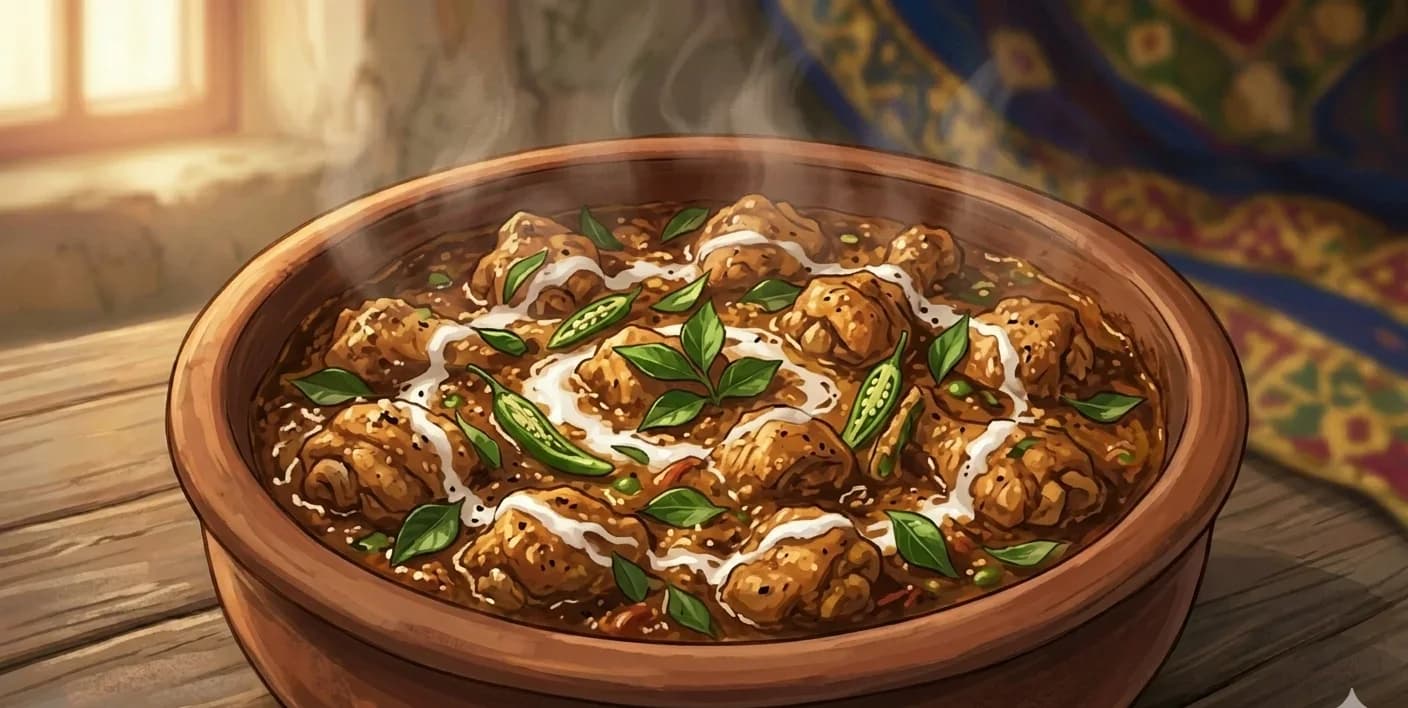
Kerala country chicken curry — native chicken in coconut oil with crackled mustard seeds, coconut milk and twice-extracted aromatics
"Nadan" means country-style in Malayalam: unpretentious, rooted in the village kitchen, built from locally available ingredients without reference to hotel cooking or restaurant convention. Nadan Kozhi Curry is exactly that. A chicken curry that makes no concessions, built on the four pillars of Keralite cooking: coconut oil, curry leaves, mustard seeds, and coconut milk.
The chicken for this curry, in its traditional context, would be a free-range native bird, smaller, firmer, more flavorful than commercial broiler chicken, with less fat and more connective tissue. The cooking reflects this: the curry needs time to allow tougher muscle fibers to soften, which is why coconut milk arrives in two extracts, the thin one first for cooking, the thick one last for finishing. A broiler chicken, used here, will cook faster and produce a slightly softer, gentler result. Both are valid.
What makes this curry distinctly Keralite is the opening: mustard seeds and whole dried red chilli crackled in coconut oil. The mustard seeds must pop; the red chilli must darken. Only then does the garlic, ginger, and green chilli arrive, followed by curry leaves. Each element layers its character into the oil before the onions even begin. The masalas go in next (turmeric, chilli powder, coriander powder, garam masala) and are fried briefly before the chicken is added.
The result is warm, aromatic, and coconut-rich without being sweet or mild. There is heat from the whole red chilli and the fresh green chilli, depth from the fried aromatics, and a gentle creaminess from the coconut milk. It is the kind of curry that makes the rice in the bowl feel like the right place to be.
At a Glance
Yield
6–8 servings
Prep
20 minutes
Cook
45 minutes
Total
1 hour 5 minutes
Difficulty
Medium
Ingredients
- 3¼ lbchicken boneless leg, cut into large pieces
- 1 lbonion (about 2½–3 onions), finely sliced
- ⅔ cupginger, finely chopped or minced
- ⅓ cupgarlic, finely sliced or minced
- 3¼ tbspwhole dried red chilli
- ⅔ cupgreen chilli, slit
- 3¼ tbspmustard seeds
- ⅔ cupcoconut oil
- ¾ cupcurry leaves (about 20–25 leaves)
- 1¾ tbspred chilli powder
- ¾ tspturmeric powder
- 1¾ tbspcoriander powder
- 1⅔ tspsalt, or to taste
- ⅓ tspgaram masala powder
- 2½ cupcoconut milk (use 400 ml thin / second extract for cooking, 200 ml thick / first extract to finish)
Method
- 1
Crackle and bloom. Heat the coconut oil in a wide, heavy pan or a cheena chatti over medium-high heat. Add the mustard seeds. Wait. The seeds need to fully pop and crackle, which takes 30–45 seconds. Once they are actively popping, add the whole dried red chillies. Let them darken for 10–15 seconds. The oil should now smell sharply of mustard and roasted chilli.
- 2
Add aromatics. Add the garlic, ginger, and slit green chillies. Stir and fry for 1 minute. The garlic should begin to color at the edges. Add the curry leaves (20–25 leaves), which will hiss and crisp.
- 3
Fry the onions. Add the sliced onions. Cook over medium heat for 12–15 minutes, stirring regularly, until the onions are a deep, even golden brown. This is not soft-cooking. The onions need color.
- 4
Fry the masalas. Add the red chilli powder, turmeric, coriander powder, and salt. Stir through and fry for 2 minutes. The spice-oil mixture should smell toasted and fragrant.
- 5
Add chicken. Add the chicken pieces and stir to coat thoroughly in the masala. Cook over medium-high heat for 5–6 minutes, stirring, until the chicken is sealed on all sides.
- 6
Cook in thin coconut milk. Pour in the thin coconut milk (second extract). Stir and bring to a simmer. Reduce heat to medium-low, cover partially, and cook for 18–20 minutes until the chicken is completely cooked through and the gravy has reduced slightly.
- 7
Finish with thick coconut milk. Add the garam masala powder. Pour in the thick coconut milk (first extract). Stir gently and heat through without boiling. Keep at a low simmer for 3–4 minutes. Taste for salt. Serve immediately.
Key Ingredient Benefits
Country chicken (nadan kozhi): Free-range native breeds have a firmer texture, more distinct flavor, and higher connective tissue content than commercial broiler chicken. The additional cooking time needed for native birds allows deeper flavor development in the sauce. If using commercial boneless leg, reduce cooking time in step 6 to 12–15 minutes.
Coconut oil: Used generously here. This is Kerala cooking, and coconut oil is not a substitute but the primary fat. Its medium-chain fatty acids have a distinct flavor profile and behave differently from long-chain fats in cooking. Research on medium-chain fats and metabolic pathways continues; what is certain is that coconut oil is the correct sensory choice for this dish.
Mustard seeds: Brown mustard seeds (as used in South Indian cooking) have a sharper, more pungent character than the yellow seeds common in Western cooking. Both will work but black or brown mustard seeds are traditional.
Garam masala: Added only at the end and in small quantity. Just enough to introduce the warm, complex spice character without overwhelming the coconut-forward profile.
Why This Works
Cracking mustard seeds before other aromatics arrive ensures maximum flavor extraction. Whole mustard seeds contain their volatile compounds locked inside the seed coat; heat causes the seeds to pop, rupturing the coat and releasing these compounds directly into the oil. The oil then carries this flavor through every subsequent ingredient.
Browning the onions deeply (rather than just softening them) creates the color and body of the curry's gravy. Caramelized onion solids provide natural sweetness and a mahogany depth that undercooked onions cannot deliver.
The two-extract coconut milk technique manages the trade-off between cooking needs and flavor preservation. The second (thin) extract, lower in fat, can withstand sustained heat without splitting. The first (thick) extract is fragile. It should never fully boil after being added, or the fat separates from the protein, creating an oily, broken sauce. Added at the end over very low heat, it enriches without breaking.
Substitutions & Variations
- Bone-in chicken: Use 2 kg bone-in pieces for a more flavorful result with a slightly richer gravy. Increase cooking time to 30–35 minutes in thin coconut milk.
- Without coconut milk: A small amount of water and a grated fresh coconut ground to paste can replace coconut milk for a more traditional, rustic version.
- Tomato version: Add 2 medium chopped tomatoes with the onions for a slightly tangy, red-tinged curry. Common in certain coastal Kerala households.
- Pepper-heavy version: Double the garam masala and add 1 teaspoon of freshly ground black pepper for a more robust, peppery finish. The Malabar style.
Serving Suggestions
- With plain Kerala boiled rice. The essential pairing.
- With Kerala paratha or Malabar paratha for a restaurant-style meal.
- With pathiri (rice flour flatbreads) for a lighter, coastal presentation.
- The curry can also be served alongside puttu for a more substantial breakfast-style meal.
Storage & Reheating
Nadan Kozhi Curry keeps in the refrigerator for up to 2 days. The coconut milk gravy will thicken on cooling. Reheat very gently over low heat. Do not boil. Add a splash of thin coconut milk or water to restore consistency. The flavors will deepen overnight. Can be frozen for up to 1 month; thaw overnight and reheat slowly, stirring frequently to prevent the coconut milk from separating.
Cultural Notes
Naadan kozhi curry (നാടൻ കോഴി കറി, "country-style chicken curry") is the everyday Kerala home chicken curry built on the standard Kerala flavor foundation: coconut, curry leaves, kashmiri red chili powder, turmeric, fennel, black pepper, and a base of sliced shallots cooked down in coconut oil until soft. The dish is the equivalent in Kerala home cooking of what chicken-curry-punjabi is in Punjab: the most basic everyday non-vegetarian curry that families prepare on weeknights, that mothers teach to children as their first chicken preparation, and that anchors the home cooking tradition across the state.
The word naadan means "country" or "rural" and signals a home-style cooking approach rather than a restaurant version. The dish has no formal recipe codification and varies from household to household: some families add a small amount of coconut milk for richness, others keep it pure tomato-and-shallot; some use tamarind for sourness, others use yogurt; some include a tempering of mustard seeds and curry leaves, others a final scatter of fresh coconut. The constants are the kashmiri red chili powder (for the signature deep red color), the curry leaves (for the signature Kerala aroma), and the coconut oil (the cooking medium that defines Kerala home cooking).
The technique is forgiving. Bone-in chicken pieces are marinated briefly in turmeric, kashmiri red chili powder, and salt. A base of sliced shallots, ginger, garlic, green chilies, and curry leaves is cooked in coconut oil until soft and deep golden. Ground spices (coriander, fennel, black pepper, cinnamon, cloves) are bloomed in the oil for thirty seconds, then chopped tomatoes and the marinated chicken are added. Water or thin coconut milk thins the curry to gravy consistency, the pot covers, and the curry simmers for thirty to forty minutes until the chicken is tender and the gravy has reduced. The dish is finished with a final addition of thick coconut milk (if used), fresh curry leaves, and a small amount of garam masala. The pairing with rice, appam, kerala-paratha, or puttu is universal across Kerala households.
Nutrition Facts
Calories: 624kcal (31%)|Total Carbohydrates: 8.8g (3%)|Protein: 48.2g (96%)|Total Fat: 44.2g (57%)|Saturated Fat: 29.2g (146%)|Cholesterol: 169mg (56%)|Sodium: 1421mg (62%)|Dietary Fiber: 2.5g (9%)|Total Sugars: 4.6g
You Might Also Like

Ratings & Comments
Ratings & Comments
Ratings
Share your thoughts on this recipe.
Sign in to rate and comment