Kerala · Indian Cuisine
Steamed Rice Cylinders (Puttu)
Steamed cylinders of rice flour and fresh coconut — Kerala's most iconic breakfast
Ask someone from Kerala what they miss most when they are away from home, and there is a good chance they say puttu. Not a complex dish, not even a particularly ancient one in its current cylindrical form, but one so embedded in the rhythm of the Kerala morning that its absence is felt bodily.
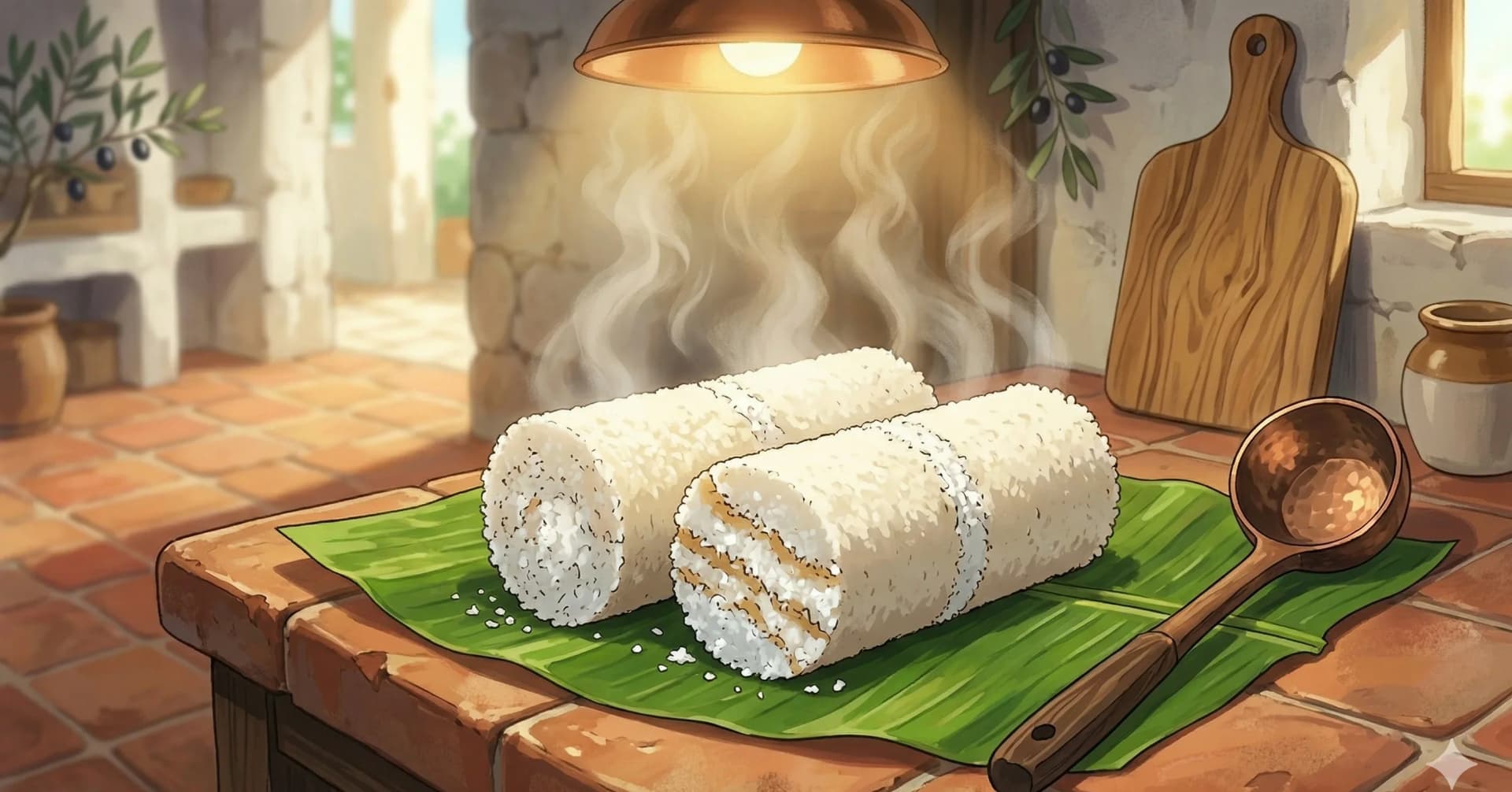
Puttu is steam-cooked rice flour and fresh coconut, layered alternately in a cylindrical mold called a puttu kutti, then pushed out in one piece onto the plate. The layers stay distinct (alternating white and white-cream) and the texture when it lands is grainy and slightly crumbly at first, then yielding, with the coconut providing moisture and sweetness to what would otherwise be dry rice flour.
The preparation sounds simple and is, but the texture depends on getting the moisture level right. The rice flour should be wet enough to hold together when you press a handful in your palm, releasing water if you squeeze, but not so wet that it becomes dense or heavy. Too dry and the puttu will be chalky and crumbling; too wet and it will compact into a solid mass with no porosity. The right texture feels like damp sand just before it becomes mud.
The layering itself (coconut, flour, coconut) is what creates the characteristic visual and textural rhythm of puttu. Steam passes up through the layers, cooking everything evenly from below.
Puttu is eaten with kadala curry (black chickpea curry) for the classic savory combination, or with ripe banana and sugar, or with coconut milk and a pinch of sugar for the simplest possible version. All three pairings are correct.
At a Glance
Yield
2–3 puttu cylinders (serves 2)
Prep
15 minutes
Cook
10 minutes
Total
25 minutes
Difficulty
Easy
Ingredients
- ¾ lbrice flour (roasted, if available; otherwise use plain rice flour)
- 3½ ozfresh coconut, grated
- ⅓ cupwater, approximately (may need more)
- ⅓ tspsalt
Method
- 1
Season the flour. In a wide bowl, combine the rice flour, salt, and about 3 tablespoons of the grated coconut. Mix together with your fingers so the coconut is distributed through the flour.
- 2
Add water gradually. Begin adding water in small amounts (a tablespoon at a time) mixing with your fingertips as you go. Work the water through the flour by rubbing and pressing, not kneading. The goal is to hydrate the flour evenly rather than develop any kind of dough. After each addition, check the texture: take a small handful and press firmly. If it holds together, the moisture is right. If it crumbles, add a little more water. If it compresses into a solid, wet ball, the flour is too wet.
- 3
Prepare the puttu maker. A puttu kutti (puttu maker) has two components: the cylindrical tube with a perforated bottom that sits over a pressure cooker or a vessel of boiling water, and the steam source below it. If you have a puttu maker, fill the lower vessel with water and bring it to a boil. If you do not have a puttu maker, improvise: use a clean length of bamboo with holes drilled at the base, or an idli steamer with the rice flour loosely packed into a tall container.
- 4
Layer the puttu maker. Add the remaining grated coconut to the bottom of the cylinder first, a generous 2-tablespoon layer. Then add rice flour mixture, about half the cylinder's height. Then more grated coconut. Then more rice flour mixture to fill the tube. Finish with a final layer of grated coconut. Do not pack tightly. The rice flour should be loosely filled so steam can pass through.
- 5
Steam. Attach the filled tube to the steam source. Steam for 2–3 minutes, until you see steam rising clearly through the entire tube and the top layer of coconut begins to look wet and cooked.
- 6
Serve. Push the puttu out of the tube onto a plate using the included plunger or a spoon. The cylinder should come out intact, with the coconut layers visible at each end and the white rice flour in between. Serve immediately.
Key Ingredient Benefits
Rice flour: Traditionally, puttu is made from red rice flour (kuthari podi), coarsely ground, slightly nutty, with a warmth that white rice flour lacks. If red rice flour is available, use it. Roasted rice flour produces a more aromatic, slightly drier puttu that holds together slightly better.
Fresh coconut: Non-negotiable here. Desiccated coconut has insufficient moisture and lacks the fresh, slightly sweet character that makes puttu what it is. In a dish this simple, the quality of the coconut is the quality of the dish.
Salt: Just enough to season the flour. Not to make the puttu taste salty, but to make it taste like itself rather than like blank rice flour.
Water quality: Soft water produces a slightly cleaner-tasting puttu. This matters more than it might seem in a four-ingredient preparation.
Why This Works
The loose, granular texture of well-made puttu depends on hydrating the starch partially, not fully gelatinizing it as in pathiri, and not creating a dough. The steam finishing step causes the partially hydrated starch granules to gelatinize in situ, with enough space between them (maintained by the loose packing) to allow each granule to swell and set individually rather than fusing into a dense mass.
Fresh coconut's natural moisture lubricates the gaps between starch granules and provides the fat needed to prevent the cooked flour from tasting dry. The fat in coconut also carries the volatile aromatic compounds that give fresh coconut its characteristic fragrance.
Layering the coconut at the bottom and top of the mold rather than mixing it throughout gives the dish its visual identity and ensures each slice or bite of the extracted cylinder contains a proportion of coconut without it all falling to the bottom during steaming.
Substitutions & Variations
- Red rice puttu: Use coarsely ground red rice flour for a more complex, nutty, traditional result.
- Wheat puttu: Whole wheat flour can replace rice flour for a heartier, denser version. Common in some regions of Kerala.
- Ragi puttu: Finger millet (ragi) flour produces a dark, slightly earthy puttu. Requires slightly more water to hydrate.
- Sweet puttu: Mix a tablespoon of jaggery powder into the rice flour with the coconut for a lightly sweet breakfast version.
- Mini puttu: Use a smaller mold or roll the flour into balls by hand and steam in an idli cooker for a different shape with identical flavor.
Serving Suggestions
- With kadala curry (Kerala black chickpea curry). The defining combination. The slightly bitter, spiced curry against the neutral rice flour is precisely calibrated contrast.
- With ripe banana, simply laid beside the puttu. Eat alternating bites.
- With coconut milk, a pinch of sugar, and a very ripe banana. This is the breakfast version most often made for children.
- With pappadum and banana chips for a complete, textured Kerala breakfast plate.
- With parippu curry (dal). A gentler pairing for mornings when kadala feels too assertive.
Storage & Reheating
Puttu is at its best immediately after steaming and pushing from the mold. It dries out quickly as it cools. Leftover puttu can be crumbled into warm coconut milk for a very satisfying porridge-like dish. Alternatively, crumble cold puttu into a pan with a little coconut oil, a pinch of salt, and some grated coconut, and stir-fry briefly. This is a common next-morning use. Do not refrigerate the steamed puttu; the texture becomes dense and unpleasant. The dry rice flour mixture can be prepared and kept covered for a few hours before steaming.
Cultural Notes
Puttu (പുട്ട്) is the Kerala steamed cylinder of rice flour and grated coconut, layered in alternating bands of rice and coconut in a tall cylindrical bamboo or steel steamer, and cooked over boiling water until the rice softens and absorbs the coconut moisture. The dish is one of the foundational breakfast staples of Kerala, eaten across Hindu, Muslim, and Christian communities of the state, and represents one of the older indigenous Kerala dishes that predates the Portuguese and Arab culinary influences of the medieval period.
The technique demands a specific steamer. The puttu kutti (literally "puttu stick") is a vertical cylindrical steamer with a perforated bottom that sits over a pot of boiling water, allowing steam to rise through the cylinder and cook the rice. The cylinder is filled in alternating layers: a tablespoon of grated fresh coconut, a handful of moistened rice flour, more coconut, more rice flour, and so on, with the layers stacked but not packed (the loose stacking is critical, as packed rice will not cook evenly). The whole cylinder is steamed for eight to ten minutes, then pushed out onto a plate as an intact column with visible white and yellow-tinged bands.
The serving determines the eating experience. Puttu is eaten in different ways across Kerala's diverse communities: with ripe banana mashed into the rice and a drizzle of jaggery syrup at Hindu and Christian breakfasts; with kadala curry (a black chickpea curry made with coconut and tamarind) in the most universally recognized combination called kadala curry-puttu; with fish curry and pickle in coastal Christian and Muslim households; or with simple sugar and milk as a child's preparation. The dish travels well as a packed lunch since the cooked column holds together at room temperature and can be reheated by steaming, and Kerala's labor migration to the Gulf states from the 1970s onward carried the dish into the South Indian-Gulf restaurant tradition that now serves puttu at breakfast across Dubai, Sharjah, Doha, and other Gulf cities with large Malayali diaspora communities.
Nutrition Facts
Calories: 481kcal (24%)|Total Carbohydrates: 81.6g (30%)|Protein: 8.3g (17%)|Total Fat: 14g (18%)|Saturated Fat: 10.5g (53%)|Cholesterol: 0mg (0%)|Sodium: 681mg (30%)|Dietary Fiber: 7.6g (27%)|Total Sugars: 2.8g
You Might Also Like


Ratings & Comments
Ratings & Comments
Ratings
Share your thoughts on this recipe.
Sign in to rate and comment