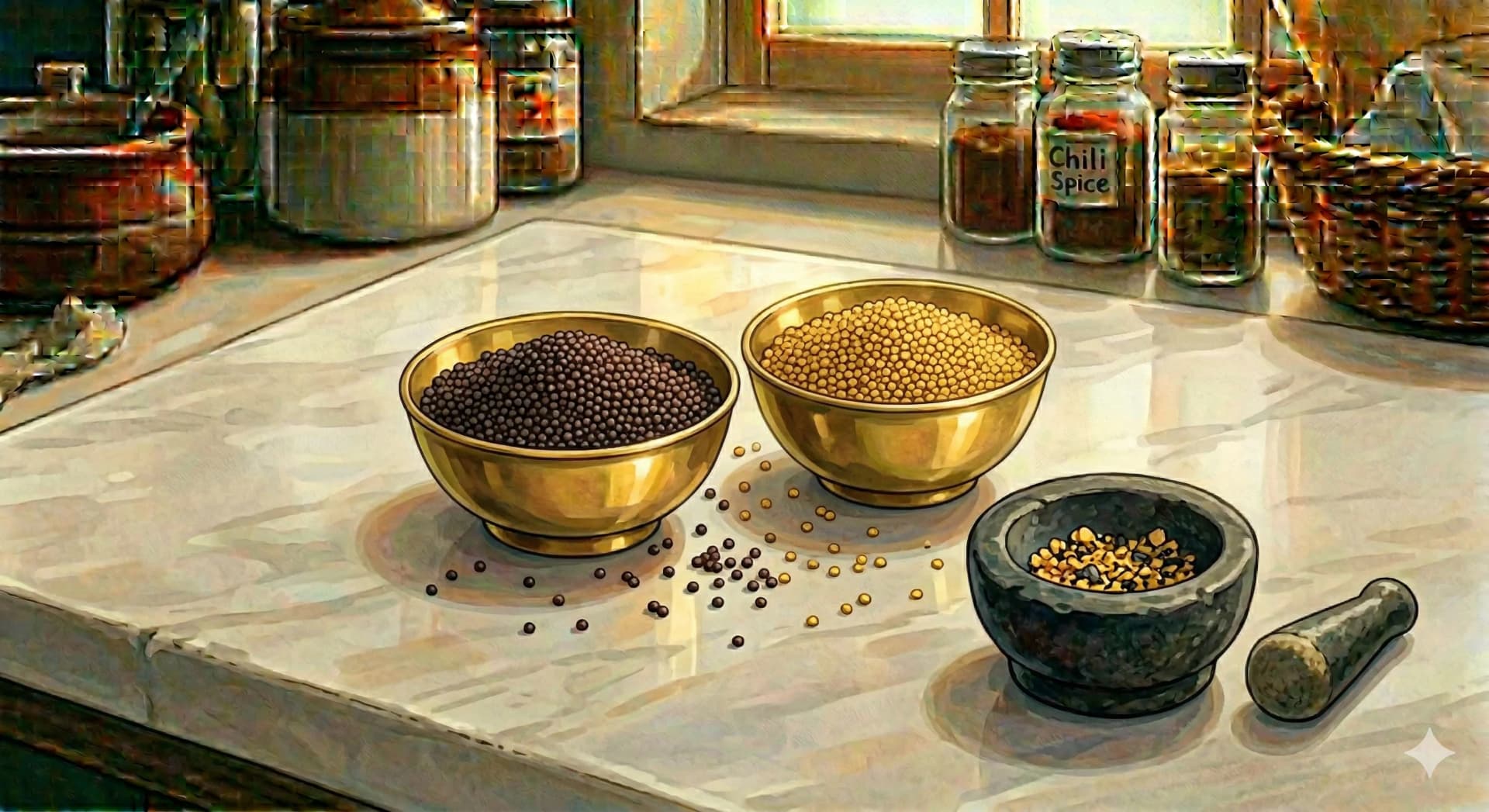
Mustard Seeds
Also known as: Rai, Sarson, Brassica juncea (brown), Brassica nigra (black), Brassica alba (yellow)
Mustard seeds are one of the most chemically remarkable spices in the pantry because their flavor changes entirely depending on how they are prepared. This is not a subtle shift in intensity but a complete transformation: the same seed can deliver two entirely different flavor experiences depending on whether it is ground raw and combined with liquid, or fried whole in hot oil.
Raw ground mustard, when mixed with water, triggers an enzymatic reaction that converts glucosinolates into isothiocyanates, the compounds responsible for the sharp, nose-clearing pungency of prepared mustard, wasabi, and horseradish. But when whole mustard seeds are dropped into very hot oil, this reaction never has a chance to begin. Instead, the seeds toast rapidly, their surface starch gelatinizes, they pop and crackle, and what emerges is a nutty, sweet, slightly smoky flavor with almost no pungency whatsoever.
This duality is why mustard seeds are used in fundamentally different ways across different cooking traditions, sometimes within the same country. South Indian cooking exploits the hot-oil method almost exclusively, using mustard seeds as the backbone of tempering (tadka or chaunk): seeds go into hot oil first, they pop and become nutty and aromatic, and then the rest of the tempering ingredients follow. Bengali cooking, on the other hand, makes considerable use of ground mustard paste, which leverages exactly that sharp enzymatic pungency, especially in mustard fish preparations (shorshe maach) and kasundi, the pungent Bengali mustard condiment.
Three species matter in the kitchen. Black mustard (Brassica nigra) is the most pungent and most historically significant, the species used across South India for tempering. Brown mustard (Brassica juncea) is slightly less sharp but more common in South Asian cooking broadly and is the standard for Dijon mustard. Yellow or white mustard (Brassica alba) is milder and more common in American and European prepared mustards.
Key facts at a glance:
- Dual flavor profile — nutty when fried whole, pungent when ground raw with liquid
- Three species — black (Brassica nigra), brown (Brassica juncea), yellow (Brassica alba)
- Backbone of South Indian tempering — the first spice added to hot oil
- Glucosinolate-to-isothiocyanate conversion — the enzymatic reaction behind mustard's heat
- Over 3,000 years of cultivation — referenced in Sanskrit texts and Tamil Sangam literature
Flavor Profile
Origin
India, Mediterranean, Central Asia
Traditional Medicine Perspectives
Ayurveda:
Mustard seeds are considered one of the most heating (ushna) spices in the Ayurvedic pharmacopoeia. They strongly increase Pitta and reduce Kapha and Vata. Traditionally they are considered excellent for stimulating digestive fire (agni), clearing cold and damp conditions in the body, and promoting circulation. Mustard is one of the spices used in Panchakarma treatments, particularly in external applications: mustard seed poultices (lepa) are applied to cold, stiff joints and areas of blocked circulation to bring warmth and stimulate movement. Internally, small amounts in cooking are considered therapeutic for sluggish digestion, cold-type congestion, and accumulation of ama (metabolic waste). Those with excess Pitta, inflammatory conditions, or fever are advised to use mustard sparingly.
Traditional Chinese Medicine:
Mustard seeds are warming in TCM, entering the lung and stomach meridians. They are categorized as pungent and warm, useful for resolving cold phlegm obstructing the lungs and treating cold-type respiratory conditions. Ground mustard has been used topically in similar fashion to Ayurvedic external applications, drawing circulation to the surface and warming cold conditions. The ability of mustard to resolve stagnation (of both phlegm and blood circulation) is a shared thread across multiple traditional medicine systems.
Modern Scientific Research
The glucosinolate compounds in mustard seeds have attracted considerable research attention, primarily because their breakdown products, including allyl isothiocyanate, sulforaphane, and related compounds found across the Brassica family, show promising activity in cancer prevention research. Allyl isothiocyanate in particular has been studied for its ability to induce apoptosis in several cancer cell lines in laboratory settings, though clinical human trials remain limited. The broader field of cruciferous vegetables and cancer prevention is one of the better-supported areas of nutritional epidemiology, with consistent associations in population studies.
Mustard seeds are a notable dietary source of selenium, an essential trace mineral involved in thyroid function, DNA synthesis, and antioxidant defense.
Selenium deficiency is associated with increased cancer and cardiovascular risk in population studies, and selenium-rich foods including mustard seeds represent a whole-food source of this often-underdiscussed nutrient. Topical mustard applications, the traditional poultice tradition, have been examined for counterirritant mechanisms: allyl isothiocyanate activates TRPA1 receptors in the skin, producing heat sensation and increased local circulation, which provides the physiological basis for the traditional external applications.
Cultural History
Mustard has one of the longest documented histories of any cultivated plant. Seeds have been found in prehistoric sites across Europe and Asia, and mustard appears in Sanskrit texts dating back over 3,000 years. In India, it was likely one of the earliest cultivated oilseed crops: mustard oil extracted from Brassica juncea and Brassica nigra remains the dominant cooking fat of Bengal, Odisha, Bihar, and Punjab. Sarson da saag, the classic Punjabi dish of mustard greens cooked with ghee, represents a culinary culture where the entire plant, seeds, greens, and oil, has always been used together.
In South Indian cooking, the black mustard seed's role in tempering is ancient and culturally central. Tamil Sangam literature from roughly 200 BCE to 300 CE already references mustard seeds and the technique of frying them in sesame oil. The first act of making a sambar, a rasam, a dal, a sabzi, or a chutney in Tamil Nadu, Kerala, Karnataka, or Andhra cooking is almost always dropping mustard seeds into hot oil and waiting for them to pop. This is not seasoning added at the end: it is the flavor foundation built first. The tempering oil infused with mustard, curry leaves, dried red chilies, and asafoetida becomes the aromatic base upon which everything else builds.
The same seed followed completely different culinary paths — one becoming a tempering spice and the other the world's most consumed condiment category — a testament to the unusual versatility of Brassica seeds.
The European mustard tradition diverged early: Greek and Roman cooks made pastes from crushed mustard seeds mixed with wine, the precursor to modern Dijon and English mustard. Charlemagne reportedly ordered mustard grown on royal estates in the 9th century. The mustard industry of Dijon developed in the 14th century and formalized the use of verjuice (unfermented grape juice) to trigger and fix the pungent enzyme reaction. This remains the basis of commercial Dijon production.
Culinary Uses
In South Indian cooking, the technique of tempering with mustard seeds is both specific and non-negotiable for authentic results. Oil must be genuinely hot before the seeds go in: if the oil is not hot enough, the seeds will soak and turn bitter rather than popping and becoming nutty. The seeds should be added and the pan covered briefly (they scatter explosively when they pop), then uncovered once the popping subsides. The moment they pop, curry leaves, dried red chilies, and asafoetida typically follow immediately. This entire tempering process takes under two minutes and forms the flavor foundation for some of the most complex-tasting dishes in world cuisine.
In Bengali cooking, whole mustard seeds can be used in tempering (panch phoron, the five-spice blend, includes black mustard seeds alongside fenugreek, nigella, cumin, and fennel), but the more distinctive Bengali application is making a raw ground mustard paste. Seeds are soaked briefly, then ground with green chilies and sometimes a little oil and turmeric into a pale yellow paste of intense pungency. This paste is central to shorshe maach (mustard fish), where it is mixed with mustard oil and cooked gently with fish. The key is not to overheat the paste, which would destroy the enzymatic pungency that makes the dish distinctive.
Preparation Methods
Tempering (South Indian method): Heat oil or ghee over medium-high heat until shimmering. Add mustard seeds. Cover the pan. When popping slows (15-30 seconds), uncover and immediately add curry leaves, dried red chilies, and any other tempering ingredients. Pour this flavored oil over cooked dal, rice, or vegetables.
Ground mustard paste (Bengali method): Soak whole mustard seeds in cold water for 30 minutes. Drain. Grind with green chilies, a pinch of turmeric, and salt using a mortar or blender. Add just enough water or mustard oil to form a paste. Use immediately or within a few hours before the flavor fades.
Achaar (pickle): Combine mustard seeds with mustard oil, turmeric, salt, and vegetables or fruit. The seeds ferment slightly in the oil and acid over days, softening and mellowing while contributing a characteristic mustard depth to the pickle.
Storage: Keep whole mustard seeds in an airtight container. They last 2-3 years. Ground mustard loses pungency rapidly once ground; prepare fresh or store ground mustard sealed tightly for no more than a few months.
Traditional Dishes
- Dal Tadka
- Sambar
- Rasam
- Avial
- Tamil Nadu Sabzi
- Bengali Mustard Fish (Shorshe Maach)
- Kasundi
- Mustard Pickle (Achaar)
- Aloo Methi
- Panch Phoron dishes
- Sarson da Saag
Recipes Using Mustard Seeds
- Maharashtrian Tomato Soup (Tomato Saar)
- Carrot and Cabbage Thoran
- Chicken Chettinad
- Fritters in Yogurt Curry (Kadhi Pakora)
- Onion Coconut Curry (Kandyache Pitley)
- Fish Moilee
- Maharashtrian Spiced Rice (Masale Bhaat)
- Country Chicken Curry (Nandan Kozhi Curry)
- Dosa Masala
- Chicken 65
- Vada Pav
- Dahi Vada
- Rolled Chickpea Pinwheels (Khandvi)
- Goan Rice Porridge (Pez-Conji)
- Tamarind Rice
- Lamb Ishtu
Comments
Share your thoughts on this ingredient.
Sign in to comment0 Comments