Kerala · Indian Cuisine
Mixed Vegetables in Coconut (Avial)
Kerala mixed vegetable dish with freshly ground coconut and tangy yogurt
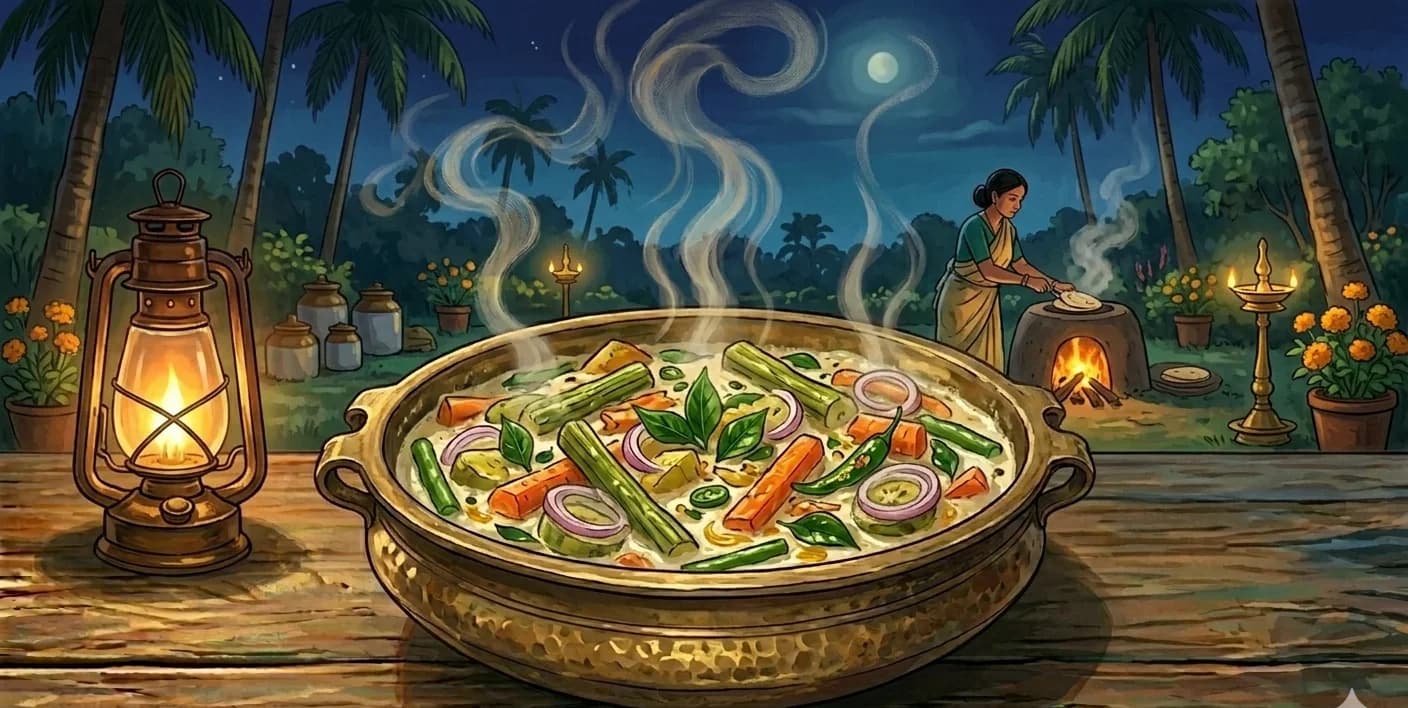
Avial arrives at the Onam Sadya banquet (the grand Kerala harvest feast served on a banana leaf) as something that quietly anchors everything around it. The rice, the sambhar, the pickles and papadums are vivid and assertive; Avial is the gentle one. Pale green-white, its sauce thick and cling-coated rather than soupy, carrying the fresh fragrance of coconut, cumin, and curry leaves, with a yogurt tanginess that holds everything together. Eat a spoonful with rice and nothing else, and you understand why it is considered one of Kerala's great dishes.
The word avial simply means to boil or mix, which tells you something about how unshowy this dish chooses to be. It is one of the few dishes on the Sadya that is entirely vegetarian by both tradition and design, and it draws its authority from the combination of whatever vegetables are fresh and seasonal: raw banana, yam, drumstick, carrot, beans, raw mango, each one cut to the same finger-length so they cook consistently. A single-vegetable version is possible but misses the point; the beauty is in the chorus.
Avial is attributed in folklore to Bhima, the Pandava warrior from the Mahabharata, who is said to have improvised it when left to cook for a large gathering with only assorted vegetables at hand. Whether or not this origin holds, it reflects the dish's character: resourceful, undemanding of precision, but deeply satisfying when made with care.
The key technical point is restraint. The coconut paste should be coarse, not smooth. Some texture in the coating is traditional and desirable. The yogurt must be added off the heat; boiling it splits it and produces a greasy, curdled texture. The coconut oil drizzled at the very end is not decorative. Its fragrance and freshness are flavors that cooking would drive off. These three moments of restraint are what make Avial Avial.
At a Glance
Yield
Serves 4
Prep
25 minutes
Cook
30 minutes
Total
55 minutes
Difficulty
Medium
Ingredients
- 1small raw banana (plantain), peeled and cut into finger-length pieces
- 3½ ozyam, peeled and cut into finger-length pieces
- 1drumstick (moringa pod), cut into 5 cm lengths (or 80 g green beans)
- 1medium carrot, cut into finger-length sticks
- 2¾ ozgreen beans, topped and tailed, halved
- 3½ ozraw mango (if in season), peeled and cut into thin strips
- 1medium potato, peeled and cut into finger-length sticks
- 5½ ozfresh grated coconut (or frozen grated coconut, thawed)
- 3green chillies, roughly chopped
- 2⅓ tspcumin seeds
- 5½ ozfull-fat plain yogurt, at room temperature, lightly whisked
- 1⅞ tspturmeric
- 1⅔ tspfine salt
- ¾ cupfresh or dried curry leaves (about 2 sprigs)
- 2 tbspcoconut oil
Method
- 1
Cook the longer-cooking vegetables first. Place the yam (100 g) and drumstick (1) pieces in a wide pan with 150 ml of water, turmeric (1 teaspoon), and half the salt (2 teaspoons). Bring to a boil over medium-high heat and cook for 8–10 minutes until the yam begins to soften at the edges. Drumstick is porous and cooks relatively quickly; yam takes longer. Both should be just shy of done when the next vegetables go in.
- 2
Add remaining vegetables. Add the raw banana (1), potato (1), carrot (1), and green beans (80 g) to the pan. Add a little more water if needed. The water level should be just enough to prevent burning, not enough to boil the vegetables (you want them to steam-cook and absorb flavour, not become waterlogged). Add the raw mango (100 g) now if using. Add the remaining salt. Cook over medium heat for 8–10 minutes more, until all vegetables are just tender when pressed with a finger. They should yield cleanly but hold their shape. Do not allow them to become soft or mushy.
- 3
Make the coconut (2 tablespoons) paste. While the vegetables cook, combine the grated coconut (150 g), green chillies (3), and cumin seeds (1 teaspoon) in a blender or stone grinder. Process to a coarse paste, adding just enough water (1–2 tablespoons) to help the blender move. The paste should have texture; you want to be able to see individual strands of coconut. An overly smooth paste loses this quality and blends into the yogurt rather than providing the characteristic coating.
- 4
Add the coconut paste. When the vegetables are just cooked, check that there is very little liquid remaining in the pan. If there is more than a few tablespoons, increase heat briefly to reduce it. Add the coconut paste and fold gently through the vegetables with a wooden spoon or spatula. The paste will coat each piece. Cook for 2–3 minutes over low heat, stirring gently, until the coconut is heated through and fragrant.
- 5
Add yogurt off the heat. Remove the pan from the heat entirely. Add the whisked yogurt and fold through gently. The yogurt should coat the vegetables evenly. Do not return to the heat after this point. Boiling the yogurt causes it to split, producing a curdled, greasy texture that is the most common mistake in avial.
- 6
Finish with curry leaves and coconut oil. Scatter the curry leaves over the top. Whole sprigs are traditional; the leaves can be stripped off the stalk if preferred, but leaving the sprig is more common. Drizzle the coconut oil over the surface. The oil should pool slightly on top rather than being stirred in. The fragrance that rises when the curry leaves hit the warm oil is the signal that the dish is ready.
Key Ingredient Benefits
Fresh coconut provides dietary fibre, medium-chain fatty acids, and a range of minerals including manganese. The fat in fresh coconut is predominantly saturated, in the form of lauric acid, which research suggests may behave differently from other saturated fats in terms of cholesterol metabolism. This remains an area of ongoing study. Coconut has been a central part of the Kerala diet for centuries.
Yogurt provides protein and calcium, as well as live cultures in traditionally made or probiotic yogurt. Adding yogurt off the heat (a standard step in avial) preserves its live bacterial cultures. Traditionally prepared Kerala avial uses slightly soured homemade yogurt, more acidic than commercial, which gives the dish a brighter, sharper tang.
Drumstick (moringa) is a pod vegetable widely used in South Indian cooking. Research has explored the nutritional composition of moringa leaves extensively; the pod itself provides dietary fibre and some iron. It has been used in traditional South Indian medicine and cooking for centuries as both food and herbal preparation.
Curry leaves are aromatic and used generously in Kerala cooking. They are high in iron and have traditionally been used in Ayurvedic preparations. Research has explored potential anti-oxidative properties of compounds in curry leaves, though most strong health claims remain in early stages of study.
Why This Works
Cooking the vegetables in staggered additions according to their density (yam and drumstick first, then the softer vegetables) ensures every piece finishes at the same point of doneness. This is the practical skill at the center of avial preparation; a dish where the yam is hard and the beans are mushy is not avial in the Sadya tradition.
The coarse coconut paste creates a textural and flavour layer that a smooth paste cannot. The visible fibres of grated coconut hold the yogurt, preventing it from running to the bottom of the pan, and contribute a chew and freshness that is part of the dish's identity. Cumin seeds in the paste provide a toasted, earthy note that bridges the sweetness of coconut and the tang of yogurt.
Finishing with coconut oil rather than cooking in it preserves the oil's volatile aromatic compounds: the grassy, slightly floral fragrance that characterises raw Kerala coconut oil. Cooking with it would drive these off. This off-heat finishing technique appears across Kerala cooking wherever coconut oil's freshness is wanted as a top note.
Substitutions & Variations
Vegetables: Avial is intentionally flexible. Use whichever combination of vegetables is fresh and available. Traditionally the key is variety: at least four to five different vegetables, and the inclusion of something slightly starchy (yam, banana, potato), something fibrous (drumstick, beans), and ideally something with acidity (raw mango, kokum, or a small amount of tamarind paste). Do not substitute ripe banana for raw; ripe banana becomes sweet and mushy.
Yogurt to sour curd: More traditional versions use heavily soured homemade curd (sour enough to be almost uncomfortably tangy on its own). If your yogurt is mild, add a small squeeze of lime juice to approximate this acidity.
No fresh coconut: Frozen grated coconut (thawed) is an acceptable substitute. Desiccated coconut can be used in a pinch. Soak in warm water for 10 minutes before grinding, but the resulting texture is less fresh.
Vegan version: Replace the yogurt with a small amount of tamarind paste dissolved in water (1 teaspoon tamarind in 3 tablespoons water). The flavor profile shifts but remains authentic. Some regional variations of avial use tamarind rather than yogurt.
Serving Suggestions
Avial is essential to the Kerala Onam Sadya (the full feast served on a banana leaf at Onam harvest festival) where it sits alongside rice, sambhar, rasam, various pickles, papadums, and payasam dessert. In a simpler home context, avial is excellent as a side to plain rice or alongside any Kerala fish or prawn curry, where its mildness and freshness offer contrast to richer, spiced preparations. It also works beautifully as a light main for a vegetarian meal, served simply with steamed rice and a papadum.
Storage & Reheating
Avial keeps in the refrigerator for up to 2 days, though the vegetables continue to soften slightly and the flavors mellow. The yogurt-coconut coating is delicate; do not reheat vigorously. Warm gently in a pan over the lowest heat, stirring minimally, adding a tablespoon of water if the mixture seems dry. Do not bring to a boil. A drizzle of fresh coconut oil added at serving restores some of the fresh fragrance.
Cultural Notes
Avial (അവിയൽ) is the Kerala mixed vegetable preparation in which a wide assortment of vegetables (drumsticks, carrot, plantain, ash gourd, cucumber, yam, snake gourd, green beans, and others) is cooked with a coarsely ground paste of coconut, cumin, green chilies, and turmeric, then finished with a final drizzle of raw coconut oil and a scatter of fresh curry leaves. The dish is one of the foundational vegetarian preparations of Kerala cooking and a fixture of the sadya, the elaborate vegetarian banquet served on a banana leaf at major Kerala festivals (Onam, Vishu) and at Kerala wedding meals.
The dish has a documented mythological origin attributed to Bhima, one of the Pandava brothers of the Mahabharata epic. According to the Kerala folk tradition, Bhima was working as a cook (named Ballava) at the court of King Virata during the Pandavas' year of incognito exile. When faced with the need to feed a sudden gathering of guests with limited vegetables and limited time, Bhima allegedly chopped together whatever vegetables were available, cooked them with coconut paste, and named the resulting dish avial. Whether the origin story is historical or legendary, the dish has been documented as a Kerala specialty since at least the medieval period and remains identified with the broader Kerala vegetarian tradition.
The technique demands attention to vegetable timing. The various vegetables are cut into long sticks (about three inches long, half an inch thick) and cooked in a clay or heavy pot with a small amount of water, salt, and turmeric, with the slow-cooking vegetables (yam, plantain, ash gourd) going in first and the quick-cooking ones (cucumber, snake gourd) added in the second half. When all the vegetables are just tender, the coconut paste (made from fresh grated coconut, cumin seeds, green chilies, and a small amount of water ground to a coarse paste) is added and stirred gently. The final step is a drizzle of raw coconut oil and a generous scatter of fresh curry leaves, both added off the heat so their volatile aromatics stay sharp. Sour yogurt or a small amount of tamarind water is added for tang. The dish appears at every Kerala sadya alongside sambar, thoran, tomato-saar, and the procession of other vegetable preparations that make up the formal banquet.
Nutrition Facts
Calories: 331kcal (17%)|Total Carbohydrates: 41g (15%)|Protein: 6g (12%)|Total Fat: 18g (23%)|Saturated Fat: 15.1g (76%)|Cholesterol: 5mg (2%)|Sodium: 1026mg (45%)|Dietary Fiber: 8.4g (30%)|Total Sugars: 12.9g
You Might Also Like
Ratings & Comments
Ratings & Comments
Ratings
Share your thoughts on this recipe.
Sign in to rate and comment