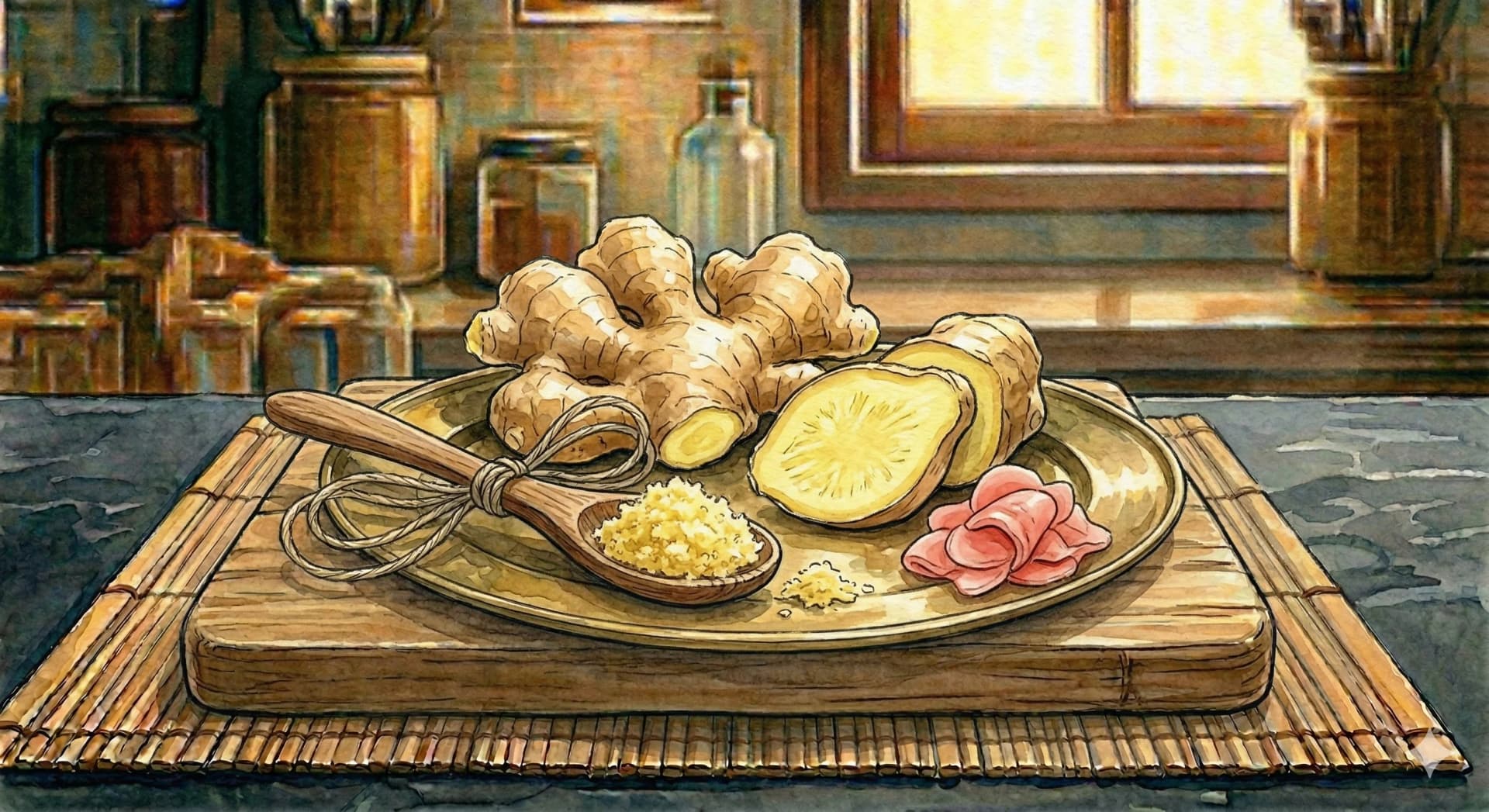
Ginger
Also known as: Adrak (fresh), Sonth (dried), Zingiber officinale
Ginger is one of the oldest and most globally dispersed culinary and medicinal plants, used continuously across Asia, the Middle East, and Europe for over five thousand years. Its sharp, warming heat and bright, citrusy aroma make it indispensable in both sweet and savory cooking.
Key facts at a glance:
- 5,000+ years of use — one of the oldest cultivated spice plants
- Dual nature — warming heat with bright, citrusy aroma
- Global reach — foundational across Asian, Middle Eastern, and European cuisines
- Medicinal powerhouse — gingerols and shogaols with well-documented anti-nausea properties
Flavor Profile
Origin
Southeast Asia, South Asia, China
Traditional Medicine Perspectives
Ayurveda
Ginger (Shunthi when dried, Adrak when fresh) is considered one of Ayurveda's most important medicinal plants. It is classified as a deepana (digestive stimulant) and is used to kindle agni (digestive fire). Fresh and dried ginger are considered distinct medicines — fresh is more cooling and drying, dried is more heating and stimulating.
Traditional Chinese Medicine
In TCM, fresh ginger (Sheng Jiang) warms the Lung and Stomach, disperses cold, and stops vomiting. Dried ginger (Gan Jiang) is hotter and more penetrating — used to warm the interior and rescue devastated Yang. Ginger is prescribed for nausea, cold-induced digestive complaints, and exterior wind-cold patterns.
Modern Scientific Research
Ginger contains gingerols and shogaols — bioactive compounds with well-documented anti-nausea properties. Clinical trials consistently show ginger reduces nausea related to pregnancy, chemotherapy, and motion sickness.
Research also suggests anti-inflammatory effects comparable to ibuprofen in some studies, with potential benefits for osteoarthritis and muscle pain.
Its gastroprotective properties are supported by multiple studies showing reduction in gastric ulcer formation.
Cultural History
Ginger appears in ancient Sanskrit texts, Chinese medical manuscripts, and the writings of Greek and Roman physicians. The spice trade routes that connected Asia to Europe were partly built on demand for ginger.
In medieval Europe, ginger was nearly as common as pepper.
In South Asia, it remains a foundational flavor — nearly every savory dish begins with ginger, garlic, and onion.
Culinary Uses
Fresh ginger is used in stir-fries, curries, soups, and marinades. Dried ground ginger is used in baking, spice blends, and some curry powders.
Ginger pairs with garlic, scallion, turmeric, cardamom, citrus, and soy sauce. It is essential in many Asian cuisines and widely used in Middle Eastern and West African cooking.
Preparation Methods
Peel fresh ginger with a spoon (easier than a peeler on the knobbly root). Grate on a microplane for maximum juice release.
Slice or julienne for soups and braises. Store unpeeled fresh ginger in the freezer and grate directly from frozen.
Traditional Dishes
- Ginger tea
- Ginger chicken
- Khichdi
- Gingerbread
- Miso soup
Recipes Using Ginger
- Baek Kimchi (White Kimchi)
- Carom-Spiced Fish Curry (Ajwaini Machi Curry)
- Kerala Beef Masala
- Miso Soup with Ginger and Reishi
- Country Chicken Curry (Nandan Kozhi Curry)
- Khao Soi Gai (ข้าวซอย)
- Lentil Fritters (Parrupu Vada)
- Dosa Masala
- Vegetable Ishtu
- Broth-Cooked Pilaf (Yakhni Pulao)
- Lamb Ishtu
- Tandoori Aloo
- Licorice Root & Ginger Throat Soother
- Reishi Mushroom Congee
Comments
Share your thoughts on this ingredient.
Sign in to comment0 Comments