Kerala · Indian Cuisine
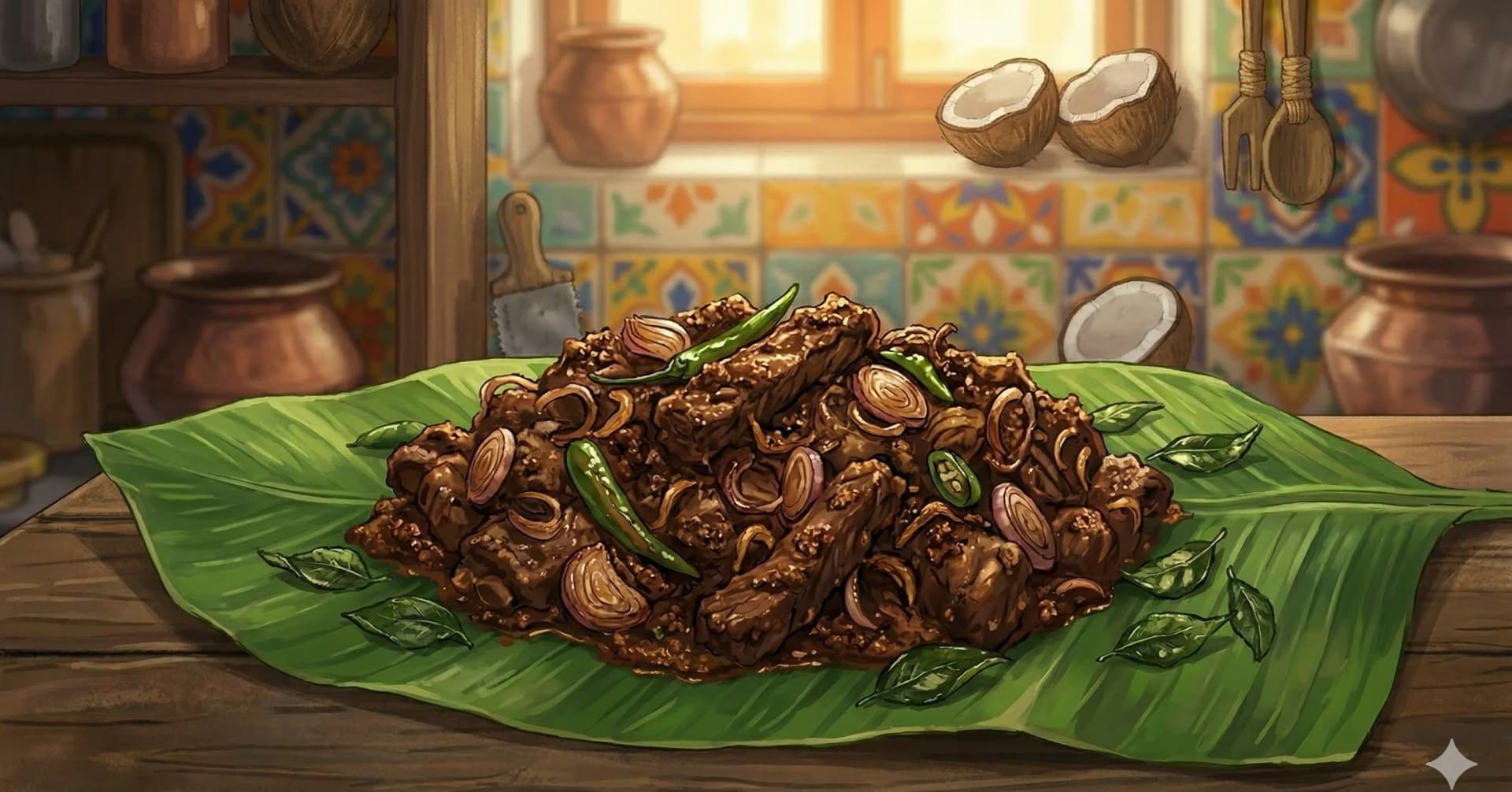
Kerala Beef Masala
Slow-braised beef in coconut oil with crushed shallots, saunf and whole spices
Beef sits at the heart of certain strands of Kerala cooking in a way that surprises those who know only North Indian food. For Kerala's Syrian Christian communities (one of the oldest Christian communities in the world, tracing lineage to St. Thomas's arrival in 52 CE) and for the Hindu communities of Malabar, beef has long been a central ingredient, woven into feast-day cooking and family identity.
This preparation, dark and aromatic and built in two stages, is a definitive expression of that tradition. The beef is first braised in coconut milk with onions, green chillies, ginger, and curry leaves until it is completely tender. Then a crushed masala of shallots, ginger-garlic paste, whole fennel seeds, black pepper, and red chillies is fried in coconut oil until deeply fragrant, and the pre-cooked beef is added to this base. The two-stage cooking means the beef arrives in the masala already soft, absorbing the final flavors without needing to tenderize further.
The result is intensely spiced and aromatic. The warmth of black pepper and red chilli is balanced by the sweetness of coconut milk, and the crushed-rather-than-blended masala gives the finished dish a coarser, more textured quality than a smooth curry. Coconut oil is the medium throughout, and its presence is not incidental. Kerala cooking without coconut oil is a different cuisine.
Fennel seeds (saunf) are the aromatic that centers this dish and identifies it geographically. The Keralite use of fennel, both whole and powdered, is a fingerprint.
At a Glance
Yield
6–8 servings
Prep
30 minutes
Cook
1 hour 15 minutes
Total
1 hour 45 minutes
Difficulty
Medium
Ingredients
- 2¾ lbbeef, cut into juliennes or thick strips
- ¾ lbonions (about 2 onions), sliced
- ½ cupgreen chillies, slit
- 3¼ tbspginger, chopped
- 1 cupred chilli (whole or as paste), for initial cooking
- —Salt to taste
- ¾ cupcurry leaves
- 2⅛ cupcoconut milk
- 3½ ozshallots
- 3¼ tbspginger garlic paste
- 1¾ tbspsaunf (fennel seeds)
- 1½ tbspblack pepper, whole
- 1 cupred chillies (whole, dried)
- ⅓ cupgarlic, sliced or crushed
- 3¼ tbspchopped ginger
- ¾ lbonions (about 2 onions), sliced
- ½ cupgreen chillies, slit
- ¾ cupcurry leaves
- 1¼ tbspturmeric powder
- 1¾ tbspchilli powder
- 3¾ tbspcoriander powder
- —Salt to taste
- —Coconut oil, for frying throughout
Method
- 1
Start the braise. Put the beef strips into a heavy pot with the first quantity of sliced onions, the slit green chillies, the chopped ginger, the red chilli, the first lot of curry leaves and salt to taste. Pour in the coconut milk. There is no oil at this stage and no browning; this pot is about tenderising, not colour.
- 2
Braise until tender. Bring to a boil, then lower the heat, cover, and cook for 45 to 50 minutes, stirring occasionally so nothing catches. The beef is ready when a strip gives easily under a fork and the coconut milk has reduced into a thick, clinging gravy. If liquid runs low before the beef is tender, add a splash of hot water. Set the pot aside with everything still in it.
- 3
Crush the masala. Put the shallots, ginger garlic paste, fennel seeds, whole black pepper and dried red chillies into a heavy mortar and crush them coarsely. Do not use a blender. Crushing keeps the shallots in ragged pieces that caramelise with real character instead of turning into a smooth wet paste, and it leaves some fennel seeds whole so they release their flavour in bursts rather than evenly through the dish.
- 4
Fry the crushed masala. Heat a generous pour of coconut oil in a wide, heavy pan over medium heat. Add the crushed masala and fry, stirring, for 4 to 5 minutes. The shallots will soften and start to brown at the edges and the fennel will come up sweet and aniseedy over the pepper. This is the smell you are cooking toward.
- 5
Build the second aromatic layer. Add the sliced garlic, the second quantity of chopped ginger, the second lot of sliced onions and the remaining slit green chillies. Cook over medium heat for 12 to 15 minutes, stirring regularly, until the onions are properly browned rather than just soft. Add the second lot of curry leaves and let them crisp for 20 seconds.
- 6
Fry the ground spices. Add the turmeric, chilli powder and coriander powder along with a little more coconut oil if the pan looks dry. Fry for 2 minutes, stirring constantly. The spices should smell toasted and lose their raw, dusty edge. Keep them moving; ground spices burn fast in a hot dry pan and turn bitter.
- 7
Combine and fry together. Tip the braised beef into the masala along with all its reduced gravy. Raise the heat to medium-high and fry everything together for 10 to 12 minutes, turning the meat through the masala rather than stirring it hard. The liquid will cook away and the masala will darken and cling to the strips. The dish is ready when it looks dry and glossy and the oil separates at the edges of the pan.
- 8
Taste and rest. Check the salt. Take the pan off the heat and leave it to sit for 10 minutes before serving; the beef reabsorbs a little of the oil and the flavours settle. Serve hot with kerala paratha, appam or plain rice.
Key Ingredient Benefits
Beef: This recipe traditionally uses less tender cuts (shank, chuck, or brisket) that benefit from long braising. These cuts contain significant collagen, which breaks down into gelatin during the braise and enriches the braising liquid naturally.
Coconut milk: The braising liquid here. Coconut milk adds richness, a mild sweetness, and slight acidity. It also moderates the sharpness of red chilli during the long braise. First and second extracts are used in Kerala cooking for different stages. First extract (thicker, richer) is typically reserved for finishing; the cooking here uses the full milk throughout.
Saunf (fennel seeds): A defining spice of Kerala's coastal cooking. Distinctly anise-forward, with a slight sweetness that counterpoints the heat of black pepper and red chilli. Traditional medicine in Kerala associates fennel with digestive comfort; it is used throughout the cuisine at every scale from home cooking to festival feasts.
Black pepper: Kerala (specifically the Malabar coast) was the original source of black pepper that drove the spice trade. Its use here is generous and deliberate. Piperine, pepper's primary compound, has been studied for its potential to enhance the bioavailability of other spice compounds, including curcumin from turmeric.
Why This Works
The two-stage cooking method (braise first, fry in masala second) solves a common problem with tougher cuts: if you try to build flavor and tenderize simultaneously in a spiced gravy, the spices often over-reduce and burn before the meat is done. By braising first in coconut milk, which tenderizes gently with its mild acidity and fat content, then introducing the beef to a separately fried, fresh masala, both the meat texture and the spice flavor are optimized.
Crushing rather than blending the shallot-spice masala preserves cellular structure in the shallots, which means they caramelize with more distinct character than a smooth paste. It also means the fennel seeds remain partially whole, releasing their flavor in bursts rather than uniformly throughout.
Coconut oil is critical for Kerala-character cooking. Its medium-chain fatty acids have a distinctive, slightly tropical flavor that no other oil replicates. It also has a high smoke point when refined, allowing the masala to be fried at sufficient temperature.
Substitutions & Variations
- Cut of beef: Julienne cuts (thin strips) are specified but the dish works equally well with large cubes. Adjust braising time accordingly. Cubes need longer.
- Coconut milk: Replace with thin coconut cream diluted with water, or use stock for a less rich result.
- Vegetarian adaptation: Replace beef with jackfruit (kaatan chakka). Raw jackfruit braised in coconut milk makes an authentic Keralite dish with similar architecture.
- Without coconut milk in the braise: Braise with water, stock, and a small amount of vinegar for a drier, more intensely spiced result.
Serving Suggestions
- Serve with plain rice. The masala is rich enough to work as the only accompaniment.
- Kerala paratha or pathiri alongside the beef masala is a classic combination.
- Appam with beef masala is the Syrian Christian feast pairing.
- A fresh coconut chutney or a simple kachumber salad of tomato and onion with lime cuts through the richness.
Storage & Reheating
Beef masala improves overnight as the spices deepen. Store in the refrigerator for up to 3 days. Reheat in a pan over medium heat with a tablespoon of coconut oil and a splash of water. The dish tends to dry out as it sits. Freezes well for up to 2 months; the texture of the beef remains good post-freeze if braised until completely tender originally.
Cultural Notes
Kerala beef masala (നാടൻ ബീഫ് കറി, naadan beef curry; also called beef ularthiyathu in its dry version) is the dry-fried Kerala beef preparation that takes pieces of beef chuck or stewing beef and cooks them down in a coconut-and-spice masala until the meat is tender, the gravy has reduced to a thick coating, and the surface develops the dark caramelized edges that diners recognize as the signature visual element. The dish is closely associated with the Kerala Syrian Christian and Latin Catholic communities, who unlike most Indian regional cuisines eat beef regularly as part of their daily cooking (beef is religiously avoided by Hindu and Jain communities across most of India, but Kerala's Christian and Muslim communities have maintained continuous beef-cooking traditions for centuries).
The dish has two main forms. The wet version (beef curry, naadan beef) keeps more gravy and is served with rice or appam at family lunches. The dry version (beef ularthiyathu, "stir-fried beef") cooks the meat further until almost all the moisture has evaporated and the beef pieces are coated in a sticky dark masala, which is the version that appears as a side dish or a snack with parotta and tea at small Kerala roadside restaurants (thattukada).
The technique demands patience for the slow cook. Beef chuck or stewing beef is cut into one-inch cubes, marinated briefly in turmeric, kashmiri red chili powder, ginger-garlic paste, and salt. The base masala is built from sliced shallots, ginger, garlic, green chilies, curry leaves, and a generous amount of fresh grated coconut sautéed in coconut oil until the coconut turns deep golden. The masala is ground to a paste, and the marinated beef is added to a heavy pot along with the paste, more coconut oil, and the Kerala spice essentials: coriander, fennel, black pepper, cinnamon, and cloves. The pot covers and cooks slowly for ninety minutes to two hours, with periodic checking and stirring, until the meat is fork-tender and the gravy has reached the desired consistency. The dish is finished with fresh curry leaves and small pieces of fresh coconut for textural contrast. Kerala writer Salman Rushdie and other Kerala-diaspora authors have written about beef ularthiyathu as the dish that most strongly evokes Kerala home cooking for Malayalis living abroad.
Nutrition Facts
Calories: 393kcal (20%)|Total Carbohydrates: 15.8g (6%)|Protein: 35.5g (71%)|Total Fat: 22.3g (29%)|Saturated Fat: 16.1g (81%)|Cholesterol: 95mg (32%)|Sodium: 371mg (16%)|Dietary Fiber: 1.8g (6%)|Total Sugars: 5.9g
You Might Also Like

Ratings & Comments
Ratings & Comments
Ratings
Share your thoughts on this recipe.
Sign in to rate and comment