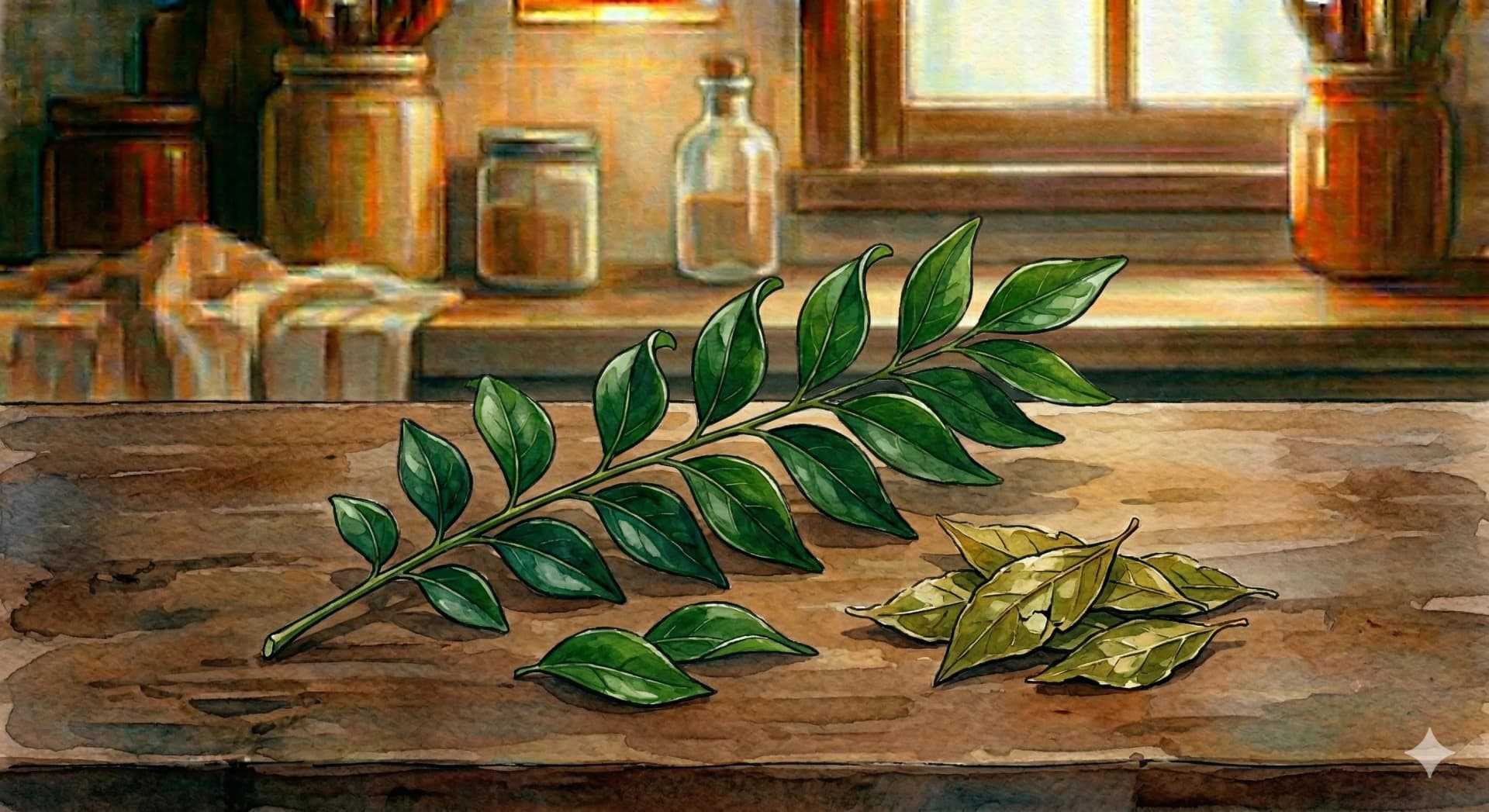
Curry Leaves
Also known as: Kadi Patta, Meetha Neem, Karivepillai (Tamil), Murraya koenigii, Sweet Neem
Curry leaves are one of the most important and most misunderstood ingredients in South Indian cooking. The misunderstanding begins with the name: curry leaves are not related to "curry powder" and have nothing to do with the spice blend product sold in jars.
The English word "curry" is a broad colonial approximation derived from the Tamil word "kari," meaning a sauce or side dish. Curry leaves (Murraya koenigii) are a specific aromatic herb from a small citrus-family tree native to South India and Sri Lanka. The name is coincidental and misleading.
The flavor of a fresh curry leaf is genuinely difficult to describe to someone who has not experienced it. It is citrusy but not like lemon, herbal but not like any familiar Western herb, with a faintly anise-like undertone, a slight bitterness, and an aromatic complexity that fills the kitchen the moment the leaves hit hot oil.
This aroma is entirely due to volatile compounds that exist in the fresh leaf in great abundance and dissipate rapidly once the leaf is dried or stored. This volatility is the most important practical fact about curry leaves: dried curry leaves are dramatically less flavorful than fresh, so much so that some cooks consider dried curry leaves not worth using at all. A recipe calling for curry leaves almost always means fresh.
Unlike bay leaves, which are typically removed before serving because they are tough and unpleasant to bite into, curry leaves in South Indian cooking are eaten. They become crisped and flavorful in hot oil during tempering, and while some diners pick them out as a matter of preference, the traditional approach is to eat them. Crisped in oil, they develop a concentrated version of their characteristic flavor and a satisfying texture.
Key facts at a glance:
- Curry leaves (Murraya koenigii) — A specific aromatic herb from a small citrus-family tree native to South India and Sri Lanka.
- The flavor of a fresh curry leaf — Genuinely difficult to describe to someone who has not experienced it.
- This aroma — Entirely due to volatile compounds that exist in the fresh leaf in great abundance and dissipate rapidly once the leaf is dried or stored.
- Curry leaves — One of the most important and most misunderstood ingredients in South Indian cooking.
Flavor Profile
Origin
South India, Sri Lanka
Traditional Medicine Perspectives
Ayurveda:
Curry leaves are classified in Ayurveda as having a bitter and pungent taste (tikta and katu rasa) with a cooling potency, making them beneficial for Pitta and Kapha conditions. The bitter taste is considered purifying and blood-cleansing in Ayurvedic thought, and curry leaves have traditionally been used for conditions including anemia, liver disorders, and skin conditions where blood purification is indicated. They are considered beneficial for eye health, with traditional use for maintaining vision and preventing cataracts. One of the most widespread traditional applications is for hair health: curry leaf preparations including oil infusions made by simmering leaves in coconut oil are applied to the scalp to strengthen hair, prevent premature graying, and treat dandruff. This application is common across South Indian households and is backed by the traditional use of centuries. Digestive benefits are also well-recognized: the leaves are considered carminative, helping to resolve gas, bloating, and sluggish digestion.
Traditional Chinese Medicine:
Curry leaves are not part of the classical TCM pharmacopoeia, reflecting their geographic specificity to South Asia. However, in contemporary integrative practice and in research contexts, the carbazole alkaloids present in curry leaves have attracted attention for their pharmacological activities, and TCM practitioners familiar with the herb have noted similarities to bitter, cooling digestive herbs in the TCM system.
Modern Scientific Research
Curry leaves contain a class of compounds called carbazole alkaloids, of which mahanimbine is perhaps the most studied, that have demonstrated significant pharmacological activity in laboratory and animal research. The anti-diabetic effects of curry leaf extracts have been among the most consistently replicated findings: multiple animal studies show that curry leaf alkaloids reduce blood glucose levels, improve insulin sensitivity, and reduce the severity of diet-induced metabolic syndrome. Human clinical data is more limited but includes small trials showing blood sugar reduction in diabetic patients consuming curry leaf preparations. The mechanisms proposed include inhibition of intestinal alpha-glucosidase (slowing carbohydrate absorption) and stimulation of insulin secretion.
Anti-obesity research on curry leaves has produced interesting findings in animal models, where mahanimbine and related alkaloids reduced fat accumulation and body weight in high-fat-diet models. Antioxidant activity is consistently high: curry leaf extracts rank among the stronger plant antioxidants tested, with activity attributed to both alkaloids and phenolic compounds including quercetin and kaempferol. Hair growth research, providing some scientific basis for the widespread traditional hair-care application, has shown that curry leaf extract applied topically in animal models promoted hair follicle activity and increased hair count in some studies, though rigorous human trials are lacking. Antimicrobial activity has been demonstrated against several bacteria and fungi, consistent with the traditional association of curry leaves with food preservation and gut health.
Cultural History
Curry leaves have been an integral part of South Indian cooking for as long as written culinary records exist in the region. Tamil Sangam literature, spanning roughly from 300 BCE to 300 CE, references "kari" dishes with aromatic leaves, and the curry leaf tree (Murraya koenigii) grows natively throughout peninsular India and Sri Lanka. Unlike imported spices that arrived through trade, curry leaves were always locally available and never part of the luxury spice trade. Their integration into daily cooking is native and ancient.
The tree grows readily in warm climates and is cultivated in home gardens across South India, Sri Lanka, and now wherever South Indian diaspora communities have settled worldwide. The practice of keeping a curry leaf plant at home is culturally embedded: homes in Tamil Nadu, Kerala, Karnataka, and Andhra Pradesh often have a curry leaf tree growing in the yard or in a large pot near the kitchen, providing fresh leaves for daily use. The tree is remarkably easy to grow in warm climates and begins producing usable leaves within a year of planting.
The word "kari" (the root of "curry") in classical Tamil referred specifically to the kind of spiced sauce or side dish that curry leaves were used in. When British traders encountered these preparations in South India, they described them all as "curry" and looked for a single spice that made them taste that way. The search for a "curry spice" led to the creation of commercial curry powder blends, a product with no equivalent in actual South Indian cooking, where each dish is spiced individually with its own combination of whole and ground spices. The confusion between the leaf and the powder, both called "curry," has persisted in English ever since.
Culinary Uses
The tempering technique is where curry leaves are most important and most effective. In the South Indian method, mustard seeds go into hot oil first and pop.
Then dried red chilies, asafoetida, and finally fresh curry leaves are added. The leaves go in last because they spit dramatically when fresh leaves hit hot oil (stand back or cover the pan briefly): the instant of contact with the oil causes the moisture in the leaves to flash to steam, producing a fragrant burst that aromas the entire dish. This oil, now heavily infused with the combined aromatics of mustard, chili, and curry leaf, is what gets poured over cooked dal, mixed into rice, or used as the starting base for sambar or rasam.
Curry leaf tempering (tadka) poured over a plain cooked dal transforms it into something deeply complex in about two minutes. This is the fundamental trick of South Indian cooking: the tadka system, where a separately made aromatic oil is added to a simply cooked base, allowing for intense flavor concentration without cooking the delicate fresh herb in a long-simmered dish that would destroy its character.
Preparation Methods
Standard tempering (tadka): Heat 2 tablespoons of oil or ghee in a small pan until shimmering. Add mustard seeds and cover. When they pop (10-15 seconds), uncover and add dried red chilies and a pinch of asafoetida. Immediately add 10-15 fresh curry leaves (they will spit: keep the pan close to pour level or use a lid as a shield). Stir for 10-15 seconds until fragrant and leaves are slightly crisped. Pour immediately over cooked dal, rice, or vegetables.
Curry leaf oil: Simmer a large handful of fresh curry leaves in coconut oil over very low heat for 10-15 minutes until the leaves crisp and the oil takes on their flavor and color. Strain. Use as a finishing oil drizzled over dishes, in marinades, or as a base for dressings. This oil keeps refrigerated for 2-3 weeks.
Storing fresh leaves: Fresh curry leaves can be wrapped in a damp paper towel, stored in a bag in the refrigerator, and used within 1-2 weeks. For longer storage, freeze directly in a bag without blanching. Frozen curry leaves can go directly into hot oil from frozen.
Growing your own: Murraya koenigii grows readily in pots in warm climates (minimum temperature around 10C / 50F). Purchase a plant from an Indian grocery, keep in a sunny spot, and water regularly. Harvest outer branches, leaving the main stem to continue growing.
Traditional Dishes
- Sambar
- Rasam
- Chettinad Chicken
- Curry Leaf Rice (Kari Veppilai Sadam)
- Kerala Fish Curry
- Tadka Dal
- Avial
- Coconut Chutney
- South Indian Chutneys
- Vada
- Idli Podi
- Egg Curry
- Potato Curry
Comments
Share your thoughts on this ingredient.
Sign in to comment0 Comments