Thai Cuisine
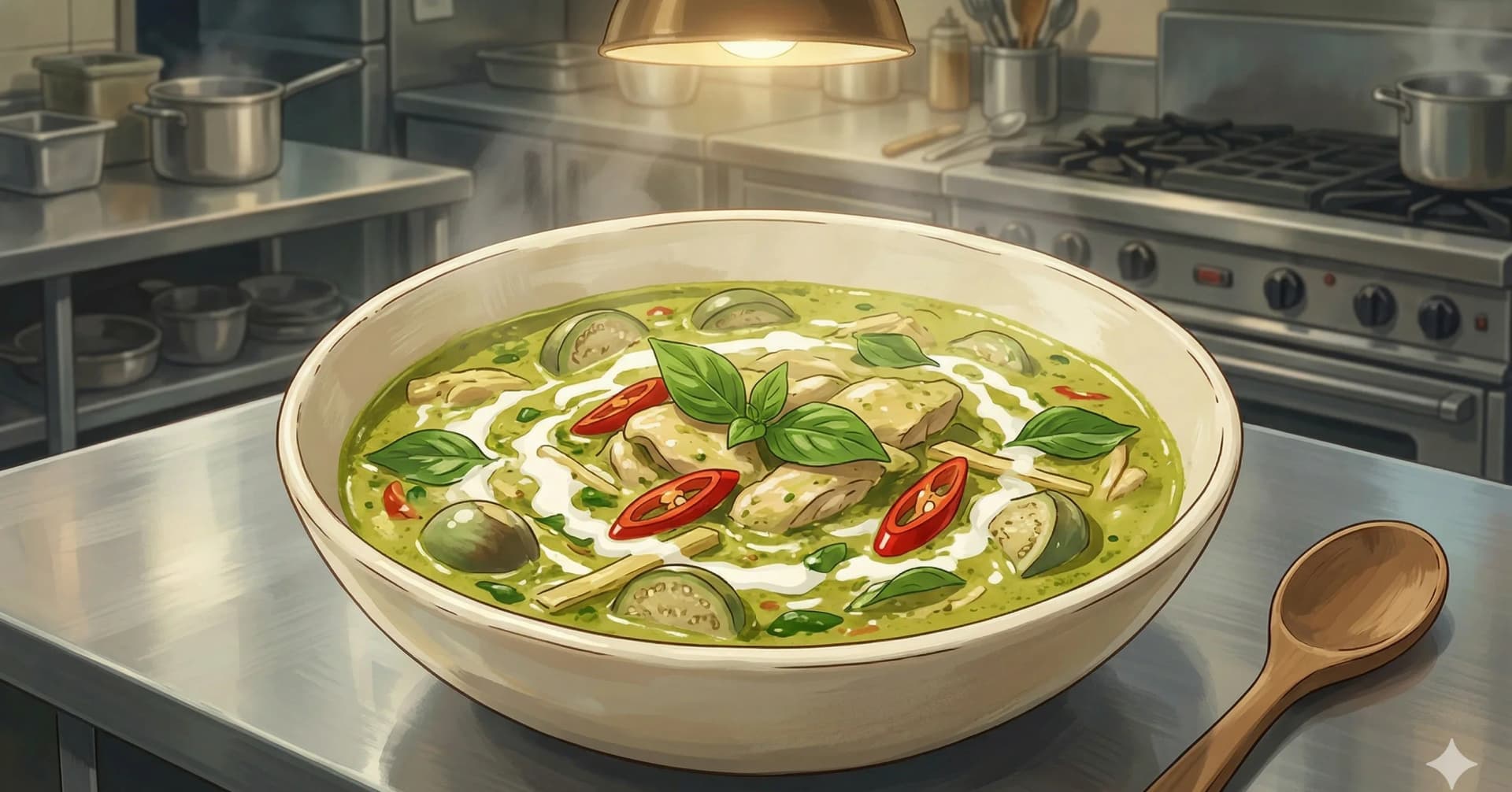
Gaeng Kiew Waan Gai (Thai Green Curry with Chicken)
Thailand's beloved coconut curry, fragrant with green chilies, makrut lime, and Thai basil over tender braised chicken thighs
Open a pot of green curry and you meet something alive. The steam carries Thai basil first, then the sharp citrus of makrut lime, then the warm hum of coconut fat and fermented shrimp paste underneath. It smells the way a Southeast Asian kitchen is supposed to smell, layered and insistent.
Gaeng kiew waan, which translates to "sweet green curry," is arguably the most popular curry in Thailand. The name does not refer to sugar. It describes the color, a softer, gentler green compared to the aggressive red of gaeng phet. The green comes from fresh green chilies in the paste, which also deliver a sharp, bright heat quite different from the slow burn of dried red chilies used in red curry or panang curry. Thai cooks serve it with jasmine rice at home, over rice vermicelli at street stalls, and even alongside roti at night markets. It crosses every context from weeknight dinner to celebration.
This recipe follows the traditional method of cracking the coconut milk, cooking the paste in the separated fat until the oil visibly separates, then building the sauce. That step takes only a few minutes but transforms the flavor from raw and sharp to deep and rounded. An optional enhancement technique borrowed from Pailin Chongchitnant's approach folds shrimp paste and fingerroot into store-bought curry paste, bridging the gap between jarred convenience and homemade complexity. The finished curry should be aromatic enough to fill the kitchen, spicy enough to make you reach for the rice, and rich enough to feel like a full meal in a single bowl.
At a Glance
Yield
4 servings
Prep
20 minutes
Cook
20 minutes
Total
40 minutes
Difficulty
Easy
Ingredients
- 3½ tbspgreen curry paste (store-bought, about 3.5 tablespoons)
- ¼ ozfermented shrimp paste (gapi)
- ⅞ cupThai basil leaves (about 15 leaves), finely julienned
- ¼ ozfingerroot (krachai), sliced, fresh, frozen, or brined (optional)
- 1¾ cupfull-fat coconut milk, divided
- 1 cupunsalted chicken stock
- 1 lbboneless, skinless chicken thighs, cut into 2.5 cm pieces
- 2½ tbsppalm sugar, finely chopped (or light brown sugar)
- 22to 30 ml fish sauce, divided
- 5makrut lime leaves (kaffir lime leaves)
- 8 ozThai eggplant, cut into bite-sized wedges (or one 540 ml can bamboo shoots (about ½–1 eggplant), drained and rinsed)
- 1¾ tbspfresh ginger, finely grated (optional, if not enhancing paste)
- ¼ ozlemongrass paste (optional, if not enhancing paste)
- 1½ cupThai basil leaves (about 1 cup, loosely packed)
- 1½ ozred bell pepper, julienned
- 3½ ozsnow peas, trimmed (optional)
- 1 tbsplime juice (about half a lime)
- —Steamed jasmine rice, for serving
- —Crispy fried Asian shallots
- —Fresh Thai basil or cilantro sprigs
- —Sliced green or red chilies
Method
- 1
If enhancing the paste, pound the julienned Thai basil in a mortar and pestle until it breaks down into a rough green paste. Add the fingerroot if using and pound until smooth. Add the shrimp paste and store-bought curry paste, then pound and fold until everything is well combined. The mixture will smell deeply savory and look noticeably greener than the paste alone. Set aside.
- 2
Pour about 180 ml of the coconut milk into a heavy-bottomed pot over medium heat. Bring it to a full boil and let it bubble until you see the fat start to separate from the solids. This takes about 2 to 3 minutes and the surface will look slightly oily and broken rather than smooth.
- 3
Add the curry paste to the cracked coconut milk and stir frequently. Cook for 3 to 5 minutes until the paste darkens slightly, becomes very fragrant, and the coconut oil visibly pools around the edges of the paste. If the paste sticks, deglaze with a splash of the remaining coconut milk. The kitchen should smell intensely aromatic at this point.
- 4
Add the chicken pieces and turn them in the paste until each piece is well coated. Cook for 1 minute, letting the chicken absorb the flavors directly from the concentrated paste.
- 5
Pour in the remaining coconut milk and the chicken stock. Add the palm sugar and half of the fish sauce (about 11 ml). Take the makrut lime leaves and twist each one firmly to bruise it, then tear into rough pieces, discarding the tough center stem. Drop them into the pot. Stir everything together, bring to a gentle simmer, and let it cook for 10 to 12 minutes. The chicken should be fork-tender and the sauce should taste rich and well-seasoned.
- 6
Taste the sauce and adjust. If it tastes flat, add more fish sauce a teaspoon at a time. If using Thai eggplant, add them now and push them below the surface of the curry. Cook for 3 minutes, pressing them into the liquid for the first minute so they do not float and brown. They are done when a fork pierces them with slight resistance. If using bamboo shoots instead, add them and cook for just 1 minute to heat through.
- 7
If using snow peas, add them and cook for 2 minutes until they turn bright green and are just barely tender. Turn off the heat.
- 8
Stir in the julienned red pepper, the Thai basil leaves, and the lime juice. The basil will wilt almost immediately in the residual heat. Taste one final time and add more fish sauce or a pinch of sugar if needed. Ladle over steamed jasmine rice, scatter with the garnishes, and serve while the curry is still steaming.
Key Ingredient Benefits
Coconut milk: Full-fat coconut milk is essential here, both for the cracking technique and for the rich body of the finished sauce. Light coconut milk will not separate properly and produces a thin, watery curry. Coconut milk is high in saturated fat, though these are primarily medium-chain triglycerides (MCTs), which are metabolized more rapidly than long-chain fats. A 400 ml can shared among four servings provides a moderate amount per person.
Green curry paste: The quality of the paste determines the quality of the curry. Maeploy brand is widely recommended by Thai cooking teachers for its balance of heat, herb flavor, and consistency. Aroy-D is a solid second choice. Brands marketed primarily to Western audiences tend to be significantly milder and less complex. If using an unfamiliar brand, start with the amount called for and taste the sauce early, adding more cooked paste if the flavor seems weak.
Makrut lime leaves: These provide the distinctive citrus perfume that defines Thai curries. The aromatic compounds are concentrated in the leaf's oil glands and are released when the leaves are torn or bruised. They are traditionally left in the curry but are not meant to be eaten whole. Dried makrut lime leaves are a poor substitute as much of the volatile oil evaporates during drying. Frozen leaves retain their aroma well and are available at most Asian grocery stores.
Fish sauce: Fermented from anchovies and salt, fish sauce provides glutamate-rich umami that rounds out the sweetness of the coconut milk. Quality varies enormously. Squid, Megachef, and Red Boat are reliable brands. The sauce is high in sodium, so it replaces salt entirely in this recipe.
Thai basil: Distinguished from Italian basil by its purple stems, sturdy leaves, and anise-like flavor. It holds up better to heat than sweet basil and contributes a licorice note that is characteristic of the finished curry. Holy basil (krapao) is a different herb and is not interchangeable here, though it is the correct choice for pad krapow and similar stir-fries.
Why This Works
Thai green curry relies on a technique called cracking the coconut milk. When coconut milk boils undisturbed, the fat separates from the water and protein solids. Frying the curry paste in this separated coconut fat rather than in neutral oil produces a deeper, more integrated flavor because the fat-soluble aromatic compounds in the paste dissolve directly into the coconut fat. This is the same principle behind blooming spices in ghee or butter, and it is what separates a restaurant-quality green curry from one that tastes like paste stirred into soup.
The paste enhancement technique addresses a real gap in commercial products. Most store-bought green curry pastes omit shrimp paste to remain vegetarian-friendly, and they limit green chilies to keep the heat approachable. Adding shrimp paste back in provides the fermented umami backbone that traditional homemade pastes always include. The extra Thai basil boosts the green color, which fades in commercial production. Fingerroot, a rhizome that tastes like a cross between ginger and mild white pepper, is a classic addition to green curry that most brands leave out entirely.
Adding fish sauce in stages rather than all at once allows you to build the seasoning gradually. The first addition flavors the simmering broth. The final adjustment at the end accounts for the vegetables and coconut milk dilution and lets you hit the right balance of salty, sweet, and sour without overshooting.
Substitutions & Variations
Protein: Chicken breast can replace thighs. Slice it 1 cm thick, marinate in 15 ml fish sauce for 10 minutes, and add it later in the cooking process since it overcooks easily. Shrimp, tofu, or sliced pork loin all work. For shrimp, add them in the last 3 minutes of cooking.
Vegetables: Bamboo shoots are the most traditional alternative to Thai eggplant and require no cooking, only heating. Japanese eggplant, sliced 1 cm thick, cooks in about 5 minutes. Winter melon, peeled and cubed, needs a full 10 minutes and should go in with the chicken. Snow peas, baby corn, and green beans are common additions.
Curry paste: For a fully homemade paste, blend 10 green Thai chilies, 30 g shallots, 15 g garlic, 15 g galangal, 10 g lemongrass (tender parts only), 5 g coriander root, 5 g cumin seeds (toasted), 5 g coriander seeds (toasted), 5 makrut lime leaves, and 5 g shrimp paste. This produces enough for one batch of curry.
Vegetarian or vegan: Replace fish sauce with soy sauce or mushroom sauce. Replace shrimp paste with miso paste. Use vegetable stock and tofu or mixed vegetables as the protein.
Heat level: For a milder curry, reduce the paste to 35 ml and omit the chili garnish. For more heat, add 2 to 3 sliced serrano or green Thai chilies with the paste.
Noodle variation: Green curry is commonly served over rice vermicelli (kanom jeen) in Thailand. Boil Vietnamese rice vermicelli for 7 to 10 minutes, drain, and portion into bowls before ladling the curry over the top.
Serving Suggestions
Steamed jasmine rice is the classic and essential pairing. The neutral sweetness of the rice absorbs the sauce and tempers the heat, and green curry without rice feels incomplete. For a more elaborate Thai meal, serve alongside som tam for a sharp, crunchy contrast, or larb for a lime-bright counterpoint to the rich coconut sauce. A bowl of tom yum goong makes a vibrant starter that sets up the palate for the curry. If you are building a full spread, pad thai provides noodle variety, while massaman curry offers a warmer, more spice-driven curry to compare side by side. A platter of raw vegetables, sliced cucumber, and long beans served alongside is traditional in Thailand and gives the tongue a place to cool down between spoonfuls. For a northern Thai variation on the coconut curry theme, try khao soi, which layers crispy fried noodles over a similar but turmeric-tinged base.
Storage & Reheating
Refrigerator: Store in an airtight container for up to 5 days. The flavors continue to develop overnight and many find the curry tastes even better the next day. Keep the rice separate.
Reheating: Warm gently in a saucepan over medium-low heat, stirring occasionally. Add a splash of water or coconut milk if the sauce has thickened. If using eggplant, take care not to overheat, as the eggplant will turn mushy. Microwave reheating works in a pinch but can cause the coconut milk to separate.
Freezing: The curry freezes well for up to 2 months. Eggplant will soften further upon thawing, so if you plan to freeze, consider using bamboo shoots instead or adding fresh eggplant when you reheat. Thaw overnight in the refrigerator and reheat on the stovetop.
Cultural Notes
Gaeng keow wan (แกงเขียวหวาน, "sweet green curry") is the Thai curry most familiar on international menus and, within Thailand, a defining dish of the central plains cooking tradition. The "green" comes from fresh green prik kee noo (bird's eye chilies) pounded into the curry paste along with sweet basil, kaffir lime peel, lemongrass, galangal, coriander root, garlic, shallots, and shrimp paste. The color is the giveaway: where red curries use dried red chilies and yellow curries use turmeric, the green curry's color comes from chlorophyll, kept bright by working the paste fresh and finishing the dish with whole basil leaves added off the heat.
The "sweet" (wan) in the name is part of the cultural signature. Thai green curry is not sweet the way a dessert is sweet; it is sweet relative to other Thai curries, balanced with palm sugar to round out the heat of the chilies and the salt of the fish sauce. Coconut milk does most of the body work, with a thicker first-press coconut cream "cracked" over high heat at the start of cooking until the oil separates and the curry paste fries in that oil. This step (called khaeg ka-thi) is the foundation technique for nearly every coconut-based Thai curry and is one of the markers Thai cooks use to judge whether a curry has been made properly.
The dish belongs to the central Thai royal court tradition and is documented in Thai cookbooks dating to the 19th century, though the modern green curry as recognized today appears to have settled into its current form during the late 19th and early 20th centuries, after the introduction of chilies from the New World had filtered through Southeast Asia and become a staple. Green curry is typically served with steamed jasmine rice or, more traditionally in central Thailand, with kanom jeen (fresh rice noodles) for a breakfast or lunch dish. The dish takes well to chicken, beef, fish balls, or vegetarian preparations with Thai eggplant, bamboo shoots, and pea aubergine.
Nutrition Facts
Calories: 518kcal (26%)|Total Carbohydrates: 22.1g (8%)|Protein: 31.3g (63%)|Total Fat: 35.7g (46%)|Saturated Fat: 24.4g (122%)|Cholesterol: 120mg (40%)|Sodium: 1013mg (44%)|Dietary Fiber: 5g (18%)|Total Sugars: 14.3g
You Might Also Like
Ratings & Comments
Ratings & Comments
Ratings
Share your thoughts on this recipe.
Sign in to rate and comment