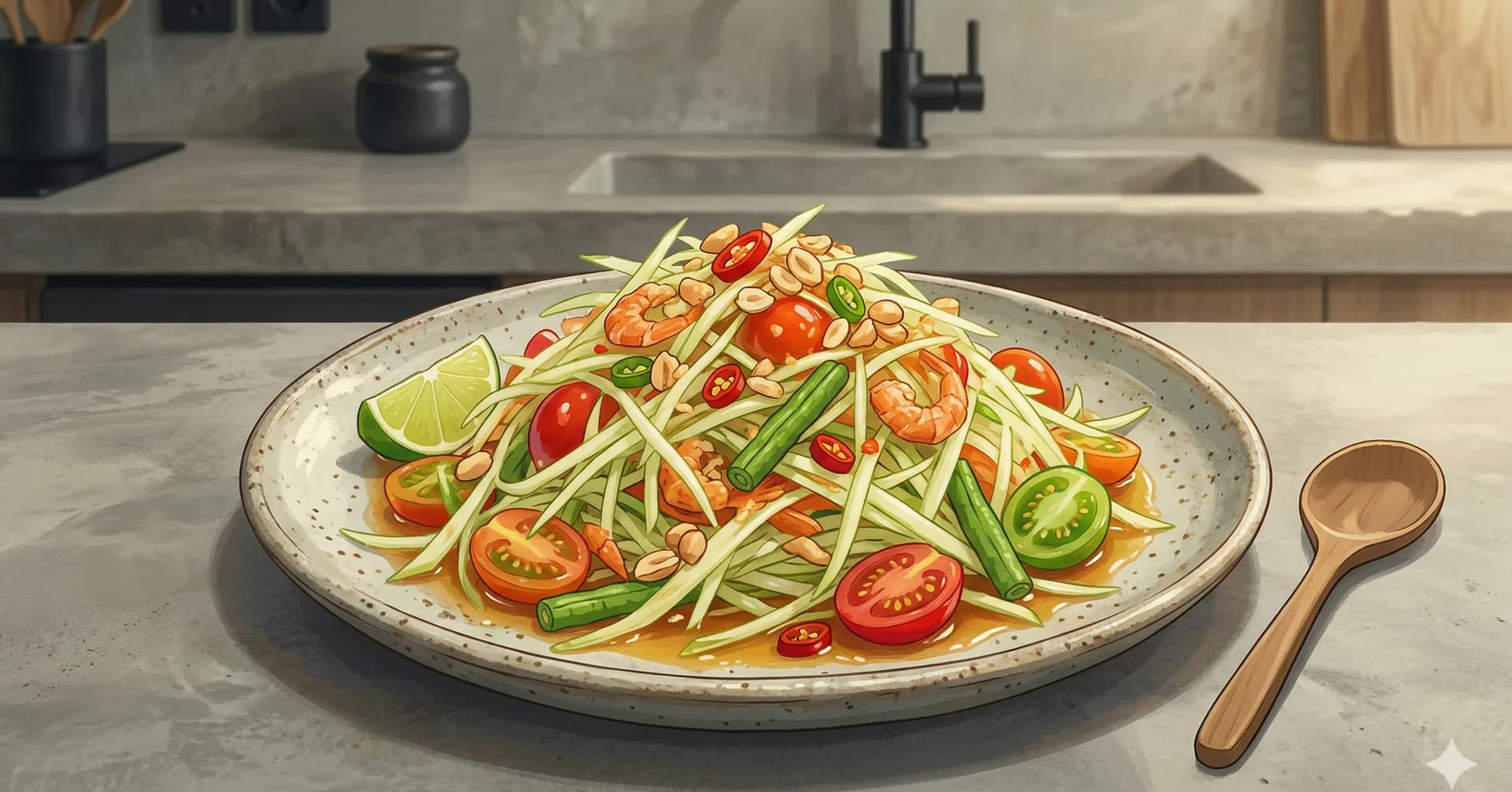
Thai Cuisine
Som Tam Thai (Green Papaya Salad)
Northeastern Thai pounded salad of shredded green papaya in a sweet-sour-spicy lime dressing
Som tam is built on contradiction. It is raw yet deeply flavored, simple in its ingredient count yet layered in a way that keeps you reaching back into the bowl. The name itself tells you most of what you need to know: som means sour, tam means to pound. You crush garlic and chilies in a mortar, build a dressing around them one element at a time, then work shredded green papaya into it with a rhythmic pound-and-flip motion until the strands go slightly translucent and every surface carries the sauce.
This recipe follows the Thai style of som tam, sometimes called som tum thai, which is the version most widely served in restaurants outside Thailand. It leans a little sweeter than the Lao-influenced som tum plara, and it includes roasted peanuts and dried shrimp, both of which give the salad a toasty, savory backbone that balances the bright acid of the lime and tamarind. The dressing is not measured once and forgotten. You taste it, adjust it, and taste again. The four-way tension between sweet, salty, sour, and spicy should feel balanced but alive, tilting in whichever direction you prefer on a given day.
Green papaya is not a specialty fruit so much as a fruit caught early. The large Southeast Asian varieties, about 25 to 30 cm long, are what you want. They are firm, pale green inside, and nearly flavorless on their own, which is exactly the point. They exist in this dish as texture and as a vehicle for dressing. If you have made larb or yam nua, you already understand the Thai instinct for salads that hit hard and fast. Som tam is the original expression of that idea, eaten across Thailand from street carts to fine dining rooms, almost always alongside sticky rice and something grilled.
At a Glance
Yield
2 servings
Prep
25 minutes
Cook
0 minutes
Total
25 minutes
Difficulty
Easy
Ingredients
Dressing Ingredients
- 2 clovesgarlic, peeled
- 1to 6 Thai chilies, to taste (see Substitutions)
- 1½ tbsppalm sugar, finely chopped
- 2 tbspfresh lime juice (about 1 large lime)
- 2 tsptamarind paste (store-bought concentrate, not Indian-style)
- 1½ tbspfish sauce
Salad Ingredients
- 7 ozgreen papaya, peeled, seeded, and julienned into short matchsticks
- 3long beans, cut into 5 cm pieces
- 1½ ozroasted unsalted peanuts, plus extra for garnish
- ½ ozdried shrimp, roughly chopped if large
- 2¾ ozgrape or cherry tomatoes, halved (or 1 small tomato (about ½–1 tomato), cut into thin wedges)
- 1salted duck egg, halved and scooped from the shell, cut into wedges
- —Fresh Thai basil leaves, for garnish
Method
- 1
Soak the julienned green papaya in a bowl of ice water for 15 to 20 minutes while you prepare the remaining ingredients. This firms the strands and makes them noticeably crunchier. Drain thoroughly, spread on a clean kitchen towel, and press dry with a second towel. Residual water will dilute the dressing, so take a moment to get the papaya as dry as possible.
- 2
Place the garlic and chilies in a large mortar. Pound until the garlic is broken into small fragments and the chilies are split open and releasing their seeds. You are not making a smooth paste here, just a rough, fragrant crush.
- 3
Add the chopped palm sugar to the mortar and pound until it dissolves into the garlic and chili mixture, forming a wet, slightly gritty paste. The sugar needs direct contact with the pestle to break down properly.
- 4
Drop in the long bean pieces and pound them with moderate force, about four or five strikes, until each piece cracks open and softens slightly. The beans should look bruised and flattened but not pulverized.
- 5
Add the dried shrimp and about two-thirds of the peanuts. Pound a few times to break the peanuts into coarse, uneven pieces and to split open some of the shrimp. Reserve the remaining peanuts for garnish.
- 6
Pour in the lime juice, tamarind paste, and fish sauce. Drop the squeezed lime shell into the mortar as well; the oils in the zest will add fragrance as you work. Stir everything together with a large spoon until the sugar fully dissolves into the liquid.
- 7
Add the tomatoes and press them lightly with the pestle, just enough to crack the skins and release some juice into the dressing. The tomato liquid is part of the sauce, so do not skip this.
- 8
Add the drained papaya to the mortar. If your mortar is too small to hold everything, transfer the dressing and pounded ingredients to a large mixing bowl and add the papaya there. Using the pound-and-flip technique, pound the papaya several times, then use a spoon to scoop from the bottom and turn the salad over so the dressing redistributes to the top. Repeat four to five rounds of pounding and flipping until the papaya strands look slightly wilted and translucent and every piece is coated in dressing. If working in a bowl, use a gloved hand to massage and squeeze the papaya into the dressing with the same intention.
- 9
Taste the dressing pooled at the bottom of the mortar. Adjust with more lime juice if it needs brightness, more fish sauce if it lacks salinity, more sugar if the acid is too sharp, or another chili pounded in if you want more heat. The balance should feel dynamic, not one-note.
- 10
Pile the salad onto a plate, spooning any remaining dressing over the top. Scatter the reserved peanuts over the surface. If using salted duck egg, tuck the wedges around the edges. Finish with Thai basil leaves if you have them. Serve immediately.
Key Ingredient Benefits
Green papaya: The unripe fruit of Carica papaya, widely cultivated across tropical Southeast Asia. It contains papain, a cysteine protease enzyme used traditionally as a meat tenderizer and studied for potential digestive and anti-inflammatory effects. In its green state, the fruit is low in sugar, high in water content, and a source of dietary fiber, vitamin C, and folate.
Thai chilies (prik khi nu): Small, thin-walled chilies measuring roughly 50,000 to 100,000 Scoville heat units. Their capsaicin content has been studied for effects on metabolism, pain perception, and cardiovascular function. In Thai cooking, they are valued as much for their fruity, sharp flavor as for their heat.
Palm sugar: Derived from the sap of sugar palms (Borassus flabellifer) or coconut palms, palm sugar retains small amounts of minerals including potassium, iron, and zinc lost during the refinement of white sugar. Its caramel-like flavor is distinct from cane sugar and integral to the character of Thai dressings.
Dried shrimp: Sun-dried and lightly salted, these are a concentrated source of protein, calcium (from the shells), and astaxanthin. They function as a seasoning as much as an ingredient, adding chewy texture and deep umami.
Tamarind: The pulp of Tamarindus indica contains tartaric acid, which gives it a distinctive sour-sweet flavor. It also provides iron, magnesium, and thiamine. Thai and Indian tamarind products differ significantly in concentration and flavor profile; Thai-style tamarind paste is milder and thinner.
Why This Works
The mortar and pestle is not decorative tradition. Pounding releases volatile compounds from garlic and chilies far more effectively than mincing, because the cell walls rupture under compression rather than being sliced. This creates a more aromatic, more pungent base than a knife can achieve. The same pounding action bruises the long beans and cracks the peanuts unevenly, giving the salad textural variety that chopping would flatten into uniformity.
Building the dressing in stages matters. The sugar dissolves more completely when pounded directly into the garlic-chili paste than when stirred into liquid. The tomatoes, pressed just enough to split, contribute both acidity and body to the sauce. The papaya goes in last because it wilts quickly on contact with salt and acid. Working it with the pound-and-flip method ensures even coating without turning the strands to mush.
The combination of lime juice and tamarind paste creates a rounder sourness than either ingredient alone. Lime is sharp and immediate; tamarind is mellow, fruity, and slightly sweet. Together they give the dressing a layered acidity that holds up against the sugar and fish sauce without collapsing into a single flat note.
Substitutions & Variations
Green papaya: Green mango, peeled and julienned, is the closest substitute and is traditional in some Thai salads. For a more accessible option, seeded and julienned English cucumber works surprisingly well, though it will wilt faster. Firm, shredded kohlrabi or chayote squash also provide good crunch. Pailin Chongchitnant suggests both as viable alternatives.
Long beans: Standard green beans, cut to the same length, are a direct swap. Blanch them in boiling water for 15 seconds if you find raw green beans difficult to digest or too grassy in flavor.
Palm sugar: Light brown sugar or coconut sugar. Maple syrup works in a pinch. The caramel depth will be slightly different but the balance of the dressing will hold.
Tamarind paste: If unavailable, increase the lime juice by 5 ml and add a small pinch of brown sugar to round out the acidity. The result will be sharper and less complex but still good.
Thai chilies: Serrano peppers are milder but structurally similar. For less heat without losing chili flavor, remove the seeds and pith from one Thai chili rather than omitting chilies entirely.
Dried shrimp: For a vegetarian version, omit the dried shrimp and substitute soy sauce for the fish sauce. Add a pinch of MSG or a splash of mushroom-based stir-fry sauce to compensate for the lost umami.
Mortar and pestle: If you do not own one, combine the fish sauce, lime juice, tamarind, and finely chopped palm sugar in a bowl and stir until dissolved. Finely mince the garlic and chilies, roughly chop the peanuts, and smash the long beans with a rolling pin. Toss everything in a large bowl and massage the papaya into the dressing with a gloved hand. The result is good, though less deeply seasoned than the pounded version.
Serving Suggestions
The classic pairing is sticky rice and grilled chicken. If you have access to gai yang, the smoky, lemongrass-marinated bird is the definitive companion. The cooling crunch of the papaya and the heat of the dressing cut through the richness of charred skin and rendered fat.
Som tam also works as part of a larger Thai spread. Set it alongside pad thai for textural contrast, or serve it before a bowl of tom yum goong as a bright opener. It pairs naturally with green curry, where the coconut richness of the curry finds relief in the salad's acidity.
For a Southeast Asian combination plate, serve som tam with goi cuon (Vietnamese fresh spring rolls) and a small bowl of jasmine rice. The flavors overlap enough to feel cohesive but differ enough to keep each bite interesting. A cold Thai beer or a glass of slightly sweet Riesling handles the heat well.
Storage & Reheating
Freshly made: Som tam is best eaten within minutes of preparation. The salt and acid in the dressing begin to draw moisture from the papaya immediately, and the salad softens noticeably after 20 to 30 minutes.
Short hold: If you must prepare components in advance, keep the julienned papaya in ice water (refrigerated, up to 4 hours) and make the dressing through step 6 in the mortar or a jar. Combine and pound the salad just before serving.
Leftovers: Leftover som tam will keep in the refrigerator for up to 1 day in a sealed container. The papaya will lose its crunch and the dressing will thin as the vegetables release water. It is still flavorful but texturally quite different. There is no meaningful way to reheat this dish, as it is served cold or at room temperature.
Cultural Notes
Som tam (ส้มตำ) is one of the most-eaten dishes in Thailand, despite being a regional specialty rather than a central Thai dish. The salad belongs to the cuisine of Isan, the northeastern region of Thailand that shares deep cultural and culinary ties with neighboring Laos. The name decomposes to som (sour) plus tam (pounded), and the technique is exactly that: green unripe papaya shredded into long strips, then pounded in a clay mortar (krok din) with a wooden pestle along with garlic, bird's eye chili, long beans, cherry tomatoes, palm sugar, fish sauce, lime, and peanuts. The pounding bruises the papaya enough to soak up the dressing without turning it to mush.
The salad exists in distinct regional versions, and the choice between them is often a marker of identity. Som tam Thai (also called som tam farang) is the central Thailand and Bangkok-style version, with peanuts and dried shrimp, sweeter and milder, the version most often served in international Thai restaurants. Som tam pla ra (or som tam Lao, also som tam pu pla ra) is the Isan and Lao version, with fermented fish sauce (pla ra) and pickled black crab (pu dong), funkier and sharper, and considered by Isan people to be the only "real" som tam. Som tam pu uses small raw field crabs pounded directly in the mortar. Som tam thad serves the salad on a large communal platter alongside sticky rice and grilled meats.
In Bangkok, dedicated som tam stalls operated by Isan migrants are a fixture of nearly every neighborhood, and several long-running shops have built reputations on a single dish of som tam Lao made the traditional way with pla ra and pickled crab. The pounding sound of som tam being made (the rhythmic thok-thok of the pestle against clay) is one of the defining ambient sounds of any Thai market or food court, and the dish is so commonly eaten that Thailand reportedly consumes more papaya as som tam than as fresh fruit. Som tam is typically eaten alongside larb, grilled meats, and sticky rice as part of the broader Isan meal format.
Nutrition Facts
Calories: 321kcal (16%)|Total Carbohydrates: 34.9g (13%)|Protein: 15.7g (31%)|Total Fat: 15.3g (20%)|Saturated Fat: 2.7g (14%)|Cholesterol: 255mg (85%)|Sodium: 1894mg (82%)|Dietary Fiber: 4.5g (16%)|Total Sugars: 21.7g
You Might Also Like
Ratings & Comments
Ratings & Comments
Ratings
Share your thoughts on this recipe.
Sign in to rate and comment