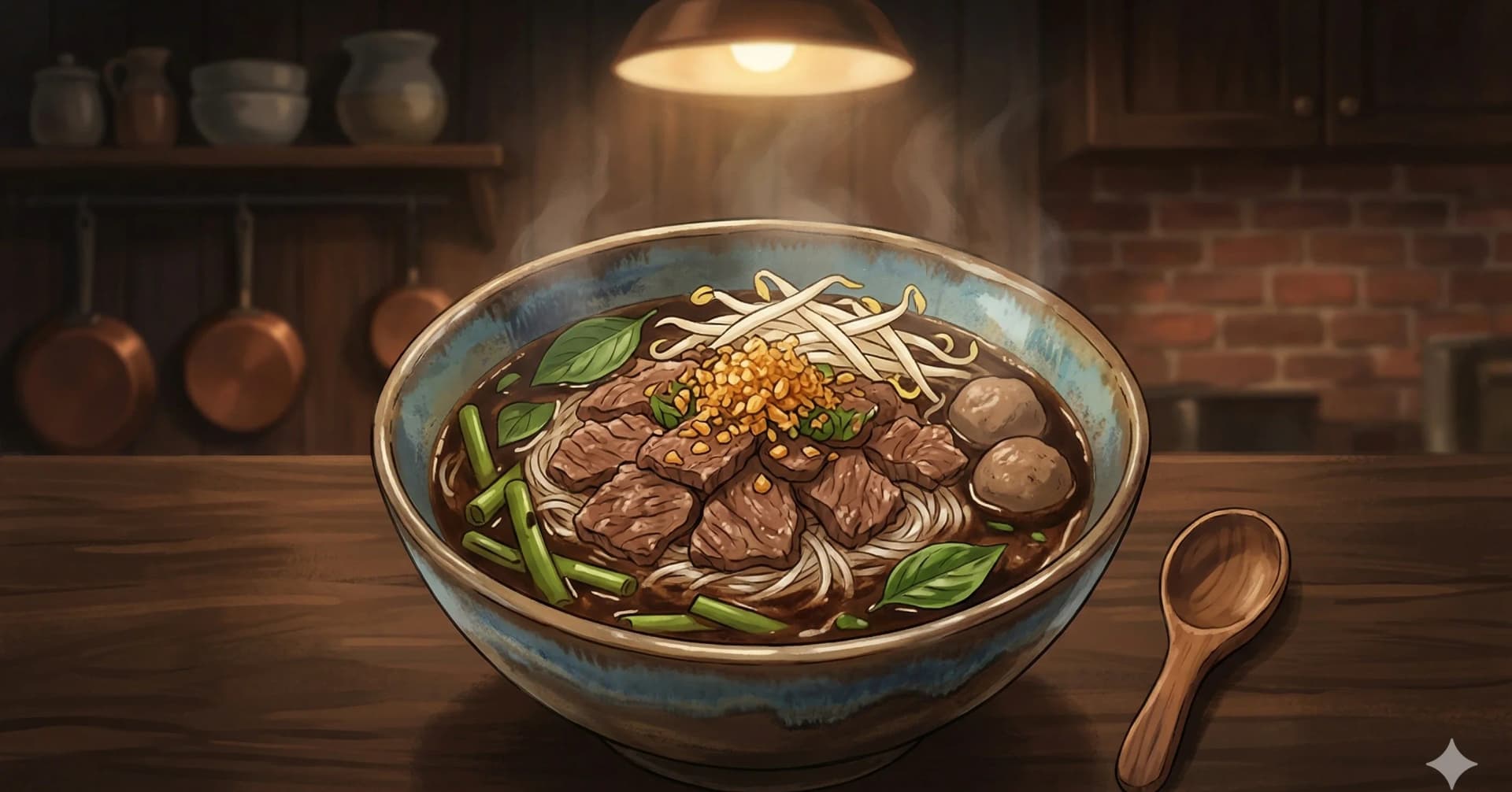
Thai Cuisine
Boat Noodles (ก๋วยเตี๋ยวเรือ)
Dark, spice-infused Thai noodle soup with pork, toasted aromatics, and enriched broth
The broth is the first thing that separates boat noodles from every other Thai noodle soup. It is dark, almost opaque, stained by layers of soy sauce and black soy sauce, and it carries a warmth from toasted cinnamon, star anise, and coriander seeds that pushes it closer to the aromatic world of pho bo or bun bo hue than to the bright, citrus-forward soups most people associate with Thai cooking. This is a dish built on slow extraction and quiet complexity, not on the shock of fresh chilies.
Boat noodles, or guay tiew ruea, are named for the canal vendors who once served them from narrow boats along Bangkok's waterways. The bowls were small because passing large, sloshing containers of hot soup across the water was impractical. That tradition stuck. In Thailand, a single serving of boat noodles is no bigger than a cup, and eating five or six bowls in a sitting is completely normal. Each bowl disappears in a few concentrated spoonfuls, and you keep ordering until you are done.
What makes the broth distinctive, beyond the spices, is the addition of liquid pork blood, stirred in at the end. The blood thickens the broth and gives it a silky, almost velvety body. It does not taste of iron or meat. If you have eaten blood sausage or morcilla without knowing what it was, you have already eaten something very similar. The blood is optional, but it is responsible for the specific richness that Thai people call nam tok, which translates to waterfall, a reference to the way meat drippings once fell through bamboo trays into the soup below.
The rest of the bowl comes together quickly once the broth is made. Thin rice noodles, blanched for seconds. Sliced pork, cooked directly in the broth. Meatballs, bean sprouts, water spinach. A spoonful of chili vinegar at the table ties everything together with acid and heat. The process looks long on paper, but the broth does most of the work unattended, and it freezes well, making this a strong candidate for cooking once and eating several times.
At a Glance
Yield
5 servings
Prep
45 minutes
Cook
2 hours 30 minutes
Total
3 hours 15 minutes
Difficulty
Medium
Ingredients
Broth Ingredients
- 3¼ qtwater
- 2 lbpork neck bones (see note 1)
- 15 cmcinnamon stick, crushed into pieces
- 1 wholestar anise
- 2¾ tspcoriander seeds
- 10 slicesgalangal, each about 3 mm thick
- 3cilantro roots or 6 cilantro stems, lightly crushed
- 8 cmdaikon, peeled and cut into large chunks
- 1/2medium onion, cut into large chunks
- 5 clovesgarlic, smashed until cracked
- ⅞ tspground white pepper (about 1/2 teaspoon)
- 1pandan leaf, about 45 cm, folded and tied in a knot (optional)
- 3 tbspsoy sauce
- 2 tbspGolden Mountain sauce or Maggi seasoning
- 2 tbsptao jiew, Thai fermented soybean paste (about 2 tablespoons; substitute miso or doenjang)
- 2 tbspwhite vinegar
- 1½ tbspblack soy sauce or dark soy sauce (about 1 1/2 tablespoons)
- 1 tbspfish sauce
- 2 tbsprock sugar or 30 ml granulated sugar
- —Salt, to taste
- ⅓ cupliquid pork or beef blood (optional; see note 2)
Pork Ingredients
- 8 ozpork shoulder, sliced 3 mm thick against the grain
- 1 tbspsoy sauce
- ½ tspsugar (about 1/2 teaspoon)
To Assemble
- 1 lbdried small rice noodles, 1.5 mm width (sen lek)
- 8 ozAsian-style pork or beef meatballs (see note 3)
- 4 ozwater spinach or baby spinach, cut into 5 cm pieces
- 4 ozbean sprouts
- 6 sprigscilantro, chopped
- 1 stalkgreen onion, chopped
To Serve
- —Chili vinegar (see note 4)
- —Thai basil or holy basil sprigs (optional)
- —Fried garlic and garlic oil (optional)
- —Crispy pork rinds (optional)
- —Roasted chili flakes, to taste (optional)
Method
- 1
Place the pork neck bones in a large stock pot and add the water. The bones should be fully submerged. Bring to a simmer over medium heat and cook for 30 minutes, skimming any grey foam that rises to the surface during the first 10 minutes.
- 2
While the bones simmer, prepare the spice bag. Crush the cinnamon stick pieces in a mortar and pestle or under a heavy pan until broken into rough shards. Add the cinnamon, star anise, and coriander seeds to a dry skillet over medium-high heat. Shake the pan constantly until the coriander seeds begin to pop and darken a shade, and the kitchen fills with a warm, resinous smell, about 2 minutes. Transfer the toasted spices, along with the galangal slices and crushed cilantro roots, into a cheesecloth pouch or soup infusion bag and tie it closed.
- 3
After the bones have simmered for 30 minutes and the broth looks relatively clear, add the spice bag, daikon, onion, garlic, white pepper, and pandan leaf. Add all the liquid seasonings and sugar: soy sauce, Golden Mountain sauce, tao jiew, white vinegar, black soy sauce, fish sauce, and rock sugar. Stir gently to dissolve the sugar and distribute the soybean paste. Reduce heat to a gentle simmer and cook for 1 hour 15 minutes, adding water as needed to keep the bones fully submerged.
- 4
While the broth simmers, soak the dried rice noodles in room-temperature water for 25 to 30 minutes. They are ready when completely limp and pliable, with no remaining stiffness. Drain and set aside.
- 5
Prepare the marinated pork by tossing the sliced pork shoulder with the soy sauce and sugar. Mix well and let sit at room temperature while the broth finishes.
- 6
When the broth is done, taste it. It should be savory and slightly too salty on its own, because the noodles, vegetables, and bean sprouts will dilute it in the bowl. Adjust with salt or a touch more sugar as needed. Remove and discard the spice bag and pandan leaf. Lift out the daikon chunks (save them to eat alongside the noodles or in another meal). Remove the pork neck bones and use a fork to pull any tender meat from the bones. Reserve this meat for the bowls.
- 7
Return the broth to a simmer over high heat. Place the sliced marinated pork in a wire skimmer or fine-mesh sieve and lower it into the broth. Stir the pork gently in the hot liquid until no pink remains, less than 1 minute. Lift the skimmer out, letting the broth drain back into the pot, and transfer the cooked pork to a bowl.
- 8
Bring the broth back to a steady simmer. If using blood, pour it in a slow, thin stream while stirring the broth continuously with a ladle or chopsticks. The broth will thicken visibly and take on a deeper color. If the blood is added too quickly or without stirring, it will form clumps instead of integrating smoothly. Add the meatballs, reduce heat to the lowest setting, and cover until ready to serve. Stir the broth occasionally, as the blood tends to settle.
- 9
Bring a large pot of water to a vigorous, rolling boil. You want as much water as practical, so the temperature stays high when you add noodles. Divide the soaked noodles into individual portions and place them in serving bowls. Prepare bean sprouts, spinach, and all toppings so everything is within reach.
- 10
Working one portion at a time, place a handful of noodles, a small amount of bean sprouts, and a handful of water spinach into a noodle strainer or metal sieve. Plunge the strainer into the boiling water and agitate it for 5 to 10 seconds. The noodles should be tender but still have a slight chew. Shake off excess water and transfer to a serving bowl. Repeat with the remaining portions.
- 11
Give the broth a stir to redistribute the blood, then ladle it generously over each bowl of noodles, adding a few meatballs per serving. Top with the sliced marinated pork, pulled meat from the bones, fried garlic and a drizzle of garlic oil, chopped cilantro and green onion, and a sprig of Thai basil if using. Serve immediately with chili vinegar, roasted chili flakes, and crispy pork rinds on the side.
Key Ingredient Benefits
Pork neck bones: These have a higher meat-to-bone ratio than back bones, providing both collagen for the broth and tender pulled pork for the bowl. The long simmer extracts gelatin from the connective tissue, giving the cooled broth a jelly-like consistency that signals body and richness when reheated.
Galangal: A close relative of ginger but with a sharper, more piney and citrusy flavor. It contains galangin, a flavonoid studied for antioxidant properties. In Thai traditional medicine, galangal is considered warming and carminative, used to relieve digestive discomfort. Dried galangal can substitute in the broth, though the fragrance will be less vivid.
Tao jiew (fermented soybean paste): Thai tao jiew is a wet, chunky paste of soybeans fermented with salt and rice. The fermentation produces glutamic acid (natural MSG), organic acids, and bioactive peptides. It occupies the same culinary niche as Japanese miso or Korean doenjang, though its flavor profile is milder and less funky than doenjang.
Pork blood: One of the most concentrated dietary sources of heme iron, containing roughly 6 mg of iron per 100 ml. Heme iron is absorbed two to three times more efficiently than non-heme iron from plant sources. In Thai and Chinese food traditions, blood soups are considered restorative and are sometimes recommended for recovery from illness or fatigue. If blood is unavailable or unwanted, coconut milk can be stirred in as a substitute thickener, though the flavor profile shifts noticeably.
Coriander seeds: The dried fruit of the cilantro plant, with a warm, citrusy flavor completely different from the leaves. Contains linalool, which has been studied for anxiolytic and anti-inflammatory effects in animal models. Toasting the seeds intensifies their aroma and makes them more brittle for easier grinding.
Why This Works
Toasting the cinnamon, star anise, and coriander seeds in a dry skillet before adding them to the broth unlocks volatile oils and creates Maillard compounds on the surface of the spices. This produces a deeper, smokier aroma than raw spices would contribute, and it is the same logic that drives the charred-spice technique in Vietnamese pho, a dish that shares more DNA with boat noodles than most Thai soups do.
Wrapping the spices in a bag and simmering them for the full duration of the broth, rather than adding them as a finishing touch, allows the fat-soluble and water-soluble flavor compounds to fully extract. Cinnamon's cinnamaldehyde, star anise's anethole, and coriander's linalool all need time and heat to dissolve into the broth at their fullest concentrations.
The multiple soy sauces are not redundant. Regular soy sauce provides salt and umami. Black soy sauce adds color, body, and a faint molasses quality. Golden Mountain sauce contributes a hydrolyzed-protein savoriness that reads differently on the palate from fermented soy sauce. Tao jiew adds a coarse, funky fermented depth. Together they produce a layered saltiness that a single seasoning cannot achieve.
Adding the blood at the end, off the boil and with constant stirring, keeps it from coagulating into lumps. The proteins in the blood thicken the broth gently, like a light roux, and bind to some of the fat, creating a cohesive, silky texture rather than an oily surface.
Substitutions & Variations
Bones: Beef bones or veal bones produce an excellent broth with a different character. Expect a longer simmer, closer to 2 hours, for full extraction from beef. The finished soup will be richer and heavier.
Protein: Thinly sliced beef (flank or top sirloin, cut against the grain) is a common alternative to pork shoulder. Blanch it in the broth the same way. Cooked liver, sliced thin after simmering in the broth until firm, is traditional in many Bangkok boat noodle shops.
Noodles: Boat noodle shops in Thailand offer a range of noodles. Rice vermicelli (sen mee) needs only a 5-second blanch after soaking. Fresh wide rice noodles (sen yai), the same noodles used in pad see ew, need only a 2-second dip to warm through. Glass noodles (woon sen) require a 2-minute boil. Instant wheat noodles (mama) are popular and cook in about 1 minute.
Blood substitute: If blood is unavailable, stir in 60 ml of full-fat coconut milk at the end for a different but still rich effect. The broth will be lighter in color and taste.
Golden Mountain sauce: Maggi seasoning or Bragg's Liquid Aminos are close substitutes. In a pinch, increase the regular soy sauce by 15 ml.
Vegetarian approach: Replace pork bones with a base of dried shiitake mushrooms (50 g, soaked) and kombu. Use firm tofu in place of the pork, and soy sauce in place of fish sauce. Skip the blood entirely and add coconut milk for richness.
Spicier broth: Some vendors in Thailand add a small amount of dried chili paste directly to the broth. Toast 3 to 4 dried Thai chilies alongside the spices, grind them to a powder, and stir into the broth during the last 15 minutes of simmering.
Serving Suggestions
Boat noodles are traditionally served in small bowls, and in Thailand the fun is in ordering several rounds. At home, you can serve regular-sized portions, or set up the components on the counter and let people assemble their own small bowls, refilling as they like.
The chili vinegar is practically mandatory. Its sharp acidity lifts the dark, heavy broth and makes each spoonful feel new. If you have time for only one condiment, make this one.
For a Thai noodle soup spread, pair boat noodles with tom yum goong for a bright, sour contrast to the deep, dark broth. A plate of pad thai or pad see ew alongside rounds out the table with something dry and caramelized against the wet, saucy noodle soup.
Boat noodles sit in the same extended family as khao soi, another Thai noodle soup that builds complexity through spice and slow cooking. Where khao soi leans on coconut milk and curry paste, boat noodles rely on bones, soy sauces, and time. Exploring them side by side is one of the best ways to understand the range of Thai noodle soups.
For a broader Southeast Asian comparison, the toasted whole-spice approach connects boat noodles to pho bo, which uses a similar cinnamon-and-star-anise backbone. The intensity and darkness of the broth, however, push boat noodles closer to the spirit of bun bo hue, with its fermented shrimp paste and lemongrass heat.
Storage & Reheating
Broth (without blood): Refrigerate in an airtight container for up to 1 week, or freeze for up to 3 months. If frozen, thaw overnight in the refrigerator before reheating. The broth may gel when cold due to the gelatin from the bones; this is a sign of a well-made stock and it will liquefy again with gentle heat.
Broth (with blood): Keeps refrigerated for up to 5 days. The blood-thickened broth can be frozen, though it may separate slightly upon thawing. Reheat gently over medium-low heat while stirring to re-emulsify.
Cooked pork and meatballs: Store separately from the broth in an airtight container, refrigerated, for up to 5 days.
Soaked noodles (uncooked): Drain well and lay on a kitchen towel to absorb excess moisture. Store in a covered container in the refrigerator for up to 1 week. Any pooling water will make the noodles mushy.
Cooked noodles: Do not store well. Cook fresh for each serving.
Chili vinegar: Keeps in a sealed jar in the refrigerator for several weeks. The flavor mellows and integrates over the first few days.
Fried garlic: Store the garlic and the garlic oil in separate containers in the refrigerator. The garlic stays crisp for about 2 weeks; the oil keeps for a month or longer.
Cultural Notes
Kuay tiew rua (ก๋วยเตี๋ยวเรือ, "boat noodles") is the Bangkok noodle soup named for the wooden canal boats from which it was originally sold. Before Bangkok's klongs (canals) were largely paved over during the 20th century, vendors paddled long boats through the waterways serving small bowls of intensely flavored noodle soup to passengers, residents, and dockside workers. The boats are gone from most of the city, but the dish remains, served from stationary stalls that still call themselves "boat noodle" shops and still serve the soup in deliberately small bowls.
The signature small portion size is the defining cultural quirk of the dish. A standard bowl holds perhaps four or five mouthfuls. The expectation is that diners order multiple bowls in sequence rather than a single large portion, and at traditional boat noodle shops the empty bowls are stacked on the table as a running tally of how much each diner has eaten. Champion eaters routinely stack 15 to 20 bowls in a single sitting, and the stack itself has become a visual symbol of the dish in Thai food media.
The broth is the soup's signature feature. The traditional preparation uses pork or beef bone stock simmered with cinnamon, star anise, and Chinese herbs, then darkened and thickened with pig's or cow's blood added at the end of the cooking process (the blood cooks into the broth and gives it the characteristic dark color and slight earthy thickness). Modern shops increasingly offer a "no blood" version to accommodate diners uncomfortable with the traditional preparation, but old-line boat noodle shops in the Victory Monument area of Bangkok, especially along the canal known as Khlong Saen Saeb, continue to serve the dish in its original form. Toppings include pork or beef slices, meatballs, blanched morning glory, bean sprouts, and a final scatter of fried garlic, scallions, and crushed peanuts.
Nutrition Facts
Calories: 976kcal (49%)|Total Carbohydrates: 96.4g (35%)|Protein: 63g (126%)|Total Fat: 36.1g (46%)|Saturated Fat: 12.1g (61%)|Cholesterol: 279mg (93%)|Sodium: 1889mg (82%)|Dietary Fiber: 6.9g (25%)|Total Sugars: 7.6g
You Might Also Like
 Medium
Vietnamese Cuisine
Spicy Beef Noodle Soup (Bún Bò Huế)
3 hours 45 minutes
 Medium
Vietnamese Cuisine
Bun Rieu (Vietnamese Crab and Tomato Noodle Soup)
2 hours
 Medium
Vietnamese Cuisine
Cháo Lòng (Vietnamese Pork Organ Rice Porridge)
2 hours 15 minutes
 Medium
Vietnamese Cuisine
Canh Khổ Qua (Vietnamese Stuffed Bitter Melon Soup)
55 minutes
Ratings & Comments
Ratings & Comments
Ratings
Share your thoughts on this recipe.
Sign in to rate and comment