Thai Cuisine
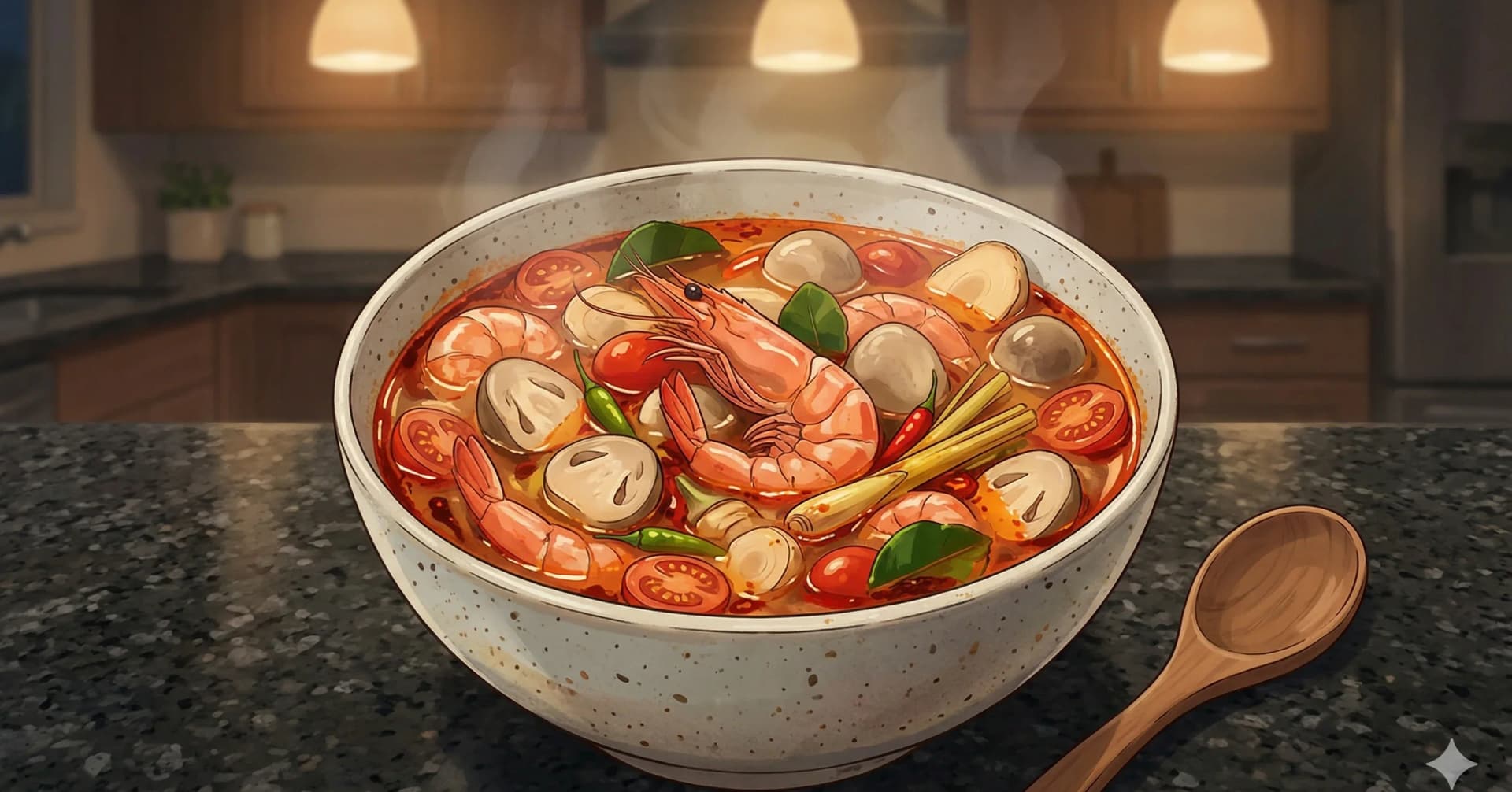
Tom Yum Goong
Hot and sour shrimp soup with lemongrass, galangal, and makrut lime
The first thing you notice is the steam. Before anything touches your tongue, the broth sends up a wave of lemongrass and lime leaf so sharp and bright it opens your sinuses and wakes the back of your palate. Then comes the heat, layered and deliberate: the slow burn of pounded Thai chilies sitting underneath the sweet, roasty depth of nam prik pao (Thai chili paste). And finally the sour, carried by fresh lime juice added at the very end, pulling everything into focus the way acid always does.
Tom yum goong is arguably Thailand's most recognized dish, eaten at every level of Thai life, from school cafeterias to white-tablecloth restaurants, from street-side shophouses to home kitchens on weeknight evenings. The name tells you what it is: "tom" means boiled, "yum" means mixed (as in the sour-spicy salad dressing style), and "goong" means shrimp. It is a soup built on what Thai cooks call the tom yum trinity: lemongrass, galangal, and makrut lime leaves. These three aromatics, bruised and simmered together, produce a fragrance that is unmistakably Thai and impossible to replicate with dried substitutes or pastes alone.
What separates a forgettable tom yum from one that stays with you is the liquid itself. Making a quick shrimp stock from the shells and heads, sauteed until they turn orange and the tomalley (that rich, fatty substance inside the heads) releases into the pot, gives the broth a depth and body that water or even chicken stock cannot match. This step takes ten extra minutes and changes everything. The broth becomes rounded, faintly sweet, and unmistakably of the sea, which is exactly the foundation that the aromatics, fish sauce, and lime juice need to land properly.
At a Glance
Yield
Serves 4
Prep
20 minutes
Cook
20 minutes
Total
40 minutes
Difficulty
Easy
Ingredients
Stock Ingredients
- —Shells and heads reserved from the shrimp below
- 1 tbspneutral oil
- 1 qtwater (about 4 1/4 cups)
- 1 ozdaikon, finely chopped, optional
- 1 ozonion, finely chopped, optional
Soup Ingredients
- 1 lbmedium to large shrimp (12–15 shrimp), head-on and shell-on
- 2 stalkslemongrass, bottom half only, smashed until cracked and cut into 5 cm pieces
- 8 slicesgalangal, about 3 mm thick
- 6makrut lime leaves, centre ribs removed, torn into pieces
- 2to 5 Thai chilies, pounded to a rough paste or finely minced
- 7 ozoyster mushrooms, torn into bite-sized pieces
- ¼ cupnam prik pao, Thai chili paste (about 1/4 cup)
- 3 tbspfish sauce
- ½ cupfresh lime juice (about 1/2 cup)
- 1¼ tspsugar, if needed
- 1roma tomato, cut into thin wedges, optional (see note)
- ⅓ cupevaporated milk (about 1/3 cup), optional for creamy version
To Serve
- —Fresh cilantro leaves, roughly chopped
- —Jasmine rice
Method
- 1
Peel and devein the shrimp, keeping the meat in a bowl in the refrigerator. Place all shells and heads into a stockpot with the oil and the chopped daikon and onion if using. Set the pot over medium-high heat and saute for 3 to 4 minutes, pressing on the heads with your spatula to release the orange tomalley. The kitchen will begin to smell like grilled shrimp, sweet and briny. When the shells have all turned orange and the bits on the bottom of the pot are browning, pour in the water and scrape up everything stuck to the bottom. Bring to a simmer and cook for 5 minutes.
- 2
Strain the stock through a wire strainer, pressing on the shells to extract all the liquid. Discard the shells. Measure out 960 ml (4 cups) of stock, adding water if you are short.
- 3
While the stock simmers, prepare the aromatics. Smash the lemongrass stalks firmly with the flat of a knife or a pestle until they crack open and become fibrous. Twist the makrut lime leaves to bruise them, then tear into rough pieces, pulling away and discarding the tough centre rib. Slice the galangal thinly. Pound the Thai chilies in a mortar to a rough, uneven paste, or mince them finely.
- 4
Return the strained stock to the pot. Add the lemongrass, galangal, makrut lime leaves, pounded chilies, and oyster mushrooms. Bring to a simmer and cook for 5 minutes. The broth should become intensely aromatic, with the lemongrass dominating and the galangal adding a warm, peppery undertone. The mushrooms will soften and absorb some of the broth's flavour.
- 5
Loosen the nam prik pao by stirring a few spoonfuls of the hot broth into it, then pour the mixture into the pot. Add the fish sauce. Stir well and bring back to a rolling boil. If you are making the creamy version, stir in the evaporated milk now.
- 6
Add the shrimp to the boiling soup. Cook for 30 to 45 seconds, watching the shrimp closely. When they are roughly halfway curled and turning pink on the outside but still slightly translucent in the centre, turn off the heat. The residual heat of the broth will finish cooking them through in about another minute. This is the difference between tender, sweet shrimp and rubbery ones.
- 7
Add the lime juice and stir. Taste the soup. It should lead with sour, followed by spicy, then salty, with a background sweetness. If the sourness feels sharp or one-dimensional, add the sugar to round it out. Adjust fish sauce for salt and lime juice for acidity until the balance feels right. The soup is meant to be eaten with rice, so it should taste bold and slightly intense on its own.
- 8
Stir in the chopped cilantro. Ladle into bowls, distributing the shrimp and mushrooms evenly. Serve alongside jasmine rice. Remind your guests that the lemongrass, galangal slices, and lime leaf pieces are for flavour and are not meant to be eaten.
Key Ingredient Benefits
Lemongrass (Cymbopogon citratus) is the dominant flavour in tom yum and one of the most widely used herbs in Southeast Asian cooking and traditional medicine. Its essential oil is rich in citral, a terpene compound that gives it its intense lemon-like aroma. In Thai traditional medicine, lemongrass tea is used for digestive comfort and as a mild fever reducer. Some laboratory studies have shown citral to have antimicrobial and anti-inflammatory properties in vitro, though clinical evidence in humans is limited. Use only the bottom half of fresh stalks for the best flavour concentration.
Galangal (Alpinia galanga) looks like ginger but tastes sharply different: piney, peppery, and almost medicinal, with none of ginger's warm sweetness. It is one of the oldest spices in Southeast Asian cooking and appears in Thai, Indonesian, and Malaysian cuisines. In traditional Thai medicine, galangal is associated with warming the body and easing stomach discomfort. Research has identified bioactive compounds including galangin and acetoxychavicol acetate, which have shown antioxidant activity in laboratory settings. Do not substitute ginger, as the flavour profiles are fundamentally different.
Makrut lime leaves (Citrus hystrix) contribute a floral, intensely citrusy aroma that is distinct from any other citrus. The leaves contain high concentrations of citronellal, which gives them their penetrating fragrance. In Southeast Asian folk medicine, makrut lime is used topically and in baths for its perceived cleansing properties. The leaves are very tough and fibrous, which is why they are torn and bruised rather than eaten whole.
Fish sauce (nam pla) is the primary salt seasoning in Thai cooking, made from small fish fermented with salt for months to years. Like other fermented condiments, it is a concentrated source of glutamate, the amino acid responsible for umami taste. Good quality fish sauce (made with only fish and salt) provides protein, sodium, and small amounts of B vitamins. Its sodium content is high, roughly 1,500 mg per tablespoon, so adjust to your dietary needs.
Thai chilies (Capsicum annuum or C. frutescens) provide significant capsaicin, the compound responsible for the sensation of heat. Research has linked capsaicin consumption to increased thermogenesis and potential pain-relieving effects through the TRPV1 receptor pathway. In Thai cuisine, the heat in tom yum is meant to be noticeable and stimulating, not overwhelming. Start with fewer chilies and add more after tasting.
Why This Works
Building a quick shrimp stock from the shells and heads is the single most important step. Shrimp shells are rich in chitin and amino acids that, when sauteed in oil, undergo browning reactions that produce the same kinds of savoury, roasted flavour compounds you get from searing meat. The heads contain tomalley, a concentrated source of fat and umami that dissolves into the stock and gives the broth a body and richness that water cannot provide. This ten-minute stock is the reason restaurant tom yum tastes fuller than most home versions.
Smashing the lemongrass and bruising the lime leaves before simmering ruptures the plant cells, releasing the essential oils (citral in lemongrass, citronellal in makrut lime) into the broth far more efficiently than simply dropping them in whole. The same logic applies to pounding the chilies rather than slicing them: a rough paste exposes more surface area and distributes the capsaicin more evenly through the soup.
Adding the shrimp at a rolling boil and then immediately turning off the heat is a technique that uses carryover cooking to prevent overcooking. Shrimp proteins denature and tighten rapidly above 60 C (140 F), so the gentler finish from residual heat keeps them tender rather than chewy.
The lime juice goes in at the very end, off the heat, because its volatile aromatic compounds (limonene, linalool) evaporate quickly when heated. Adding it after cooking preserves the bright, fresh quality of the lime rather than reducing it to a flat sourness.
Nam prik pao contributes more than just heat. It is made from dried shrimp, dried chilies, shallots, garlic, and tamarind, all fried in oil until deeply caramelised. It brings a roasted, umami-rich sweetness that bridges the sharp sour and hot notes of the soup and makes the flavour feel complete rather than two-dimensional.
Substitutions & Variations
Shrimp stock to chicken stock: If head-on, shell-on shrimp are unavailable, use 960 ml of unsalted chicken stock or a combination of chicken stock and water. The soup will be lighter and less shrimp-forward, but still good. Homemade stock is always preferable to store-bought.
Nam prik pao unavailable: Add 1 roma tomato cut into wedges with the shrimp for extra umami, and an additional 5 g (1 teaspoon) of sugar during seasoning to compensate for the paste's sweetness. The soup will be a clear tom yum style rather than the richer, more common restaurant version.
Oyster mushrooms to other mushrooms: Straw mushrooms are traditional and worth seeking out at Asian grocers. Shimeji, enoki, or fresh shiitake all work well. Avoid button or cremini mushrooms, which lack the delicate texture suited to a light broth.
Creamy version (tom yum nam kon): Stir in 75 ml of evaporated milk along with the nam prik pao for a richer, creamier broth. Evaporated milk is traditional for this variation, not coconut milk. Coconut milk will work but will shift the flavour profile closer to tom kha gai.
Protein swaps: Chicken thigh (sliced thinly), fish fillets (cut into chunks), or mixed seafood (squid, mussels) all work in place of shrimp. Adjust cooking times accordingly. For a chicken version, use chicken stock as the base.
Spice level: For a milder soup, reduce the Thai chilies to 1 and halve the nam prik pao. For more heat, add extra pounded chilies at the end along with the lime juice for a brighter, more immediate burn.
Serving Suggestions
Tom yum goong is traditionally served as part of a shared Thai meal, not as a standalone soup course. Set it alongside jasmine rice and one or two other dishes: a pad krapow (stir-fried holy basil with minced pork), a larb salad, or a simple Thai omelette. Each person takes a small bowl of soup to sip alongside their rice and other dishes.
You can also serve it as a complete meal by adding cooked rice noodles directly to the bowl, turning it into a tom yum noodle soup. A plate of pad thai makes a satisfying companion if you want a noodle alongside the soup.
For a more substantial spread, pair with green curry or gaeng som (sour curry) and steamed vegetables. The bright acidity of tom yum contrasts well with the richness of coconut-based curries.
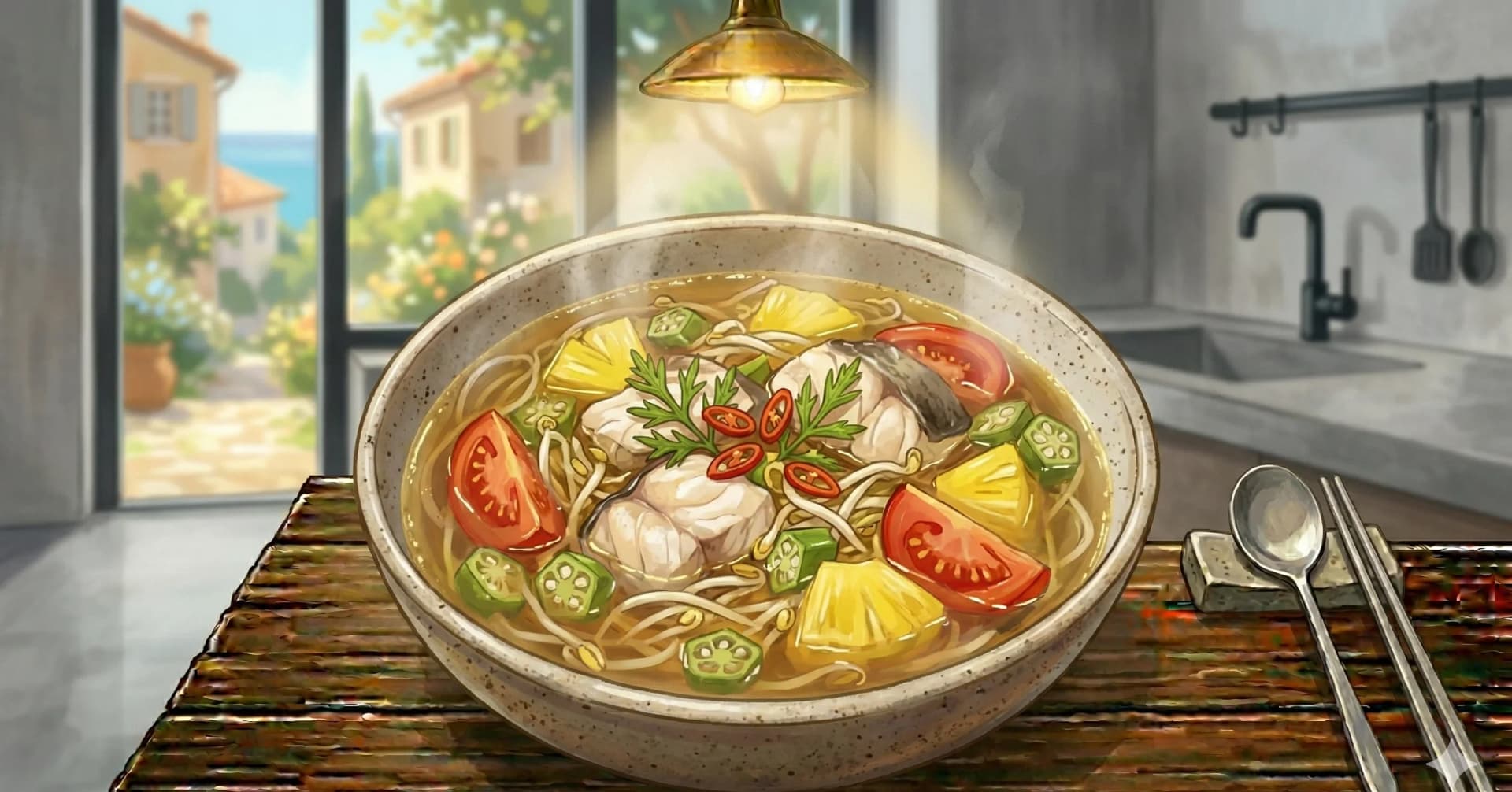
If you enjoy Thai soups, khao tom (rice soup) makes a gentler companion for mornings, while canh chua offers a Vietnamese perspective on the hot and sour soup tradition with tamarind as its souring agent instead of lime.
Storage & Reheating
The broth keeps well in a sealed container in the refrigerator for up to 2 days. Store the broth and shrimp separately if possible, as the shrimp will continue to firm up in the hot liquid. Reheat gently in a covered pot over low heat. Do not bring to a vigorous boil, as this will toughen the shrimp and cook off the lime's brightness. Add a squeeze of fresh lime juice after reheating to restore the sour note. The broth (without shrimp) freezes well for up to 1 month. Thaw in the refrigerator overnight and reheat with freshly cooked shrimp. The aromatic herbs lose potency over time, so frozen broth will taste slightly flatter than fresh.
Cultural Notes
Tom yum goong (ต้มยำกุ้ง) is the most internationally recognized Thai soup, and within Thailand it carries the same cultural weight that minestrone carries in Italy or pho carries in Vietnam: a dish that is everywhere, made by everyone, varied endlessly. The name decomposes literally: tom (boil), yum (the Thai flavor category of hot-sour-salty mixed salads and soups), goong (shrimp or prawn). The defining aromatics, lemongrass, galangal, kaffir lime leaves, and bird's eye chilies, are bruised but not pounded, so they release flavor while staying recognizable in the bowl. Fish sauce supplies the salt, lime juice the sour, and Thai chili paste (nam prik pao) gives the broth its sweet-smoky depth.
The soup exists in two main forms. Tom yum nam sai is the clear version, with no dairy or coconut, where the herb broth comes through at its sharpest. Tom yum nam khon is the creamy version, where evaporated milk or coconut milk is stirred in at the end to soften the heat and add body. Bangkok preference leans toward nam khon in restaurants, but the clear version is widely considered the more traditional preparation and is the form most commonly cooked at home. Both are made with whole shrimp left in the shell, since the shrimp heads release a coral-orange fat that colors the broth and adds depth that peeled shrimp cannot supply.
The dish has been documented in Thai cookbooks since at least the early 20th century and is part of the broader yum family of hot-sour Thai preparations that also includes yum nua (beef salad), yum woon sen (glass noodle salad), and yum talay (mixed seafood salad). In international Thai restaurants, tom yum goong is typically the most-ordered soup. Its concentration of aromatic compounds (citronellal from lemongrass, galangin from galangal, limonene from kaffir lime peel) gives it the distinct herbaceous-citrus profile that no other Thai soup matches.
Nutrition Facts
Calories: 201kcal (10%)|Total Carbohydrates: 14.6g (5%)|Protein: 24.5g (49%)|Total Fat: 6.1g (8%)|Saturated Fat: 1.5g (8%)|Cholesterol: 166mg (55%)|Sodium: 1031mg (45%)|Dietary Fiber: 1.6g (6%)|Total Sugars: 6.5g
You Might Also Like
Ratings & Comments
Ratings & Comments
Ratings
Share your thoughts on this recipe.
Sign in to rate and comment