Thai Cuisine
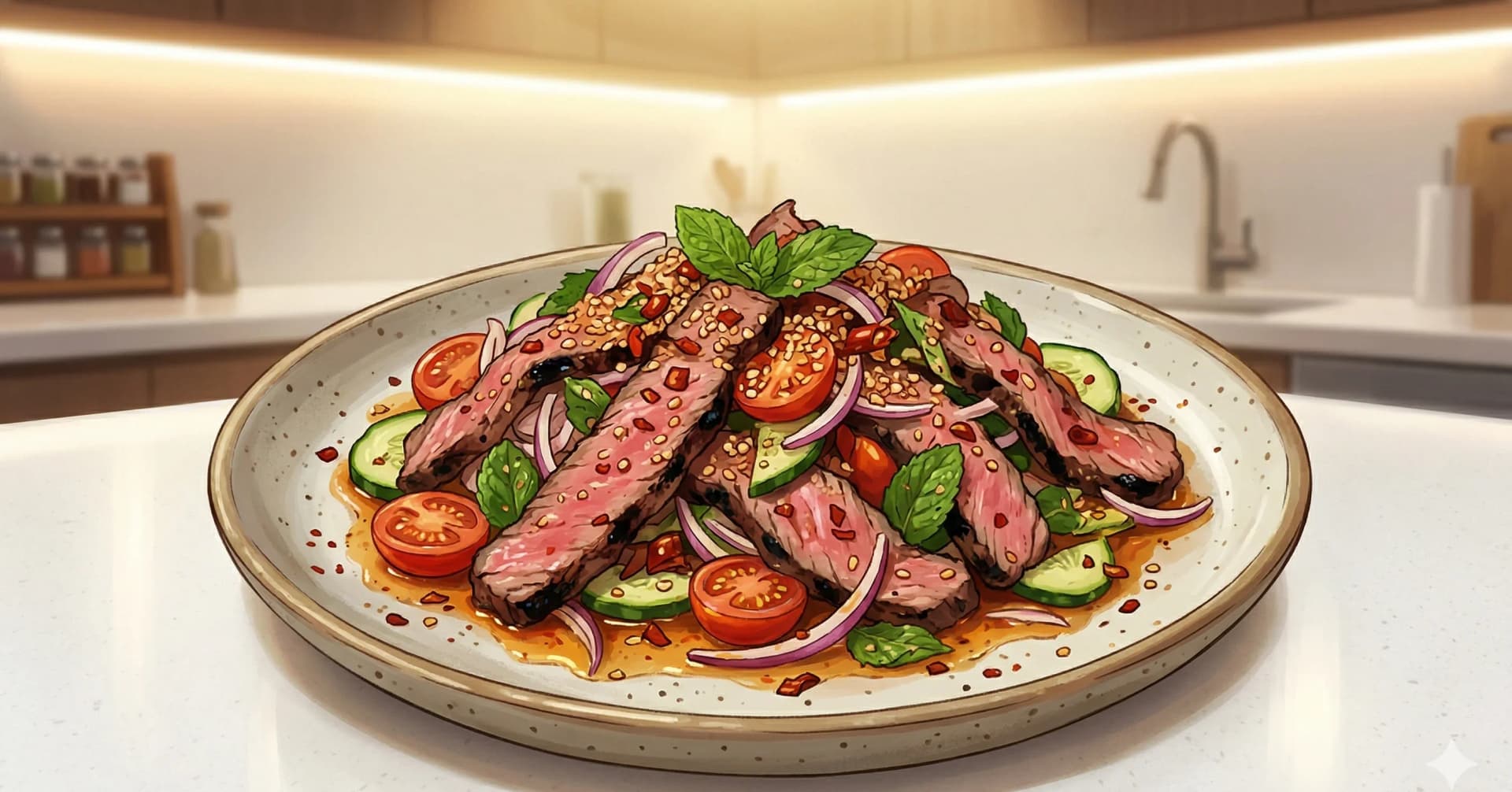
Yam Nua (Thai Spicy Beef Salad)
Grilled steak tossed in a sharp lime-fish sauce-chili dressing with fresh herbs and crunchy aromatics
Yam nua belongs to the Thai family of yam salads, which is to say it is not really a salad in the Western sense at all. There is no bed of leaves, no creamy dressing. Instead, sliced grilled beef is tossed with raw aromatics and dressed in a thin, punchy liquid built from lime juice, fish sauce, sugar, and fresh chilies. The dressing hits every register at once: sour, salty, sweet, and hot, balanced not by muting any one element but by making sure each one pushes back against the others.
The technique is minimal. A good steak, seared hard or grilled over high heat, rested, sliced thin against the grain. A dressing mixed fresh in a mortar or whisked together in a bowl. Tomatoes, onion, herbs, celery, all left raw or barely handled. The dish comes together in the time it takes the steak to rest. That speed is part of the point. Yam salads are street food at heart, assembled to order and eaten before the herbs wilt or the dressing loses its bite.
What separates a good yam nua from a forgettable one is the dressing. Pounding the garlic and chili in a mortar rather than mincing them with a knife releases more of their oils and creates a slightly cloudy, deeply aromatic base. The cilantro stems, crushed alongside the garlic, add an herbal backbone that the leaves alone cannot provide. The ratio of lime to fish sauce to sugar should feel taut, almost confrontational, because the richness of the beef will absorb and soften the impact. If the dressing tastes perfectly balanced on its own, it will seem flat on the plate.
If you have cooked larb or som tam, you already understand this logic. Yam nua is the same sensibility applied to grilled beef, and it sits naturally on a table alongside pad thai, gai yang, or a bowl of tom yum goong.
At a Glance
Yield
2 to 3 servings
Prep
20 minutes
Cook
10 minutes
Total
30 minutes
Difficulty
Easy
Ingredients
Dressing Ingredients
- 3 tbspfresh lime juice (about 2 limes)
- 2 tbspfish sauce
- 2⅓ tsppalm sugar, finely grated (or 2 tsp white sugar)
- 2to 6 Thai chilies, finely chopped, to taste
- 1small clove garlic, peeled
- ¾ cupcilantro stems, finely chopped
- 1 tbspgrapeseed oil or other neutral oil
Beef Ingredients
- ¾ lbsirloin, flank, or rib-eye steak, about 2 cm thick, at room temperature
- 1 tbspneutral oil
- —Fine sea salt and freshly ground black pepper
Salad Ingredients
- 2 ozred onion or shallots, very thinly sliced into half-moons
- 3½ ozcherry tomatoes, halved (or 1 medium tomato (about ½–1 tomato), cut into thin wedges)
- 2¾ ozChinese celery, leaves and stalks, cut into 4 cm pieces (or inner stalks of regular celery with their leaves)
- ⅞ cupfresh mint leaves, roughly torn if large
- ¾ cupfresh cilantro leaves, loosely packed
- 2 tbspchopped green onion
- 1½ ozroasted unsalted peanuts, roughly chopped
To Serve
- —Extra mint and cilantro leaves
- 1lime, cut into wedges
Method
- 1
Soak the sliced red onion in a small bowl of ice water while you prepare the remaining ingredients. This softens the raw bite and crisps the slices. Drain and press dry on a towel just before assembling the salad.
- 2
Prepare the dressing. Place the garlic, a pinch of salt, and the chopped cilantro stems in a mortar. Pound until the garlic breaks down into a rough, fragrant paste with no large pieces remaining. The cilantro stems should be fully crushed, releasing a green, almost grassy fragrance into the paste. If you do not have a mortar, finely mince the garlic and cilantro stems, then smear them across a cutting board with the flat side of a knife to bruise the fibers.
- 3
Scrape the paste into a mixing bowl. Add the lime juice, fish sauce, sugar, neutral oil, and chopped chilies. Stir until the sugar dissolves completely. Taste the dressing. It should lean noticeably sour and salty, sharper than you think is balanced, because the richness of the beef will mellow it on the plate. Adjust with more lime juice, fish sauce, or sugar as needed. Set aside.
- 4
Pat the steak dry with paper towels. Rub both sides with oil and season generously with salt and pepper. Heat a cast-iron skillet or grill pan over the highest heat your stove allows. Wait until the surface is faintly smoking before the steak goes in.
- 5
Lay the steak in the pan and press it down gently with a spatula for the first 10 seconds to ensure full contact with the surface. Cook without moving for 2 minutes. Flip and cook for another 2 minutes. The exterior should be deeply browned with scattered dark spots, and the interior should register about 50 to 52C (122 to 125F) on an instant-read thermometer for medium-rare.
- 6
Transfer the steak to a plate and tent loosely with foil. Rest for 10 minutes. The internal temperature will climb to about 55C (130F) as the juices redistribute. Do not skip the resting period. Cutting too soon will lose all that flavorful liquid into the dressing, thinning it out and leaving the meat dry.
- 7
While the steak rests, combine the drained onion, cherry tomatoes, Chinese celery, mint, cilantro leaves, and green onion in a large mixing bowl. Toss gently with about one-third of the dressing, just enough to lightly coat the vegetables and herbs.
- 8
Slice the rested steak against the grain into strips roughly 5 mm thick and 5 cm long. Angle the knife at about 45 degrees for wider slices that catch more dressing on their surface. Collect any juices from the cutting board and stir them into the remaining dressing.
- 9
Add the sliced beef to the bowl with the dressed vegetables. Pour the remaining dressing over the top. Toss everything together with your hands or two spoons until each slice of beef is coated and the herbs are evenly distributed. Work gently to avoid bruising the mint and cilantro.
- 10
Transfer to a serving plate or shallow bowl. Scatter the chopped peanuts over the top. Finish with a few extra mint and cilantro leaves and the lime wedges on the side. Serve immediately, while the herbs are still bright and the dressing has not yet fully softened the onion.
Key Ingredient Benefits
Beef steak: A concentrated source of complete protein, heme iron (more bioavailable than the non-heme iron found in plants), zinc, and vitamin B12. Grass-fed beef tends to have a higher proportion of omega-3 fatty acids and conjugated linoleic acid compared to grain-finished cuts, though the absolute amounts remain modest. Flank and sirloin are leaner cuts; rib-eye contributes more intramuscular fat, which adds richness in a salad where the meat is the centerpiece.
Fish sauce: Produced through the long fermentation of anchovies with salt, fish sauce is rich in glutamate and other free amino acids responsible for its deep umami character. It contains significant sodium, so its use in dressings replaces the need for additional salt. Thai brands such as Tiparos and Megachef vary in salinity and sweetness; taste and adjust accordingly.
Thai chilies (prik khi nu): These small, potent chilies register between 50,000 and 100,000 Scoville heat units. Capsaicin, the compound responsible for the heat, has been studied for effects on metabolism, appetite regulation, and pain signaling. In the context of this dressing, the chilies provide both heat and a fruity, slightly floral flavor that complements the lime.
Chinese celery: Thinner-stalked and more intensely flavored than Western celery, Chinese celery has a distinctly herbal, almost parsley-like taste. It is a common ingredient in Thai yam salads, where it adds crunch and a bitter-green note that balances the sweetness of tomatoes and sugar. It provides dietary fiber, vitamin K, and small amounts of apigenin, a flavonoid studied for potential anti-inflammatory effects.
Mint: Fresh mint contributes menthol, which produces a cooling sensation that plays well against the heat of the chilies. It is a traditional herb in Thai beef salads and contributes vitamin A, manganese, and folate in small amounts.
Why This Works
Pounding the garlic and cilantro stems in a mortar rather than mincing them releases intracellular compounds more aggressively than a knife cut. The allicin precursors in garlic and the volatile aldehydes in cilantro both become more available through compression, producing a dressing that tastes more aromatic and more pungent from the same quantity of ingredients.
Resting the steak for a full 10 minutes allows the proteins to relax and reabsorb their juices. In a dish where the sliced meat is tossed with a thin dressing, this matters more than it does when serving steak on its own. Under-rested beef will bleed into the dressing, diluting its concentration and turning the plate watery. Well-rested slices hold together and carry the dressing on their surface rather than losing their own liquid into it.
The neutral oil in the dressing is not traditional to every version of yam nua, but it serves a purpose borrowed from the RecipeTinEats approach. A small amount of oil rounds out the acidity and helps the dressing cling to the beef and vegetables rather than pooling at the bottom of the bowl. It softens the aggressive edges of the lime and fish sauce without dulling them.
Soaking the onion in ice water removes much of the harsh sulfur compounds that make raw alliums unpleasant. The onion stays crunchy and sweet, contributing texture and flavor without overpowering the herbs.
Substitutions & Variations
Beef: Flank steak, skirt steak, hanger steak, or rib-eye all work well. The key is a cut that tastes beefy and has some fat or marbling. For a lighter version, thinly sliced grilled pork loin or seared tuna can stand in, though the dish will lose some of its characteristic richness.
Chinese celery: The inner stalks of regular celery, with their smaller leaves attached, are the closest substitute. Chopped regular celery leaves alone also work. In a pinch, thinly sliced lemongrass or a handful of shredded lettuce can fill the textural role.
Thai chilies: Serrano peppers are milder but structurally similar. Bird's eye chilies from Southeast Asian grocers are interchangeable. For less heat, halve the chilies lengthwise and scrape out the seeds and pith before chopping.
Palm sugar: Coconut sugar, light brown sugar, or white sugar. Palm sugar gives a rounder, more caramel-like sweetness, but the quantity here is small enough that any granulated sugar will balance the dressing adequately.
Fish sauce: For a gluten-free version, ensure your fish sauce contains no wheat (most do not, but some cheaper brands add hydrolyzed wheat protein). For a vegetarian adaptation, substitute soy sauce or a mushroom-based seasoning sauce and add a small pinch of MSG to compensate for the lost depth.
Peanuts: Toasted cashews or toasted rice powder (khao khua) can replace the peanuts. Toasted rice powder, made the same way as in gai yang, adds a sandy, nutty crunch and is traditional in the closely related dish nam tok.
Grilling vs. pan-searing: If you have access to a charcoal grill, use it. The smoky char adds another layer of flavor that a skillet cannot replicate. Grill over the hottest part of the coals for the same timing as the pan method.
Serving Suggestions
Yam nua is a complete main course on its own alongside steamed jasmine rice. The rice absorbs the extra dressing pooled on the plate, and each forkful of beef, herbs, and rice together makes the portions feel generous.
For a larger Thai meal, pair it with som tam and sticky rice for a combination that covers the full spectrum of Thai flavors. Add gai yang and you have a classic Isaan-style spread. A bowl of tom yum goong before the salad makes a sharp, aromatic opener that sets the palate for the beef.
The salad also works as part of a mixed plate alongside pad thai or green curry, where its brightness and acidity cut through richer, heavier dishes. A cold lager, a dry Riesling, or sparkling water with lime all handle the heat and acid well.
Storage & Reheating
Freshly made: Yam nua is best eaten within minutes of assembly. The herbs wilt, the onion softens, and the dressing thins as the vegetables release water. This is a dish designed to be eaten immediately.
Short hold: If you need to prepare ahead, grill and rest the steak up to 2 hours in advance. Wrap it tightly and hold at room temperature. Make the dressing and store it separately in a jar. Prepare the vegetables and herbs and keep them in a sealed container in the refrigerator. Slice the steak, combine everything, and dress just before serving.
Leftovers: Leftover assembled salad will keep in the refrigerator for up to 1 day. The beef will firm up and the herbs will darken significantly. The flavor remains good, but the texture is noticeably different. Bring to room temperature for 15 minutes before eating. Do not attempt to reheat this dish, as the herbs and vegetables will collapse and the dressing will lose its brightness.
Cultural Notes
Yam nua (ยำเนื้อ, "beef salad") is one of the most representative dishes of the broader Thai yam (or yum) tradition: the family of hot-sour-salty composed salads that also includes yum woon sen (glass noodle salad), yum talay (mixed seafood salad), and the related som tam (green papaya salad). Within this family, yam nua is the assertive, beef-forward member, defined by the contrast between grilled rare-to-medium beef and the bright herbal dressing that surrounds it.
The dish is built around a piece of grilled beef (traditionally sirloin or flank steak), cooked over charcoal until the surface chars but the interior stays pink, rested, and sliced thin against the grain. The slices are tossed with sliced shallot, halved cherry tomatoes, sliced cucumber, sawtooth coriander, mint, cilantro, and a generous handful of bird's eye chilies. The dressing is a balance of fish sauce, fresh lime juice, palm sugar, and a small amount of the beef's resting juice for added depth. The salad is served at room temperature on a bed of butter lettuce or rice and is eaten as part of a larger Thai meal rather than as a standalone dish.
Yam nua occupies the position of the prestige salad in Thai dining: it is the salad ordered for guests, for special meals, and for occasions where the host wants to demonstrate that the meal involved real expense. Beef has historically been more expensive in Thailand than pork or chicken, and yam nua, made from a quality cut, signals a more upscale meal than the everyday pork or seafood yams. The dish appears most commonly at sit-down Thai restaurants and at home cooking for guests rather than at street stalls or one-plate lunch counters, where lighter proteins dominate.
Nutrition Facts
Calories: 231kcal (12%)|Total Carbohydrates: 17.6g (6%)|Protein: 6g (12%)|Total Fat: 16.9g (22%)|Saturated Fat: 2.3g (12%)|Cholesterol: 0mg (0%)|Sodium: 991mg (43%)|Dietary Fiber: 3.6g (13%)|Total Sugars: 7g
You Might Also Like
Ratings & Comments
Ratings & Comments
Ratings
Share your thoughts on this recipe.
Sign in to rate and comment