Thai Cuisine
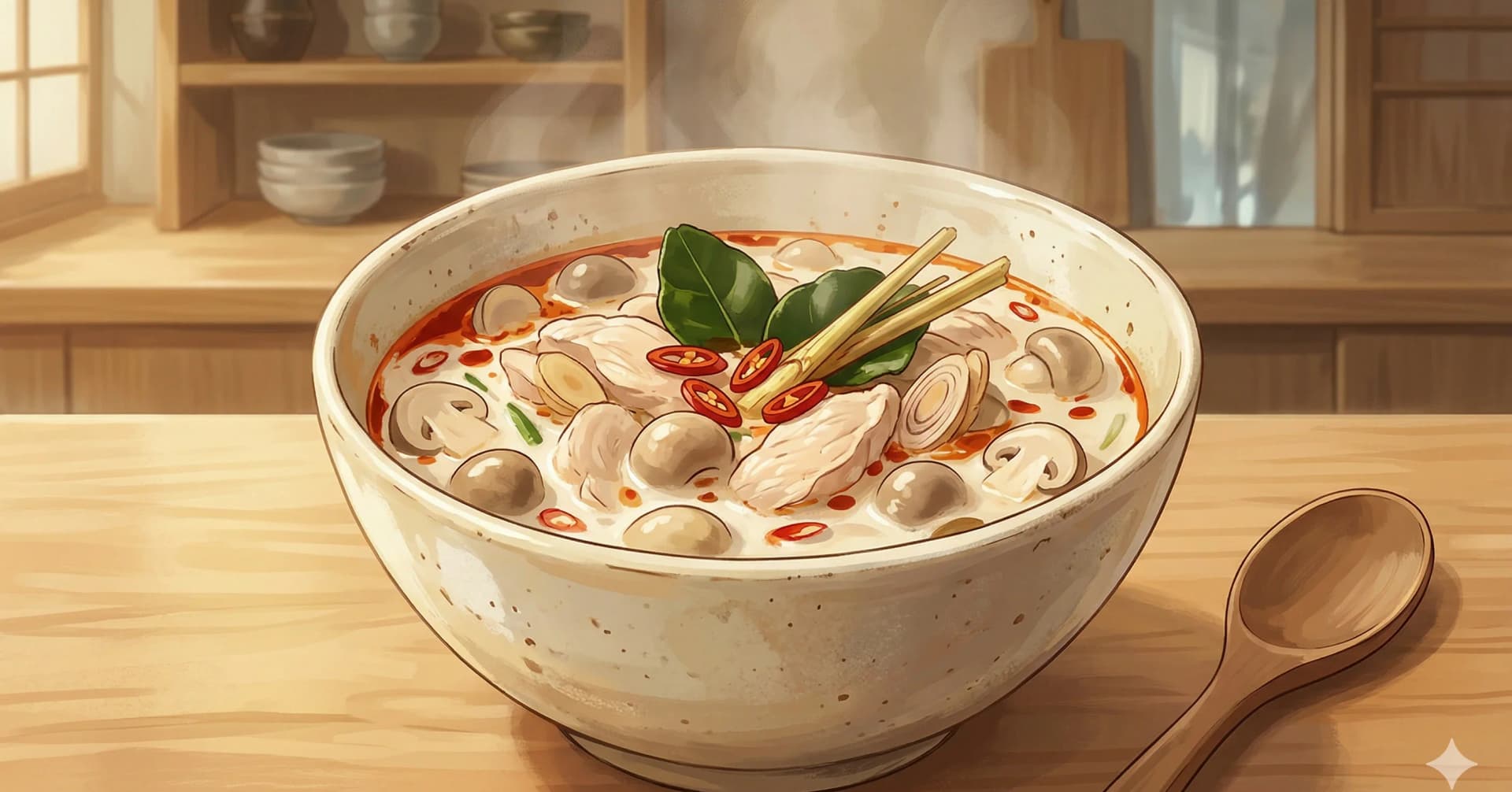
Tom Kha Gai (Thai Coconut Galangal Chicken Soup)
A silky, aromatic Thai soup of chicken simmered in coconut milk with galangal, lemongrass, and makrut lime leaves, finished with a bright squeeze of lime
Close your eyes over a bowl of tom kha gai and the first thing you notice is the perfume. Galangal, sharper and more floral than ginger, meets the citrus hum of lemongrass and the almost bergamot-like fragrance of makrut lime leaves. Then the coconut milk arrives, rich and full, carrying those aromatics across your palate in a way that broth alone never could.
Tom kha gai (literally "boiled galangal chicken") is one of the central soups of Thai cuisine, sitting alongside tom yum goong as a dish that appears on nearly every Thai restaurant menu worldwide. Where tom yum is sharp and transparent, tom kha is rounded and opaque. The coconut milk softens every edge. In Thai home cooking, both soups function as part of a shared meal, ladled over rice rather than sipped from a bowl, though eating it either way is perfectly correct.
The technique is forgiving once you understand one principle: coconut milk should not boil hard. A gentle simmer keeps the fat emulsified and the broth silky. A rolling boil causes the coconut fat to separate, leaving an oily, grainy surface. If you keep the heat low and resist the urge to rush, the soup practically makes itself. The aromatics do the work. You build the broth, poach the chicken, and finish with lime juice and fish sauce off the heat so neither loses its brightness. From start to table, it takes under 40 minutes.
At a Glance
Yield
4 servings
Prep
15 minutes
Cook
25 minutes
Total
40 minutes
Difficulty
Easy
Ingredients
- 1½ ozgalangal (about a thumb-sized piece), sliced into thin rounds
- 2 stalkslemongrass, bottom half only, outer layers removed, cut into 5 cm pieces and lightly bruised with the back of a knife
- 6makrut lime leaves, torn in half with the central rib removed
- 3to 5 fresh red Thai chilies, lightly smashed or halved lengthwise
- 1¾ cupfull-fat coconut milk
- 2 cupchicken stock
- ¾ lbboneless skinless chicken thighs, sliced against the grain into bite-sized pieces
- 5½ ozoyster mushrooms, torn into bite-sized strips (or straw mushrooms, halved)
- 2medium Roma tomatoes (about 150 g), cut into wedges
- 2 tbspfish sauce, plus more to taste
- 1¼ tbsppalm sugar (or light brown sugar)
- 3 tbspfresh lime juice (about 2–3 limes), plus more to taste
- ½ cupfresh cilantro leaves, roughly torn
- 2scallions, thinly sliced
- —Extra lime wedges for serving
Method
- 1
Pour the chicken stock into a medium saucepan and bring it to a gentle boil over medium heat. Add the galangal slices, lemongrass pieces, and torn makrut lime leaves. Let the aromatics simmer for 3 to 4 minutes until the broth smells fragrant and slightly floral.
- 2
Add the chicken pieces to the broth and reduce the heat to medium-low. Simmer gently for about 5 minutes, skimming any foam that rises to the surface. The chicken should turn opaque on the outside but does not need to be cooked through yet, as it will continue cooking.
- 3
Pour in the coconut milk and stir to combine. Bring the liquid back to a very gentle simmer. You want small bubbles breaking the surface lazily, not a rolling boil. If the soup begins to bubble vigorously, lower the heat immediately.
- 4
Add the mushrooms, tomato wedges, and smashed Thai chilies. Stir gently and let everything simmer together for 6 to 8 minutes. The mushrooms will soften and the tomatoes will begin to release their juice. The chicken should be cooked through and tender when you cut into a thicker piece.
- 5
Stir in about half of the fish sauce and all of the palm sugar. Let the sugar dissolve for a minute, then taste the broth. It should be savory and slightly sweet with the coconut richness in the foreground.
- 6
Remove the pot from the heat. Add the lime juice and the remaining fish sauce. Stir gently and taste again. The soup should balance creamy, sour, salty, and sweet, with sour and salty leading slightly. Adjust with more lime juice for brightness or more fish sauce for depth. The flavors should feel vivid and layered, not muted.
- 7
Ladle the soup into bowls, making sure each serving gets a good mix of chicken, mushrooms, and tomatoes. Scatter the torn cilantro and sliced scallions over the top and serve with lime wedges on the side. The galangal, lemongrass, and lime leaves are meant for fragrance and are not intended to be eaten. Serve with steamed jasmine rice.
Key Ingredient Benefits
Galangal: The defining ingredient of this soup, galangal (kha in Thai) is a rhizome in the ginger family with a sharper, more piney and citrusy flavor than ginger. It contains compounds such as galangin that have been studied for anti-inflammatory and antioxidant properties, though clinical evidence in humans is limited. Fresh galangal is preferred, but frozen works well. Dried galangal can be used in a pinch, though it produces a less vibrant flavor. Ginger is not a true substitute, as it changes the character of the dish entirely.
Coconut milk: Full-fat coconut milk provides the creamy body essential to tom kha. It is a source of medium-chain triglycerides (MCTs), which some research suggests may be metabolized more readily than other saturated fats. The fat in coconut milk also acts as a solvent for the fat-soluble flavor compounds in galangal, lemongrass, and lime leaves, which is why these aromatics taste more vivid in coconut milk than in water-based broths.
Lemongrass: Rich in citral, the compound responsible for its bright lemony scent. Traditional Southeast Asian medicine uses lemongrass teas for digestive comfort and relaxation. It is fibrous and not pleasant to chew, so it should be removed before eating or left in large enough pieces that diners can set it aside.
Fish sauce: Fermented fish sauce provides glutamates and other umami compounds that deepen the broth far beyond what salt alone could achieve. It is high in sodium, so it doubles as the primary seasoning. Quality varies significantly between brands. Thai brands like Squid or Megachef are reliable choices.
Why This Works
Tom kha gai rests on a technique that is closer to infusion than cooking. The galangal, lemongrass, and makrut lime leaves are not minced or ground into the broth. They are added in large pieces and left whole, releasing their volatile oils slowly into the coconut milk. This produces clean, bright flavors rather than the muddier taste you get from crushed pastes. It is the same logic behind steeping tea: gentle extraction over time.
Splitting the liquid into stock and coconut milk serves two purposes. The stock provides depth and gelatin, the savory backbone that coconut milk alone cannot deliver. The coconut milk contributes fat, body, and sweetness. Together they create a broth that is rich without being heavy.
Adding fish sauce and lime juice off the heat preserves their volatile aromatic compounds. Fish sauce loses nuance when boiled, and lime juice turns bitter and flat with prolonged heat. Seasoning at the end also gives you complete control over the final balance, which matters enormously in Thai cooking where the interplay of sour, salty, sweet, and spicy defines the dish.
The light cornstarch marinade technique used by some cooks (tossing the chicken with a small amount of cornstarch before simmering) is worth noting. It creates a thin coating that helps the chicken stay tender and gives the broth a slightly more luxurious body. This is optional but effective, particularly with chicken breast, which dries out more easily than thigh meat.
Substitutions & Variations
Protein: Prawns are a classic alternative, added in the last 3 to 4 minutes of cooking until just pink and curled. For a vegetarian version, replace the chicken with firm tofu or a mix of mushrooms (shiitake, king oyster, and straw) and use vegetable stock. This is a natural pairing with the green curry approach of swapping proteins freely.
Galangal: Frozen galangal is the best substitute for fresh. Dried galangal (about 8 to 10 slices rehydrated) works in a pinch. Ginger will produce a pleasant soup but it will not taste like tom kha.
Coconut milk: Light coconut milk can be used for a thinner, less rich result. Do not use coconut cream alone, as it will be too thick. A 50/50 mix of coconut cream and stock is a good middle ground.
Mushrooms: Straw mushrooms are traditional and worth seeking out in Asian grocery stores (canned are fine). Button mushrooms, shiitake, or king oyster mushrooms are all reasonable alternatives. The mushroom choice is flexible.
Heat level: For a milder soup, reduce the Thai chilies to 1 or omit them entirely. For more heat, add a tablespoon of Thai roasted chili paste (nam prik pao) with the fish sauce. This also adds a smoky sweetness that some versions of tom kha include.
Tom kha as a curry: Some Thai cooks add a spoonful of red curry paste to the broth for a richer, more complex variation that bridges the gap between tom kha and massaman curry. Stir it into the stock before adding the coconut milk.
Serving Suggestions
Tom kha gai is traditionally served as part of a shared Thai meal with steamed jasmine rice. The soup is ladled over the rice or eaten alongside it, not before the meal as a separate course. For a full Thai table, pair it with pad thai for contrasting texture, a green curry for deeper spice, or khao soi if you want to build a soup-focused spread. A plate of stir-fried morning glory or steamed greens rounds out the meal and gives the palate a clean resting point. The soup also stands beautifully on its own as a light meal with extra rice, particularly on cool evenings when the warmth and fragrance are exactly what you want. For a Southeast Asian soup comparison, try it alongside pho ga or khao tom to appreciate how different cultures build flavor from chicken and aromatics.
Storage & Reheating
Refrigerator: Store in an airtight container for up to 3 days. The galangal, lemongrass, and lime leaves will continue to infuse, so the flavor will intensify. Remove the aromatics after a day if you prefer a lighter profile.
Reheating: Warm gently over medium-low heat, stirring occasionally. Do not let the soup come to a hard boil, as the coconut milk may separate. If the soup has thickened in the fridge, add a splash of chicken stock or water to restore the consistency. Taste and adjust with a squeeze of fresh lime juice, as the acidity fades overnight.
Freezing: The soup freezes well for up to 2 months. The coconut milk may separate slightly on thawing, but a gentle reheat with stirring will bring it back together. Freeze in individual portions for easy weeknight meals.
Cultural Notes
Tom kha gai (ต้มข่าไก่) is the central Thai chicken soup that runs in parallel with tom yum goong but takes a different shape entirely. The name breaks down to tom (boil), kha (galangal), gai (chicken), and galangal is the dominant note, present in such quantity that the broth is sometimes described as "drinking galangal." The other classic aromatics from tom yum (lemongrass, kaffir lime leaves, bird's eye chilies) appear here as well, but the heat is dialed way back. The soup is built on coconut milk rather than clear broth, and the addition of fish sauce, lime juice, and palm sugar produces a sweet, tangy, savory profile that is gentler than its hotter cousin.
The galangal in this dish is non-negotiable. Kha and ginger are visually similar and sometimes confused in international markets, but they are not interchangeable. Galangal is fibrous, sharper, with a piney, almost mustardy bite, where ginger is softer and sweeter. Tom kha gai made with ginger has the broth color right but tastes wrong to anyone who has eaten the original in Thailand. The galangal is sliced thinly and simmered with the chicken so the broth picks up the root's aromatic oils, and the slices are eaten or left in the bowl depending on the diner's preference.
The soup belongs to the central Thai everyday cooking repertoire and is one of the dishes most commonly cooked when someone in the household is recovering from a cold, partly because the broth is easy to drink and partly because Thai traditional thinking has long credited galangal with digestive and warming properties. The dish has crossed over into international Thai menus as the gentler alternative to tom yum, often suggested to diners as the "mild" option, though Thais themselves generally consider it not a milder dish but simply a different one, galangal-forward rather than chili-forward.
Nutrition Facts
Calories: 450kcal (23%)|Total Carbohydrates: 19.5g (7%)|Protein: 24.9g (50%)|Total Fat: 32.6g (42%)|Saturated Fat: 23.6g (118%)|Cholesterol: 90mg (30%)|Sodium: 958mg (42%)|Dietary Fiber: 3.9g (14%)|Total Sugars: 10.5g
You Might Also Like
 Easy
EasyVietnamese Cuisine
Ga Kho Gung (Vietnamese Caramelized Ginger Chicken)
1 hour
 Easy
EasyVietnamese Cuisine
Cháo Gà (Vietnamese Chicken Rice Porridge)
1 hour 30 minutes
 Medium
Thai Cuisine
Boat Noodles (ก๋วยเตี๋ยวเรือ)
3 hours 15 minutes
 Easy
EasyIndonesian Cuisine
Bubur Ayam (Indonesian Chicken Rice Porridge)
1 hour 10 minutes
Ratings & Comments
Ratings & Comments
Ratings
Share your thoughts on this recipe.
Sign in to rate and comment