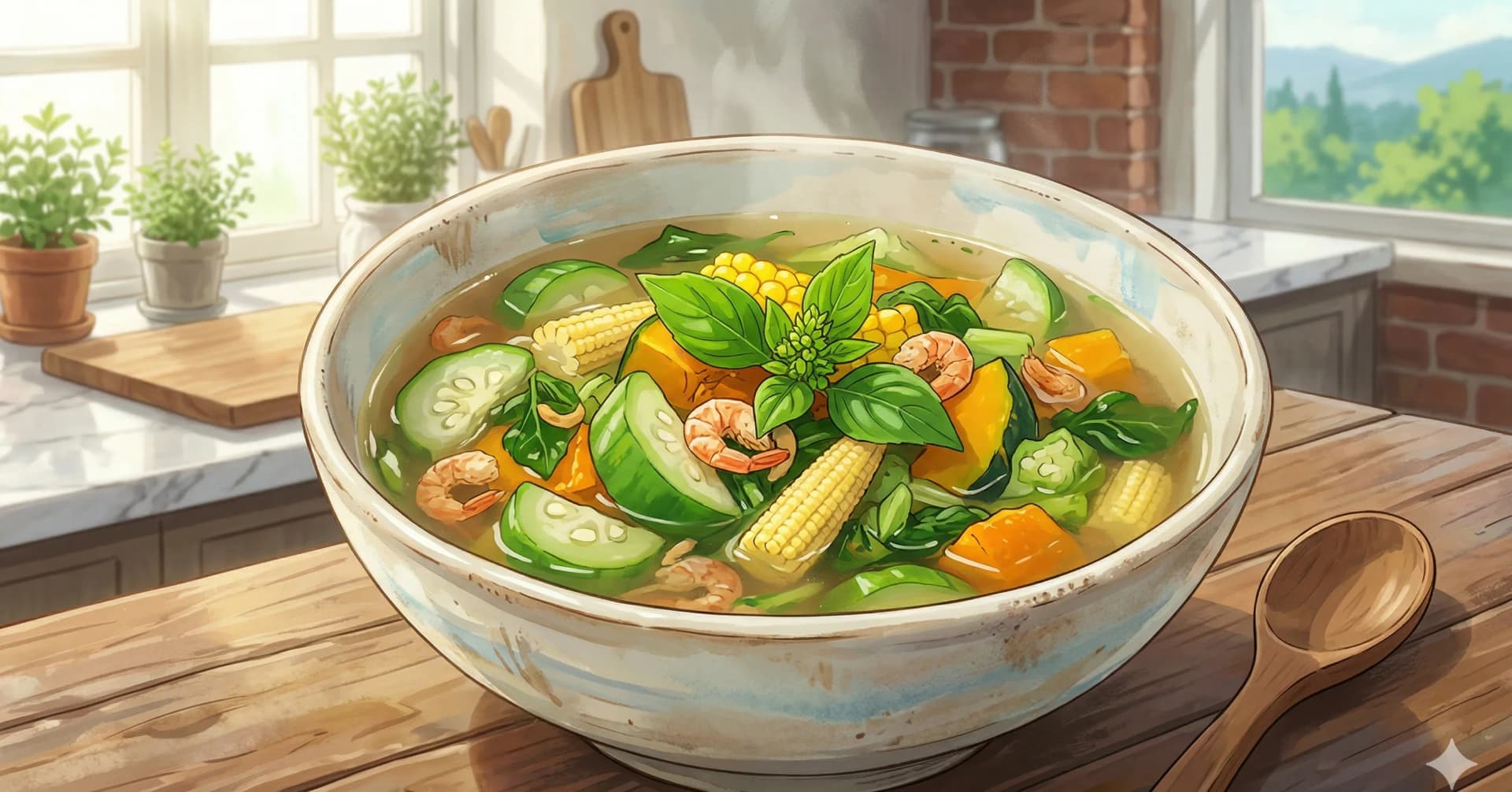
Thai Cuisine
Gaeng Liang (Thai Vegetable Soup with Shrimp Paste and Basil)
A fragrant, peppery Thai vegetable soup built on a pounded paste of shrimp paste, dried shrimp, and shallots, finished with handfuls of sweet basil
Gaeng liang is one of the oldest and most quietly beloved soups in central Thai cooking. It appears on family tables far more often than it appears on restaurant menus, which is part of the reason so few people outside Thailand know it. The soup belongs to a tradition of clear, broth-forward dishes that treat vegetables as the main event rather than a side thought. If you have ever loved the herbal punch of tom yum goong or the sour brightness of gaeng som, gaeng liang will feel like a natural next step, though it takes a different path to get there.
The flavor engine is a small, potent paste pounded from dried shrimp, shrimp paste, shallots, and white peppercorns. There is no chili in the traditional version. The heat comes entirely from pepper, which means gaeng liang tastes warm and tingling rather than fiery. That paste dissolves into a light stock, and then the vegetables go in, timed so each one cooks to its ideal texture. The finish is a generous pile of sweet basil, which wilts into the hot broth and perfumes every spoonful.
The vegetable selection is flexible by design. Traditional versions use whatever is fresh and in season: kabocha pumpkin, chayote, luffa gourd, ivy gourd, corn, and various squash all appear regularly. What stays constant is the paste, the pepper, and the basil. Those three elements are the identity of gaeng liang.
In Thailand, gaeng liang is comfort food in the truest sense. It is the soup grandmothers make when someone is unwell, the dish served to new mothers, and the bowl that appears when the weather calls for something restorative. It sits alongside other coconut-free soups like jungle curry and gaeng som as proof that Thai cuisine does not always need richness to achieve depth.
At a Glance
Yield
4 servings
Prep
20 minutes
Cook
20 minutes
Total
40 minutes
Difficulty
Easy
Ingredients
Curry Paste Ingredients
- ¾ ozdried shrimp, soaked in warm water for 10 minutes, then drained
- ¼ ozfermented shrimp paste (gapi)
- 1¾ ozshallots (about 3 small), roughly chopped
- 1⅔ tspwhite peppercorns
- 1 stalklemongrass, bottom half only (about 20 g), thinly sliced
Soup Ingredients
- 3⅛ cupchicken stock, shrimp stock, or light vegetable stock
- 7 ozkabocha pumpkin (or butternut squash), peeled and cut into 2 cm cubes
- 5½ ozchayote, halved, seed removed, cut into 2 cm wedges
- 5½ ozluffa gourd (or zucchini), peeled, halved lengthwise (about ½–1 zucchini), and cut into 2 cm half-moons
- 2ears fresh corn (about 200 g), each cut into 4 rounds
- 3½ ozprawns, peeled and deveined (optional)
- 15to 30 ml fish sauce, to taste
- 1¼ tsppalm sugar or light brown sugar (optional, about 1 teaspoon)
- 1¾ cupsweet basil leaves
- 1to 2 fresh red spur chilies, sliced on the diagonal (optional, for garnish)
Method
- 1
Pound the drained dried shrimp in a mortar with the white peppercorns and a pinch of coarse salt. Work them into a rough, fibrous mass. The shrimp will break apart gradually, and the peppercorns will crack and release their sharp, floral aroma. This takes about 2 to 3 minutes of steady pounding.
- 2
Add the shallots and lemongrass to the mortar and continue pounding until the mixture forms a coarse, wet paste. You should see no large chunks of shallot remaining, though the texture will be rougher than a typical curry paste. Fold in the shrimp paste and pound briefly to combine. The finished paste will smell intensely savory and peppery, with a slight sweetness from the shallots.
- 3
Bring the stock to a gentle simmer in a medium saucepan over medium heat. Add the paste and stir to dissolve it into the broth. The liquid will turn slightly cloudy and take on a golden hue. Let it simmer for 2 to 3 minutes so the flavors of the paste bloom into the stock.
- 4
Add the kabocha pumpkin and corn rounds first, as these take the longest to cook. Simmer for 5 to 6 minutes until the pumpkin edges begin to soften and a skewer meets some resistance in the center but slides through the edges.
- 5
Add the chayote and luffa gourd. Continue simmering for 4 to 5 minutes. The chayote should be translucent and tender but still hold its shape, and the luffa should be soft and slightly silky without falling apart.
- 6
If using prawns, add them now and cook for 2 to 3 minutes until they curl and turn pink through to the center. Overcooking will make them rubbery, so watch the color change closely.
- 7
Season with fish sauce, starting with 15 ml and tasting before adding more. The broth should taste savory and well-seasoned with a pronounced pepper warmth. Add the palm sugar if the broth needs a touch of sweetness to balance the shrimp paste. The sugar should be barely perceptible, rounding out the savory notes rather than making the soup sweet.
- 8
Remove from heat. Stir in the sweet basil leaves and let them wilt in the residual heat for 30 seconds. The basil will release its anise-like fragrance into the broth and soften without losing its color entirely. Scatter the sliced red chilies over the top if using.
- 9
Ladle into bowls and serve immediately with steamed jasmine rice. The soup is meant to be eaten alongside the rice, spooned over it or alternated between bites.
Key Ingredient Benefits
Dried shrimp: These small, intensely flavored preserved shrimp are a cornerstone of Southeast Asian cooking. Look for ones that are bright orange-pink with a clean, sweet-salty smell. Avoid any that look gray or smell strongly of ammonia. They keep for months in a sealed container in the refrigerator. Soaking them briefly before pounding softens them enough to break down in the mortar. Dried shrimp are high in protein and provide significant calcium, as the tiny shells are consumed whole.
Fermented shrimp paste (gapi): Thai gapi is denser and more pungent than Malaysian belacan. A small amount provides a deep umami backbone that dried shrimp alone cannot achieve. The smell is powerful raw but transforms into something rounded and savory once dissolved into hot broth. Store tightly sealed in the refrigerator. It keeps nearly indefinitely.
Kabocha pumpkin: This dense, sweet Japanese variety (also called kabocha squash) is the preferred pumpkin in Thai cooking. Its flesh holds its shape during simmering better than butternut and has a naturally sweet, chestnut-like flavor. The skin is edible once cooked, though peeling is more traditional in gaeng liang. Kabocha is rich in beta-carotene, vitamin C, and dietary fiber.
Chayote (sayongte): A mild, crisp squash common across Southeast Asia and Latin America. It cooks to a pleasant, slightly slippery texture similar to a tender cucumber. The single flat seed in the center is edible when young. Chayote is low in calories and provides folate and vitamin C.
Luffa gourd (buap): Also called sponge gourd or Chinese okra, luffa has a delicate, slightly sweet flavor when young and fresh. It cooks quickly to a silky, almost melting texture. Choose firm, unblemished specimens no longer than 25 cm. Older luffa develops tough fibers (the same fibers that become bath sponges when fully mature). In traditional Thai and Chinese medicine, luffa is considered a cooling food.
White peppercorns: These are fully ripe peppercorns with their outer skin removed, revealing a milder, more floral flavor than black pepper. They are the traditional pepper in Thai cooking and appear in nearly every Thai curry paste. White pepper provides warmth without the fruity, woody notes of black pepper, making it better suited to clear broths where a cleaner pepper flavor is desired.
Why This Works
Gaeng liang builds its depth from fermented ingredients rather than aromatics or fat. The combination of dried shrimp and shrimp paste creates a double layer of umami: the dried shrimp contribute a concentrated, slightly sweet brininess, while the fermented paste adds a deeper, funkier savory base. Together, they give the broth a complexity that belies the short ingredient list.
White peppercorns provide the only heat in the traditional recipe, and they do it differently from chilies. Piperine, the active compound in pepper, activates different receptors than capsaicin, producing a warming, tingling sensation rather than a burning one. This gentler heat is what makes gaeng liang feel soothing rather than aggressive, and it is one reason the soup is considered restorative in Thai food culture.
The vegetables are staggered into the pot by density, a simple but important technique. Pumpkin and corn go in first because they are dense and starchy. Chayote and luffa follow because they cook faster and turn mushy if overdone. This staging means every vegetable reaches its ideal texture at the same time, which is the difference between a carefully made gaeng liang and a pot of overcooked vegetables in broth.
Sweet basil added off the heat preserves its volatile aromatic compounds, particularly linalool and eugenol, which would break down and dissipate if simmered. The residual heat is enough to wilt the leaves and release their fragrance into the broth without destroying the delicate top notes. This is the same principle behind adding basil at the end of a green curry or finishing tom yum goong with lime juice off the heat.
Substitutions & Variations
Vegetables: The vegetable selection in gaeng liang is highly flexible. Traditional options beyond those listed include ivy gourd (tamlueng), angled loofah, wing beans, ash gourd, and pea eggplant. For Western-market substitutions: zucchini works well for luffa, butternut squash for kabocha, and kohlrabi or turnip for chayote. The key is to include a mix of textures, something dense and starchy, something crisp, and something that cooks to a soft texture.
Protein: Prawns are the most common addition, but the soup is also excellent with no protein at all, purely as a vegetable broth. Some regional versions include small pieces of freshwater fish, crab meat, or sliced pork. For a richer variation, add 100 g of cooked crab meat in the last minute of cooking.
Lemongrass in the paste: Not all versions include lemongrass. Pailin Chongchitnant's version omits it, relying solely on shrimp, shrimp paste, shallots, and white pepper for the paste. Including lemongrass, as Nart's version suggests, adds a citrusy layer that some cooks prefer. Both approaches are traditional. Try it both ways and decide which you prefer.
Vegetarian or vegan: Replace dried shrimp with 15 g dried shiitake mushrooms (soaked and pounded). Replace shrimp paste with 10 g white miso or fermented soybean paste. Use vegetable stock. Replace fish sauce with soy sauce or mushroom sauce. The character will be different, but the peppery, basil-fragrant broth will still be satisfying.
Spice level: For more heat, add 2 to 3 fresh green Thai chilies to the paste and pound them in with the peppercorns. This moves the soup closer to a jungle curry in spirit while keeping its distinctive shrimp paste base. Some cooks in Thailand's southern regions do add chilies as a matter of course.
Richer variation: For a version with slightly more body, stir 60 ml of coconut cream into the finished soup just before adding the basil. This is not traditional but produces a pleasant, lightly creamy broth that bridges the gap between gaeng liang and a light coconut curry.
Serving Suggestions
Gaeng liang is a communal dish, meant to sit at the center of a Thai table alongside rice and two or three other preparations. Its light, peppery character makes it an ideal counterpoint to richer dishes. Pair it with green curry for a study in contrasts: one rich and coconut-based, the other lean and broth-forward. It also works beautifully alongside jungle curry, another coconut-free preparation, creating a meal that is vegetable-heavy and restorative.
For a complete Thai soup-centered meal, serve gaeng liang with tom yum goong and steamed jasmine rice. The two soups share a love of aromatic herbs but approach them from very different angles, one sour and fiery, the other peppery and gentle. Gaeng som is another natural companion, offering tartness where gaeng liang offers warmth. The Vietnamese sour soup canh chua shares a similar spirit of vegetables in a clear, flavored broth and makes an interesting cross-cultural pairing.
For a simpler meal, gaeng liang with a plate of rice and a side of khao tom (Thai rice soup) makes a light, nourishing dinner. A small plate of raw vegetables and a dipping sauce rounds out the table without competing with the soup's delicate flavors.
Storage & Reheating
Refrigerator: Store in an airtight container for up to 3 days. The vegetables will soften further as they sit, which is acceptable but changes the texture. Keep the basil in the broth; it will darken but continue to flavor the soup. Store rice separately.
Reheating: Warm gently in a saucepan over medium-low heat until the broth reaches a simmer. Avoid boiling vigorously, as the pumpkin may break down into the broth. Add a few fresh basil leaves just before serving to refresh the aroma.
Freezing: Gaeng liang freezes adequately for up to 1 month, though the vegetable textures will soften noticeably upon thawing. The luffa in particular becomes very soft. If you plan to freeze, consider slightly undercooking all vegetables. Thaw overnight in the refrigerator and reheat on the stovetop. Stir in fresh basil after reheating.
Make-ahead paste: The pounded paste can be made up to 2 days in advance and stored in a sealed container in the refrigerator. This makes the active cooking time very short, essentially just simmering vegetables in broth.
Cultural Notes
Gaeng liang (แกงเลียง, "spicy herbal vegetable soup") is one of the oldest documented Thai dishes, predating the introduction of chilies from the New World and the development of the coconut-milk curries that now dominate central Thai cooking. The soup uses white peppercorns rather than chilies for its heat, and the absence of coconut milk gives it a clean, broth-forward profile that sits closer to the older indigenous Thai cooking tradition than to the post-Columbian Thai curries.
The defining technique is the pounded paste that forms the broth's foundation. White peppercorns, shallots, garlic, krachai (fingerroot), and dried shrimp are pounded together in a mortar with shrimp paste (kapi), then dissolved into simmering stock or water along with fresh shrimp or small fish. The vegetables go in next, in an order designed to keep each one at its proper texture: dense vegetables like Thai pumpkin, gourd, and squash first; quicker-cooking vegetables like glass noodle melon, ivy gourd leaves, mushrooms, and corn next; and finally a large handful of fresh holy basil or sweet basil leaves stirred in just before serving.
The dish carries strong cultural ties to postpartum Thai cooking. Gaeng liang has been treated for generations as a recovery food for women after childbirth, on the traditional thinking that the white-pepper warmth, the nourishing vegetables, and the broad herbal profile all support the body's return to balance. Thai mothers and grandmothers often prepare large pots of gaeng liang for new mothers in the family during the first weeks postpartum. The dish appears less commonly at restaurants than at home, partly because of the seasonal and personal-variation nature of the vegetable mix, and partly because it occupies a specific cultural niche tied to home and family rather than commercial dining.
Nutrition Facts
Calories: 115kcal (6%)|Total Carbohydrates: 15g (5%)|Protein: 12.5g (25%)|Total Fat: 1g (1%)|Saturated Fat: 0.3g (2%)|Cholesterol: 67mg (22%)|Sodium: 1081mg (47%)|Dietary Fiber: 1.6g (6%)|Total Sugars: 5.2g
You Might Also Like
 Easy
EasyTraditional Chinese Medicine · China
Bok Choy in Ginger Sauce (姜汁白菜)
6 minutes
 Medium
Thai Cuisine
Boat Noodles (ก๋วยเตี๋ยวเรือ)
3 hours 15 minutes
 Easy
EasyVietnamese Cuisine
Canh Chua Cá (Vietnamese Sweet and Sour Fish Soup)
35 minutes
 Easy
EasyVietnamese Cuisine
Ga Kho Gung (Vietnamese Caramelized Ginger Chicken)
1 hour
Ratings & Comments
Ratings & Comments
Ratings
Share your thoughts on this recipe.
Sign in to rate and comment