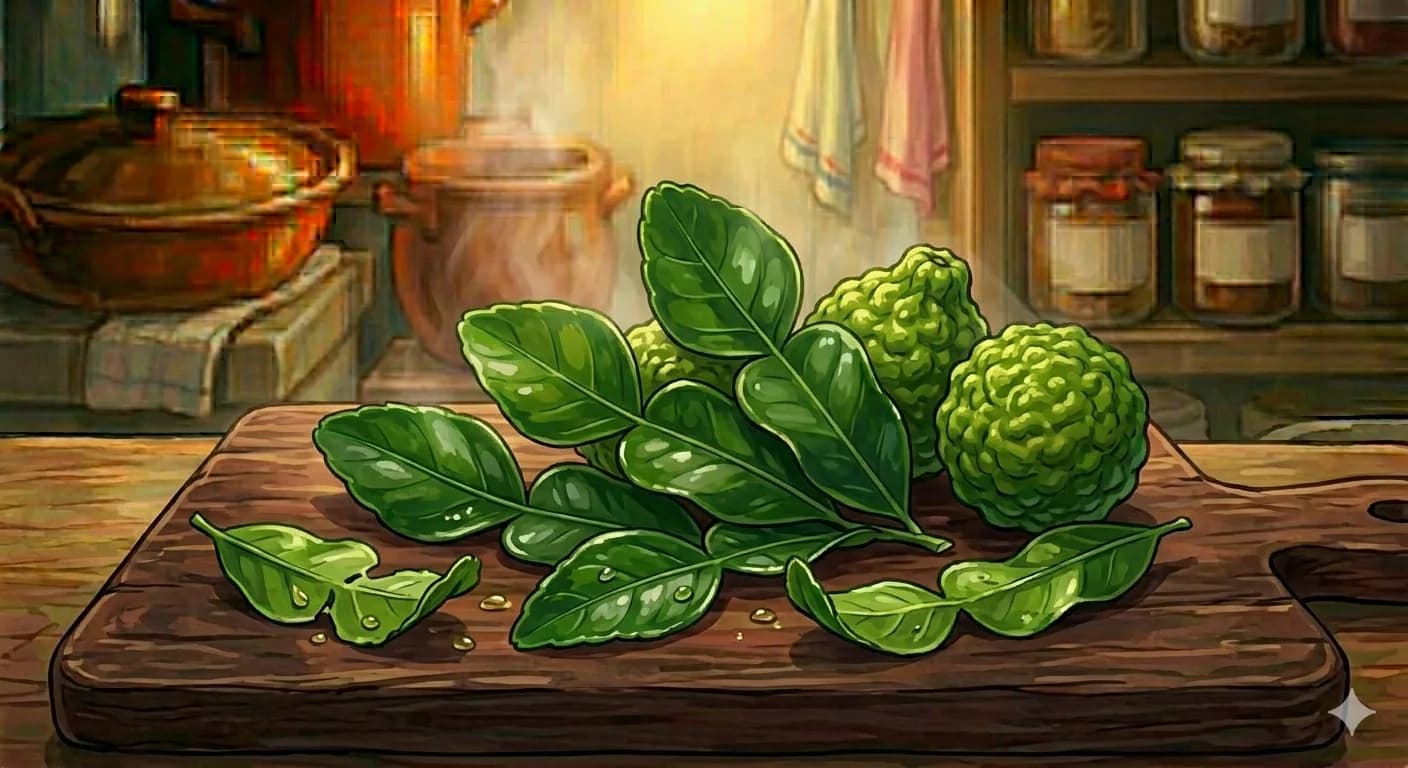
Kaffir Lime Leaves
Also known as: Makrut Lime Leaves, Bai Makrut, Daun Jeruk Purut, Daun Limau Purut, Citrus hystrix leaves
Kaffir lime leaves (also known as makrut lime leaves) release one of the most electrifying aromas in all of cooking — a bright, intensely floral citrus that is completely unlike lemon, regular lime, or any other citrus you have ever encountered.
The leaves come from the Citrus hystrix tree, and their flavor is concentrated in the essential oils that sit in the glossy, dark green surface of each distinctive double-lobed leaf. Crush one between your fingers and the scent hits immediately — sharp, clean, almost electric, with a quality that is simultaneously floral and herbaceous.
No substitute truly replicates this flavor. Lemon zest, regular lime leaves, lemongrass — they exist in the same aromatic neighborhood, but kaffir lime leaves occupy their own address entirely. When a Thai curry or Indonesian rendang calls for these leaves, it is because that particular fragrance is load-bearing.
Key facts at a glance:
- Leaves of the Citrus hystrix tree — distinctive double-lobed shape
- Intensely aromatic — floral, citrusy, and herbaceous all at once
- Irreplaceable in Southeast Asian cooking — Thai, Indonesian, Malaysian, and Cambodian cuisines
- Used in 11 recipes on the site — curries, soups, and braises
- Available fresh, frozen, or dried — fresh and frozen are vastly superior to dried
Flavor Profile
Origin
Southeast Asia, Thailand, Indonesia, Malaysia, Cambodia, Southern India, Sri Lanka
Traditional Medicine Perspectives
Traditional Thai Medicine
In Thai traditional medicine, kaffir lime leaves and fruit are considered cleansing and invigorating. The leaves are used in herbal steam baths (ob samoontprai) believed to clear the respiratory passages and refresh the skin. The essential oil from the leaves is used in traditional massage blends. The rind of the kaffir lime fruit is an ingredient in traditional herbal tonics used to support digestion.
Jamu (Indonesian Traditional Medicine)
In the Jamu tradition of Indonesia, daun jeruk purut is used in herbal preparations believed to support oral health and freshen breath. The leaves are also included in traditional postpartum recovery preparations. The essential oils are used topically in preparations intended to support skin health.
Modern Scientific Research
The essential oil of kaffir lime leaves contains high concentrations of citronellal (up to 80 percent in some analyses), along with limonene, linalool, and beta-pinene. These terpene compounds are responsible for the leaves' intense aroma and have been the subject of considerable laboratory research.
Laboratory studies on the essential oil have repeatedly shown antimicrobial activity against common foodborne and respiratory-tract organisms. A 2019 study by Srifuengfung and colleagues in the Journal of Traditional and Complementary Medicine, for example, formulated antibacterial oral sprays from kaffir lime peel and leaf oils and confirmed activity against several pathogens, with similar in vitro findings reported across the wider literature against Staphylococcus aureus, E. coli, and Candida species. The relevance of these laboratory findings to dietary use is limited (the leaves are typically removed before eating, and the oil dose from a few infused leaves is small), but they line up with the long traditional use of the leaves in tropical cuisines where food preservation was historically difficult.
The leaves also contain flavonoids and phenolic compounds with antioxidant activity in laboratory assays. The dietary relevance of those findings is similarly unestablished.
Cultural History
Kaffir lime leaves are native to tropical Southeast Asia and have been used in the region's cooking for centuries, long before the codification of the Thai, Indonesian, or Malaysian cuisines we know today. The tree grows wild across the tropical belt from southern India through Southeast Asia, and every culture in the region developed its own relationship with the leaves and the knobbly, intensely fragrant fruit.
In Thailand, kaffir lime leaves (bai makrut) are as fundamental as fish sauce. They appear in virtually every curry paste, in the soups that define the cuisine (tom kha, tom yum), and as a raw garnish shredded over salads and larb. The leaves are one of the "holy trinity" aromatics of Thai cooking, alongside lemongrass and galangal.
In Indonesia, the leaves (daun jeruk purut) are essential to rendang, opor ayam, soto, and dozens of other dishes. They are often added whole to slow-cooked curries, where they release their oils gradually into the coconut-milk base. In Malaysia and Cambodia, they occupy a similar central role. The cultural reach of these leaves maps almost perfectly onto the areas where coconut milk-based curries developed as a primary cooking method.
Culinary Uses
In Thai curries, kaffir lime leaves are added at two stages for maximum impact. First, they are pounded into the curry paste itself (along with lemongrass, galangal, chilies, and shrimp paste) to build the aromatic foundation. Then, additional whole leaves are torn and added to the simmering curry for a fresh, bright top note. This double-layered technique — embedded in the paste plus floating in the liquid — is what gives Thai curries their complex citrus dimension.
In soups like tom kha gai, the leaves are added whole to the coconut milk broth alongside galangal and lemongrass. They are not meant to be eaten — they infuse their oils into the liquid as it simmers. The leaves should be torn or bruised before adding to release the essential oils from the surface cells.
For Indonesian rendang and opor ayam, kaffir lime leaves are added to the slow-cooking coconut milk sauce, where they contribute a floral citrus note that balances the richness of the coconut and the heat of the chilies. The long, slow cooking extracts every bit of flavor from the leaves.
Shredded raw as a garnish, kaffir lime leaves add an explosive hit of fresh citrus to finished dishes. Remove the tough center rib, stack the leaves, roll tightly, and slice into hair-thin ribbons. Scatter over fried rice, curries, or Thai salads just before serving.
Preparation Methods
Fresh leaves deliver the best flavor by far. To use whole in soups and curries, tear each leaf in half (or crush lightly) to break the surface cells and release the essential oils. Remove before serving — the texture is too tough to eat comfortably.
For curry pastes and preparations where the leaf is ground in, remove the tough center rib first. Stack several leaves, roll them tightly, and slice as finely as possible before adding to the mortar or food processor. The finer the cut, the more oil is released.
Frozen leaves retain their aroma remarkably well — much better than dried. If you find fresh leaves, buy extra and freeze them flat in a zip-lock bag. They will keep their flavor for months. Dried leaves lose most of their essential oils and should be considered a last resort — they contribute a shadow of the fresh flavor at best.
If you have access to a kaffir lime tree, the leaves can be harvested at any stage of maturity, though mature, dark green leaves have the highest oil content. Young, lighter green leaves are more tender but less aromatic.
Comments
Share your thoughts on this ingredient.
Sign in to comment0 Comments