Thai Cuisine
Braised Pork Leg on Rice (Khao Kha Moo / ข้าวขาหมู)
Slow-braised pork leg in a dark, star anise and cinnamon broth, served over rice with a jammy egg and pickled mustard greens
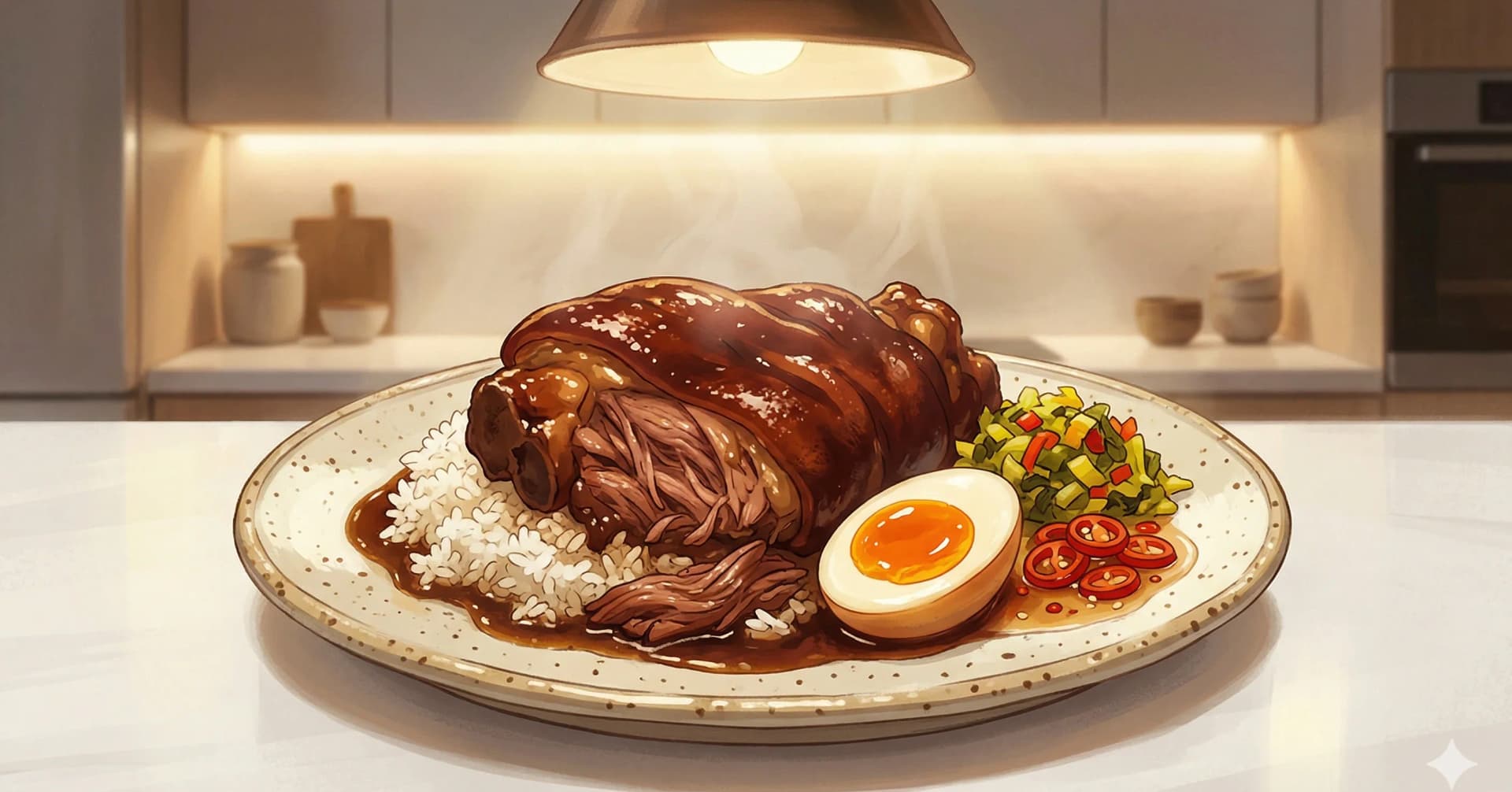
Lift the lid after three hours of braising and the smell that rises from the pot is unmistakable: dark soy, star anise, cinnamon, and the deep, meaty sweetness of pork that has surrendered all its resistance to the liquid. The meat, once firm and dense, now pulls apart at the suggestion of a spoon, and the skin has turned translucent, wobbling with dissolved collagen that will set into a rich jelly when cooled. This is khao kha moo, one of Bangkok's most beloved street foods, a dish so comforting and complete that entire restaurants are devoted to nothing else.
Khao kha moo belongs to Thailand's Chinese-Thai culinary tradition. Its roots trace to the braised pork dishes of Teochew Chinese immigrants who settled in Thailand centuries ago, bringing with them the technique of slow-cooking pork in soy sauce and warm spices. Thai cooks adopted the method and made it their own, adding coriander root, white pepper, and a sharp chili-vinegar dipping sauce that cuts through the richness with a shock of heat and acid.
The dish arrives as a composed plate: slices of dark, glistening pork arranged over a mound of steamed rice, a halved soft-boiled egg stained brown from the braising liquid, a pile of pickled mustard greens for their sour crunch, and a small bowl of chili vinegar that you spoon over each bite as you eat. The pork itself should be tender enough that a fork passes through it without resistance, the fat rendered to a silky texture, the skin soft and gelatinous. It is slow food served fast, the kind of dish that takes hours to prepare but arrives at the table as a complete, self-contained meal that needs nothing else.
At a Glance
Yield
6 servings
Prep
30 minutes
Cook
3 hours
Total
3 hours 30 minutes
Difficulty
Medium
Ingredients
Pork Ingredients
- 3¼ lbpork leg (skin-on ham hock or pork shank), bone-in
- ¼ cupdark soy sauce
- 2 tbsplight soy sauce
- 2 tbspoyster sauce
- 2½ tbsppalm sugar or brown sugar
- 8 clovesgarlic, smashed
- 4coriander roots (or 30 g cilantro stems), roughly chopped
- 1 tspwhite peppercorns, cracked
- 3star anise
- 2cinnamon sticks (cassia), about 8 cm each
- 1 tspfive-spice powder
- 1 qtwater
- 1 tbspneutral oil
- 6eggs, soft-boiled (7 minutes for jammy yolks), peeled
Dipping Sauce Ingredients
To Serve
- —Steamed jasmine rice
- 7 ozpickled mustard greens (pak gad dong), sliced
- —Fresh cilantro leaves
- —Sliced bird's eye chilies
Method
- 1
Bring a large pot of water to a boil. Add the pork leg and blanch for 5 minutes to remove impurities. The water will turn cloudy and grey. Drain, rinse the pork under running water, and scrub the skin clean. Pat dry with paper towels.
- 2
Heat the oil in a large Dutch oven or heavy pot over medium-high heat. Place the pork leg skin-side down and sear for 3 to 4 minutes until the skin turns golden brown and begins to blister. Turn and sear the other sides briefly. This step develops flavor and helps the skin absorb the braising liquid more evenly.
- 3
Add the smashed garlic, coriander roots, and cracked white peppercorns. Stir around the pork for 1 minute until the garlic turns fragrant and begins to color.
- 4
Add the dark soy sauce, light soy sauce, oyster sauce, palm sugar, star anise, cinnamon sticks, and five-spice powder. Stir to coat the pork in the dark mixture. The soy sauce will sizzle and caramelize slightly on the hot pot surface.
- 5
Pour in the water. The liquid should come about three-quarters up the side of the pork. Bring to a boil, then immediately reduce the heat to the lowest setting that maintains a very gentle simmer. You want lazy bubbles breaking the surface every few seconds, not a rolling boil. Cover with the lid slightly ajar.
- 6
Braise for 2.5 to 3 hours, turning the pork every 45 minutes so each side spends time submerged. After 2 hours, check the meat by pressing it with a spoon. It should yield easily and feel soft throughout. The skin should be glossy and deeply colored, almost black from the dark soy sauce.
- 7
Add the peeled soft-boiled eggs to the braising liquid during the last 30 minutes of cooking. They will absorb the dark color and savory flavor, turning a beautiful amber brown on the outside while the yolks remain jammy and orange.
- 8
While the pork braises, make the chili vinegar sauce. Combine the white vinegar, sliced chilies, garlic, sugar, and salt in a small bowl. Stir and let sit for at least 20 minutes to allow the flavors to meld. The sauce should taste sharp, spicy, and slightly sweet.
- 9
When the pork is tender, remove it from the liquid and let it rest on a cutting board for 10 minutes. Strain the braising liquid through a fine mesh strainer into a clean pot. Skim off excess fat if desired, though some fat adds richness. Return the liquid to a gentle simmer.
- 10
Slice the pork into pieces about 1 cm thick, cutting across the grain where possible. Include pieces of the skin and fat with each slice. The knife should pass through without effort, and the meat should hold together just barely.
- 11
Halve the braised eggs lengthwise. The yolks should be jammy and slightly molten in the center.
- 12
Assemble each plate: a mound of steamed jasmine rice, several slices of pork arranged over or beside the rice, a halved egg, a pile of sliced pickled mustard greens, and a ladleful of the braising liquid spooned over everything. Garnish with cilantro. Serve the chili vinegar sauce on the side.
- 13
To eat, spoon the chili vinegar over the pork and rice with each bite. The sharp acid and chili heat cut through the richness of the braised meat and sauce, creating a balance that makes the dish feel lighter than it looks.
Key Ingredient Benefits
Pork leg (kha moo): A cut rich in collagen, connective tissue, and intramuscular fat. During the long braise, collagen converts to gelatin, which provides glycine and proline, amino acids that preliminary research suggests may support joint health and gut lining integrity. The skin, while high in fat, is the primary source of this gelatin.
Star anise: Contains anethole, which gives it its distinctive liquorice-like flavor. In traditional Chinese and Thai medicine, star anise is considered warming and is associated with digestive comfort.
Coriander root: The root of the cilantro plant, used extensively in Thai cooking as an aromatic base. It has a more concentrated, earthier flavor than the leaves. In Thai traditional medicine, coriander root is associated with digestive health and is often combined with garlic and white pepper as a foundational paste.
Pickled mustard greens (pak gad dong): Fermented vegetables that provide probiotics from the lacto-fermentation process. The sour flavor serves a practical purpose alongside rich, braised meat, stimulating saliva production and aiding the perception of freshness.
Why This Works
Long, slow braising converts the collagen in the pork leg's connective tissue and skin into gelatin, which dissolves into the braising liquid and gives both the meat and the sauce their characteristic silky, lip-coating richness. A pork leg is ideal for this because it contains more connective tissue than leaner cuts like loin, which means more gelatin and more body in the final sauce.
Blanching the pork before braising removes blood and denatured proteins that would cloud the braising liquid and contribute off-flavors. Starting with clean, seared pork produces a cleaner, more refined final dish.
The five-spice and dark soy combination is borrowed from Chinese braising traditions, where these ingredients have been used together for centuries. Five-spice powder (star anise, cinnamon, fennel, cloves, and Sichuan pepper) provides a warm, aromatic complexity, while dark soy sauce contributes color and a subtle molasses-like sweetness. The Thai additions of coriander root, white pepper, and the chili vinegar sauce shift the dish away from its Chinese origins and into distinctly Thai flavor territory.
The chili vinegar sauce is not optional. It transforms the dish from rich and one-dimensional into something dynamic. The acid brightens the heavy braising liquid, the chili adds sharp heat, and the garlic provides a pungent note that lifts the entire plate.
Substitutions & Variations
Pork cut: If a whole pork leg is too large, use 1 kg of pork belly with skin on. The braise time reduces to about 2 hours. Boneless pork shoulder also works but lacks the gelatin-rich skin.
Pressure cooker: Braise at high pressure for 45 minutes, then natural release. The result is slightly less silky than the stovetop version but dramatically faster.
Pickled mustard greens: If unavailable, serve with pickled daikon, sauerkraut, or a quick-pickled cucumber (sliced cucumber tossed with rice vinegar, sugar, and salt, left for 15 minutes).
Spice adjustments: Omit five-spice powder and increase the star anise to 5 and cinnamon to 3 sticks for a simpler, more pronounced warm-spice profile.
Serving Suggestions
Khao kha moo is a one-plate meal in the Thai tradition. In Bangkok, it is served at dedicated stalls that make nothing else, and the only accompaniments are the ones already on the plate: the rice, the egg, the pickled greens, and the chili vinegar.
For a home dinner, you can pair it with a simple Thai soup like tom kha gai for a lighter counterpoint, or som tam for a sharp, refreshing contrast to the richness.
The braised pork also works beautifully sliced into a banh mi-style sandwich, where the sweet-savory meat meets pickled vegetables and fresh cilantro in a different context.
Storage & Reheating
Refrigerator: The braised pork and its liquid keep beautifully for up to 5 days. The sauce will set into a wobbly jelly as the gelatin solidifies. This is normal and a sign of a well-made braise.
Freezer: The pork and braising liquid freeze well for up to 3 months. Freeze in portions with enough liquid to keep the meat moist. Thaw overnight in the refrigerator.
Reheating: Warm the pork gently in its braising liquid over medium-low heat until heated through. The gelatin will melt back into a silky sauce. Avoid high heat, which can toughen the meat.
Eggs: The braised eggs are best eaten within 2 days. They can be stored in the braising liquid.
Cultural Notes
Khao kha moo (ข้าวขาหมู, "stewed pork leg over rice") is the Thai-Chinese braised pork dish that appears at street stalls across Thailand, served in a deep aluminum pot kept warm over a low flame from morning until the day's batch sells out. The dish descends from the Hokkien Chinese braised pork tradition that traveled to Thailand with 19th-century immigrants from southern Fujian, who adapted the technique to Thai aromatics and palate preferences. The result is a slow-braised pork leg cooked for several hours in a dark broth of soy sauce, palm sugar, five-spice, garlic, cilantro root, and black pepper, simmered until the meat falls apart and the skin turns gelatinous.
The serving format is fixed and culturally specific. The vendor carves slices from the leg to order, lays them over a mound of steamed jasmine rice, adds a halved hard-boiled egg that has been simmered in the same braising liquid, and ladles dark gravy over everything. The standard accompaniments are pickled mustard greens (pak gad dong) for sour-salty crunch and a small dish of chili-vinegar sauce with sliced bird's eye chilies and garlic for diners to drizzle on top. Boiled Chinese broccoli is often included as a green counterpart to the rich pork.
The most famous khao kha moo vendor in Thailand is the Chiang Mai street stall run by Khun Kaew, widely known as the "Cowboy Hat Lady" for the wide-brimmed cowboy hat she wears while working her wok in the Chang Phueak Gate night market. The stall received a Michelin Bib Gourmand recommendation in 2018 and routinely draws lines that stretch around the block, with diners waiting an hour or more for a 60 baht plate of pork rice. In Bangkok, the most prestigious khao kha moo shops cluster in the Yaowarat (Chinatown) area, where several family-run vendors have operated continuously for three or four generations.
Nutrition Facts
Calories: 618kcal (31%)|Total Carbohydrates: 12.6g (5%)|Protein: 50.8g (102%)|Total Fat: 39.6g (51%)|Saturated Fat: 14.1g (71%)|Cholesterol: 194mg (65%)|Sodium: 1247mg (54%)|Dietary Fiber: 2.5g (9%)|Total Sugars: 6.3g
You Might Also Like
 Medium
Thai Cuisine
Boat Noodles (ก๋วยเตี๋ยวเรือ)
3 hours 15 minutes
 Easy
EasyVietnamese Cuisine
Ga Kho Gung (Vietnamese Caramelized Ginger Chicken)
1 hour
 Medium
Vietnamese Cuisine
Cháo Lòng (Vietnamese Pork Organ Rice Porridge)
2 hours 15 minutes
 Easy
EasyVietnamese Cuisine
Cháo Gà (Vietnamese Chicken Rice Porridge)
1 hour 30 minutes
Ratings & Comments
Ratings & Comments
Ratings
Share your thoughts on this recipe.
Sign in to rate and comment