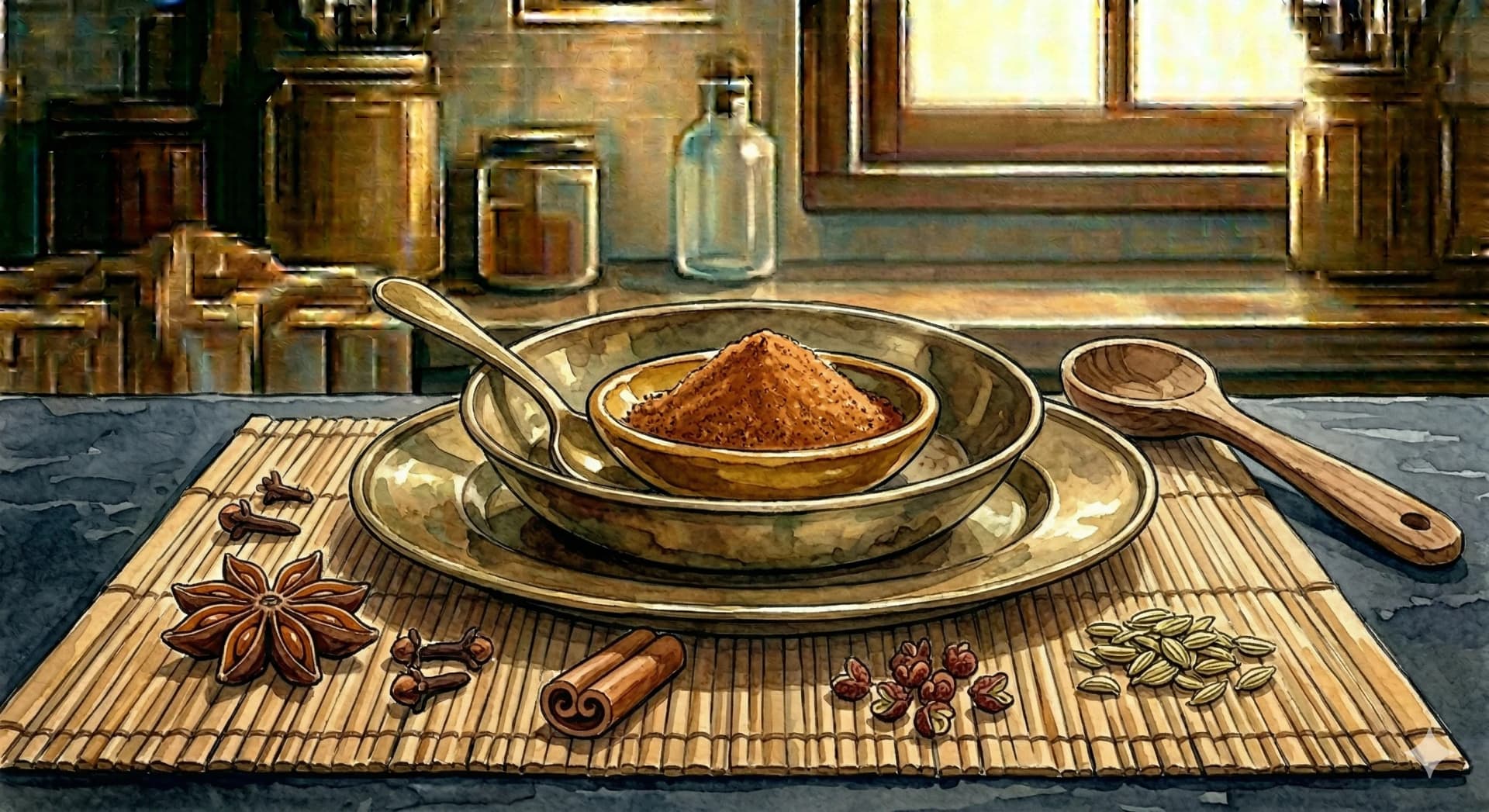
Five-Spice Powder
Also known as: Wu Xiang Fen, Chinese Five Spice, Five Fragrance Powder
Five-spice powder is one of the defining spice blends of Chinese cooking — a fragrant, complex mixture of star anise, cloves, cassia cinnamon, Sichuan peppercorn, and fennel seeds.
It captures the five fundamental flavors of Chinese cuisine (sweet, sour, bitter, salty, and pungent) in a single blend and corresponds to the five elements of Chinese philosophy. The aroma is warm, sweet, and slightly numbing, with a depth that transforms roasted meats, braises, and baked goods.
Key facts at a glance:
- Five components — star anise, cloves, cassia cinnamon, Sichuan peppercorn, fennel seeds
- Philosophical roots — reflects the five elements (wood, fire, earth, metal, water)
- Warm and numbing — distinctive aroma from the interplay of sweet and pungent spices
- Versatile — used in roasted meats, braises, and even baked goods
Flavor Profile
Origin
China, Cantonese cuisine, Chinese cuisine broadly
Traditional Medicine Perspectives
Traditional Chinese Medicine
Five-spice powder is understood in TCM as a warming, aromatic blend that activates Qi and Blood circulation, strengthens the Spleen and Stomach, and dispels cold-damp. Each component contributes specific medicinal properties: star anise warms the Kidney and Liver, Sichuan peppercorn warms the middle burner, cinnamon warms Yang and invigorates Blood, fennel regulates Qi, and cloves warm the Kidney. As a combined formula, the blend is considered strongly warming and carminative.
Modern Scientific Research
Each component of five-spice powder has been individually studied for bioactive compounds. Anethole (from star anise and fennel) shows antimicrobial and anti-inflammatory properties. Cinnamaldehyde from cassia shows insulin-sensitizing effects and antimicrobial activity.
Hydroxy-alpha-sanshool from Sichuan peppercorn activates specific mechanoreceptors, creating the characteristic numbing sensation.
Eugenol from cloves is a potent antioxidant and antimicrobial. As a blend, five-spice represents a concentrated source of diverse bioactive polyphenols.
Cultural History
Five-spice powder reflects a distinctly Chinese approach to spice blending — one rooted not just in flavor but in cosmological philosophy. The five flavors and five elements (wood, fire, earth, metal, water) are fundamental to Chinese medical and culinary theory, and the blend embodies the principle of balance.
Regional variations exist: some versions include white pepper or ginger, and Cantonese five-spice tends to be more delicate than northern versions.
The blend has been used in Chinese cooking for centuries and is the seasoning that makes Cantonese roast duck, char siu, and red-braised pork instantly recognizable.
Culinary Uses
Use in marinades for duck, pork, and beef. Essential in char siu pork, Cantonese roast duck, red-braised pork, and lu wei (master stock) preparations.
Rub onto meats before roasting. Add a small amount to stir-fry sauces and noodle broths. Use sparingly — it is potent.
Works unexpectedly well in baked goods: shortbread, spice cookies, and chocolate desserts.
Preparation Methods
Buy in small quantities and store in an airtight container away from light — five-spice loses potency quickly once ground.
For best flavor, make your own: toast whole spices individually, then grind together.
Use no more than half a teaspoon in most dishes; the blend is strong.
Traditional Dishes
- Char siu pork
- Cantonese roast duck
- Red-braised pork (hong shao rou)
- Lu wei (master stock)
- Five-spice tofu
Comments
Share your thoughts on this ingredient.
Sign in to comment0 Comments