Chinese Cuisine
Zongzi (Sticky Rice Dumplings)
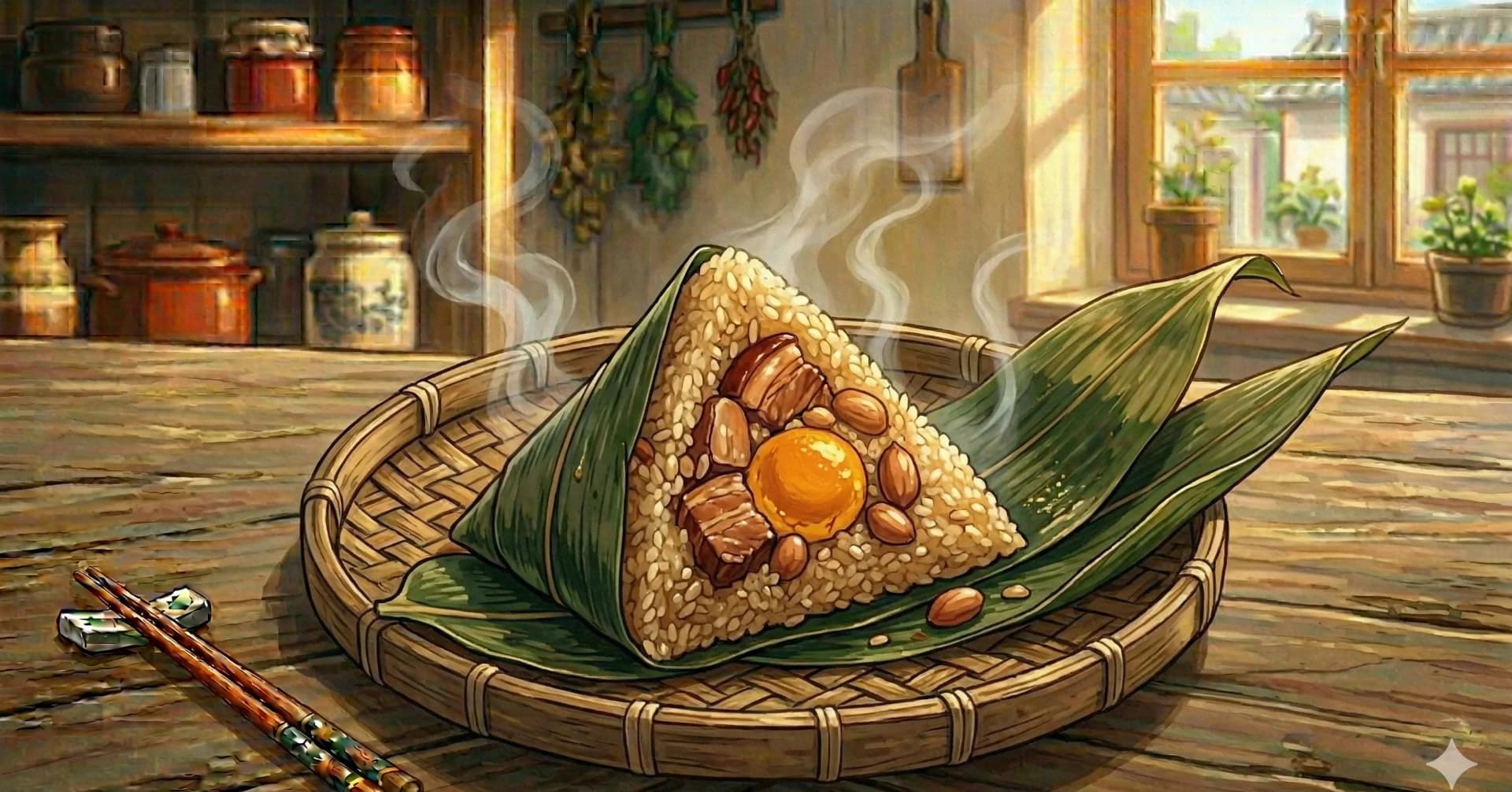
Bamboo leaf parcels of seasoned glutinous rice filled with marinated pork belly, salted duck egg yolk, and Chinese sausage
Zongzi are the kind of food that marks time. They appear every year around the Dragon Boat Festival, and for many Chinese families, the rhythm of soaking, marinating, wrapping, and boiling is as much a part of the celebration as dragon boat races or drinking realgar wine. The process is slow and deliberate, stretching across two full days, and there is no shortcut that does not compromise the result.
These Cantonese-style zongzi are the most luxurious version. Where northern Chinese zongzi tend toward simplicity (plain glutinous rice with dates or sweet red bean paste), the Cantonese version is a savory treasure wrapped in bamboo. Each parcel holds rice seasoned with soy sauce, a piece of richly marinated pork belly, half a salted duck egg yolk that turns golden and sandy during the long simmer, sliced Chinese sausage, and tender peanuts. The bamboo leaf wrapping infuses everything with a subtle, tea-like fragrance that deepens over hours of cooking.
The technique of wrapping zongzi is best learned by watching someone who has done it many times. Written instructions can only go so far. The bamboo leaf must be folded into a cone, filled snugly but not too tightly (the rice expands), then sealed and tied with string in a way that holds through eight hours of simmering. It takes practice. Your first few will likely be imperfect, and that is perfectly fine. Even a loosely wrapped zongzi tastes wonderful, and this recipe makes fifteen, so you have plenty of chances to improve your technique.
The long simmer is what transforms the parcels. The rice absorbs the pork fat and soy seasoning, turning dense and glossy and deeply savory. A well-made zongzi needs nothing else, though a sprinkle of sugar on top is a common Cantonese touch.
At a Glance
Yield
15 dumplings
Prep
45 minutes (plus overnight soaking and marinating)
Cook
8 hours
Total
32 hours (including soaking and marinating)
Difficulty
Involved
Ingredients
Wrappers
- 36to 40 dried bamboo leaves
- —Kitchen twine, cut into 15 lengths of about 3 feet each
Rice Ingredients
- 2 lbuncooked glutinous rice (sticky rice)
- 2 tbsplight soy sauce
- 2 tspsalt
Pork Ingredients
- 1 lbpork belly, skin removed, cut into 15 pieces roughly 1 inch wide
- 1 tbsplight soy sauce
- 1 tbspdark soy sauce
- 2 tspShaoxing rice wine
- ½ tspsugar
- ½ tspground white pepper
- ¼ ozfive-spice powder
Filling Ingredients
- 3¼ ozraw peanuts (soaked overnight with the rice)
- 6salted duck egg yolks (12 halves for 15 dumplings; some parcels will not have egg yolk), each cut in half
- 3Chinese sausages (lap cheong), each cut into 5 pieces
To Assemble
- 1 tspneutral oil
- ½ cupwater
Method
- 1
Start the overnight soaks (day before). Rinse the bamboo leaves thoroughly, then submerge them in a large basin of water, weighing them down with a plate so they stay covered. In a separate large bowl, rinse the glutinous rice until the water runs mostly clear, then cover with several inches of water and let soak overnight. Add the raw peanuts to the rice to soak together. Rinse each bamboo leaf individually before soaking, running your thumb along both sides to remove any grit.
- 2
Marinate the pork (day before). Cut the pork belly into 15 roughly equal pieces. In a bowl, combine the pork with 1 tablespoon light soy sauce, 1 tablespoon dark soy sauce, Shaoxing wine, sugar, white pepper, and five-spice powder. Toss until every piece is coated. Cover and refrigerate overnight. Season the pork slightly more aggressively than you normally would. It should taste a touch too salty on its own, because the rice will absorb excess seasoning during the long simmer.
- 3
Cook the pork briefly (day of). Heat 1 teaspoon of oil in a wok or skillet over medium-high heat. Add the marinated pork pieces and sear on all sides until the surface is lightly browned, about 2 minutes. Add 1/2 cup of water, cover, and simmer for 5 to 10 minutes until the liquid has mostly evaporated and the pork has tightened slightly. Remove from heat and let cool.
- 4
Season the rice. Drain the soaked glutinous rice and peanuts thoroughly. Transfer to a large bowl and add 2 tablespoons of light soy sauce and 2 teaspoons of salt. Mix well with your hands until the rice is evenly seasoned and faintly golden.
- 5
Prepare the remaining fillings. Cut each salted duck egg yolk in half. Cut each Chinese sausage into 5 equal pieces. Drain the bamboo leaves and shake off excess water. Keep them in a bowl of water as you work so they stay pliable.
- 6
Wrap the zongzi. Take two bamboo leaves and overlap them lengthwise by about an inch, smooth side facing up. Fold the overlapping leaves into a cone shape, making sure the pointed tip is sealed tightly so no rice can escape. Scoop about 2 heaping tablespoons of seasoned rice into the cone. Press gently to compact. Nestle a piece of pork belly, a few peanuts, a piece of sausage, and half a salted egg yolk (if using) into the rice. Cover the filling with another 2 tablespoons of rice, pressing down gently to enclose the filling completely. Fold the top of the bamboo leaves down over the opening, then fold the excess leaf around the sides to form a tight, roughly triangular or rectangular parcel. Tie securely with kitchen twine, wrapping in two directions to hold the shape. The parcel should feel snug but not bursting. Repeat with remaining ingredients.
- 7
Boil the zongzi. Place the wrapped zongzi in a large, deep stockpot. Set a heavy plate on top to keep them submerged. Add enough cold water to cover the dumplings by at least 2 inches. Bring to a rolling boil over high heat, then reduce to a low, steady simmer. Cover the pot and cook for 7 to 8 hours. Check the water level every hour or so, and add only boiling water (never cold or room-temperature water, which would shock the rice and interrupt the cooking). The dumplings should remain fully submerged at all times.
- 8
Test and serve. After 7 hours, carefully remove one zongzi and unwrap it to check. The rice should be uniformly soft, sticky, and deeply flavored, with no hard or chalky grains remaining. The pork should be meltingly tender. If the rice is still firm in the center, re-wrap and continue simmering. Serve hot, unwrapping each parcel at the table.
Key Ingredient Benefits
Glutinous rice: Despite its name, glutinous rice is gluten-free. The term refers to its sticky, glue-like texture when cooked, a result of its very high amylopectin starch content. It ranks high on the glycemic index and is dense in calories. In traditional Chinese medicine, it is classified as warming and is said to tonify the spleen and stomach. Those with blood sugar concerns or who experience bloating should eat it in moderation.
Pork belly: The fattiest common cut of pork, chosen here specifically because its rendered fat flavors the rice during the long simmer. It is high in saturated fat and calories. In traditional Chinese medicine, pork is considered nourishing to yin and moistening.
Salted duck egg yolks: These are made by curing whole duck eggs in a salt and clay mixture or a saturated brine for several weeks. The yolks become dense, sandy, and intensely savory, while the whites turn firm and very salty (only the yolks are used in zongzi). They are high in cholesterol and sodium.
Bamboo leaves: Used as a wrapper, not as food. During the long boil, they release subtle aromatic compounds that give zongzi their characteristic fragrance. In traditional Chinese medicine, bamboo leaf tea is used to clear heat and calm the mind, though these properties are not meaningfully transferred during this cooking process.
Peanuts: A common allergen. They add a soft, creamy texture to the finished zongzi and absorb the surrounding flavors. They provide protein, fiber, and monounsaturated fats.
Why This Works
The overnight soak is non-negotiable. Glutinous rice grains are extremely dense, and without thorough hydration they will remain hard even after hours of boiling. Soaked rice absorbs the soy seasoning immediately and expands predictably during cooking, which prevents the bamboo leaf from bursting.
Marinating the pork aggressively and pre-cooking it briefly accomplishes two things. The brief sear develops Maillard flavors on the surface of the pork, and the short braise tightens the meat so it holds together during wrapping. During the long simmer, the pork slowly renders its fat into the surrounding rice, creating that distinctive richness that makes Cantonese zongzi so satisfying.
The very long cooking time transforms the texture of the rice from individual grains into a cohesive, almost paste-like mass that clings to the fillings. This is the hallmark of a properly cooked zongzi. The bamboo leaf slowly releases tannins and aromatic compounds into the rice, adding a subtle, complex fragrance that deepens with each hour of simmering.
Adding only boiling water to maintain the level is a detail that matters more than it might seem. Cold water drops the temperature dramatically, stalling the cooking and potentially causing uneven texture in the rice. Keeping a kettle of boiling water nearby makes this easy.
Substitutions & Variations
Bamboo leaves: Dried lotus leaves work as an alternative wrapper but produce a different fragrance. Reed leaves are used in some regional styles. Banana leaves will hold the shape but lack the traditional aroma. If using frozen bamboo leaves, thaw and blanch briefly before wrapping.
Pork belly: Boneless pork shoulder or country-style ribs can substitute, though the result will be leaner and slightly less rich. The fat from pork belly is what makes the rice so luxurious, so this is a meaningful trade-off.
Salted duck egg yolks: These can be omitted entirely if unavailable. Some cooks substitute salted egg yolk pieces or simply add an extra piece of sausage per dumpling.
Peanuts: Dried chestnuts (soaked overnight) are a traditional alternative that adds a sweeter, starchier element. Mung beans, soaked and split, are another classic filling used in many Cantonese households.
Sweet version: For sweet zongzi in the northern style, omit all savory fillings and seasoning. Fill plain soaked glutinous rice with red bean paste, pitted Chinese dates, or red date sticky rice filling. Serve with honey or sugar for dipping. The boiling time can be reduced to 2 to 3 hours for smaller sweet dumplings.
Additional fillings: Dried shiitake mushrooms (soaked and quartered), dried scallops, dried shrimp, and peeled split mung beans are all traditional additions in different Cantonese households.
Serving Suggestions
Zongzi are traditionally eaten during the Dragon Boat Festival, but they make a hearty meal any time of year. Serve them unwrapped on small plates with a light sprinkle of sugar on top, which is the classic Cantonese way to eat them, or alongside a simple dipping sauce of soy sauce with a few drops of sesame oil.
A bowl of hot and sour soup or wonton soup provides a brothy, lighter counterpoint to the dense, rich dumplings. For a dim sum-style meal, serve zongzi alongside har gow and lo mai gai for a glutinous rice celebration.
Zongzi also work well as a portable meal. Wrapped in their bamboo leaves, they travel easily and can be eaten at room temperature, making them an ideal packed lunch or picnic food.
Storage & Reheating
Refrigerating: Store cooked zongzi in the refrigerator for up to 5 days, still wrapped in their bamboo leaves. To reheat, bring a pot of water to a boil and simmer the zongzi for 15 to 20 minutes until heated through. You can also microwave an unwrapped zongzi for 3 to 4 minutes, though boiling produces a better, more evenly heated result.
Freezing: Zongzi freeze exceptionally well, which is one reason recipes make large batches. Let them cool completely, then place in airtight freezer bags. They keep for up to 3 months. To reheat from frozen, boil directly (without thawing) for 30 to 40 minutes. Do not microwave from frozen, as the center will remain cold while the outside overheats.
Batch cooking: This recipe is designed to produce a large batch. The two-day process rewards scale. Making fifteen is barely more work than making five, and having a freezer stocked with zongzi means a satisfying meal is always a short boil away.
Cultural Notes
Zongzi (粽子) is the pyramidal or rectangular Chinese sticky rice bundle wrapped in bamboo or reed leaves, tied with kitchen string, and boiled or steamed for several hours until the rice cooks through and absorbs the grassy aromatic compounds from the leaves. The dish is the central food of the Dragon Boat Festival (Duan Wu Jie, 端午節), held on the fifth day of the fifth lunar month (typically late May or June in the Western calendar), and it carries deep cultural and historical weight as one of the foods most strongly tied to a specific Chinese holiday.
The traditional origin story dates to the late Warring States period (475-221 BCE) and connects zongzi to the death of the poet and minister Qu Yuan (340-278 BCE), who drowned himself in the Miluo River in protest of the corruption of his home state of Chu. Local villagers, distraught at his death, reportedly threw packets of rice wrapped in leaves into the river to feed his spirit and to keep fish from disturbing his body. The annual commemoration of Qu Yuan on the fifth day of the fifth lunar month became the Dragon Boat Festival, and zongzi became the food of the holiday across the Chinese world. Whether the historical attribution is fully accurate or partly legendary, the cultural connection between the poet, the festival, and the food remains the foundational story.
The form varies dramatically by region. Southern Chinese versions (Cantonese and Hokkien) typically use savory fillings: marinated pork belly, salted duck egg yolk, dried shrimp, mushroom, chestnuts. Northern versions are more commonly sweet: red bean paste, jujube, sometimes plain glutinous rice meant to be dipped in sugar after cooking. The Hangzhou and Jiaxing region of Zhejiang produces an especially famous savory pork-and-salted-egg-yolk zongzi that is sold widely throughout the Yangtze delta. The wrapping leaves themselves vary by region: southern Chinese cooks typically use bamboo leaves, while northern cooks use reed leaves (lu wei), each contributing a different aromatic profile to the finished rice. Families gather to wrap zongzi together in the days before Dragon Boat Festival, with the folding technique passed down through generations.
Nutrition Facts
Calories: 1026kcal (51%)|Total Carbohydrates: 72g (26%)|Protein: 32g (64%)|Total Fat: 66g (85%)|Saturated Fat: 23.3g (117%)|Cholesterol: 695mg (232%)|Sodium: 2861mg (124%)|Dietary Fiber: 1.2g (4%)|Total Sugars: 2.4g
You Might Also Like
Ratings & Comments
Ratings & Comments
Ratings
Share your thoughts on this recipe.
Sign in to rate and comment