Chinese Cuisine
Suan La Tang (Hot and Sour Soup)
A glossy, tangy broth loaded with mushrooms, tofu, and silky egg ribbons
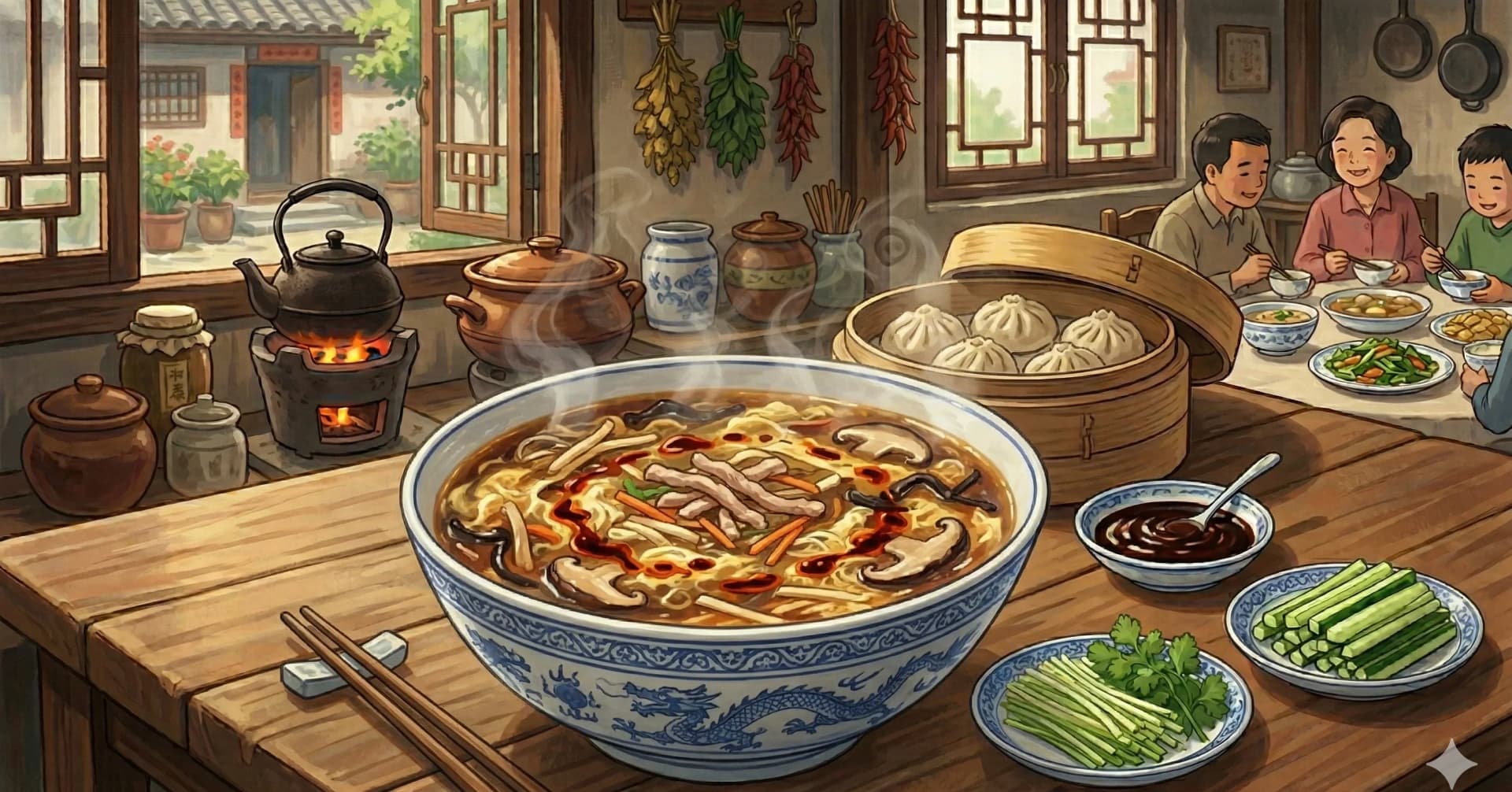
Hot and sour soup is one of the most widely ordered Chinese dishes outside of China, but the takeout version rarely captures what makes the real thing so good. The authentic version is not fiery. The heat comes from white pepper, not chili, and it delivers a slow, warming tingle at the back of your throat rather than a sharp burn on the tongue. The sour comes from black rice vinegar, specifically Zhenjiang (Chinkiang) vinegar, which has a mellow, almost malty acidity that balsamic cannot replicate.
What makes this soup substantial is the sheer variety of textures packed into every spoonful. Slippery strips of soft tofu. Snappy wood ear mushrooms. Earthy shiitakes with their intense umami. The subtle, woody fragrance of dried lily buds. Thin strips of tender pork. And weaving through everything, ribbons of egg that float like clouds in the glossy broth.
The key to the authentic version is slicing everything into thin, uniform strips. This is not a rough-chop-and-dump soup. The uniformity matters for both aesthetics and cooking time, since every ingredient finishes at the same moment. The cornstarch slurry thickens the broth into something silky that coats the spoon and clings to every ingredient, keeping the heat and acidity suspended in each bite.
One important detail: the seasonings go in at the very end, after the heat is turned off. Black rice vinegar and white pepper lose their pungency quickly when boiled. Adding them just before serving preserves their intensity and gives the soup its distinctive sharp, warming character. If you add them too early, the soup will taste flat and you will wonder what went wrong.
At a Glance
Yield
6 servings
Prep
10 minutes (plus 1 hour soaking)
Cook
10 minutes
Total
1 hour 20 minutes
Difficulty
Easy
Ingredients
- 5dried shiitake mushrooms
- ¼ ozdried wood ear mushrooms
- 20strands dried lily buds (lily flowers)
- 2¾ ozlean pork, cut into thin strips
- ½ tspcornstarch
- 1 tspwater
- 0 tbspneutral cooking oil
- 1½ ozcarrot (about ½–1 carrot), cut into thin matchsticks
- 1¾ ozbamboo shoots, cut into thin strips
- 3½ ozsoft or medium-firm tofu, cut into thin strips
- 1large egg, lightly beaten
- 1 qtunsalted chicken stock or water
- 4 tbspcornstarch, mixed with 60 ml water
- 3 tbspblack rice vinegar (Zhenjiang/Chinkiang)
- 1 tbsplight soy sauce
- ½ tspground white pepper
- 0 tbspsesame oil
- —Fresh cilantro or sliced scallions
Method
- 1
Rehydrate the dried ingredients. Soak the dried shiitake mushrooms, wood ear mushrooms, and lily buds in plenty of warm water for at least 1 hour, or overnight if you plan ahead. Once soft and expanded, drain. Slice the shiitakes and wood ear into thin strips. Tear the lily buds lengthwise into thinner strands.
- 2
Marinate the pork. Cut the pork against the grain into thin strips. Toss with the cornstarch and water, then coat with the oil. Set aside while you prepare the remaining ingredients.
- 3
Prepare the vegetables. Cut the carrot and bamboo shoots into thin matchstick strips. Slice the tofu into thin strips of similar size. Lightly beat the egg in a small bowl.
- 4
Cook the pork. Bring the stock (or water) to a full boil in a wok or large pot. Add the marinated pork strips and immediately stir with chopsticks to separate the strands. Use a spoon to skim any foam that rises to the surface.
- 5
Add the dried ingredients and vegetables. Add the sliced shiitakes, wood ear, lily buds, carrot, and bamboo shoots. Cook for about 2 minutes at a steady simmer.
- 6
Thicken the soup. Reduce the heat to a gentle simmer. Give the cornstarch slurry a good stir (it settles quickly) and pour it into the soup in a thin, steady stream while stirring the soup with a ladle. The broth will turn glossy and thicken visibly within 30 seconds.
- 7
Add the tofu and egg. Once the soup has thickened, gently slide in the tofu strips. Then pour the beaten egg in a thin stream in a slow circular motion. Do not stir for a few seconds, allowing the egg to set into ribbons. Then give a gentle stir to distribute.
- 8
Season and serve. When the soup returns to a gentle bubble, turn off the heat. Immediately add the black rice vinegar, soy sauce, white pepper, and sesame oil. Stir gently to combine. Taste and adjust the vinegar and pepper to your preference. Ladle into bowls and garnish with cilantro or scallions. Serve warm.
Key Ingredient Benefits
Black Rice Vinegar (Zhenjiang/Chinkiang). A dark, mellow vinegar made from fermented glutinous rice and wheat bran. It is not gluten-free. Its flavor is distinctly different from balsamic vinegar, rice wine vinegar, or cider vinegar, and none of these make a good substitute. It is widely available in Asian grocery stores.
White Pepper. In Chinese cooking, white pepper is preferred over black pepper for soups and light-colored dishes because it provides heat without the dark specks. It has a slightly different flavor profile, more floral and less sharp than black pepper. In Traditional Chinese Medicine, it is considered a warming spice.
Dried Wood Ear Mushrooms. An edible fungus with very little flavor of its own, valued instead for its crunchy, slightly gelatinous texture. It absorbs surrounding flavors readily. Wood ear contains iron and fiber and has been used in TCM for circulation, though scientific evidence for specific health claims is limited.
Dried Lily Buds. Also called golden needles, these are the dried buds of the daylily flower. They contribute a subtle woody, earthy note and a slightly chewy texture. They are traditional in this soup and in dishes like Moo Shu Pork.
Why This Works
The timing of the seasonings is everything. White pepper contains volatile compounds that dissipate rapidly with heat. Black rice vinegar behaves similarly. By adding both after the heat is off, you preserve their full intensity. A bowl seasoned this way will be noticeably more pungent and aromatic than one where the seasonings were added during cooking.
The cornstarch slurry creates a viscosity that does more than just thicken the soup. It suspends the seasonings evenly throughout the broth, so every spoonful carries the same balance of hot and sour. Without the starch, the vinegar would pool at the bottom and the pepper would float. The slurry also slows down heat loss, keeping the soup warmer longer in the bowl.
Marinating the pork strips with cornstarch and a touch of oil is a technique called velveting. The thin starch coating protects the delicate meat fibers from the boiling liquid, keeping them tender and silky rather than tough and stringy. This same approach appears throughout Chinese cooking, from Gong Bao Ji Ding to Ginger Scallion Beef.
Substitutions & Variations
Vegetarian version. Omit the pork and use vegetable stock. The soup is still very good with just the mushrooms, tofu, and vegetables providing substance.
Shrimp variation. Replace the pork with peeled shrimp, adding them at the same stage. They will cook through in about 1 minute.
No lily buds? The soup works without them, though you lose a layer of earthy complexity. Shiitake and wood ear are the most important dried ingredients here.
Fresh shiitakes. If dried shiitakes are unavailable, fresh ones will work but will produce a less intense flavor. Slice them thin and add them at the same cooking stage.
Spicier version. For more heat, add a teaspoon of chili oil on top of each bowl when serving. This is common in Sichuan-influenced versions and pairs well with the vinegar.
Serving Suggestions
Hot and sour soup works as a first course before a larger meal or as a light supper on its own with steamed rice. It pairs naturally with Claypot Rice, Dan Dan Noodles, or Jiaozi. At a full table, serve it alongside Black Bean Chicken and a plate of steamed greens.
The soup is best eaten immediately after seasoning, while the vinegar and pepper are at their most pungent. If you are making it in advance, hold the seasonings and add them when you reheat.
Storage & Reheating
The soup base (without the final seasonings) keeps in the refrigerator for up to 3 days. The tofu will soften further with time, which is acceptable. Reheat gently on the stovetop, bring to a simmer, then turn off the heat and add the vinegar, soy sauce, white pepper, and sesame oil fresh. This will give you the brightest flavor.
Do not freeze this soup. The tofu and egg ribbons do not survive freezing well, and the cornstarch thickening breaks down when frozen and thawed.
Cultural Notes
Hot and sour soup (酸辣汤, suan la tang) is the broad category of Chinese soups defined by the contrast between vinegar acidity and white pepper heat. The dish has no single regional origin, since vinegar-and-pepper soups appear across northern, central, and Sichuan Chinese cooking, but the version most commonly served at Chinese restaurants outside China traces to Sichuan, where the suan la (sour-spicy) flavor profile is one of the classical Sichuan flavor combinations alongside má la (numbing-spicy) and yu xiang (fish-fragrant). The Sichuan version uses Chinese black vinegar (Chinkiang vinegar) for the sour element and ground white pepper for the heat, with no chili oil in the traditional preparation.
The classical filling is a layered mix of contrasting textures. Wood ear mushrooms (hei mu er) and shiitake provide chewy, slightly slippery bites; lily buds (jin zhen, golden needles) add a fibrous floral note; firm tofu cubes give a soft contrast; thin slices of pork (or sometimes chicken) bring savory depth; bamboo shoot strips add crunch; and beaten egg, drizzled into the simmering broth at the end, sets in long pale ribbons. The broth is thickened with a cornstarch slurry to a glossy, almost gravy-like consistency that holds the ingredients suspended. The final flourish is the vinegar and pepper, added off the heat so the acid and the aromatic compounds in the pepper stay sharp rather than cooked into dullness.
The dish has been heavily adapted in American Chinese restaurants, where the texture often turns thicker and the seasoning sweeter to match the Cantonese-American palate. The chili oil and bright red color found in many American versions are typically restaurant additions rather than features of the traditional Sichuan preparation. For diners interested in the authentic version, Fuchsia Dunlop's recipes in The Food of Sichuan and the version served at long-established Sichuan restaurants in Chengdu and Chongqing both preserve the older balance of vinegar against white pepper, with the heat from white pepper rather than chili and the sour from vinegar carrying the dish.
Nutrition Facts
Calories: 117kcal (6%)|Total Carbohydrates: 15.2g (6%)|Protein: 8.4g (17%)|Total Fat: 2.5g (3%)|Saturated Fat: 0.6g (3%)|Cholesterol: 40mg (13%)|Sodium: 665mg (29%)|Dietary Fiber: 2.1g (8%)|Total Sugars: 1g
You Might Also Like
Ratings & Comments
Ratings & Comments
Ratings
Share your thoughts on this recipe.
Sign in to rate and comment