Cross-Cultural · China
Salt and Pepper Squid (椒鹽鮮魷)
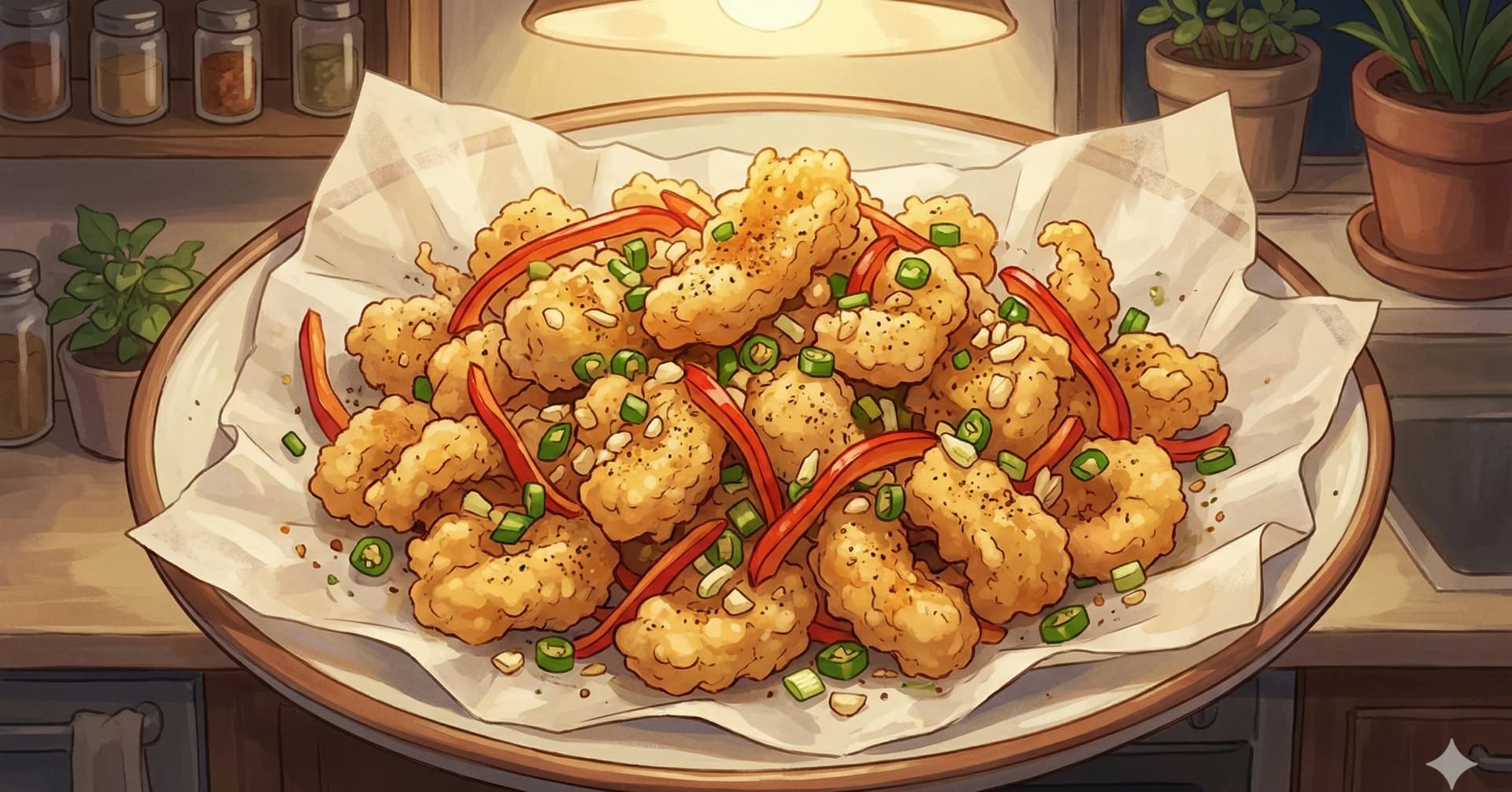
Double-fried squid with a wet batter coating, tossed with garlic, chili, and scallion in a salt-white pepper seasoning
Salt and pepper squid is one of the great Cantonese seafood dishes. The version you make at home can be better than what most restaurants serve if you get two things right: the scoring and the double fry.
Scoring means cutting a cross-hatch pattern into the inside surface of the squid body without cutting through. When the squid hits hot oil, the scored pieces curl into beautiful spirals, creating more surface area for the batter to cling to. The scoring also shortens the muscle fibers, keeping the squid tender.
The batter is wet, not dry. Flour and potato starch mixed with water into a thick paste that seals in moisture. The first fry cooks the squid through. The second fry at higher temperature creates the shattering crunch. After frying, the squid gets a fast toss with garlic, chili, scallion, and a salt-white pepper seasoning. No sauce, no glaze, just salt and heat and crunch.
At a Glance
Yield
4 servings
Prep
30 minutes
Cook
15 minutes
Total
45 minutes
Difficulty
Medium
Ingredients
Marinade Ingredients
- 1 lbsquid, cleaned, scored, and cut
- 1/4 tspwhite pepper
- 1 tbspcooking wine
- 1large egg yolk
- 1 tbsppotato starch
Batter Ingredients
- 4 tbspall-purpose flour
- 2 tbsppotato starch
- 4 tbspwater
- 1 tspbaking powder
Stir-Fry Ingredients
- 2 tspgarlic salt, for seasoning
- 1/4 tspground white pepper, for seasoning
- 2 cupsneutral oil, for frying
- 1/4red bell pepper, thin strips
- 2Thai bird's eye chilies, diced
- 3garlic cloves, minced
- 3scallion stalks, whites diced
Method
- 1
Clean, score cross-hatch, cut squid into 1-inch pieces. Pat dry. Marinate with white pepper, wine, egg yolk, potato starch.
- 2
Make batter: flour + potato starch + water + baking powder + salt + oil into thick paste. Coat the marinated squid in the batter mix.
- 3
First fry at 175°C (350°F) for 2.5-3 min until golden and curled. Second fry at 190°C (380°F) for 30-40 sec until very crispy.
- 4
Toss the fried squid in a clean wok with garlic, chili, scallion, bell pepper. Season with garlic salt and white pepper. Serve immediately.
Key Ingredient Benefits
Squid (calamari): A lean, fast-cooking seafood with about 18 g of protein per 100 g and very little fat. Squid is an excellent source of vitamin B12, selenium, copper, and phosphorus. The texture depends entirely on cooking time — squid cooked for 30 seconds is tender, squid cooked for 4 minutes is rubbery, squid cooked for 30 minutes is tender again. Anything in between is a disaster. The double-fry technique used here keeps the actual squid cooking time under 90 seconds total.
White pepper: Ground from fully ripened peppercorns with the outer husk removed, white pepper has a subtler, more "woody" heat than black pepper, with floral and slightly fermented notes. It is the traditional Chinese seasoning for seafood and light-colored sauces (where black pepper specks would be visible). White pepper contains piperine, the compound that gives black pepper its bite, in slightly lower concentrations.
Potato starch: Almost pure amylopectin, the branched starch molecule that produces a lighter, crisper, more glass-like crust than cornstarch or wheat flour. Potato starch is what gives Korean fried chicken and salt-and-pepper squid their characteristic shattering crunch. It also absorbs less oil than flour-based batters, producing a lighter, cleaner result.
Garlic, red chili, and scallion: The classic Cantonese "san jiao" (three aromatics) finish for fried seafood. All three are added off-heat at the very end so they retain their fresh punch — the garlic stays crisp, the chili keeps its bright red color, the scallion stays vivid green. The same three-aromatic finish appears in salt and pepper shrimp and salt-and-pepper pork chops.
Baking powder: A pinch in the batter creates tiny gas bubbles during frying, producing a lighter, airier crust. The carbon dioxide released from the baking powder is what makes the difference between a dense, doughy batter and a crisp, almost tempura-like one.
Why This Works
The cross-hatch scoring on the inside of the squid body is the single most important technique in this dish. Squid muscle fibers run in one direction; scoring them cuts the fibers short, which prevents them from contracting into tough rubber bands during frying. The scoring also gives the squid its dramatic curling spiral shape — the cuts open up in the hot oil and the squid wraps around itself. Without scoring, you have flat sheets of rubbery calamari.
The wet batter (flour, potato starch, water, baking powder, oil) seals moisture inside the squid in a way that a dry dredge cannot. Squid loses tenderness the moment its internal moisture starts to evaporate, and the batter acts as a barrier that buys you those crucial extra seconds. Baking powder in the batter creates microbubbles that expand during frying, producing a lighter, crisper coating.
Double frying separates this from the home version that comes out greasy and limp. The first fry at 175°C (350°F) cooks the squid through and sets the batter. The brief rest allows residual heat to drive moisture outward to the crust surface. The second fry at 190°C (380°F) drives that moisture out for good and creates a rigid, shatteringly crisp shell that survives the final stir-fry toss. The same principle drives Korean fried chicken (kkanpunggi) and tangsuyuk.
White pepper rather than black is the traditional Chinese seasoning for this dish. It provides a subtle, woody, slightly floral heat that complements seafood without overpowering it. Black pepper's sharper, more dominant character competes with the squid; white pepper's quieter heat lets the squid sweetness come through. The same logic applies to most Cantonese seafood seasoning.
The aromatics go in off-heat at the very end. A hot wok is preheated and the fried squid is added with the garlic-chili-scallion mixture. The toss is fast — 15 to 20 seconds maximum — so the aromatics flavor the crust without burning, and the squid stays crispy.
Substitutions & Variations
Squid alternatives: Cuttlefish works identically and many consider it superior (sweeter, slightly more tender). Shrimp can be used with the same batter and seasoning — peel and devein, leave the tails on, no need to score. Soft-shell crab is excellent. Strips of firm white fish (cod, snapper) work but require more delicate handling.
Frozen pre-cooked squid: Skip the marinade entirely. Defrost, squeeze thoroughly dry, coat in batter, and reduce the first fry to 30 to 40 seconds at 350°F. Double fry for 20 to 30 seconds. The texture will be slightly less tender than fresh but the technique still works.
Potato starch: Cornstarch substitutes at a 1:1 ratio and produces a very close, slightly less crisp result. Tapioca starch produces a glassier, more delicate crust. Wheat flour alone is not recommended — too gluten-heavy, produces an empanada-like coating.
White pepper: Black pepper works in a pinch but changes the character of the dish. Sichuan peppercorn (ground) adds the signature numbing tingle of Sichuan-style salt and pepper squid (jiāo má xiān yóu).
Chili: Fresh red Thai chilies, jalapeños, Fresno chilies, or dried chili flakes all work. Adjust quantity to taste. For a non-spicy version, omit entirely; the garlic-and-scallion seasoning is still excellent.
Baking powder: Cannot really be skipped without producing a denser, doughier batter. Baking soda substitutes at half the quantity but can produce a slightly metallic aftertaste.
Seasoning blend: Some restaurants add MSG or chicken bouillon powder to the final salt-pepper blend for extra umami depth. Optional and traditional.
Serving Suggestions
Salt and pepper squid is one of the great Cantonese appetizers, the kind of dish that disappears from the table within minutes. Serve immediately while the coating is at peak crispness — squid that has been sitting for more than 5 minutes is acceptable but not great.
For a proper Cantonese seafood spread, pair with clams in black bean sauce, steamed fish with ginger and scallion, and a stir-fried vegetable like gai lan. This is the classic banquet template.
For a more casual presentation, serve as a beer snack with cold lager (Tsingtao or Asahi are canonical). The combination of crispy squid and cold beer is one of the great pleasures of dai pai dong (food stall) culture in Hong Kong.
Pair with a crisp white wine (Sauvignon Blanc, Albariño, Picpoul) or a chilled dry sake. Hot Chinese tea also works — jasmine, oolong, or pu-erh all cut through the fried richness well.
Set out a small dish of lemon wedges for those who want a brighter, more Western-leaning flavor profile. Traditional Cantonese versions do not include lemon, but many modern restaurants serve it on the side.
Storage & Reheating
Refrigerator: Best eaten immediately. If you must store, refrigerate in an airtight container for up to 1 day. The coating softens considerably as it sits and never fully recovers.
Reheating: Oven at 200°C (400°F) on a wire rack for 5 to 7 minutes is the only effective method. Air fryer at the same temperature for 3 to 4 minutes works equally well. Avoid the microwave entirely — it makes the squid rubbery and the coating soggy.
Make-ahead components: The squid can be cleaned, scored, and marinated up to 4 hours in advance and held refrigerated. The seasoning blend (salt + white pepper + sugar) can be mixed days ahead. The aromatic mix (minced garlic, sliced chili, chopped scallion) is best prepped within an hour of cooking.
Freezing: Not recommended. Fried squid suffers significantly on thawing — the coating goes soggy and the squid can become rubbery.
Restaurant tip: Many Cantonese kitchens do the first fry in advance and hold the par-fried squid at room temperature for up to 30 minutes, then do the second fry to order. This is a useful technique for home dinner parties: do the first fry just before guests arrive, then finish during service.
Cultural Notes
Salt and pepper squid (jiāo yán xiān yóu in Mandarin, jiu yim sin yau in Cantonese, written 椒鹽鮮魷) is one of the foundational Cantonese seafood preparations and a fixture of dai pai dong (大排檔, "big plate stalls") street food culture in Hong Kong and Guangdong. The dish belongs to a larger family of "salt and pepper" preparations (jiāo yán style) that also includes pork chops, shrimp, ribs, and even tofu — all sharing the same technique of double-frying and finishing with garlic, chili, scallion, and the salt-pepper-sugar blend.
The dish reflects the Cantonese principle of xiān (鮮, "freshness/sweetness from the sea") — letting the natural flavor of seafood come through without burying it under heavy sauces. The seasoning here is intentionally restrained: salt, white pepper, garlic, chili. No oyster sauce, no soy, no sugar-soy reduction. This restraint is what distinguishes Cantonese seafood cooking from heavier regional styles like Sichuan or Hunan.
Salt and pepper squid is closely associated with Hong Kong's cha chaan teng (tea restaurant) and dai pai dong culture, where it appears as one of the most-ordered seafood appetizers. In the West, it became a staple of Chinese-American and Chinese-Australian restaurant menus in the 1980s and 1990s and remains one of the most recognizable Cantonese dishes globally.
The technique of cross-hatch scoring squid for visual appeal and texture appears in cuisines across Asia, including the Japanese kakuari technique for sashimi and the Korean kalbi-style scoring. The Cantonese version is the most technique-forward — the scoring is precise, the curling shape is intentional, and the visual presentation is part of why this dish reads as restaurant-grade rather than home-style.
Nutrition Facts
Calories: 293kcal (15%)|Total Carbohydrates: 18g (7%)|Protein: 19.6g (39%)|Total Fat: 15.4g (20%)|Saturated Fat: 2.6g (13%)|Cholesterol: 308mg (103%)|Sodium: 1044mg (45%)|Dietary Fiber: 1.1g (4%)|Total Sugars: 0.8g
You Might Also Like
Ratings & Comments
Ratings & Comments
Ratings
Share your thoughts on this recipe.
Sign in to rate and comment