Chinese Cuisine
Har Gow (Crystal Shrimp Dumplings)
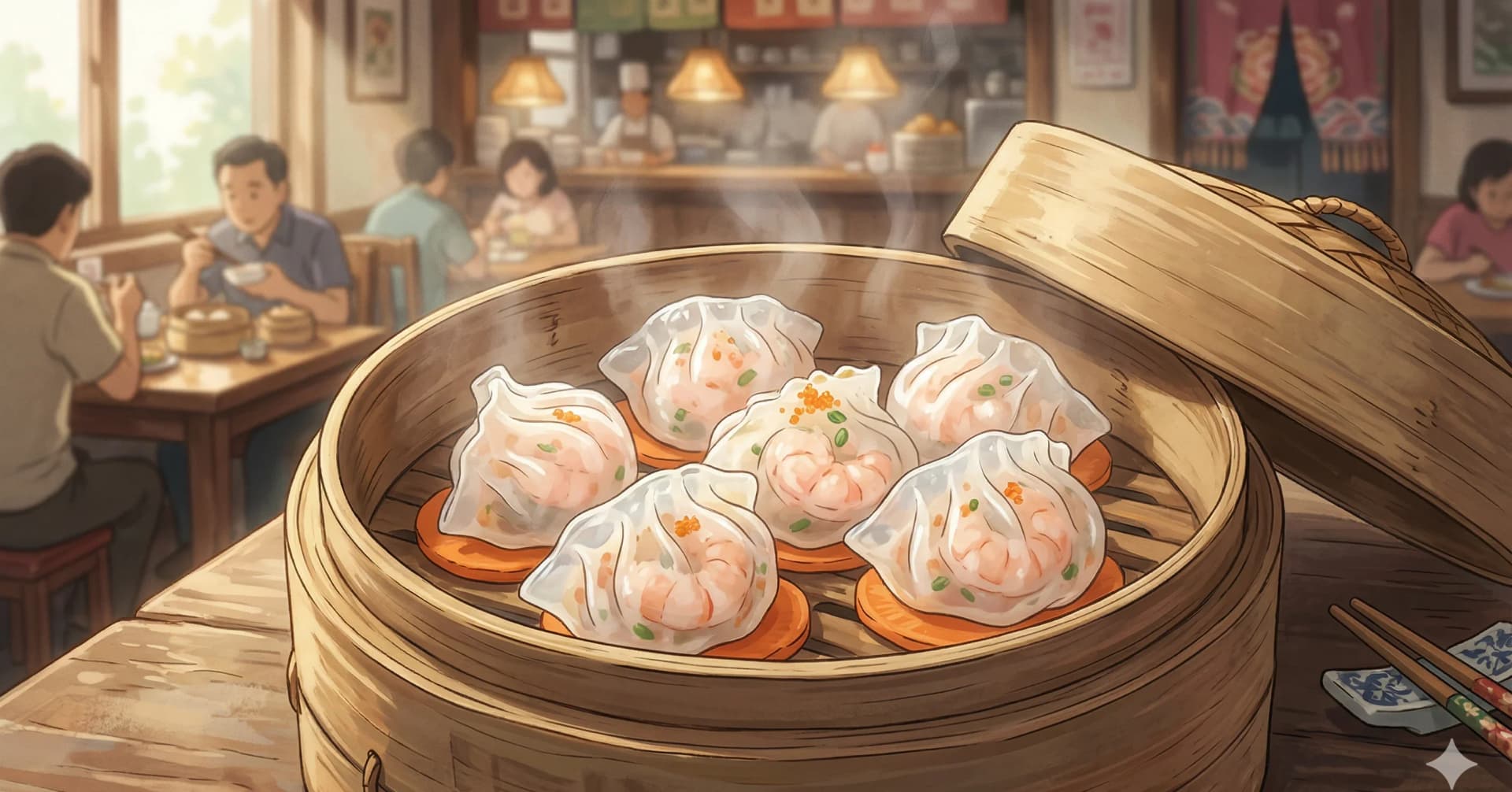
Translucent wheat starch dumplings filled with whole and minced shrimp, water chestnuts, and bamboo shoots
Among the endless parade of small dishes that arrive in bamboo steamers at a Cantonese dim sum table, har gow holds a special place. It is one of the first dishes any serious dim sum restaurant is judged by. The wrapper should be sheer enough to see the pink of the shrimp through it, delicate enough to yield at the first bite, and sturdy enough to hold together from steamer to plate. Getting there takes wheat starch, boiling water, and a willingness to work quickly.
The dough behaves nothing like a regular flour dough. There is no gluten to develop, no resting period, and no forgiveness if the water is not boiling when it meets the starch. The window of workability is short. You mix, you knead briefly, and you start wrapping immediately. If the dough sits too long, it dries out and cracks. This is why dim sum kitchens assign har gow to their most skilled cooks.
The filling should be generous with whole shrimp. Each dumpling gets one whole shrimp nestled alongside a portion of minced shrimp mixed with crunchy water chestnuts and bamboo shoots. The whole shrimp is not just about flavor. It gives a satisfying bite and its pink color shows through the translucent skin, making the dumpling look as beautiful as it tastes. A small amount of lard keeps the filling juicy, and ginger tames any fishiness without making itself known. Sesame oil rounds things out, but only a touch, because too much would overpower the clean sweetness of fresh shrimp.
If you have a Chinese cleaver, this is its moment. The broad flat side presses each dough ball into a paper-thin circle more efficiently than any rolling pin. Oil the blade lightly and it will not stick.
At a Glance
Yield
12 dumplings (2 to 3 servings)
Prep
30 minutes
Cook
8 minutes
Total
38 minutes
Difficulty
Involved
Ingredients
Filling Ingredients
- 7 ozmedium shrimp, peeled and deveined
- 1 ozwater chestnuts, minced
- 1½ ozbamboo shoots, minced
- 1½ tspfresh ginger, minced
- ¼ ozfresh chives, finely chopped
- 1½ tsptapioca starch (or cornstarch)
- 1 tsplard (or neutral cooking oil)
- 0 tbspsesame oil
- ¼ tspsalt
- 1 pinchsugar
- 1 pinchwhite pepper
Dough Ingredients
- 1½ ozwheat starch
- 1½ oztapioca starch, or cornstarch
- 1 pinchsalt
- 1 tsplard (or neutral cooking oil)
- ⅓ cupboiling water
- 12thin slices carrot, cut on the diagonal
Dipping Sauce Ingredients
- —Chinkiang (black) vinegar
- —Light soy sauce
- —Thinly sliced fresh ginger
Method
- 1
Prepare the shrimp. Set aside 12 whole shrimp. Place the remaining shrimp on a cutting board and crush them under the flat side of a cleaver, pressing firmly with the heel of your hand. Give the crushed flesh a rough chop. If you do not have a cleaver, mince the shrimp with a knife until you have a coarse paste with some texture remaining.
- 2
Mix the filling. In a bowl, combine the whole shrimp, minced shrimp, water chestnuts, bamboo shoots, ginger, chives, tapioca starch, lard, sesame oil, salt, sugar, and white pepper. Stir well in one direction until the mixture holds together. Cover and refrigerate while you prepare the dough.
- 3
Make the dough. Combine the wheat starch, tapioca starch, salt, and lard in a mixing bowl. Bring water to a full, rolling boil and pour it immediately over the starch mixture. The water must be at a true boil, not merely hot, or the starches will not hydrate properly and you will end up with a loose, unworkable slurry. Stir quickly with chopsticks until the mixture forms shaggy clumps, then knead with your hands into a smooth, soft, slightly elastic dough. Work quickly.
- 4
Shape the wrappers. Roll the dough into a rope and divide it into 12 equal pieces. Lightly oil your work surface and the flat side of a cleaver (or a rolling pin). Take one piece of dough, roll it into a ball, and press it flat with the oiled cleaver blade, rocking gently side to side to create a very thin, even circle about 3 inches across. If using a rolling pin, flatten the ball and roll outward from the center. The wrapper should be quite thin and slightly translucent. Peel it gently from the surface. Repeat with remaining pieces.
- 5
Fill and pleat the dumplings. Place a spoonful of filling in the center of a wrapper, including one whole shrimp. Hold the wrapper in both hands. With the index finger of one hand, pleat the far edge of the wrapper into small folds while pressing the near edge forward with the thumb of the other hand. Seal the pleats together firmly to form a crescent shape. The dumpling should have a curved, ridged spine along one side and a smooth belly on the other.
- 6
Set up the steamer. Bring water to a boil in the pot or wok beneath your steamer basket. Scatter the carrot slices across the base of the steamer, spacing them evenly. Place one dumpling on top of each carrot slice. The carrot prevents sticking far better than oil or parchment for this particular dough.
- 7
Steam the dumplings. When the water is at a full boil, set the steamer basket in place and cover. Steam over medium heat for 6 minutes. Do not overcook or the wrappers will become gummy and the shrimp will turn rubbery. The wrappers should look fully translucent and the filling should be pink and firm.
- 8
Rest briefly before serving. Let the dumplings cool for about 1 minute in the steamer before gently removing them. Very hot har gow wrappers tend to stick. Serve with a small dish of vinegar and ginger on the side.
Key Ingredient Benefits
Wheat starch: This is the starch fraction of wheat flour with the gluten washed away. It is sometimes labeled "non-glutinous wheat starch" or "tang flour" in Chinese groceries. It naturally contains trace amounts of gluten, so it is not suitable for celiac diets despite appearing gluten-free. In traditional Cantonese cooking, it is the foundation of all translucent dim sum wrappers.
Water chestnuts: These are the corms of an aquatic plant, not true nuts. They stay crunchy even after cooking, which is why they appear in so many Chinese fillings. In traditional Chinese medicine, water chestnuts are considered cooling and are sometimes eaten raw in southern China during hot weather. They are a reasonable source of potassium.
Shrimp and starch coating: The teaspoon of starch mixed into the filling is a technique called "velveting" in broad terms. It creates a thin protective layer around the protein, slowing heat transfer during cooking and resulting in a more tender, succulent texture. This principle applies across many Chinese preparations, from stir-fried chicken to steamed fish.
Why This Works
The magic of har gow lies in the 1:1:1 ratio of wheat starch, tapioca starch, and boiling water by volume. Wheat starch gelatinizes on contact with boiling water, creating the characteristic translucency. Tapioca starch contributes elasticity and a slight chewiness, preventing the wrapper from being brittle. Without tapioca starch, the wrapper would crack and tear during pleating. Without wheat starch, the wrapper would be opaque and gummy.
Crushing rather than chopping the shrimp preserves some texture while exposing more surface area to the seasoning. The starch mixed into the filling serves a dual purpose: it lightly binds the juices so the filling does not weep during steaming, and it helps keep the shrimp tender by insulating the protein from direct heat.
Lard in the filling is traditional and functional. It melts during steaming and creates a thin film of fat around each piece of shrimp, keeping everything moist and silky. Oil works as a substitute but produces a slightly less luxurious mouthfeel.
Substitutions & Variations
Starch for wrappers: If tapioca starch is unavailable, cornstarch or potato starch can be used in its place, though the elasticity of the finished wrapper will be slightly different. Tapioca gives the best stretch and chew.
Lard: Neutral cooking oil is a straightforward substitute. The dumplings will be slightly less rich but perfectly acceptable.
Chives: Fresh chives add a mild onion note. If unavailable, omit them. Do not substitute scallions, which are too strong for this delicate filling.
Water chestnuts and bamboo shoots: Jicama can stand in for water chestnuts. If bamboo shoots are unavailable, increase the water chestnuts. The filling should always contain at least one crunchy vegetable element for textural contrast.
Larger batch: This recipe scales easily. Double everything and work in batches, keeping finished dumplings covered with a damp cloth while you assemble the rest.
For a comparison of dumpling styles and wrapping techniques, see Jiaozi for boiled flour-wrapper dumplings and Xiao Long Bao for pleated soup dumplings.
Serving Suggestions
Har gow belong on a dim sum table alongside other steamed and fried small dishes. Pair them with Lo Bak Go for pan-fried textural contrast, Lo Mai Gai for something substantial, and Xiao Long Bao for a different style of pleated dumpling. A pot of hot jasmine tea is the traditional accompaniment to any dim sum meal.
For a simpler weeknight dinner, serve har gow as the centerpiece with a bowl of Congee on the side and a dish of steamed greens.
Storage & Reheating
Freezing (uncooked): Place assembled dumplings on a parchment-lined tray, spaced apart so they do not touch. Freeze until solid, then transfer to a freezer bag. They keep for up to 4 weeks. To cook from frozen, place in a steamer with cold water (not boiling, unlike fresh dumplings). Bring the water to a boil and steam for 8 minutes after the water starts boiling.
Refrigerating (uncooked): The dough does not hold well. Assemble and cook within an hour for best results.
Reheating (cooked): Leftover har gow can be briefly re-steamed for 2 to 3 minutes. Microwaving tends to make the wrappers tough and is not recommended.
Cultural Notes
Har gow (蝦餃, "shrimp dumpling") is the Cantonese dim sum classic that is widely treated as the technical benchmark of a dim sum kitchen. The dumpling consists of three or four whole shrimp pieces wrapped in a translucent wheat-starch-and-tapioca-starch wrapper, pleated by hand into a half-moon shape with seven to ten precise pleats along the curved edge, then steamed in a small bamboo basket. The shrimp shows through the wrapper as a pink curve, and the pleats catch the light when the dumpling is lifted from the steamer. A dim sum chef's skill is often judged on har gow first: any flaw in the wrapper, the pleating, the filling balance, or the steaming time shows immediately.
The dumpling traces to the Wu Cun (Five Villages) area on the outskirts of Guangzhou in the 1920s, where teahouse cooks developed the wheat-starch wrapper as a way to showcase the freshness of local river shrimp. The translucent wrapper was a deliberate innovation: traditional Chinese dumplings used opaque wheat-flour dough, but the Guangzhou cooks worked out that a dough of wheat starch (the starch isolated from wheat flour after the gluten is washed out) and tapioca starch, hydrated with boiling water and worked into a thin sheet, would steam to a clear glass-like finish that revealed the pink shrimp inside. The technique spread from Guangzhou to Hong Kong in the 1930s and 1940s, and Hong Kong dim sum houses refined the form to the standard now expected globally.
The eating ritual is fixed. Har gow are served in baskets of three or four, eaten directly from the steamer or transferred to a small plate, and dipped lightly in soy sauce or chili oil (Cantonese dim sum diners typically use very little dipping sauce so as not to mask the shrimp flavor). The dumpling is eaten in one or two bites, since the wrapper is too delicate to hold up to multiple bites. Hong Kong's heritage dim sum restaurants, including Lin Heung Tea House, Tim Ho Wan, and Lung King Heen at the Four Seasons, all serve har gow as a benchmark item, and the dish remains the universal first order at any Cantonese dim sum meal.
Nutrition Facts
Calories: 219kcal (11%)|Total Carbohydrates: 30.4g (11%)|Protein: 13.1g (26%)|Total Fat: 4.8g (6%)|Saturated Fat: 0.5g (3%)|Cholesterol: 107mg (36%)|Sodium: 454mg (20%)|Dietary Fiber: 1.4g (5%)|Total Sugars: 2.5g
You Might Also Like
Ratings & Comments
Ratings & Comments
Ratings
Share your thoughts on this recipe.
Sign in to rate and comment