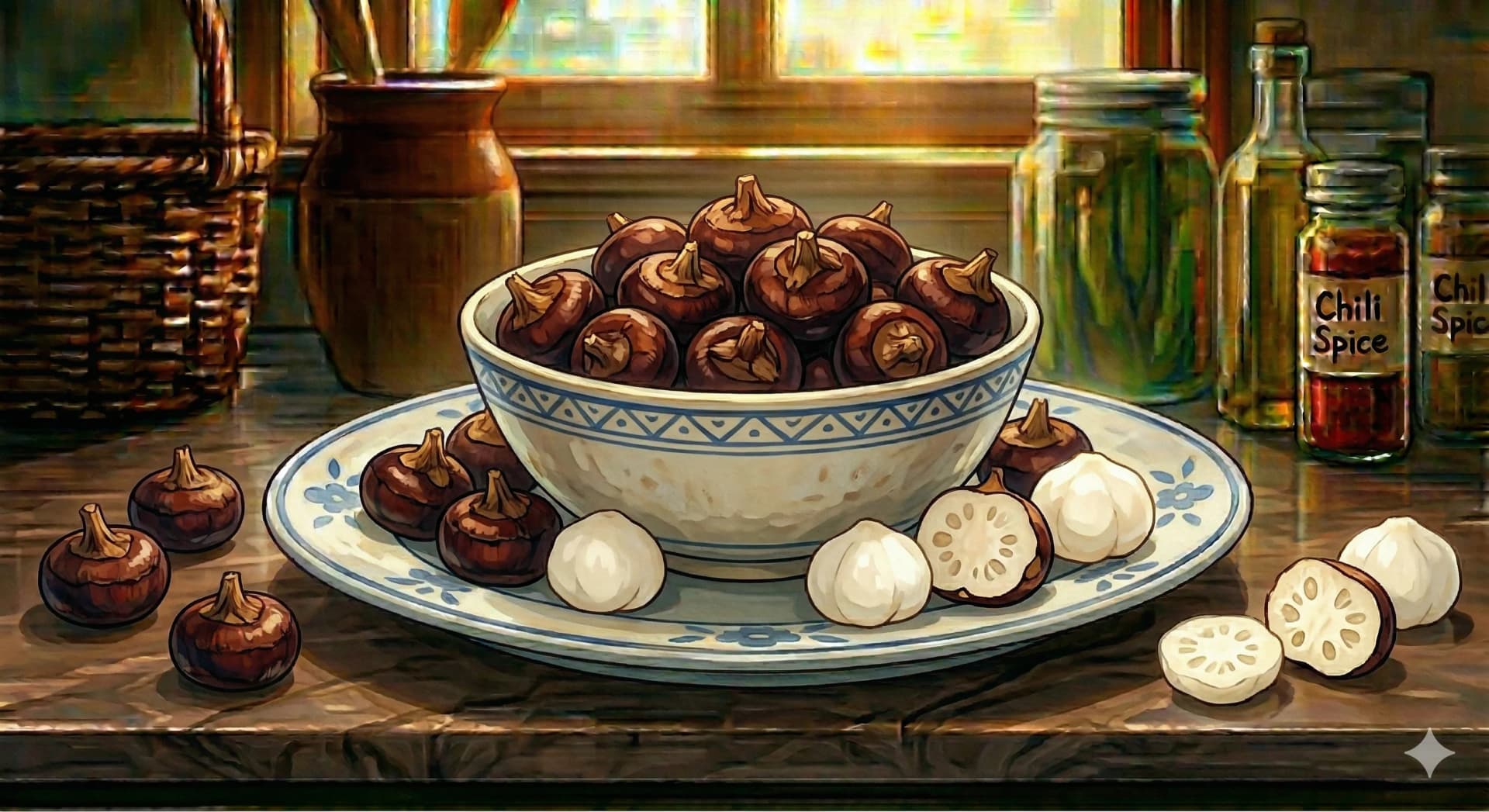
Water Chestnuts
Also known as: Ma Ti, Chinese Water Chestnut, Eleocharis dulcis, Pi Qi
Water chestnuts are the corms of an aquatic sedge plant — not a nut at all, but a firm, crisp, starchy vegetable that grows in shallow water and mudflats.
Their defining quality is their extraordinary crunch, which survives cooking remarkably well. The flavor is mild, slightly sweet, and clean, with a faint nuttiness.
Fresh water chestnuts are far superior to canned, with a sweeter flavor and even better crunch; both are used in Chinese cooking as a textural accent in stir-fries, dumplings, meatballs, and desserts.
Key facts at a glance:
- Corms of an aquatic sedge plant — not actually a nut
- Extraordinary crunch that survives cooking — used as a textural accent
- Fresh far superior to canned — sweeter flavor and better crunch
- Over three thousand years of cultivation — prominent in Guangdong and southern Chinese food culture
- Contains phloretin — a flavonoid studied for antibacterial and antioxidant properties
- Ma ti gao (water chestnut cake) — a classic Cantonese dim sum and New Year's treat
Flavor Profile
Origin
China, Southeast Asia, South Asia
Traditional Medicine Perspectives
Traditional Chinese Medicine
Water chestnuts (Ma Ti) are classified as cool and sweet in TCM, associated with the Lung and Stomach meridians. They are used to clear heat, generate fluids, transform phlegm, detoxify, and support the digestion. They are prescribed for heat conditions affecting the Lung and Stomach, thirst, dry throat, and phlegm-heat cough. Considered a cooling, refreshing food particularly appropriate for summer consumption.
Modern Scientific Research
Water chestnuts contain phloretin, a flavonoid compound studied for antibacterial and antioxidant properties.
Research suggests water chestnut extract may inhibit certain bacterial strains and have anti-inflammatory effects.
They are a good source of potassium, manganese, copper, vitamin B6, and riboflavin. The starch structure contributes to their unique cooking-resistant crunch.
Cultural History
Water chestnuts have been cultivated in China for over three thousand years and feature prominently in the food culture of Guangdong and southern China, where water-based agriculture flourished in the Pearl River Delta.
Fresh water chestnuts were once sold by street vendors as a snack across Chinese cities.
Ma ti gao (water chestnut cake) is a classic Cantonese dim sum and New Year's treat. In Cantonese cooking, water chestnut is added to meatballs and wontons specifically for the textural contrast it provides.
Culinary Uses
Add diced water chestnuts to pork, shrimp, or chicken meatballs and fillings for crunch.
Use in stir-fries as a textural element. Make ma ti gao (water chestnut cake) with rice flour.
Add to hot pots near the end of cooking to preserve crunch. Combine with bamboo shoots and mushrooms in vegetarian stir-fries.
Preparation Methods
Fresh: peel the dark brown outer skin with a knife or peeler. The inner flesh is white and firm.
Canned: drain and rinse well.
For maximum crunch in cooked dishes, add in the final minute of cooking.
Traditional Dishes
- Ma ti gao (water chestnut cake)
- Cantonese steamed meatballs with water chestnut
- Stir-fried water chestnuts with snow peas
- Wonton filling
- Red bean and water chestnut dessert soup
Comments
Share your thoughts on this ingredient.
Sign in to comment0 Comments