Chinese Cuisine
Jiao Hua Ji (Beggar's Chicken)
A whole chicken wrapped in lotus leaves and clay-baked until extraordinarily tender and aromatic
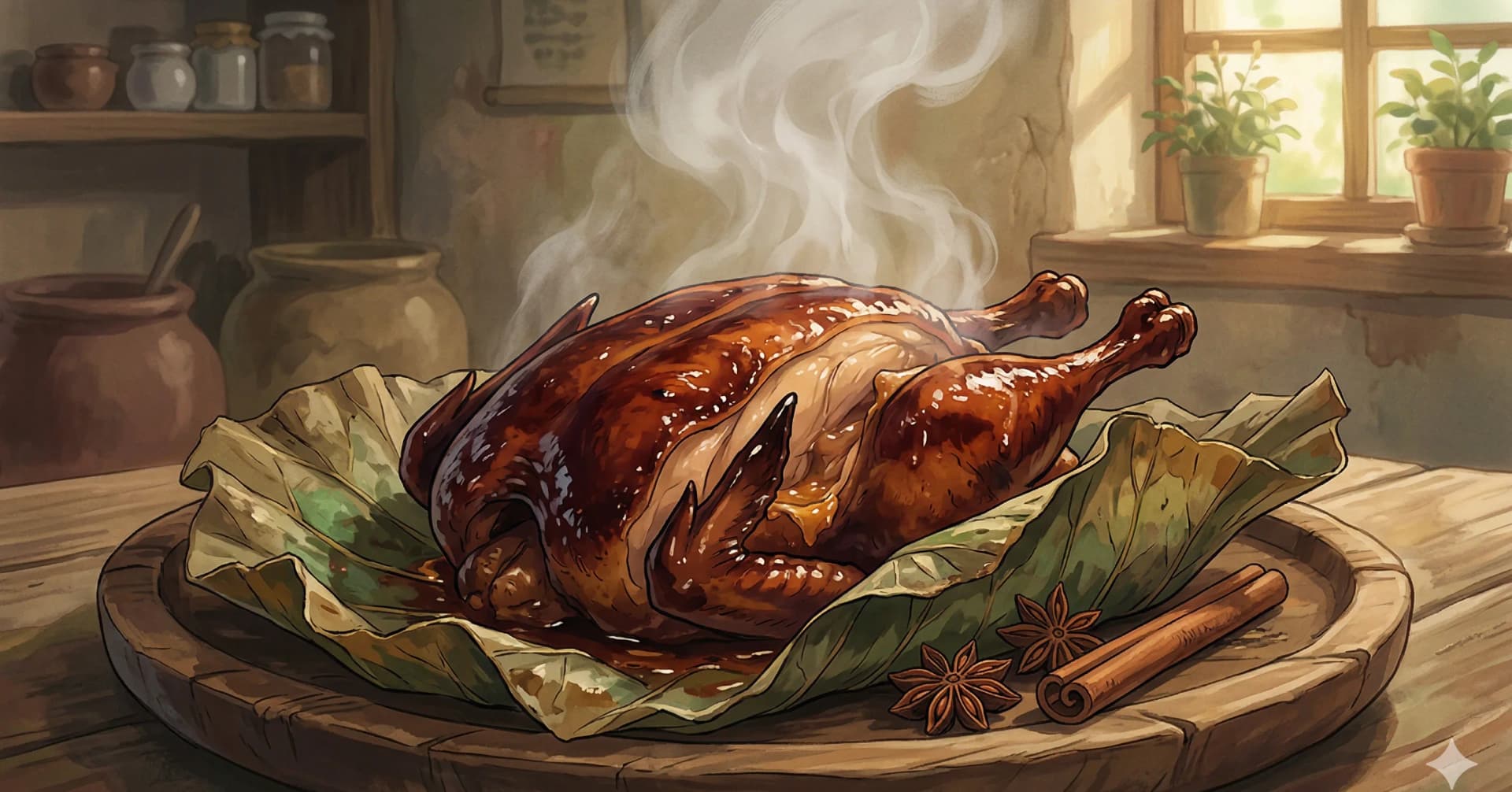
The drama of Beggar's Chicken is in the reveal. A sealed parcel, crusty and unassuming on the outside, is cracked open at the table, and the aroma that rises is remarkable: lotus leaf, warm spices, Shaoxing wine, and the deep, concentrated scent of chicken that has been steaming in its own juices for hours. The meat falls from the bone at the lightest touch, so tender that it barely holds together, suffused with the subtle botanical fragrance of the lotus leaf and the savory depth of the marinade.
Legend attributes this dish to a hungry beggar in Hangzhou who stole a chicken, wrapped it in mud and lotus leaves, and roasted it over a fire because he had no pot. Whether or not the story is true, the technique it describes is real: encasing food in an airtight shell and cooking it slowly creates a sealed environment where moisture cannot escape, flavors intensify, and tough connective tissue breaks down completely.
The traditional method uses clay from the shores of a river or lake, which is impractical for most home cooks. This adaptation uses a combination of lotus leaves, parchment, and aluminum foil to create the sealed environment, and a standard home oven to provide the heat. The results are remarkably close to the original: the chicken is incredibly moist, the lotus leaf infuses its gentle tea-like fragrance into the meat, and the presentation retains much of the drama.
The practical key is patience. This is not a quick weeknight dinner. The chicken must marinate, wrap tightly, and cook slowly. But the active work is minimal, and the result is a dish that feels like an event.
At a Glance
Yield
4 servings
Prep
45 minutes
Cook
3 hours
Total
3 hours 45 minutes
Difficulty
Involved
Ingredients
Chicken Ingredients
- 1 wholechicken (about 1.5 kg), cleaned and patted dry
Wrappers
- 3large dried lotus leaves, soaked in warm water for 30 minutes
Marinade Ingredients
- 2 tbspShaoxing wine
- 1¼ tbsplight soy sauce
- 2 tspdark soy sauce
- 2 tspsesame oil
- ¼ ozfive-spice powder
- ⅞ tspsalt
- 1¼ tspwhite pepper
- ¾ tspsugar
Filling Ingredients
- ⅓ cupfresh ginger, sliced
- 4scallions, cut into 5 cm pieces
- 2 wholestar anise
- 1cinnamon stick
- 3dried red chilies
- 4dried shiitake mushrooms, soaked, stemmed, and halved
- 1¾ ozChinese ham or Smithfield ham, diced (optional)
Method
- 1
Mix all the marinade ingredients together in a bowl. Rub the marinade thoroughly over the entire chicken, inside and out, making sure it reaches into the cavity and under the skin where possible. Let the chicken marinate for at least 1 hour, or overnight in the refrigerator for deeper flavor.
- 2
Soak the dried lotus leaves in warm water for 30 minutes, until they are pliable and easily folded. Pat them dry gently.
- 3
Stuff the cavity of the marinated chicken with the ginger slices, scallion pieces, star anise, cinnamon stick, dried chilies, shiitake mushroom halves, and diced ham. Pack them in firmly.
- 4
Tuck the wing tips behind the chicken's back. Tie the legs together with kitchen twine. This creates a compact shape that wraps more easily and cooks more evenly.
- 5
Lay the soaked lotus leaves on your work surface, overlapping them to create a large enough sheet to fully enclose the chicken. Place the chicken breast-side down in the center of the leaves.
- 6
Fold the lotus leaves tightly around the chicken, wrapping it completely. There should be no exposed chicken. Use kitchen twine to tie the bundle securely.
- 7
Wrap the lotus leaf bundle in a large sheet of parchment paper, then wrap again tightly in two layers of aluminum foil, sealing the edges as tightly as possible. The goal is an airtight package that traps all the steam and juices inside.
- 8
Preheat your oven to 200°C. Place the wrapped chicken on a baking sheet.
- 9
Roast at 200°C for 30 minutes to build initial heat. Then reduce the temperature to 150°C and continue cooking for 2.5 hours. The low, slow heat allows the connective tissue to break down completely while the sealed environment keeps the chicken moist.
- 10
After 3 hours total, remove the chicken from the oven. Let it rest in its wrapping for 15 minutes. The internal temperature should be well above 75°C, and the juices that have pooled inside the wrapping should be clear.
- 11
Transfer the wrapped chicken to a serving platter. Bring it to the table still wrapped for presentation.
- 12
Cut away the foil and parchment at the table. Open the lotus leaves. The aroma that escapes will be extraordinary: a concentrated blend of chicken, lotus, spice, and wine. The chicken skin will not be crispy but will be deeply flavored and tender.
- 13
The meat should fall easily from the bone. Use a serving spoon to portion it, spooning the accumulated juices over each serving.
- 14
Serve with steamed rice and a simple green vegetable.
Key Ingredient Benefits
Lotus leaves have been traditionally used in Chinese medicine for their cooling properties and are associated with digestive health. They contain alkaloids that some research suggests may support lipid metabolism. In cooking, their primary role is aromatic and structural.
Five-spice powder typically contains star anise, cloves, cinnamon, Sichuan peppercorn, and fennel. Each of these spices has a long history in traditional Chinese medicine, and the blend is considered warming and digestive in nature.
Chicken provides complete protein, B vitamins (particularly niacin and B6), and selenium. Cooking with the bone in produces a naturally enriched broth within the wrapping that contains minerals leached from the bones during the long cooking process.
Why This Works
Wrapping the chicken creates a sealed cooking environment, essentially turning your oven into a steamer. Moisture cannot escape, so the chicken bastes continuously in its own rendered fat and juices. The collagen in the skin, joints, and connective tissue converts completely to gelatin over the long cooking time, which is why the meat is so extraordinarily tender and the juices are rich and slightly viscous.
Lotus leaves contribute more than just fragrance. They contain natural tannins and essential oils that permeate the chicken during cooking, adding a subtle, tea-like quality that is distinct and recognizable. The leaves also serve as a structural wrapper that holds the chicken together as it softens.
The low temperature (150°C) for the majority of the cooking time ensures even heat penetration. Higher temperatures would overcook the outer layers before the center is done, while the low heat allows the entire chicken to cook at a similar rate, resulting in uniformly tender meat from breast to thigh.
Substitutions & Variations
- Lotus leaves: If unavailable, banana leaves are the best substitute, providing a similar wrapping function with a different (more tropical) aroma. Parchment paper alone works structurally but you lose the distinctive lotus fragrance.
- Clay method: For the authentic experience, encase the lotus-wrapped chicken in a layer of salt dough (flour, salt, and water mixed into a thick paste). This cracks open dramatically at the table.
- Stuffing variations: Some recipes include preserved vegetables (mei cai), dried shrimp, or chestnuts in the stuffing. Each adds a different flavor dimension.
- Duck: A whole duck prepared in the same way is an excellent variation, though the cooking time may need to be extended by 30 minutes due to the denser meat.
Serving Suggestions
Beggar's Chicken is a centerpiece dish, meant to be the star of the table. Surround it with simpler preparations: steamed rice, a stir-fried green vegetable, a cold appetizer, and a light soup. The juices that accumulate in the wrapping serve as a natural sauce and should be spooned over rice. This is a dish for special occasions, family gatherings, or any time you want to create a sense of occasion at the table.
Storage & Reheating
Leftover Beggar's Chicken can be stored in an airtight container with its juices in the refrigerator for up to 3 days. Reheat gently in a covered pot over low heat, or wrap in foil and warm in a 150°C oven for 20 to 30 minutes. The meat is so tender that it works well shredded and used in other preparations: tossed with noodles, folded into congee, or layered in a sandwich. The cooking juices, which will gel when cold, make an excellent base for soup or sauce.
Cultural Notes
Jiao hua ji (叫化雞, "beggar's chicken") is the Hangzhou specialty in which a whole chicken is stuffed with herbs and aromatics, wrapped in lotus leaves, encased in a thick layer of mud or clay, and baked in an open fire or oven for several hours until the clay shell hardens and the chicken inside becomes tender, fragrant, and perfumed throughout with the lotus leaf and the herbal stuffing. The dish is presented at the table still in its clay shell, which the diner cracks open with a wooden mallet to release a cloud of fragrant steam, revealing the chicken in the lotus wrapping inside. The dish belongs to the Hangzhou cooking tradition of Zhejiang province and remains one of the showcase dishes of Hangzhou's famous Lou Wai Lou (樓外樓) restaurant on the West Lake.
The origin story is documented in Hangzhou local histories. The dish is said to have been invented by a beggar near the West Lake who stole a chicken and, lacking a pot or cooking equipment, plastered the bird in mud from the lake shore and buried it in the embers of a fire. When the cooked bird was dug up and the dried mud cracked off, it took the feathers with it, leaving a beautifully roasted chicken. The story is partly legend, but the technique of cooking in a clay shell is documented across Chinese regional cuisines as a way to retain moisture and concentrate aromatic compounds. Hangzhou's Lou Wai Lou restaurant has served the dish continuously since the 1850s and is the standard reference for the traditional form.
The modern preparation has standardized the technique while preserving the dramatic presentation. The chicken is marinated in soy sauce, Shaoxing wine, ginger, and spices, then stuffed with a mixture that may include dried mushrooms, lotus seeds, jujubes, ginger, and pork or ham. The stuffed chicken is wrapped in softened lotus leaves, then in cellophane (to prevent the clay from sticking), then encased in a thick layer of mud or salt-clay paste, and baked at high heat for two to three hours. The hardened shell is cracked open at the table with theatrical flair, and the diners eat the chicken with their hands or chopsticks while the lotus leaf wrapping still perfumes the meat with its grassy aromatic compounds.
Nutrition Facts
Calories: 659kcal (33%)|Total Carbohydrates: 11.1g (4%)|Protein: 68.5g (137%)|Total Fat: 36g (46%)|Saturated Fat: 9.7g (49%)|Cholesterol: 214mg (71%)|Sodium: 1090mg (47%)|Dietary Fiber: 1.9g (7%)|Total Sugars: 1.8g
You Might Also Like
 Medium
Chinese Cuisine
Bai Qie Ji (White Cut Chicken)
4 hours 30 minutes
 Medium
Chinese Cuisine
Niu Rou Yang Cong Jiaozi (Beef and Onion Dumplings)
60 minutes
 Easy
EasyCross-Cultural · China
Chicken and Broccoli in White Sauce (白汁鸡花椰)
45 minutes
 Medium
Chinese Cuisine
Char Siu (Chinese BBQ Pork)
9 hours (including marinating)
Ratings & Comments
Ratings & Comments
Ratings
Share your thoughts on this recipe.
Sign in to rate and comment