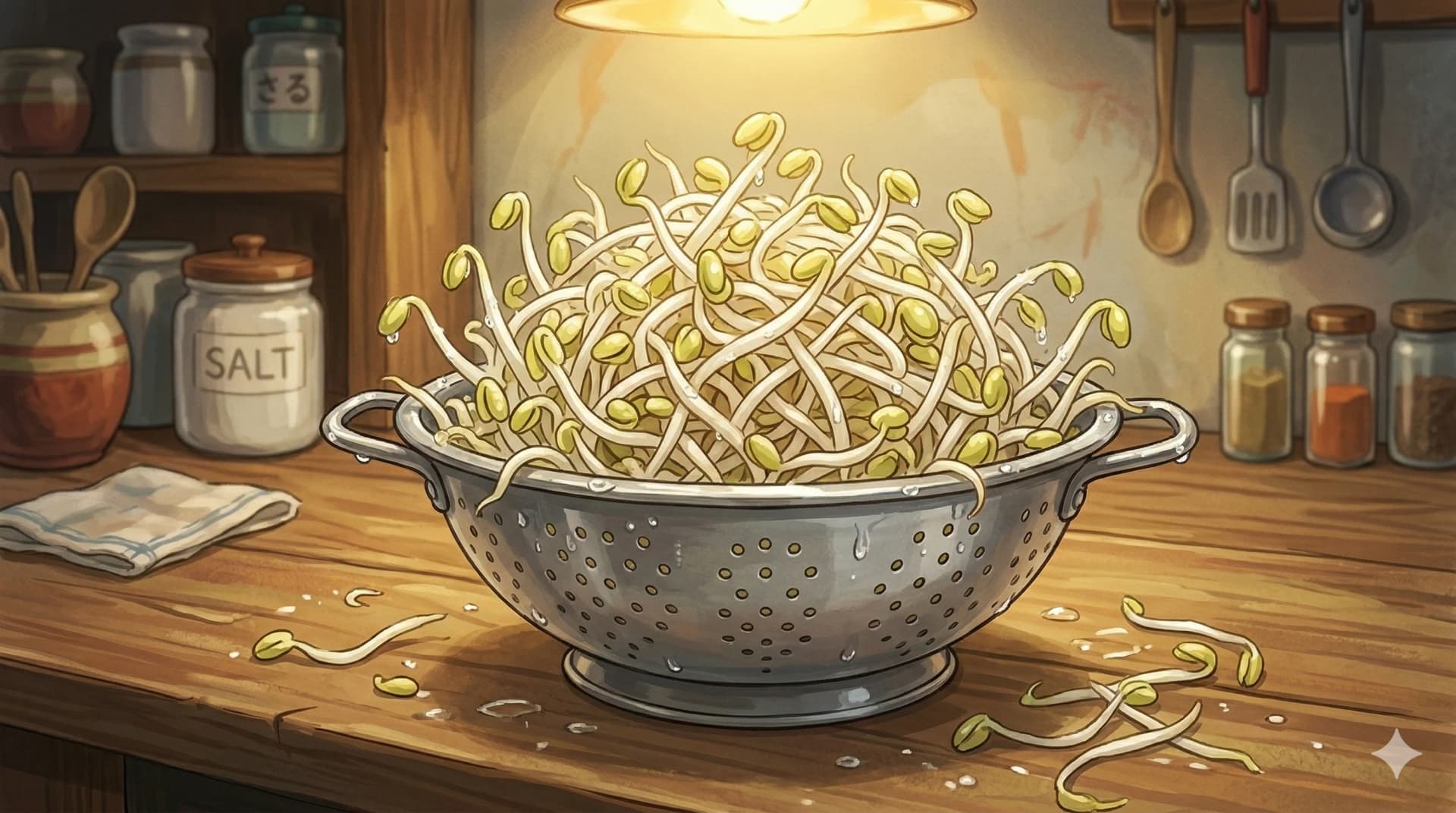
Bean Sprouts
Also known as: Dou Ya, Mung Bean Sprouts, Soybean Sprouts (Kong Namul), Green Bean Sprouts
Bean sprouts are the germinated seeds of mung beans or soybeans — white, crunchy, and mild, with a fresh, slightly grassy flavor. They add texture and bulk to stir-fries, noodle dishes, and soups without asserting a strong flavor of their own. Mung bean sprouts (the common variety in most Chinese cooking) are delicate and quick-cooking; soybean sprouts are larger and more robust.
Both contribute crunch, freshness, and a clean nutritional profile.
Key facts at a glance:
- Bean sprouts — Are the germinated seeds of mung beans or soybeans — white, crunchy, and mild, with a fresh, slightly grassy flavor.
- They add — Texture and bulk to stir-fries, noodle dishes, and soups without asserting a strong flavor of their own.
- Mung bean — Sprouts (the common variety in most Chinese cooking) are delicate and quick-cooking; soybean sprouts are larger and more robust.
- Both contribute — Crunch, freshness, and a clean nutritional profile.
Flavor Profile
Origin
China, East Asia
Traditional Medicine Perspectives
Traditional Chinese Medicine
Bean sprouts (Dou Ya) are classified as cool and sweet in TCM, associated with the Stomach and Small Intestine. Mung bean sprouts in particular are used to clear summer heat, promote urination, detoxify, and soothe the Stomach. The sprouting process is understood in TCM as activating the vital essence (jing) of the seed, making the nutrients more available and the food more vitalizing than the unsprouted bean.
Modern Scientific Research
Sprouting significantly increases the bioavailability of nutrients in legumes by reducing phytic acid (an antinutrient) and activating enzymes that break down complex sugars. Research shows sprouted mung beans have increased levels of vitamin C, folate, and antioxidants compared to unsprouted beans. The reduced phytic acid content means minerals like iron and zinc are more readily absorbed.
Bean sprouts are low in calories and high in water content.
Cultural History
Sprouting beans is a technique as ancient as agriculture in China — a way to produce fresh vegetables year-round without access to farmland, and a method for increasing the nutritional availability of legumes. Bean sprouts appear in Chinese cooking texts dating back over a thousand years. In the 19th and early 20th centuries, Chinese immigrants in North America and Australia grew mung bean sprouts as a way to maintain access to Chinese vegetables in environments where they were unavailable, making sprouts one of the most culturally significant vegetables of the Chinese diaspora.
Culinary Uses
Stir-fry at very high heat for just 1–2 minutes to preserve crunch. Add to noodle dishes — pad thai, chow mein, and rice noodle soups use bean sprouts as a key textural element. Use in spring rolls and egg rolls.
Add raw to pho and Vietnamese noodle soups as a table condiment. Combine with garlic chives for a classic simple stir-fry.
Preparation Methods
Rinse well before using. For best texture, cook very briefly in a screaming hot wok — they release a lot of water and go limp quickly. Tail the brown tips if appearance matters for the dish.
Bean sprouts deteriorate quickly — use within 2 days of purchase.
Traditional Dishes
- Pad thai
- Chow mein
- Bean sprout and garlic chive stir-fry
- Pho (raw, as table condiment)
- Spring rolls
Recipes Using Bean Sprouts
- Cháo Gà (Vietnamese Chicken Rice Porridge)
- Grilled Pork Noodle Bowl (Bún Thịt Nướng)
- Boat Noodles (ก๋วยเตี๋ยวเรือ)
- Steamed Rice Rolls (Bánh Cuốn)
- Bun Rieu (Vietnamese Crab and Tomato Noodle Soup)
- Spicy Beef Noodle Soup (Bún Bò Huế)
- Cháo Lòng (Vietnamese Pork Organ Rice Porridge)
- Bun Cha (Vietnamese Grilled Pork with Rice Noodles)
- Chicken Chow Mein (鷄肉炒麵)
- Gado-Gado (Indonesian Peanut Salad)
- Ga Nuong Xa (Vietnamese Grilled Lemongrass Chicken)
- Hu Tieu Nam Vang (Phnom Penh Noodle Soup)
- Pad Thai (ผัดไทย)
- Char Kway Teow (炒粿條)
- Chicken Pho (Phở Gà)
- Blue Rice Herb Salad (Nasi Kerabu)
- Turmeric Chicken Soup (Soto Ayam)
- Zhajiangmian (Fried Sauce Noodles)
- Beef Pho (Phở Bò)
- Curry Laksa
- Noodles in Sweet Gravy (Mee Rebus)
- Gan Chao Niu He (Beef Chow Fun)
- Hokkien Mee (福建面)
Comments
Share your thoughts on this ingredient.
Sign in to comment0 Comments